This seems to be a project that was derived from or a fork of Morphic.js, which in turn was inspired by the Smalltalk-based Squeak: https://squeak.org/
My personal plan, instead of retiring, is to work on inventing solutions to the issues plaguing large and complex software projects. One of my primary sub-goals under this mission, is to create a new programming language that'll handle complexity excellently, while also making it hard for a programmer to write bugs in it (strong static type system, deep static analysis, thorough linting, some kind of automatic proofing or verification, paradigms that make writing bugs less likely, paradigms that handle modularization and complexity gracefully, etc).
Overall, when there are big problems in the world (poverty, human rights abuses, climate change, bad software), I want to try to use my skills and abilities toward solving those problems, rather throwing my hands in the air, and giving into hopelessness.
with respect i think it's a combination. business demands value delivery and features on a constant basis, and programmers are constantly layering crap over crap in order to deliver. nobody stops and says "hey, wait a second - let's pause, and figure out how we're going to invest now to make the changes you're asking for easier in the future." programmers need to learn to identify when this is happening (a technical skill) and demand change, and product needs to learn to listen and understand the consequences of not heeding this advice. because after 5 - 10 years of 100 different people working on a given system, the complexity becomes unmanageable, and the business grinds to a halt. and then heads start to roll. and yet the people demanding the new features now are never going to have suffer the consequences, because they'll be off to another venture in 5 - 10 years.
You are describing one set of organizational and cultural problems with software engineering that can only be solved through a cultural and political approach
Other organizations and cultures have different sets of problems.
Agreed. A new language will not solve garbage in, garbage out problems. A lot of times even when a BA tries to untangle the mess of business practices by carefully documenting it and proving that a better way exists, some stakeholders can still find it challenging adapting to a well intended change.
> Culturally it seems that fitness in general is encouraged, combined with a very different attitude toward being overweight (I had several locals comment that I was a bit fat [my BMI is ~26])
This, perhaps, is the key to their longevity.
The French have a similar attitude as well (based on my time in France).
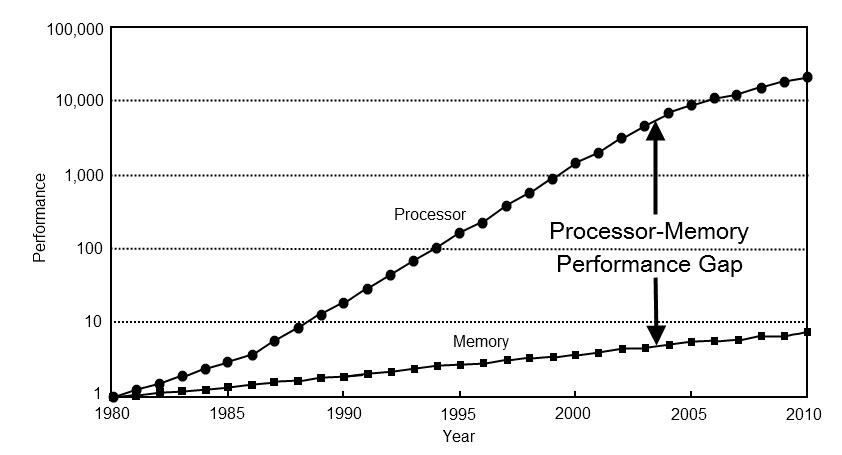
> The only thing that's seen more impressive growth than memory volume is the relative cost of a cache miss.
Has the cost of cache misses truly increased? (Also: relative to what?)
Today's CPUs have far larger caches than in the past (and not to mention a lot faster too), so the number of cache misses and the time cost of each cache miss for the same program on a modern CPU should be much lower—right?
It depends a lot on how you frame it. The absolute time spent waiting on memory has improved, although not at nearly the rate of other things[1]. When I was young and rosy cheeked, the performance gap was only order of magnitude, but it now spans more than three. So the cost of a cache miss, in terms of number of CPU cycles lost (which is what I meant by the term "relative") has grown by quite a bit. Worse, while we keep adding CPU cores, there's still only the one memory bus. Even if one core is waiting on a memory access, the others can keep working - but only for as long as they don't need to access memory, either. Which may not be for very long if, for example, you're allocating lots of short-lived objects, or using persistent data structures. In memory intensive applications, things can quickly back up so that all the cores are blocked up, waiting in line behind each other for data. If you look at the cost of this in terms of per-core CPU time rather than wall clock time, things start to look pretty icky. And this can be a devious thing, because it's an effect that isn't typically shown in the output of a performance profiler.
On the cache side, it's true that caches are bigger. But then we run into that old saw about software people's greatest achievement being to negate to efforts of hardware people. Caches get twice as big, and programmers decide the best thing to do with all that extra space is using 64-bit numbers as a matter of habit, or perhaps even switching to programming languages that don't have 32-bit numbers. Or by switching to dynamic languages that cram the cache full of pointers and object headers. Things like that.
Which isn't to say that all of these practices are objectively bad - spending computing resources on human productivity is typically a very good trade-off. Just that there's no such thing as a free lunch. Memory usage still has a performance cost, and, in stark contrast to how things worked a quarter century ago, it now kicks in long before the system starts experiencing actual memory pressure.
Nowadays there are increasingly many memory buses. I think the top-end Epyc uses 8 of them, that may each simultaneously have an operation in flight, each with its own queue. Lesser Zen2s have four memory buses.
Perhaps I over-simplified, but, from what I've seen, performance benefits from multi-channel memory architectures are pretty variable and not something a programmer should typically assume.
Partially this is due to configuration variability. A lot of laptops are still configured in single channel mode. Even high-end laptops tend to be dual channel setups, even if the CPU itself supports more. I'm inclined to say that high-end CPUs configured for 4 (or more) channels are rare enough that you probably shouldn't expect to be able to enjoy one unless you're developing in-house software where you can know exactly what kind of hardware you'll be running on.
And partially it's due to contention. All the memory channels in the world won't help you when memory access starts to pile up on the same bank. Which is, in practice, going to be something that will happen all the time if you're not taking steps to keep it form happening, because that's the kind of unhelpful jerk that stochastic processes are.
Agreed. I did not mean to detract from your point, and awareness of bus architecture is so limited that vendors usually get away with cheaping out on memory channels so we often have even fewer than our CPU module could exercise.
In practice if you have more memory buses they are more likely to be useful to help more processes or threads make simultaneous progress than to speed up one process. For a single thread to make good use of more memory buses usually requires using memory pre-fetch intrinsics and memory sequestration, and even then it is hard to keep more than two or three usefully engaged for that thread.
I think the parent talks about the relation between miss/hit, not the actual cost of a miss. In other words, if a piece of code took 100ms with 100% cache hit and 200ms with 0% hit but now it takes 20ms with 100% hit and 100ms with 0% hit, your code is 5 times slower with cache misses, when before it was only 2 times slower. Yeah, it's faster than before, but the relative cost in terms of your available performance has increased.
And I'd agree with that statement. I have been doing some heavy profiling lately and it's fun to see how good are modern processors at executing even non-optimal code if it's cache friendly. However, the moment it needs to hit L3 cache or further, the pipeline stalls and performance goes down the drain.
I was thinking, instead of that, what if you had a separate isolated tiny computer on spacecraft, that was powered by its solar panels (so there's no electrical wiring, or other connection to it), and have its own radio. And this separate computer could use the latest bleeding-edge CPU, and be encased in a radiation-hardened shell. It would use its radio to talk to the slower main computer, and do math really fast locally, and if need be, beam the results to Earth, or to a nearby orbiting satellite.
Unfortunately there isn't really any practical way to have a radiation hardened shell that is sufficiently effective. Eg. 5cm of aluminium stops only 30% of the galactic radiation. (Heavier elements (e.g. gold) are scattered by incoming particles causing incoming heavy ions which cause even more damage.)
So practically it would still experience significant radiation.
But having the main compute for Mars remain in orbit with the relay isn't a bad idea.
That does make it a bit clearer, but I do hope the compiler optimizes away the redundant curr variable.
Now, on a different note, I am a bit puzzled because I don’t see a free(*ptr) call in Linus’ or anyone else’s code. The code, as-is, would cause a memory leak.
There’s a need to capture the curr_ref before it’s overwritten, and free it after it’s overwritten.
Usually those lists are intrusive -- their nodes are meant to be part of larger objects. They will be freed in other contexts, e.g. if protected by RCU, memory reclamation is postponed until all threads have quiesced. Or the nodes are allocated by one amongst many allocators (i.e. for performance, or better concurrence), so it is best for the structure itself not to make any assumption about where the memory should be returned to.
So generally, list implementations in C will not free the node, only remove references to it and return it.
The assembly code produced by my variant and Linus's variant is exactly equivalent, assuming you write the guards the same way. This effectively means that both curr_ref and curr will be live, although the compiler will note that it can substitute entry for curr and short curr's lifetime to only exist within the loop body in the form written here.
At the end of the function curr == entry, so the caller already has a separate reference to the object. Also, removing a node from a list does not necessarily mean that you want to delete it. For example, you might want to put it in a different list.
The quote is actually likely from a member of Dubai Royal Family.
An interesting fact here is that the UAE will never become poor.
The UAE has saved up over 1.3 million USD dollars per citizen[a]. And this is just the government’s savings. Obviously, there’s immense private wealth on top of that as well. Even if with investment returns as low as 4% per year drawn out, that would translate to $52,000 per citizen.
This is 52k of money that you could almost call free money. We’re not counting for the fact that at least half these citizens are not going to simply sit at home. They’re going to work, earn, start companies, etc. And the citizenry is very highly educated. And a lot of them actually have STEM degrees too (which correlates with higher earnings). So realistically, the per capita annual income could be in the over $100k per citizen range, even after the oil has run out.
It’s not impossible (more like highly likely) for that trust to go the same way of the Nauru Phosphate Royalties Trust. Administrative burden and corruption. Mismanagement. Exponential growth can’t go on forever.
It’s interesting that UAE is doing the same thing that Nauru did except on a larger scale with petrochemicals instead of phosphate.
I've worked with the UAE's SWF, and imo, they'll never collapse. Corruption is nonexistent nearly in the investment authorities, since they are highly regulated and treated essentially as defacto Western companies listed in the NYSE or something. If they collapse, we would have far bigger problems by that time, since they're invested heavily into the modern global economy. This is not oil wealth, but actual invested wealth.
I came to share exactly this. The UAE is the most forward thinking, of any of the Gulf states. Economic planning literally spans 100 years and multiple scenarios. They're using oil wealth to actively invest in finance, tourism, technology, high-yield agri-tech, and medical research. They also have the most vibrant (by far) tech scene of the Arab world, and are working only to hyper-accelerate that.
First of all, it's not slave labour that's employed in the construction industry or any of the other sectors. I think I can speak for this considering my relatives worked those "slave" jobs as you put it.
The UAE had long been forced by the British and the Americans to abolish slavery before they gained their independence. This, unlike Saudi Arabia, where it was legal long after the 1970s.
About the "slave" jobs, most of them are basically menial jobs with really shit pay and a combined bunk accommodation. But it's far better than what we get back in India or Pakistan or Bangladesh, which is usually the unemployment line. A number of people have improved their station and are part of the local business community from those levels.
It carries a criminal prison sentence and a fine. And there’s a big push by the UAE government to go after, and prosecute employers who break this law.
I don’t know why people in Western countries, always without fail, mention this whenever the UAE comes up.
Imagine every time the US was mentioned, a person always pointed out how some private companies in the US treated their employees poorly and abusively (which I’m sure happens). It would be absurd.
You're spot on, as an Israeli I wanted to thank you for highlighting this. There are individuals in every country who perform illegal acts, that should not reflect on the country as a whole. Shukran ya habibi.
In Israel we have a lot of love for the UAE. Together, we're already sharing agra-tech, water-tech, and finance. Israel is looking forward to learning about some of the construction methods being pioneered in building up the desert. This is an unbelievably warm peace.
What you're referring to happens in Saudi Arabia and Qatar (and used to happen until the mid 2000s in the UAE, when a Federal decree was passed which stated the criminal sentence explicitly).
Saudi Arabia and Qatar haven't abolished the practice.
Things can change surprisingly fast. My grandmother was born close to the peak of the British Empire, within a few years (plus or minus) of Irish independence; by the time my older brother was born the Empire was reduced to about 5 million people outside the UK, and by the time I was born the UK had humiliated itself by managing to lose a naval dispute with Iceland despite the entire population of Iceland country being approximately the same as the number of personnel in the UK armed forces.
Again, read my last line. The SWF is responsible for all the subsidies in the UAE, and if they collapse, it would mean we have far bigger problems. The SWF invests in all major indices across all major markets, and even in multiple private equity firms (including my old firm, which was one of the biggest in the world). The collapse of $1.1T worth of investments would be the signal of a global collapse. Imagine if Blackrock or Vanguard declared themselves bankrupt one fine morning - that's what you're implying.
Also Norway would collapse too, since both the Norwegian and Abu Dhabi SWF have very similar investment profiles.
Last time I checked, the British Empire hadn't invested a dime into either the US or Chinese stock markets. Or even had a sovereign wealth fund for that matter.
I read you last line, but “if it collapses we have bigger things to worry about” was essentially the same argument my father used when he advised me to invest in Lloyds bank — those shares lost 95% of their value since I bought them precisely because “something bigger to worry about” did in fact happen.
Now I’m a software dev not an economist, so perhaps you know better, but I have been told that WW2 essentially bankrupted the British Empire, which was 36.54% of global GDP in 1913.
I am happy to assume the SWF is invested wisely, but even if the manager’s kids and grandkids continue to invest wisely and learn the explicit lessons of the mistakes of others without ever falling into the mindset that they’re “too big [for anyone else to allow them to] fail” and therefore take risks that make failure more likely, black swan events are an ever-present risk. Indeed, one reason I referenced British Empire is the phrase “the empire on which the sun never sets” — it set on the British, and one day it will set on all the nations that now exist, including UAE.
You're willfully ignoring statements. Your father asked you to invest in one company's single security. The UAE, Singaporean and Norwegian wealth funds are invested in everything from real estate to stocks to bonds to private equity. If those funds were to fail, the cause of that would be because the underlying securities failed, which would imply a collapse of the global financial system.
As for the managers' capabilities, it's not some dude sitting in an office managing a trillion dollars - it's a team of highly brilliant investors who either invest directly or outsource the investing to multiple megafund investor firms across multiple risk profiles such as Blackrock or Blackstone or Vanguard or Citadel, all of whom hire really talented folks (unlike the typical investment banking industry). Nowhere near your dad advising you to invest in LBG.
Also the term "The Sun never sets on the British empire" implied geographical dominance across the world, not immortal dominance. Before you guys, it was the Spanish claiming that.
I give the example of my father’s advice because, to repeat myself for emphasis, the global financial system did in fact go very very badly wrong (and not for the first time).
The fact that his argument was also your argument is the segue, not the point.
> it's not some dude sitting in an office managing a trillion dollars - it's a team of highly brilliant investors who either invest directly or outsource the investing to multiple megafund investor firms across multiple risk profiles
I did not wish to imply that it was merely “some dude”, and I am disappointed that you chose to interpret my words as such. After all, I would not imply that you think that Lloyds bank lost so much market cap because “some dude” was planning their business strategy.
I wish to imply that (1) things change, and (2) that a current state of competent management is not something that can be assured forever.
This implication was illustrated with one of many historical examples of nations and empires thought indefatigable at their peak which are now no more.
I also illustrated it with the example of the global financial crisis which led to Lloyds losing so much value. I believe that was caused by teams of highly brilliant investors applying a Nobel-prize winning formula.
> Also the term "The Sun never sets on the British empire" implied geographical dominance across the world, not immortal dominance. Before you guys, it was the Spanish claiming that.
I was already aware both that it was previously used by the Spanish and that one usage was geographical, however it was also used by British people in the sense of never ending dominance - https://access-socialstudies.cappelendamm.no/c316302/tekstop...
> the global financial system did in fact go very very badly wrong (and not for the first time).
And has since tripled from pre-GFC peaks. Markets are cyclical, you think funds haven't baked that into their models?
> I wish to imply that (1) things change, and (2) that a current state of competent management is not something that can be assured forever.
Competency in management is a passed down skill, not an innate skill that someone alone possesses. From what I've observed by working with them directly, all SWFs hire the best people across the world, without discriminating based on nationality (except for Chairmanship). As long as the global talent pool exists at the same standards or higher, these funds will have the manpower required to manage. In most cases, they even paid better than most private investment firms, and all of them paid more than tech, management consulting or investment banking. A lot of their venture arms were led/advised by former tech entrepreneurs for instance.
> After all, I would not imply that you think that Lloyds bank lost so much market cap because “some dude” was planning their business strategy
LBG lost so much market cap precisely because some dudes, the CEOs, failed in planning their business strategy well. All of the UK banks messed up big time during the GFC, and hence all of them are failures right now. Barclay's is only standing now because the Qataris bought into it. But that's one sector in one country alone.
> This implication was illustrated with one of many historical examples of nations and empires thought indefatigable at their peak which are now no more
None of Norway, the UAE or Singapore are empires. If you want to talk about nations, France, Spain, Norway, Sweden, etc still exist as independent nations even after so many centuries right? In almost all cases, they've even bumped up their GDP, even if not by much, in spite of losing their colonial holdings.
> I believe that was caused by teams of highly brilliant investors applying a Nobel-prize winning formula.
You're talking about Long Term Capital Management (LTCM) collapsing, which happened in 1997. Those Nobel-winning guys failed by betting massively on Russian securities, believing that Russia would open up after USSR dissolution. Again, the focus on one strategy alone.
Point was, you are focusing on one investment alone in all examples. Meanwhile, these SWFs are vastly diversified across various security products. As I said before, if you want to take down any SWF, you would have to take down the global economy. That would mean taking down BOTH USA and China, which these countries are invested into. Even if only one country collapsed, these funds will survive because they are that diversified. While the GFC punished most of the finance industry, these funds survived because they were highly spread out. If the USA AND China were to collapse though, I doubt the free market concept would even exist by then. That would mean no more FAANG, no more tech companies, no more cushy SV jobs, heck, no more HackerNews. I doubt (and they doubt too) that the USA and China would let such a collapse happen though - as we've seen in the GFC era, and currently in the C19 era.
> however it was also used by British people in the sense of never ending dominance
Their mistake, classic British hubris. Not to mention, as I've said before, neither the UAE, Norway, Singapore, etc consider themselves as empires in this day and age. On the contrary, all of these places are extremely cautious about the future - the UAE fund constantly worries about oil drying up and began investing into renewables research around the world since the early 2000s, Singapore worries constantly about global warming and Malaysia cutting them off, Norway's SWF worries too much about being too dependent on oil revenues...
You making an assumption UAE will never dip their hand into their golden goose. Money come and go. Just go ask Rothschild and Rockefeller when they had wealth beyond imagination back then. I wouldn't put too much faith in SWF. Nokia gone. Lehman gone. They take along a lot of billionaire money too. So SWF will have to be incredibily lucky like Buffet to keep their wealth. Let just say in 50 years, it will be very different than what you praised about SWF today.
Fun fact, the Rothschild and Rockefeller wealth still exists, although it's heavily fragmented. For the Rockefellers, the US government explicitly stepped in and split their golden goose (Standard Oil - > Exxon + Chevron + Texaco). The Rothschild money permeates Europe throughout. The split is because that's what happens when you get a family spanning more than thousands of members. And each of their branches are massively wealthy.
You mention the UAE dipping into its SWF, except it already does that. The SWF accumulates the oil wealth from exports, which is reinvested into various investments around the world. A fraction (about 50B USD) of the annual returns from that wealth is what is used to run the UAE and all of its welfare programmes, its military, etc. Unlike the Saudis, UAE and Qatar both benefit from really small local populations - there are about 300k Qatari citizens and 1M Emirati citizens worldwide.
And Buffett is not lucky. He made a lot of successful bets everywhere year - I recommend reading his investor letters if you can, where he explains his rationale behind every investment decision, including the ones that turned out to be duds.
Just as you say that SWFs won't exist in 50 years, there are banks in Switzerland that have existed for hundreds of years. Oxford and Cambridge are just as prestigious today as they were 800 years ago. Once a culture is established and buttressed, it will be hard to shake it off.
Idk if a monarchy where citizens are a small minority can be thought of this way.
It's like saying a company has lots of money saved. Doesn't matter much if the operation aren't profitable.
Economic activity ceasing is still what it is.
...in any case, gulf oil will likely be the last well abandoned. It's so cheap to produce that production can continue at very low oil prices. The last half of any adoption curve is long, and people will still consume some oil and gas for several more decades.
I wouldn't so boldly claim they won't go poor, you trust in good management and no internal misfortune or subterfuge. Though their savings buy them considerable time to figure out an economic path forward, the loss of their profit center will surely affect the weight of their currency and political influence.
Oil won't go away of course, once the huge capital investment no longer makes sense it will become less abundant as fewer companies will be extracting and refining it. So they could see profits from oil as a niche resource in a post oil world.
If they are well prepared then they will actually do better after the oil is gone. The resource curse results in countries focusing on a few narrow industries. Resource extraction is easy but it only benefits those who are directly employed by it. Usually governments don't make it easy for other types of businesses to flourish because they can entirely support themselves on resource extraction.
Indeed. That said, what will they diversify to? I wonder if it will be solar energy generation due to natural abundance. Barring that, it will have to be something like high tech, which itself will be dependent on importing talented labour. That will only happen with low tax rates, with Dubai acting as a hub for transient talent looking to save for a few years, then head off.
Meanwhile, given the local Emirati will form a small fraction of the economy, they may effectively act as rent seekers on income and corporate tax from the rest of the economy.
Will this be an ideal egalitarian society? Probably not, at least in terms of my values. But those seem like the underlying dynamics, for better or worse.
Of course, if diversification isn't competitive relative to the rest of the world, things will go the other way.
This is also already true. The personal income tax rate is 0%. Most types of companies don’t pay any taxes either. The only tax you directly incur is the VAT of 5%.
> Will this be an ideal egalitarian society?
In the future, it’ll probably transform more and more into a sort of hyper-capitalistic and highly-successful country like Switzerland.
I mostly agree with this post, but have to point out that the UAE is not a unitary polity. It's a loose confederacy of seven related Sheikdoms, with a wide range of policy and level of development.
Almost all of that wealth is concentrated in the sovereign wealth fund of the emirate of Abu Dhabi, because Abu Dhabi has by far the largest oil reserves. Next is Dubai, which has much less accumulated in its sovereign wealth fund, because it's nearly run out of oil. However it's done a lot to diversity its economy into finance, services, and tourism.
But as for the other five emirates, the picture is much more bleak. Nor is it like the US, where finances or taxation are co-mingled on the federal level to any serious degree. If California generates a lot of wealth relative to Alabama, you'd expect a lot to be redistributed. But Abu Dhabi will not be sending any of its enormous wealth holdings to Sharjah by any means.
You’re partly right, but there are actually a fairly significant amount of lateral transfers to other emirates (through the federal budget, which is mostly funded by Abu Dhabi). Things like the electricity and water system are run federally (by FEWA - the Federal Water & Electricity Authority) in 4 northern-most emirates. Many other benefit systems are also mostly funded by Abu Dhabi, and primarily for the benefit of the citizens of other emirates — one example might being the Sheikh Zayed Housing Programme. Abu Dhabi actually does help the nationals in all the emirates.
Do you realize most 401(k) and IRA accounts in the US are all invested securities (like equities and bonds)? Similarly, most wealthy people invest their money in general?
It is already almost uninhabitable and has been for a long time. Nevertheless ~10M people live there. Technology is solving this, either the root cause or the symptoms
Not sure what you mean “the outside”. Only indoors are air-conditioned (using electricity). And in the UAE, right now, electricity generation is slowly being switched over solar energy (away from natural gas), which is clean / renewable / sustainable. (https://www.greentechmedia.com/articles/read/worlds-largest-...)
They do have in fact one neighbor, Iran, in which in some places temperatures rise above 50°C, with high humidity, which is close to uninhabitable. And this is due to climate change, so it is going to get worse. I think it is possible this has ripple effects.