Google has plenty of low revenue, unprofitable products, some of which are social charities like Google Scholar. I don't think Mayer deserves as much credit as a visionary as you are suggesting. It was more about empire building after a sudden demotion and not paying increasing licensing costs to a third party vendor for turn-by-turn data. But I agree that the end result is a mapping platform that is far ahead of anyone else thanks to Google's significant investment and resources.
I don't expect Google to pull its map app from iOS because it is a very valuable demographic to collect data from and target. Also, Apple already has a large hole on its balance sheet trying to catch up to Google in mapping. It started around the time they very publicly fired Forstall for the whole iOS 6 maps fiasco.
True, one of the X projects like Glass would be a better direct comparison in terms of resources and headcount. Google Scholar was just the first thing that popped into my mind when thinking of a Google product that is a social charity. Which, of course, is not the right way to think about Maps since the location data they collect is probably some of the most valuable data for their ad targeting.
Let me try to describe Scholar from a different angle: Google relies on a lot of experts in their respective fields in order to be successful. And they need to stay close to the state of the art and current research. Google scholar is just the kind of database that helps with that. It makes sense to build it for internal use. And given that Google is also good at data analysis, it makes sense to open it up to the public and learn from the usage data. For example: What are hot topics? Which papers are read often in the community? This data can give an extra level of insight into what is going on in the research communities.
Exactly this. For those who weren't around in the first dot com bubble, he has a certain reputation which he has managed to bury. Benchmark used to be a much bigger firm back then, and due to poor fund performance, they had to scale back and "reboot" the firm. Along the way, he managed to bury his lesser know reputation. This was critical to getting deal flow in the current investing environment which is much more founder friendly given the increased availability of capital and competition for deals. Tolia also managed to rehab his reputation after lying about completing his Stanford degree and working for McKinsey (and teaming up with Gurley to screw over his other Epinions cofounders). He's now running NextDoor with significant investment from Gurley.
I, too, don't get the hype about voice assistants. There are a few uses cases where they may be genuinely useful like if you are driving and don't want to take your hands off the wheel, but for nearly everything else, it is usually faster, more accurate, and more reliable to use a GUI with touch or a keyboard.
It's also a matter of principle. You can always argue that if you have nothing to hide, then you have nothing to fear in support of more surveillance. But that's a slippery slope.
He is naturally a bit puffed up and that was a common critique of him from back in the Google days. I think this personality type is somewhat common among successful seed investors where being a "tech personality" helps with getting deal flow. Name brand institutional investors like Jurvetson and Horowitz don't need to rely on such tricks for deal flow.
If Forbes is accurate, then so is Sacca, although I imagine some non-trivial amount of that is in Uber, which is facing downward pressure on its private market valuation.
Once you have a one big win under your belt, it becomes easier to hit other big wins because you have greater access to capital to diversify your bets as well as much better deal flow. He did have an incredible run, which I would attribute to equal parts hard work, skill, and luck.
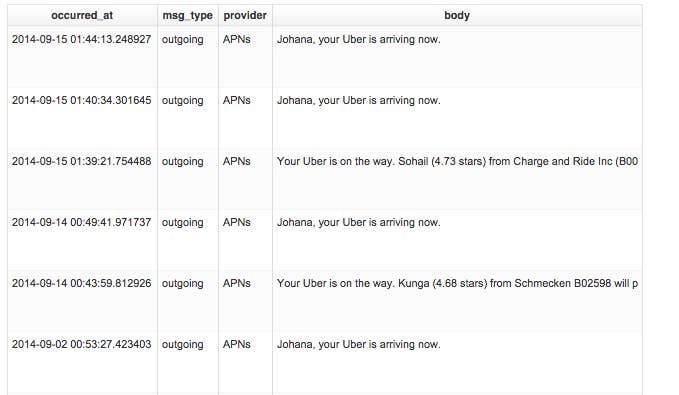
So "Hell" was the name of their program for tracking Lyft drivers, and "Heaven" or "God View" was the name of their program for tracking Uber passengers. The allegations of Uber employees abusing the privacy of individual passengers using God View go back to at least 2014, so this actually isn't anything new, just more specifics about who they were spying on. See here for a screenshot of their God View emailed to a journalist without her permission: https://www.buzzfeed.com/johanabhuiyan/uber-is-investigating...
Ah, sure. Is the complaint that they make that readily available to some set of people? It'd be silly to not expect them to have rider history in general


Source: https://www.reddit.com/r/IAmA/comments/lpzbzo/were_scientist...