Yes, same impression here. I remember trying to get some documentation fixes into the codebase and felt like it all got shelved because the Intel team didn't see those things as necessary. Some community PRs/fixes just went stale like that too. Kind of now hard to merge that in my head that they now need to crowdfund.
Just selecting 2023 as a timeframe isn't good data.
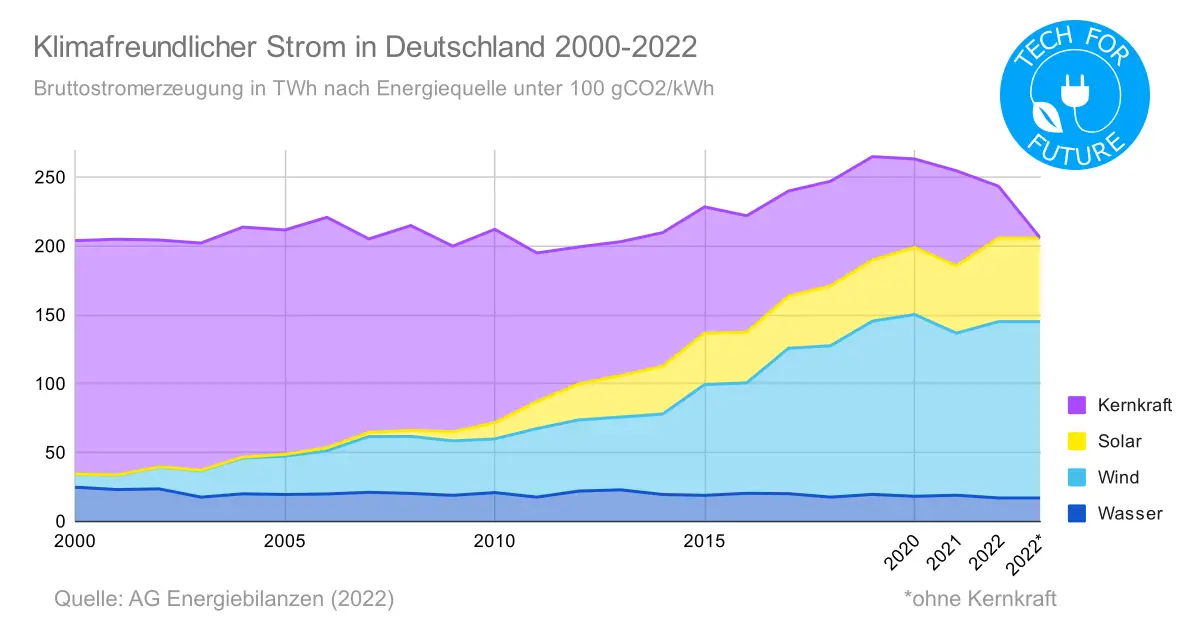
You can see here [1] that on a time frame of 2000 to 2022 Germany is yet to replace reduction of nuclear generation (Kernkraft) with renewables. Construction of renewables in 2023 has only accelerated 50% relative to 2022 [2].
I'm not sure at which one of those graphs I should be looking at. The gross power consumption one seems to refute your own claim. The total gross electricity usage of Germany in 1990 was 551 Twh, 587 twh in 2003 and is currently around 550 Twh. Current expectations is that usage will grow to 650 Twh in 2030 and to 750+ Twh in 2050.
> Firstly, it's not cheap compared to modern solar and that trend is likely to continue.
Only if you omit cost of energy storage infrastructure and grid upgrades necessary for VRE.
> Secondly, it's not a responsive source of electricity - so you can't modulate the output easily.
Repeated often by nuclear critics even though there's evidence out there of German nuclear modulating load within 24 hours.
> Fourthly, as we found last year, during heat waves rivers can run dry causing a shortage of water to cool the plants forcing them to go offline.
French powerplants did not go offline last summer, a few of them that lack sufficient cooling tower infrastructure had to eject hotter than usual water into rivers.
Germany's steel and chemistry sector require large amounts of natural gas.
In general, natural gas (currently LNG) was also to smooth a transition towards green hydrogen, the plan being to build infrastructure that can burn/store/use both, as explicitly stated by Federal ministries/agencies.
> that plan is out of the window
There hasn't been officially confirmed, soon there will be a report called "Power plant strategy 2026" that will give a better outlook as to what is gonna happen this decade.
> There hasn't been officially confirmed, soon there will be a report called "Power plant strategy 2026" that will give a better outlook as to what is gonna happen this decade.
It's a highly political topic.
Blue hydrogen from LNG is more of a research topic / aspirational thing for the fossil fuel industry than it is an actual thing. This seems to be more of a talking point than something that is being done at scale with any decent capture of carbon.
LNG in the industry is of course a thing. Heating things is done with gas and coal mostly. A lot of that will have to be transitioned away to something else. Hydrogen might be an option. But some industries might also switch to other forms of heating. E.g. there are some ways to use electricity directly for this via things like induction or plasma heating. Historically, using fossil fuels was cheap. But when you are going to use vast amounts of electricity to generate green hydrogen for industrial heating use cases, this changes. Using the electricity directly might be more efficient in some cases.
Economic challenges of quickly building grid-scale battery storage , battery production for the entire globe, NIMBY's etc.
> Modern batteries don't burst into flame
they literally do
> the overwhelming bulk of storage is not batteries
Well overwhelming bulk is a high bar and storage is geography dependent. Germany f.e. can't build as much pumped storage as Australia and Australia built a large amount of battery storage vs PSH.
Lithium-ion batteries burn. But the topic was "modern batteries", which at the instant moment means LiFeP batteries, not "previous-generation batteries".
Lithium is anyway not favored for use in utility-scale storage, where its light weight offers no compelling value. Up-and-coming chemistries include iron-air (no explosions), calcium-antimony (no explosions), and bromine-zinc (no explosions). Hundreds of other chemistries are available.
Even occupancy grids can be used to detect if you some kind of furniture or what kind of windows you have. Also, iRobot added visual slam some time ago, those maps can give huge amount of detail even if they don't contain images, just feature based bag of words models.
This meme has to end, there’s only one nuclear power plant in France (Blayais) that has no cooling towers, and another 4 have to occasionally throttle power output due to ecological concerns (used water is too hot, they currently have temporary exceptions).
I'm very impressed to learn about Snowy 2.0. Of course, it's not a silver bullet - in a renewable world, storage will have to be fairly distributed across the grid to maintain frequency.
For comparison, it seems Germany uses nearly 2x more electricity than Australia and currently has about 10x less pumped storage (including wip) than what Snowy 2.0 will have alone.