If you want to avoid doing the maths I think you can draw the problem out (assuming the world is a flat piece of paper and the source is located on the same piece of paper with you)
From the timings given you can work out the distance from location B and C to the wavefront when it hits point A (4 x 330 and 6 x 330).
If you then draw a circle centered at point B with radius 1320m, and a circle centered C with radius 1980m, then there is only one circle you can draw that intersects point A, and is tangent with the circles drawn at B and C. The center of that circle is the source (with an appropriate radius of error for timing measurement and distance measurement between A, B, and C)
Epic comment and diagram, thanks. From this, how can we calculate bearing and distance from one of our locations to the source? Edit: I see that we can use multilateration suggested by parent-sibling comment if we just had distance to source (ie radius of unique tangent circle).
So manufacturer says MTOW is 90kg, which likely means they barely got it in the air once at freezing temperatures on a very long tarmac strip. Max speed of 170 km/h would indicate that it's happy cruising at around 120-150 km/h. The place they found it in a barn is 170km away from the Morrocan coast around El Hoceima, so about two hours of flight including take-off and climb. Compared to a specified 7hr max flight time, they'd have to fill it up to about one third, so 9 liters of fuel, or 7kg.
An empty weight of 25kg and 7kg of fuel gives us rougly 32kg of empty take-off mass, and you then could load it up with not-quite 50kg of payload. Significant, but a far cry from the 150kg that was reported.
Unfortunately, the 26.5kg empty weight they specify is the bare airframe. That means it excludes the engine, VTOL powertrain (motors + escs + props), general wiring/electronics and VTOL batteries.
Their quoted "25kg" payload is likely about right for a shorter flight.
Yeah, likely. I'd still be confident that it can cross the mediterranean away from the Strait of Gibraltar. But maybe the overpromising is why they found it in a barn in mint condition, and not in the air.
$12k for the airframe. Each engine (4x) is another $8k. I wouldn't be surprised if the out-the-door cost of the airframe, engines, avionics and controls surpasses $50k.
I wonder what they're using as a flight controller? Is it linked to the ground (via cellular or similar) during the whole flight? Or autonomous for part of it?
I can't find any information on the data link, that they call: "Sprintlink Pro Data link & Video Link". So not sure if this uses cellular networks, or something else during flight. Hybrid products definitely exist: https://www.skyhopper.biz/products/communication-data-links-...
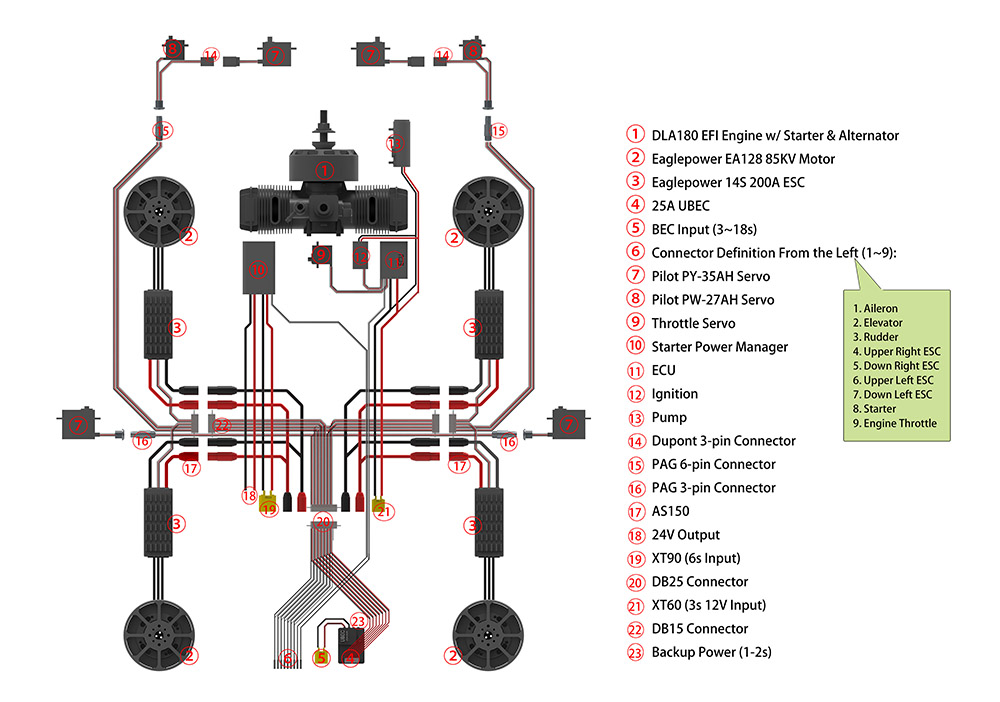
Besides "last mile shipping" and smuggling implications, I'm trying to think of how this could be useful today. Maybe some kind of search and rescue where someone activates a personal locator beacon, and you could send them supplies before you could reach them? A little under a gallon of water?
IDK, seems like a stretch. But I feel like there has to be more practical implications.
I looked up the cost of Warmates and they are also around $20k. Considering APKWS has existed for much longer and has a higher explosive yield and range and the fact that an Apache can carry a whole rocket killer swarm of 38 APKWS I honestly don't see how "slaughter bots" are supposed to be a threat when drones are that expensive.
The myth that drones are cheap should die. Crappy plastic toys with flight times measured in minutes are cheap. The real deal is just as expensive as everything else.
Doing some bistromaths on the stated hover performance.
With a 231lb empty weight, 180lb rider, and 5 gallons of kerosene (ultra light version) you get
104kg + 81kg + 15 kg = 200kg
sfc of a Nike is 40 grams / (kN second) (Should have gone with Hawk ;) )
Lets say hover thrust on a nice still day will be around ~ 1.9kN -> 76.7grams per second of flight.
Assuming I've not made any mistakes that gives roughly 3.5 minutes of hovering flight on that 15kg of fuel (ignoring the fact the vehicle gets slightly lighter as the fuel burns off).
That sort of matches up with the spec, assuming the 10-22 minutes stated is for a lighter human on the experimentally licensed version of the vehicle.
There would still be benefits to variable pitch propellers with an electric motor (motor efficiency, correct propeller pitch for the airspeed to name two).
I work in the UAV industry and would adopt variable pitch in an instant if it didn't come with complexity and weight penalties!
Interesting. I've always thought of variable pitch propellers as being more efficient by allowing the engine to stay at it's peak horse power. For a piston engine this is obviously at the peak of the nice curve you'll see on any dyno run. A fixed pitch propeller sized for climb would allow the engine to run above this speed in cruise and vise-versa if it were pitched for cruise.
Now an electric motor has maximum torque at 0rpm (stalled) and practically no torque at it's no load speed. The relationship in-between is practically linear. So long as the motor was matched and / or geared so that during all stages of flight the RPM stayed within a reasonable band I don't see what the advantage is. Maybe some second order effects of efficiency at lower speeds perhaps.
Edit: Actually, thinking again, it's the exact same reason that cruising at the lowest possible RPM for the required power output in a piston engine is typically the most efficient. Just less friction. Still think it'd be a smaller effect given we're talking roller bearings rather than plain bearings and piston rings.
Even if you disregard motor efficiency (which I don't, as with a battery powered vehicle you treasure every Wh more than you treasure every gram of fuel!), propeller efficiency is also important. Ideally you want to match your motors power handling and efficiency with your propeller. A given propeller/motor combination will have a design point in terms of torque/airspeed/rpm, and operating significantly outside of that (e.g. having a power system designed for cruise but operating at zero airspeed) has penalties.
Unfortunately I'm traveling at the moment, but I spend a large amount of my time at work balancing propellers and motors and could provide some plots that might help explain this. One of the few things years of working in academia proved to me, is that I'm terrible at explaining things like this!
I was a researcher at a reasonably big UK University until about 6 months ago, and I used SciHub fairly regularly.
Sometimes I used it because we didn't have the right subscription for that publisher to get me the journal I needed, but mainly I used SciHub to access papers I already had the "right" to access. The layers of logins screens, buggy single-sign-on systems, having to be in the right IP address range, not being able to download a PDF, meant that I almost always attempted to get the paper through SciHub first, and only went through the library systems when I couldn't find what I needed on SciHub.
I have had access to pretty much every journal in existence by working at big R1s for some time now. Still I find myself using SciHub on a daily basis when I am not on campus. Much easier to append '.sci-hub.hk' than authenticate (2-factor now), fire up the proxy, etc.
That’s the same excuse that’s trotted out in every field with a piracy problem—up until someone finds a way to do it and it turns out it wasn’t an insurmountable problem after all. That’s how we got iTunes, Spotify, Steam, Netflix, and so on.
It's not really an excuse - it truly is convenient in such a way that you only have to go to one place to get the thing you want.
If I want Man in the High Castle, I have to pay for Amazon. But if I want Ozark, I need to pay for Netflix. If I want to watch Metropolis, or The Raven, or The Maltese Falcon, they're old and not any streaming service, even if the rights are owned by a studio. Where can I find them? Yup, bittorrent.
At least piracy more-or-less forced most music to be centralised onto a single service, i.e. in many cases you can get the same songs on Spotify and Apple music. It's a shame piracy didn't force Hollywood studios to sort their out, and allow you to just go to one or two sites. Just look at what Disney are trying to do.
You are of course right: "it wasn’t an insurmountable problem after all" - it's just that studios and publishers squabble. But I'm not holding my breath on Elsevier, MacGrawHill, AddisonWesley, OUP, SUP, etc. to come up with a commerical SciHub.
The selection of movies on Netflix is beyond dismal. If it's not from the last 15 years, your chances of finding it are virtually nil. If it is from the last 15 years, your chances are merely terrible. The demise of video stores has left me with no idea how I'd (legally) watch an old movie short of purchasing the DVD. Strange that widespread access to classic movies only lasted about 20 years -- from the mid '80s to the mid '00s.
That's a false dichotomy that because there was a blockbuster nearby they automatically had every classic movie in stock. I wouldn't be surprised if Netflix's total active catalog size is much greater than what was in a blockbuster in 1999
There are a number of alternative streaming services with a better selection. One that comes to mind is Filmstruck, which has the entire Criteron Collection but there was another successful one I can't remember the name of.
If you are into classic movies I'd imagine that you would still subscribe to the Netflix DVD mail service. Millions of other do. I'd say that is widespread access to old movies, just not widespread interest.
If you must stream (if you are up for physical media, last I checked, Netflix was king, and has am incredibly broad catalogue ) try Amazon Prime.
You have to pay a rental fee of like three or four bucks per, just like blockbuster, but they have a much deeper pool of old movies than Netflix Streaming, I think.
That many people stop pirating as soon as something more convenient comes along does not contradict the idea that people used to pirate because it was convenient.
There is a huge difference between Steam and Elsevier and I'm not sure why you feel the one is an example of how the other could evolve. The one sells games for entertainment purposes to the masses, the other sells subscriptions to scientific institutions to give them access to research papers. It's b2c vs b2b and a competitive space versus a captive audience.
Pre-Steam also coincided with pre-Internet / online gaming. Having half your software assets lurking on company servers now makes protecting your IP considerably easier.
Ok, that's a good point. But video games are rarely created with public funds and in general are not crowdsourced to then be placed behind a paywall. Even Steam has plenty of competition.
If there were a disruption of the world of scientific publishing that would have a parallel in entertainment I would have chosen Spotify over Steam.
I'm only trying to refute the claim that "piracy has one USP that the competition lacks that is very hard for them to replicate: convenience". That's disproven by the fact that many companies e.g. Steam have had undeniable success on the back of that convenience.
Torrents are very inconvenient compared to many streaming services.
Therefore, you would expect most people to opt for Netflix. (And by and large I'd expect Netflix to be more popular in mass than tormenting at this point for places where it's available.)
But what if it's not available where you live (That's inconvenient), doesn't have the content you want (That's inconvenient), or you want a file you can play offline that isn't allowed to be downloaded on the Netflix app?
Convenience wins almost every time, but not having the option to do something (be it for lack of $$$ or availability) isn't convenient so that's when
more people turn to piracy.
My statement (as can be seen from its GP post) uses convenience to mean ease of use, not in the titles available sense that you (and the two following posts) do.
Far more convenient when you consider that Netflix's catalog of reasonably mainstream as-seen-in-theaters movies has been shrinking for years.
As the end user I don't care "why" their catalog has been shrinking, I only care that something I watched last year and want to watch again is no longer available on that service.
And no, I'm not going to sign up for a dozen different services just on the off chance that one of them will have what I want to see at any given point.
In my experience in the last five years, Netflix's batting average for actually hosting movies I want to see is around 20%. In terms of convenience, if they don't have the movie at all it's kind of like dividing by zero.
In the back of the van, parked up on the side of the runway at an airfield. We were flight testing a UAV and the data logging system that should have been finished weeks before....wasn't. So we were bodging stuff together so that there would be at least some data logged from the flights.
Right in the middle of summer too, but luckily in Wales so actually quite a pleasant temperature in the back of the van.
If you dig past the internet comments and read some of the "primary source" books, the picture of the leaks is very different. I can't remember the exact book I read it in, but the author states there was a tank sealant, and it lasted around 50 hours (I think), before it needed to be replaced.
This is somewhat backed up by the Jenkins book [1] which talks about the time consuming process of replacing sealant, and the Graham book [0] that is the source for the Wikipedia claims on expansion. It talks of different sealants used, and how leaks were precisely noted and collected in _shallow_ drip trays.
The SR-71 took off with a small fuel load to reduce stress and improve engine-out performance, that is why it was refuelled immediately after take-off.
The mental image of it leaking so much fuel on the ground such that it needed immediate refuelling is a myth propagated extensively on the internet.
I believe if you look for primary sources like pilots and ground handlers/mechanics you'll mostly find reference to small leaks (I think they were referred to as drips caught in cookie trays).
I had a quick search and found the KC135 chap who says the refuelling was needed due to leaks, but without being rude to him I'm not sure he's really a qualified source for that information. It sounds more to me like 2+2=5.
I'm procrastinating so lets do some napkin maths, the claim is
1) a significant amount of fuel is leaking out of the expansion gaps,
2) climbing up to 25,000 ft at 300 knots would heat the airframe enough to seal those gaps,
3) there would still be sufficient expansion room to allow for travelling at M3.2
----
Ignoring that no engineer would be happy with 1.
For 2...Total Air Temp = Static Air Temp + Ram Rise. At 25,000 ft the static air temperature is about -35 C.
Ram rise for a true airspeed of 300 kts:
RamRise = V^2 / 87^2 = 300^2 / 87^2 = 12 degrees.
So skin temperature at typical refuelling altitude would be -23 C
Titanium has an expansion coefficient of 9E-69 meters per meter-kelvin. So approximating rather grossly, assuming a s tarting temperature of 20 C over the 33 m length of the plane there would be a contraction of about 1 cm.
----
And for 3:
The aircraft then accelerates up to 1900 knots.
RamRise = 1900^2 / 87^2 = 470 degrees
Static air temp at over 60000 ft is roughly -55 C. So skin temperature would be 420 C. So assuming the same length and starting temp, the plane would expand by around 11 cm
----
So to summarise: According to the claims, at ground level and temperature the expansion gaps were large enough to significantly leak fuel. After take-off the aircraft needs to be refuelled immediately. Assuming this is done so (i.e. take-off, climb to 20,000, refuel) then the skin temperature is lower than ground level, and the expansion gaps should have grown ever so slightly. The aircraft then climbs up to its M3.2 cruise point and everything expands significantly "as designed" and the gaps disappear.
----
Perhaps the anecdote we'll see on the internet now is that the SR-71 had to take off and go supersonic to rapidly heat up the skin before briefly decelerating to refuel, but the refuel had to be done super fast to stop the skin cooling down too far...


From the timings given you can work out the distance from location B and C to the wavefront when it hits point A (4 x 330 and 6 x 330). If you then draw a circle centered at point B with radius 1320m, and a circle centered C with radius 1980m, then there is only one circle you can draw that intersects point A, and is tangent with the circles drawn at B and C. The center of that circle is the source (with an appropriate radius of error for timing measurement and distance measurement between A, B, and C)
https://imgur.com/a/tqV0ToU