    > Anna Creek Station is the world's largest working cattle
    > station. It is located in the Australian state of South
    > Australia. Its area is roughly 6,000,000 acres (24,000
    > km2; 9,400 sq mi) which is slightly larger than Israel
I wager that Kidman Beef Co probably wins this particular distinction. Their grazing lands are in the ~30-35K square mile range -- or the size of Ireland!
Empirically, all the towns and cities I like to visit are the non-high-rise pedestrian ones. They don't have to be old, but it helps.
My visits to the US have given me a very jaded view of what constitutes culture in the US. Small towns with small roads can be nice in the evenings, and that's about it.
The centres of high culture from centuries ago were also centres of traffic and trade, they were not pleasant "liveable" cities, indeed, they typically had huge slums. The origin of the word ghetto is a neighbourhood in Venice. Today, it's UNESCO World Heritage at all, and probably on the list of places you like to visit (and, incidentally, smaller than a Walmart) -- but 500 years ago, it was a prison for jews.
Whatever future generations will recognise as high culture of our present day is very hard to predict, and I'm not at all certain that they will consider the absence of car infrastructure a key feature. Silicon Valley, being ground zero of the information revolution, certainly has a decent claim, and it's nothing if not cars all over.
> Today, it's UNESCO World Heritage at all, and probably on the list of places you like to visit (and, incidentally, smaller than a Walmart) -- but 500 years ago, it was a prison for jews.
Medieval cities had separate Jewish areas due to Jewish demand, not gentile demand.
According to the Jewish Virtual Library: “In 1516, the doges, Venice’s ruling council, debated whether Jews should be allowed to remain in the city… but their residence would be confined to Ghetto Nuovo, a small, dirty island; it became the world’s first ghetto.”
> Nineteenth-century Jewish activists, demanding rights of citizenship, created the story that the Jews had been locked in ghettos since the Middle Ages
> For Weinreich, based on both the linguistic and historical evidence, there could be no doubt that up until the 18th century “the Jews wanted to be by themselves. … Separate residence (strange as this may appear in the light of present Jewish and general conceptions of rights) was part of the privileges granted the Jews at their own request” so they could worship together; provide for their own slaughterhouse, bathhouse, cemetery, and social halls; study together; run their own rabbinic courts; supervise tax collection; and when necessary, protect themselves from attacks.
> Archeology supports this part of Weinreich’s argument. Befuddled tour guides in Prague struggle to explain why, given the expectation of exclusion of Jews, the city’s famous Jewish quarter, Josefov, is so central to the old town. (One misguided explanation is that the Jews were given land near the river that was too marshy for the other city inhabitants, prone to flooding and disease-bearing miasmas.) But Prague’s Josefov is not an isolated case—it is typical. Weinreich’s point is that exclusion could also be exclusivity; restrictions also came with designated privileges. In Trier, Mainz, Aachen, Cologne, Worms, and more than 100 medieval towns in Central Europe, the Jewish district was both a central and a prime location, close to the economic heart of the city. The German Bishop Rüdiger, granting a charter of the city of Speyer in 1084 wrote, “I thought that I would increase the glory of our city a thousandfold if I were to include Jews.”
"Archeology supports this part of Weinreich’s argument." Really? How? [proof by handwaving] "One misguided explanation" - misguided how? Guess what, the current Prague Jewish Quarter looks all pretty, but it is practically brand-new (1900+); what was there was the poorest part of town, a slum, if you will ("ghetto" is, ironically, too ambiguous in this context). This was razed to the ground with the exception of about 10 historical buildings; no wonder it's a "central and prime location" - now. In all - interesting, provocative, but not persuasive (wonder why you didn't choose to quote this sentence as well, hmmm: "Yet the historical, demographic, and geographical evidence does not support this entirely logical and neat story line—a fact to which Weinreich himself gives evidence in his notes.")
Oh, and btw: since you chose to mention Prague, the historical Josefov was one of two ghettos. Still typical?
In other words, my remark on "alternate reality" seems to have been spot-on.
> (wonder why you didn't choose to quote this sentence as well, hmmm: "Yet the historical, demographic, and geographical evidence does not support this entirely logical and neat story line—a fact to which Weinreich himself gives evidence in his notes.")
Because that sentence is from a separate part of the article and refers to an entirely different point. I'll outline the structure for you:
> Weinreich’s first innovation in the History was to argue, against apparent common sense and abundant personal experience, that Yiddish was formed not through isolation but through constant interaction combined with a chosen separateness.
> Archeology supports this part of Weinreich’s argument.
> Weinreich’s second argument is equally counterintuitive. Though in some places Yiddish and German were mutually understandable, he assiduously argued that they are different languages. But Weinreich deployed his formidable linguistic artillery to argue, contrariwise, that despite significant variations in spoken and written Yiddish across the expanse of Europe (western Yiddish, more purely German; eastern Yiddish, heavily Slavic; southern Yiddish, with influence from Hungary and the Balkans), Yiddish forms one language and shares one cultural sphere and worldview, quite distinct from the surrounding culture. In short, Yiddish and German are different, but all Yiddish is one.
> Once he demonstrated that Yiddish is an independent language, Weinreich explained how it came to be, first as an altered language formed among medieval Jewish trading settlements in the French–German borderland along the Rhine valley. Weinreich deduced from traces left in early Yiddish that these first Jewish immigrants to the heart of Europe spoke a Romance language, having left Hebrew, Aramaic, and Greek behind when they left the eastern Mediterranean, although Hebrew and Aramaic were still languages of study. But early on (in the 10th or 11th century) these Jews from Rhineland France, presumably through contact with Jewish settlements in southern Germany, converted from old Judeo-French to western Yiddish, which was more purely German with some elements of Latin or early French. In subsequent centuries—when, exactly, is a source of considerable debate—this language moved east with Jewish emigrants, settlers, and refugees, either in the 12th century (after the Crusades and persecutions) or in the 14th or 15th. There it picked up a significant cargo of Slavic vocabulary and expressions and became the Yiddish more familiar today: eastern Yiddish.
> Yet the historical, demographic, and geographical evidence does not support this entirely logical and neat story line—a fact to which Weinreich himself gives evidence in his notes. Yiddish blossomed in printed books from the 16th century onward, but Weinreich argues that Yiddish began in the 10th century in the Rhineland—though there are little more than a dozen extant texts in Yiddish from before 1400. Many of these early traces of Yiddish are only a few lines long and, aside from the marginal glosses of the Talmudic scholar Rashi (c. 1100) from the Champagne region, the early texts do not congregate in the “right” geographic area.
The claim that the historical evidence does not support the idea that Yiddish originated in tenth-century France is quite different from the claim that the historical evidence does not support the idea that segregation was a privilege given to eleventh-century Jews at their own request. You want the sentence you quoted to mean the latter of those, but an honest reader would have to admit that it means the former.
Aha, I thought that referred to both; thanks for the clarification. I have reread the article, I see that I have misunderstood that claim and I apologize. I'm definitely not trying to read the article in bad faith; this just seems an overreaction (which is not even supported by the original author IMNSHO): "common wisdom says Jews were fenced in 100% from outside; invert and claim they were fencing themselves in". I do not presume to understand liguistics sufficiently to discuss the second claim beyond "sounds interesting, logical even." (Still curious about the archeological sources supporting the first.)
I don't dispute that living in a separated community has its advantages, I don't claim that ghettoes were prisons; in fact, distancing themselves from other, um, "tribes" is even supported by the Law. I'm just deeply incredulous at the claim "we don't want to live outside at all, make it a law of the land:" there are plenty of exceptions in the town statutes saying "want a house outside of the ghetto? Pay up!"; that doesn't quite look as inside influence.
Phrased as "chosen separatenes", this is still a far cry from "separate Jewish areas due to Jewish demand, not gentile demand" - to the first part I could mostly agree, to the second, not at all (and there's plenty of textual sources spanning the entire medieval and early modern period for that). I would agree that in a situation of "live in a ghetto or not here at all" (a threat which manifested itself pretty often), the mutual support in a separated community would be welcome.
I wouldn't dream of claiming that gentiles didn't like it that the Jews lived separately, or would have preferred integration. I phrase it as "due to Jewish demand, not gentile demand" because as I read things the gentiles weren't in a position to be making demands, but the Jews were. (Look at that comment from Rüdiger.) Had it been important to the Jews to live mixed in among the gentiles, they could have forced the issue.
In this view, legislation saying that the Jews must live in the Jewish quarter is basically analogous to legislation prohibiting incest -- it's not passed because people would be violating it otherwise, but because people feel that it reflects the proper order of the world, and it passes easily because there is no group that feels threatened by its passage.
Maybe they should have felt threatened, since the situation often persisted long after the point where it was a net benefit to the Jews, but it's hard to blame the communities of 1040 for not anticipating the problems of 1940.
I'm looking at a handful of such comments (which call for Jewish presence as cash cows, mostly) across multiple centuries, and an avalanche of comments, texts and laws saying "get them outta here. okay, maybe let them stay this year if they pay more." I understand that it feels cool to stand up against Established Knowledge, but alas, extraordinary claims require extraordinary evidence; which "archeology supports me in emails" is not.
You are cherry-picking facts in the extreme - the "problems of the 1940s" (you mean othe holocaust? What newspeak!) did not just pop out of nowhere, pogroms as ruler-sanctioned way of making a quick buck were a time-honoured tradition spanning the Middle Ages.
Modern US Amish (and related groups like Mennonites) live in their own circumscribed areas in the eastern US. They are exempt in law from some requirements which notionally fall on all residents of the United States equally, and exempt in practice from quite a bit more.
They draw that protection from the fact that they live in a cohesive group in a well-defined (though not, as far as I know, legally set) region. They are welcome to leave, but they would lose the special legal status that the Amish enjoy, and they would then be basically unable to practice their traditional lifestyle.
Are they being kept in a ghetto? Is it by our demand or theirs? Is it reasonable, if we give them their own laws, that we restrict that to a well-defined area?
> I'm looking at a handful of such comments (which call for Jewish presence as cash cows, mostly) across multiple centuries, and an avalanche of comments, texts and laws saying "get them outta here. okay, maybe let them stay this year if they pay more."
I took a moment to find the interchange. It appears to be the 285/75 interchange [1]. Eyeballing it based on the scale in Google maps, if you zoom out until you see Atlanta itself... and it takes quite a few zoom levels... it looks to be 12-15 miles from the Downtown Atlanta you'd be concerned about, or, in terms more relevant to the current discussion, approximately 20 Florences laid end to end.
The numbers are quite approximate, but the orders of magnitude are definitely correct.
Several of the Florences that would be laid end-to-end to get to Atlanta as the crow flies appear to be going in places that have virtually nothing there and could actually go there. I can't tell from Google maps if perhaps that's all swampland or something, but a lot of it isn't utilized, regardless of the reason.
If you want to make the point that cities should be more walkable or whatever, this is a terrible hook to do so with, because the existence of large interchanges has nothing to do with the cities not being more walkable. These large interchanges, in general, do not exist in downtown areas, and if you still complain about them it starts to sound more like you have no idea how large the world is. It comes off less like trenchant criticism and more like Puritan-style "those damned car owners are having fun and they should be stopped!".
FYI, since 285 is a loop and 75 runs all the way through Atlanta, there are two 285/75 interchanges. While I think you're correct in your selection, here's the other one for completeness: https://www.google.com/maps/place/33°37'55.6%22N+84°24'02.8%....
This is of practical importance. There are two 285/85 interchanges as well and I broke down at one of them once, and the tow truck thought I was at the other one.
That's sort of true, but "loop" just means that both ends are at interstates. See for example I-675 south of Atlanta, which runs from I-285 to I-75 in roughly a straight line.
> My visits to the US have given me a very jaded view of what constitutes culture in the US.
I am saddened by your comment here. The US has such a wealth of diversity in its cities, towns, and country-sides to offer that I can't possibly understand how one could dismiss everything in the country so categorically. Yes, even Atlanta, a city that I find is terrible to visit, but great to live.
I have lived in London, Stockholm and a few other big but pedestrian-friendly cities. Stockholm was particularly nice in summer. I did not own a car. Public transport worked great.
I now live in the countryside, but in a quaint village in a country with only quaint villages.
So, my point is that I think that car-friendly and people-friendly are exclusive. I was careful to say it was my opinion, as I guess that everyone who agrees with the article will upvote-and-move-on and those who come to comments will be doing so to disagree with it ;)
Venice is particularly interesting: it has a massive carpark where residents leave their cars.
https://en.wikipedia.org/wiki/Poundbury is another. I have never been to Poundbury, but it seems from what I've read like the kind of place I'd like to live.
We can clarify with the person who said that, but the two are one-and-the same for me. I'd guess that it's pretty rare for someone to like visiting pedestrian-friendly, compact old cities (Paris, Prague, Edinburgh) but prefer to live in modern car-dependent ones (Atlanta, Dubai etc)...
Given tourism rates and where those tourists are from, I think it's super-common to like visiting pedestrian-friendly, compact old cities but prefer to live in modern car-friendly ones. I'm such a person myself: visiting those places is fun, sort of like visiting a Humanity & Crowds theme park, but where I live I want to relax and have some separation.
That's not as incompatible as it may seem: only a fraction of area of those cities are ultra-compact medieval mazes (and you can usually recognize it because it's named "The Old {Town/District/Port/Giraffe/Whatever}"); for living and relaxing, most of the population doesn't live in the ancient part of a city. For example, this is one of the non-touristy neighborhoods: spacious yet walkable (plus public transport if you're not feeling walky), a few minutes from the Old Town. Finding a parking spot could be tricky, though. https://www.google.cz/maps/@50.0753781,14.450439,3a,75y,53.5... Note that this neighborhood is also an "old city" by most definitions (founded in the 1890s).
Me too. When I moved from San Francisco to Atlanta I traded a public transit commute for a car commute. I still spend the same amount of time getting to and from work but I don't have to spend it physically crammed in with other human beings.
To me that reads as "I no longer can use that time to read or do something productive". Each to their own, though. Though it depends on the conditions of the public transportation - being crammed in a bus is very different from having a seat on a train or ferry, as I usually do.
When I had a public transit commute, I rarely read, even though I read a lot in general. Even if I had a seat concentrating on anything was too difficult. I listened to a lot of podcasts, which I still do in my driving commute, and those had the side benefit of drowning out the noise of humanity.
My favorite commutes have been walking commutes, but I haven't had a job where I could do that in years, and I bought a house which isn't within walking distance of any jobs I'd want so that won't happen for the foreseeable future. Unless the walk from my bedroom to my home office counts as a "commute".
For me, crammed into a bus/train isn't that bad, provided that A/C is run at full blast and the direction of airflow is top->down. This means that winter commutes by public transit in the northeast is absolutely miserable, since they never ever turn on the A/C to dehumidify the space, even if humidity is close to 100%.
You seem to imply that a city can be either pedestrian-friendly or car-dependent, but there is an intermediate state: pedestrian-and-car-friendly.
Furthermore, pedestrian-friendly is nice if you manage to sleep in a nice accommodation at a walkable distance from your centers of interest: this is usually the case when you visit a town as a tourist, but not so easy when you leave there.
On the walkability and livability of Prague: having lived there for a few decades, I claim that you can't have both: mostly, you'll get a lot of talk for walkability, and a lot of construction for drivability (which has, so far, only brought more traffic into the city). Worst case, you'll get an intermediate state that's pedestrian-and-car-hostile (there are such places right in the city center, where a north-south freeway had been rammed through).
However, for all the roadbuilding of the past 30+ years, the city remains well walkable, in a loose sense: the dense public transit network (a dirt-cheap yearly pass, trains running separate from all other traffic, semi-separated light rail, and an auxillary bus network) allows me to move about easily: walk a bit, hop on, ride a few stops, walk a bit again. This way, anything is within my "walking" distance. So, even though I'm not living in the city center, I can get there within half an hour (or in half an hour by car, hunting for parking spots included).
This, I believe, is the crucial part: walking by itself is okay for short distances, but needs efficient public transport on longer trips: "we'll just buy a bus or two" doesn't cut it.
(So, yes, it's easy even when living here: walking is not a tourist attraction, it's a mode of transport; and I even see a lot of tourists on the metro, "doing as the Romans do": using public transport as an extension of their legs.)
I wonder what a comparison of the throughput of an interchange vs. an airport looks like? The East LA interchange (busiest in the world) serves 550K vehicles per day[1] while Hartsfield (busiest airport in the world) serves 278K passengers per day[2]
That was never the point. Instead, the point was that when we require high-speed expressways in our cities, the land requirements blow up insanely and the land is then useful for pretty much nothing else.
Contrast that to Florence which required much lower speeds and therefore could use the land for many useful purposes. Obviously, Atlanta has nodes of high culture elsewhere, but they certainly can't put any of them here.
As for the proportion of how much land use blows up at speed, consider this: at 5 mph, making a right turn requires just a 15' turning radius, which occupies 225 square feet. The largest curves in the Atlanta interchange (the ones for which you don't have to slow down) have a radius of close to 900', which occupies about 810,000 square feet. So to go 14 times as fast (70 instead of 5 mph) you have to occupy 3,600 times as much land.
You're right, I posted without thinking and didn't do the math. It's on par with Vatican City though (slightly smaller), but yeah, that 45 country figure is way off. Thanks for that correction.
Unless there are people living on the interchange it's a little pointless.
We need very high density around where people live. This is the most important thing ever.
Low energy costs for transport which I would say equals better communities and a better way of life for a large proportion of the population.
Of course acknowledging there exists at any time a smaller proportion of the population for who this doesn't work, but this also allows them an easier access to their lifestyle.
Allowing/encouraging high density building is whats it's about, not roads which are just the side effect.
Do we, though? I agree encouraging density in the places people want to live densely is a Good Idea - think SF, NYC, etc. People and entrenched interests working to prevent density where appropriate are worth defeating.
That said, some people want to live in sprawling suburbs, and taxing them unnecessarily for the inconvenience seems like a Bad Idea.
I grew up thinking I wanted to live in the suburbs with a large lot/house, etc. Then after living in a small place where you can walk everywhere, I realized smaller is actually better. I suspect many like me could come to that realization. Also, many people "wish" they could live in a city, but are forced to the suburbs due practical reasons: lower cost housing and better schools.
Interesting, I grew up in the suburbs and hate living in cities. I live in the bay area at the moment, and even that is a bit crammed for me.
The suburbs give you space to do stuff. I grew up on the out skirts of the Chicago suburbs and I could play soccer, go mountain biking, off road, and in the same day go to any store or restaurant you can think of. More in less space might be great, for some, but you still can't fit everything in one place.
The suburbs may require a bit of driving, but it's less dense and thus you have less traffic (easy to drive 10 miles in 15 minutes) so you get a lot more in a given area you have access to.
Timewise, cities aren't that much further from the wilderness than suburbs are. There are certainly advantages to living in suburbs, space being the primary one, but time isn't one of them.
I am 100% sure people in Boston, NYC, the Bay Area, downtown Chicago, etc. would strongly disagree that it takes 15 minutes or less to get to a place to hike, horse back ride, and/or fish.
Having lived in the Chicago suburbs, downtown Chicago, Champaign, IL and the Bay Area; assuming you live in a suburb (as opposed to Champaign, IL) you'll have access to a much larger variety of places to go in the suburbs. I will however agree that going out to bars, or traveling via foot/public transit would be difficult.
I'm cheating here because I live in Washington, DC, and in an area close to Rock Creek Park. But in order if time to get there: the hiking trails of Rock Creek Park, about 10 minutes walking; the nearest riding stables, about 10 minutes driving; fishing at Roaches Run, 25 minutes driving in light traffic.
This is only true because you have to drive through the wasteland that is the suburbs to get out of the city. In places without such excessive suburban sprawl you can get out of the city much more easily.
We are currently subsidizing living in low density areas. The per capita cost of streets, sewer, etc. is much, much higher in the suburbs. We should at least stop the subsidies.
Show me the line item on a bedroom community city's budget that says "subsidy from self-righteous city dwellers who don't realize the employees of the companies that pay taxes to the city commute from suburbs".
This kind of attitude is not welcome on HN. We are a friendly community that welcomes different opinions/views which are debated in a professional way.
Even so, here [0] is a recent HN article which does a very good job of explaining how suburbs are predicated on an (unsustainable) model of growth.
Do you not see how the constant accusations against suburbanites of leeching off the cities is equally antagonistic? It happens frequently on HN -- someone might post about inefficiencies of suburbs for transportation (often, but not always true) or the use of water for growing food in rural areas, then a bunch of others will pile on with escalating disdain for non-city life. But because the escalation is gradual and the disdain is so popular here, nobody notices that they've slid into an endless pit of belittling the roots of millions of people.
Yeah, occasionally I get a bit frustrated by this topic and it shows in the tone of my comments. Hopefully it illustrates the point, though, that there's a need for nuance and understanding on both sides.
Making the suburbs pay for their own infrastructure is not “taxing them unnecessarily”.
Currently suburban infrastructure and the automobile commuter pattern of life is heavily subsidized, while other development patterns are penalized or banned outright.
Everyone pays the same for infrastructure regardless if you live in a low or high density part of town. However, you require more infrastructure living in the suburbs. Only two other families ever use the piece of street in front of my house. At best a hundred families ever use the small park across the street.
>Everyone pays the same for infrastructure regardless if you live in a low or high density part of town.
No actually. A heavily subsidized project like the Big Dig cost vastly more per mile than a suburban side street.
Furthermore, you can't just assume that cities could exist in isolation. The inhabitants wouldn't last long without numerous inputs (food, water, power, etc.) that they can't provide for themselves and that require areas with less density to produce for them.
It's very hard to come up with numbers because everything is effectively a large interconnected system. Some patterns are probably more efficient than others but you can't just assume everyone into urban living.
The Big Dig is part of a transportation system designed to help people who live in the suburbs commute by car into the city to work. If everyone who worked in the city could also live there, there would be much less need for massive highways. As local transportation, the subway and buses are much more scalable and efficient. (Not to mention just walking.)
Residential sprawl in the suburbs is not producing food, etc. Nobody is advocating turning all cropland into city, that wouldn’t make any sense.
The advocacy is for changing tax/zoning/planning policy to encourage residential density and mixed residential-commercial use neighborhoods. Even in towns of, say, 30k people, having a denser town center full of low-rise apartment buildings and walkable neighborhoods is a big advantage for economic efficiency, for human health, and for the environment.
Having people commute one-person-per-car for 1–2 hours per day, drive cars to school, to shops, to restaurants, to the post office and the library, ... is ridiculously destructive at a societal scale. All the public infrastructure and public services cost several times as much per capita as life at higher density, not even to mention the economic/environmental cost of the cars themselves, or the massive time opportunity cost of the commuting.
> you can't just assume everyone into urban living.
Nope. But people who want to live somewhere very economically wasteful should be prepared to pay for it.
Of course the Big Dig is more expensive, but you can't compare a single road to another road. If you take all roads in one area and divide it by the number of users you get a much more meaningful number.
Of course you are completely right that we need rural areas where we for example grow good or do other things that need lots of space. However, that doesn't happen in most suburbs. In fact suburbs typically keep their density artificially low for non other than vague aesthetic reasons. I myself live in the suburbs and find it very convenient. Would I do so if I had to pay for the street and sewer that lead to my house like my parents who live in Germany had to? Probably not. My parents had to pay about 20k, and that was because most of their property was on a main, federal road. Otherwise it would have been closer to 40. At the time I thought that was insane, but given that in a multi story apartment building the cost would have been much lower, it seems fair in hindsight.
In the US town where I live, which is admittedly more exurban/rural than suburban, I pay for my own septic system, trash, water, etc. Houses that were hooked up to sewer in another part of town a number of years back had to pay for that. No, in the US, you don't typically pay for public roads although people certainly pay for upkeep when they are on private roads as some are. (I'm off a state highway and have to handle the upkeep of my long private driveway.)
Personally, I'm no particular fan of traditional suburbs. But I'm also unconvinced that it's even desirable to especially encourage urban living--especially if, in practice, that means encouraging living in a few specific walkable cities. Presumably urban living in this context doesn't mean Las Vegas.
The park is not part of infrastructure. It is a perk that the government decided to be responsible for that is a vestige of urbanized planners taking cues from New York and Philadelphia. Your street is part of a system that was put in place through the urban planners and is probably maintained by the municipality, if you would like to volunteer to not have them maintain it, you can always ask them to.
* Streets are paid for in the United States through the gas taxes collected from the distribution of fuels. It is a user tax.
* Water and electricity are maintained and run by utilities through their use rates. I will pre-empt the discourse and note that water is heavily subsidized by the government and creates weird incentives (I am looking at you Arizona with your green lawns).
* Transit, bicycle, and pedestrian movements are subsidized by the gas tax. In this case, your statement would be true.
The way this is set up means that the content creator has no idea how funding works.
1. Toll revenue goes to toll facilities. Private public partnerships (PPP's) need to be repaid and the tolls collected go directly to the repayment of the bonds, maintenance, and general operations.
2. Transit siphons monies away from the use tax. Transit exists only because of the user tax. While people see autos as bad, they fund the transit that provides movement for poor individuals. I am okay with this.
3. State and local roads is oddly worded in this phrase and brings a warning to my periphery review. Most states have amendments and/charters that require fuel funds to be allocated to the roadways, Wisconsin (http://www.wsdot.wa.gov/Finance/fueltaxes.htm), Florida, and a number of others that do not take money from other sources. In fact in Florida, the highway funds are raided yearly to fill in budget gaps.
The best I can come up with on how this chart was made to get the 50% concept is that FHWA provides matching funds for projects, the reason is that they want to provide a carrot to meet federally required mandates, such as interstates and state roads on the National Highway System. If you kick in these monies, which is free money, then you can get there. However, this is an advocacy program.
One last note. The writing is on the wall for the gas tax long term. The federal level is already having a shortfall in revenue because of the CAFE standards increase. This is why states like Oregon are trying out the Vehicle Miles Traveled tax, because they need to switch out how the roadways are paid for.
For starters, by spending trillions of dollars on wars in the Middle East to keep fuel prices low. We also set the gas tax far too low to account for all the negative externalities of driving.
> We need very high density around where people live. This is the most important thing ever.
Strongly disagree, why? In the suburbs you spend 10x less time in traffic, and have access to 10x more because it takes 15 minutes to go 10 miles vs the 1 hour I spend every day traveling 7 miles to work in the bay area.
Significantly, less energy and time is lost in the suburbs. Plus, cities have ridiculous pricing for less space, hence people with families dislike cities (on average).
Are you kidding? It depends where you are in the suburbs I'm sure. However, in general because of the ease of transit with a car you have access to far more.
For example, in NYC I wouldn't have access to a soccer field, a place to go horse back ridding, a place to go off roading, fishing, a Macy's, an Steak house, McDonalds, a Red Lobster, etc. all within 10-15 minutes. All at the same time, having a 4 bedroom, 2 bathroom house with a yard at $1500/month.
> suburbs have less things spread out over much more area
Again, it is spread out over a larger area, but the accessibility of those regions is much greater (i.e. far less traffic, 45+ mph speed limit, and cheaper fuel costs). If you want stuff within walking distance, or public transit it will not be as accessible and thus you'll have access to less.
Living in the Bay Area (even with a car) it'll take me 25 minutes to get to the Costco 4 miles from my apartment which costs me 5x what it would in the suburbs of say Chicago, Austin, or countless other locations.
I'm not kidding. I am saying there are tradeoffs between suburban living and urban living. You give up a yard in the city. It is more expensive for far less space. However…
- I have Fishing, a Steakhouse, McDonalds, several seafood places better than Red Lobster within a 10-15 minute walk in NYC. Up until a few years ago, had horseback riding as well.
- If you expand this to a 10-15 minute subway ride, the selection gets insane.
So, no, you do not get access to more things in the suburbs, not by a lot. But as you said - you are closer to outdoorsy activities, have a yard, pay less.
If you're comparing the accessibility and cost of chain stores in and out of cities I'm going to assert that you're missing a lot of what cities have to offer (museums, interesting restaurants, live music, parks with lots of people in them, etc...). Also some people truly enjoy not needing to get into a car to accomplish even the most basic task
Cost of living and accessibility to nature and open space are the big compromises though
There's interesting restaurants in the (Chicago) suburbs too. They might not be as gimmicky (no "say the secret password to get in" types), but you can find just about every cuisine and the food is usually just as good.
Museums are great, but they're something I only get the urge to see a couple of times per year.
Live music (and you should have said shows/theatre also) is definitely lacking, but if I want to see that, I can drive an hour to go downtown or take the train to see them. Even when I was super gung-ho about going to those, I didn't go to more than a show per month. And several of those were in the suburbs (Ravinia, Oddball Comedy Festival, Chicago Improv, etc).
And parks? Except for the beach at Lake Michigan, the suburbs has the city beat in parks by a huge margin. Tons of forest preserves and parks out here, plenty to explore.
There's a lot more smaller but still enjoyable things in the suburbs too, community theatre, smaller concerts, sports events that don't cost a minimum of $80 per ticket, and town festivals which I prefer to big city events because you can actually walk without being constantly smushed by everyone else (literally true in Taste of Chicago).
But yeah, those don't want to use cars need not apply. And granted, there will be people who want to see a show 2 or 3 times per week and visit a museum at lunch every other day, who would of course prefer living in a big city. But it's not for everyone.
I'll agree the suburbs have less (if any) museums, live music, and parks with people in them.
What I would argue, that if someone from the suburbs wants to visit/participate in city events it's relatively easy (although getting home drunk or something would be difficult).
That's more-or-less the clear trade. You can't walk home drunk or visit these places without figuring out transportation, which often is less enjoyable.
I would like to say, I used to visit Greek Town, neighborhood festivities, or the Art Institute in Chicago pretty regularly and it took about an hour to and from the city on the weekends (I lived about 30 miles away). Living in the city, it took roughly the same time if you lived 2-3 miles away, but didn't use a car (the benefit being less responsibility)... So honestly, I see little difference in the cultural aspects.
I think this is how most American's see this as well. The cities are for the young who want to party, the suburbs are for the more established families wanting to raise children/relax.
If the only difference was the travel time, a 10x improvement in travel times would give you access to 100x more things, because we live on a two-dimensional surface. The reduction in density cuts down on that, but it's not 100x less dense.
Strongly disagree with your disagreement, why? Bay Area traffic is horrible because of the low density and poor street planning of the past, pushing people into cars.
Modern urban planners call it “induced demand” for traffic. [0] I recently saw a Planning Department presentation about one particular neighborhood of San Francisco (slides here [1], web site here [2]), and the key issue is that traffic is horrible because there are too many parking lots and transit is impractical. Even in San Francisco, neighborhoods like the Outer Sunset practically require you to have a car, especially if your daily routine deviates from doing home -> work downtown -> home.
Significantly more energy and time are lost in the suburbs. I’m concerned about long-term sustainability, and it takes tremendously less energy to walk 3 blocks to a grocery store than to drive 3 miles. For an extreme, outside the Bay Area, example, my grandmother moved to Tucson because she thought she could play with friends who live in Tucson, but then she discovered that Tucson is spread over 200 square miles, and she would have to drive an hour to reach her friend. They play much less than she expected.
Not to mention the vast expanses of roads and pipes necessary to keep the suburb working. I hear the bonds that are used to finance suburb infrastructure inherently require growth, in that without growth, they would be unable to afford the upkeep. I think this is behind so many crises about poor infrastructure maintenance across the US. [3]
Maybe you're a bit too use to focused on the Bay Area/San Fransisco.
> low density and poor street planning of the past
You're just wrong about San Fransisco's population density being low. It is 21st most populated place per square mile in the U.S.[1].
As for you're argument that there is "induced demand" for traffic I would argue that there needs to be actual evidence for that (not a wired article). The fact is, lots of lanes create slower traffic[2], and the "induced demand" argument would mean building a bridge to no-where would suddenly make people come (which seems pretty false).
Further, if you are concerned about:
> I’m concerned about long-term sustainability
Being more distributed reduces the need to transport water (arguably the single most important resource) vast distances. The same can be argued for energy; renewable forms of energy such as wind and solar farms are often built great distances from cities, you can place them closer to residence using them in suburbs.
Not to mention, suburbs eventually becoming cities (or as populated as such). Meaning I really wouldn't worry about this "long-term," at least 50 or so years.
Regardless, that's not really the point though. My argument was that the suburbs have access to at least just as much as a city, at a more affordable price.
I feel that you do not understand, not even the articles that you link to.
> You're just wrong about San Fransisco's population density being low. It is 21st most populated place per square mile in the U.S.
21st is far below 1st. Also, dividing by city is arbitrary and misleading, because a lot of traffic moves across the entire region. As a metropolitan area, San Francisco is 7th in the US, at only ⅓ the density of New York. And the density is even worse when you consider that it is unevenly distributed, and also when you compare to other metropolises around the world. It’s denser than the typical suburb, but it is still not dense enough. This low density contributes to the traffic problem.
I am going to ignore your ad hominem straw man about induced demand. I even linked to other sources that discuss the same issue. It’s not a marginal idea.
> Being more distributed reduces the need to transport water (arguably the single most important resource) vast distances.
Being distributed would reduce infrastructure if you didn’t have to connect them. If you draw your water from a cistern and flush your toilet into a septic tank, then you don’t need vast pipes. That is not suburbs. As far as I know, the typical suburb requires the centralized systems of a city, but uses more pumps and a lot more pipe per capita to bring the water to the residents. So much that the equipment just can’t be maintained using taxable revenue. [0] We need greater density to decrease per capita public expenses.
> Not to mention, suburbs eventually becoming cities (or as populated as such).
That doesn’t automatically happen. You have HOAs that fight to preserve some unrealistic ideal. You have NIMBYs who say growth should happen but it should not happen here. You have zoning laws that make it illegal to put jobs and grocery stores in walking distance of housing. We need to recognize that the suburban lifestyle is an unprecedented disaster, and work to undo that mistake.
> My argument was that the suburbs have access to at least just as much as a city, at a more affordable price.
My argument is that there are other considerations, agreeing with aaron695 that “very high density where people live is the most important thing ever.”
I also disagree with your numbers, and I could play soccer, go mountain biking, and go to one of a huge number of stores and restaurants in one day, without even leaving this city, because it’s not spread out over a vast area. As a bonus, I also avoid trampling the road with a multi-ton death machine and spewing noxious gases into the air I breathe, because I can do all that without driving.
“Affordable” is a weird issue. As SonjaKT has pointed out, the price of housing and the cost to produce it are not directly connected. The bigger issue is that suburbs are not sustainable.
The opening statement of this piece about "how much we've given up" to accommodate cars in the US leaves me pretty cold. This isn't Italy and we aren't bound by how far we can travel by foot. The US still has huge swaths of undeveloped land. Drive from Kansas City to Denver sometime, it's a mind-numbing exercise in endurance. Energy usage concerns (which are very real) not withstanding the actual physical footprint of all this infrastructure is a drop in the ocean. The US is huge.
The US is huge, and we could build anything we want. The problem is that we don't see what we have given up by not living closer together. The dream of car culture is that we as individuals can live in a huge area, with vast potential for interaction. But the truth of what we have built is that we are cut off from one another. The "square" that I pass through every morning is a massive intersection of two suburban highways. Behind our tinted windows, we wait in long lines for out turn signal. We drive to the gym and fight for that close up parking space so we won't have to walk. Why? Because the exterior environment we have built is horrific. This is not the life I want to live.
I reject the idea that we can't live in nicer places. Americans learn the wrong lesson from visiting Europe. They think that a place has to be hundreds of years old to be livable. But we can build anything we want. Politics need to get out in front and not drag us back. Moneyed interests need to take a chance. Because when given a choice, people will choose a walkable, livable world.
> the exterior environment we have built is horrific
So true. Growing up in one of the most sprawled cities in America I had no sense for how ugly and disgusting our city was to pedestrians and why that might matter. Then I lived in Washington DC where walking almost anywhere was a pleasant experience. Now I hate the sprawl and what we've given up.
> The problem is that we don't see what we have given up by not living closer together.
Oh, I see it. I see "giving up" crowded, noisy urban areas while walking in a crowd that will make most people feel claustrophobic. I see "giving up" fast, hurried lifestyles with dirty air and people.
I like having room to breathe. I like being able to look around for a half-mile and see a few houses. I like those long drives to get places. I like not having to wait in line with 20 other people to get a bagel. I like being able to open my window in the morning and not hearing someone else's shitty conversations.
Get off the high horse. Some of us like it out here.
I think you are conflating New York with livable places. Which is understandable; New York is virtually the only walkable place in the US. But the same design principles work on any scale. Tiny villages of 20 people can be made walkable.
I am certainly not suggesting that you be forced to live close to other people. But I would like to have the option. The other half of that is that since we all live a half-mile from all our neighbors, we don't know how to behave with consideration for each other. Without a culture of reciprocal consideration, there are bound to be conflicts. It is not obvious how we get from here to there.
>Which is understandable; New York is virtually the only walkable place in the US.
Oh come one! That's not even close to being true. I live on the west side of Los Angeles, and it's very walkable here. (I believe in those ratings sites that rate walkability from 0 to 100 Santa Monica is something like a 98, just like NYC.) I used to live in Atlanta, and even there certain parts were very walkable at the time (thinking Little 5 Points, for example). San Francisco is totally walkable. Chicago, too. I'd bet most large cities in the US are walkable. Boston was when I lived there.
>New York is virtually the only walkable place in the US
Anything that holds New York City--by which one presumably means parts of Manhattan and maybe hipster areas of Brooklyn--as a minimal bar would seem to be a rather demanding standard. Very few cities in the world have that kind of density.
>Tiny villages of 20 people can be made walkable.
At some level, this is true. I suppose by some definition, the center of my rural/exurban town is walkable. There are sidewalks, the town green/library/town hall, schools, church, some number of houses, etc. Quite pleasant. But there isn't so much as a restaurant or coffeehouse or store, so while quite pleasant, it probably doesn't fall under what the typical urbanphile would call walkable.
I live in South Beach, and while we still have a car, we only drive it a couple times per week. The gold standard is being able to walk to the grocery. If you can do that, you can walk to a lot of other things as well.
Can you make a living where you're living? If so, that's awesome. Farmers obviously do that; fishermen often live in small fishing villages. Lumberjacks can live in the woods just fine. The problem is when people move to the country but still work in the city, and have to endure the traffic getting around every day.
> The dream of car culture is that we as individuals can live in a huge area, with vast potential for interaction. But the truth of what we have built is that we are cut off from one another.
No, the dream of car culture is that regular people can afford to live in their own detached house on a nice-sized plot of land. Which is what we have.
You can build dense cities in the US all you want, but there will always be a sizable portion of the population that says "I can pay $X to live in a small apartment in the city or a big house with a yard in the suburbs. Hmm..." It's an obvious choice for many people.
Regular people can afford a detached house in America, for some definitions of regular. I used to be part of the working poor, and having a car did not make me feel free, it was a constant stress. I went through a series of old clunkers, and the threat of it dying was a real threat to my continued livelihood. Millions of Americans live that way today. Car culture is self-propagating; it excludes other options via the built environment. The more convenient we make it for rich people to drive faster, the more deadly we make it for those who cannot reach that bottom rung.
It's really not in general outside of a relatively small number of in-vogue cities. Yes, there are places that have bad commutes (that don't even necessarily involve driving into or out of a city core) but it's actually the exception in the US generally.
Well the fact that many people willingly choose to have commutes that long kinda implies that the "one hour rule" isn't hard and fast.
And as another poster pointed out, those massive commutes apply to cities like LA, NY, and SF. Outside of those bubbles the dream of suburban living and short commutes is alive and well. Mine is 10 minutes.
Euclidian use-based zoning has been the law of essentially every city in the US beginning about a hundred years ago until the rise of form-based codes like the SmartCode mandates that uses be separated: housing into subdivisions, retail into strip centers & shopping malls, and offices into office parks. This means that you have to drive pretty much anywhere. So if you look at the gross density, just the space required for larger streets, collectors, arterials, and expressways guarantees a substantially less compact city. This is exacerbated by the large setbacks required by those ordinances.
This was celebrated by the architects; Frank Lloyd Wright's Broadacre City celebrated the ideal of every home sitting on an acre of land. Contrast that with the Tuscan town of Pienza, Italy, which sits on a bit over 11 acres of land and which contains over 2,000 residents. Just looking at the numbers, Americans would think it must be some horrible slum. But it's such a fabulous place that it attracts close to a million visitors a year, if I recall correctly. It would be completely illegal to build Pienza in countless American towns and cities, and on many counts. In reality, Pienza would probably violate close to 90% of the conditions in a conventional Euclidian code.
Apartments aren't the only dense, urban/suburban housing. Sensibly-scaled suburbs and urban neighborhoods that maintain mixed use zoning and the right density to allow walking for many or most errands/shopping and are still close enough to business centers that they're a reasonable public transit trip away at worst are a thing. Often the houses are close together, if not attached, they have no front yard as we know it (garage empties directly onto street, if there is a garage), narrow mixed car/pedestrian streets on a grid leading to larger arteries, and very small back yards. See e.g. Tokyo.
Start modifying those things—single-use zone residential areas, require minimum yard sizes (rather than, say, maximum) and setbacks from roads, pretty soon you're back to requiring cars, necessarily, because everything's too far away to walk. Which means more and wider roads. Which pushes everything farther apart.
Now you need useless "green space" to separate these wider, faster, busier roads from places where people are. Pushes everything farther apart, more driving, more cars. Parking lots that could each hold an entire 20,000-population old European city start popping up, maybe even by law, because everyone's driving and they need places to park. That pushes everything farther apart. Those parking lots and the big-box stores the service are hideous and dirty. More big buffers so the nearby neighborhoods don't turn into low-home-value ghettos.
The edge of the city is now several times farther from the center than before, and those in the center have to travel several times as long to reach the country. Public transit is now guaranteed to be awful for most of the city because there's insufficient density to make it work. As a "bonus" on top of all the wasted time and lower quality of life that stuff's causing and despite all the added greenery (mostly space to make up for being too far from parks and real human-oriented public green spaces, like lawns/yards, and gigantic grass buffers for ugly, noisy, dangerous roads and parking lots) the whole thing's far less green, in an environmental sense.
Do all that, then make all the urban schools terrible so middle class families with kids (can afford two+ cars, can't afford private school) can't (responsibly) choose to live there, and you've just invented most American cities.
As someone with a family who'd much prefer to live in the former environment, I don't feel like the suburbs and car culture are something we chose. They're the only realistic option, in most of the US—not because it must be that way, but because that's how it happens to be here. And yes, to preempt the usual retort (not to imply that you'd necessarily dredge it up, xienze, just in general) of course we could move overseas or to one of the handful of areas in the US where there are both jobs and nice (for our definition of nice) areas to live, but that's far from the only factor in choosing one's home. Doesn't mean it isn't frustrating to have such limited housing/lifestyle options.
The tricky thing is you can't have both. Once you build an American-style 'burb on the edge of a city, it gets much harder to expand past that with traditional urban neighborhoods. Ring the city with American suburbs and that's all you're gonna get afterward. It's like a barrier. No such thing as free lunch, and all that. Seems like city development options are either nearby-rural+decent-urban, or distant-rural+car-only-suburbs+awful-urban.
> Because when given a choice, people will choose a walkable, livable world.
Try an inductive proof. Assume that is true, see if characteristics under those circumstances match real world observations.
So, wards of the state on welfare were ordered by the state to move to the unwanted burbs which they hated and wished they could live packed together in giant ultra dense urban projects. There are no slums or poor/bad neighborhoods in cities because cities being more desirable than burbs means slums and slum dwellers are all pushed into the burbs. Starving college students and recent grads live in the burbs because they're poor and McMansions are less desirable, then if or as they get higher incomes and have kids, they move into downtown because thats nicer. All economic development in the city is via private investment because everybody wants to live there, whereas all burb development is taxpayer funded. The suburbs are full of burned out abandoned buildings and empty lots whereas continuous construction and redevelopment fills the cities. Crime rates are extremely low in cities because the less well adjusted members of society are all pushed economically into the burbs, which are overflowing with violent crime, resulting in more poverty in an anti-virtuous cycle. The cities, being more desirable, have the best public schools and the burbs, being less desirable, have 50% dropout rates and massive discipline problems.
It would make an interesting alternative history, but seems to have no relationship with reality. Therefore I think that's probably proven false.
There are lots of assumptions about complex interactions here. I'd say this is more speculation/thought experiment realm than an inductive proof. Not that I disagree with the sentiment in your post per se, just whether or not it actually proves anything.
Driving is nice there, but I think you've taken it too far. Why are there no sidewalks in the suburbs? People actively campaign their local government to stop them from building sidewalks along their street.
Sometimes we visit relatives in Atlanta. The mall is literally across the street from where they live. The only legal way to get there is by car. You couldn't even walk to the next crosswalk. It's a mile or two down, and then back up to the mall, but as there is no sidewalk, the police will stop you and ask you why you are walking. Crazy.
I agree that America has in the past de-emphasized safe pedestrian paths way too much in favor of car culture (the South in particular is pretty bad... Atlanta's not great, but I don't think their walking-unfriendliness compares to Houston or Dallas). I think the culture is changing somewhat though. I think there's a much greater desire for pedestrian friendliness than there used to be.
Of course, any demand for improvements will always be the usual mix of NIMBY, people who think almost any government spending is useless, people who don't like change of any sort, people who fear sidewalks will bring in "undesirables", or people who don't seem to understand what an easement is.
It really depends on the neighborhood culture, though. Personally around here (Tampa Florida) I think I've seen more concerns along the lines of "why can't my child safely walk to school". The statistics probably help shed light on the problem too... Florida cities in general has very high pedestrian fatality rates (due to the issue of being a traditional retirement area + poor pedestrian considerations in road design).
Exactly this, there is no reason you can't have something that's good for both cars and people with some effort, but so much of the US is just a giant middle finger to pedestrians.
I live in a fairly walkable area of the suburbs. I routinely walk to the grocery store, hardware store, restaurants, etc. And yet, the infrastructure kind of sucks. The most direct paths are missing sidewalks in a couple of places. The main road only has a sidewalk on one side for most of it. Many of the intersections have crosswalks on only one, two, or three sides. There are a couple of businesses I almost never visit simply because getting there requires crossing three crosswalks of the same intersection, then doing it again on the way back. And it's a dangerous intersection to cross which requires great care, because people routinely blow through red lights to turn right on red. Naturally, there is zero police enforcement of this.
It even goes beyond a lack of infrastructure and sometimes involves intentional barriers. I used to take a shortcut through the neighborhood next door, which gave me some variety and bypassed one of the bits of missing sidewalk. Then they put up a fence and I can't go that way anymore.
So many places in this country are within a reasonable walking distance of things, but make it unnecessarily difficult to take advantage of that fact. Get rid of pointless fences, put sidewalks and crosswalks everywhere, and you'd improve things significantly.
There are empty parts of Italy too - it's not like the whole country's the same density as Florence. The point (and it's an inherently subjective one) is how much nicer it is to live in Florence than in Atlanta.
I'm Italian, I LOVE Florence and I upvoted you. Indeed, nothing was given up to build that interchange. If you want to build a new Florence in the US, you won't be room-bound.
OTOH, one of the factor of Florence's charm is its history, and one cannot build several centuries of history out of a blueprint.
Yeah. It's a fascinating comparison, but it's being presented as a clearly problematic tradeoff, but it's not clear why.
The unspoken conceit of the argument is that all land is equally valuable. Which...maybe so! But if you believe that, I'd love to chat with you about doing a land deal...
Edit: Plus if you look at the comments at the link, there's some pretty serious criticism of the basic accuracy too...
still very many countries have incredible amounts of land going unused, usually owned by the state. with technology we no longer need to live on top of each other and should be free to choose to or to not too.
cities are not inexpensive places to live and in some areas they aren't the safest either. still it should always be choice. we as a world are far from running out of space or arable lands
Visitors in the US can't help to notice just how much emphasis was put on cars when designing cities (e.g. LA). I wonder if that design has paid off, given that today's technology can be used to significantly lower city traffic.
A lot of that emphasis only dates from the mud 20th century, with the unholy trinity of urban renewal, the interstate highway system, and tearing out commuter rail/interurban/streetcar lines.
I'm the author of the original post on originalgreen.org. While the images are sensational and actually went viral a couple years ago, the real message is to point out that the need for speed necessitates massive waste of land and resources. At speeds experienced in Florence, the curb radii of the streets are essentially invisible, whereas the expressway radii each take up much of the Atlanta image. Yet which place provides wonderful experiences? Isn't it time to slow down?
The need for speed also leads to urban pedestrians having to see and avoid vehicles that are optimized for Atlanta-sized interchanges. And the trendiest "green" cars are the worst: the Tesla Model S P85D weighs about 5,000 lbs and accelerates from 0 to 60 mph in 3.2 seconds in "Insane Mode".
Interchanges have a beauty of their own. Maybe just to an engineerish person. Tons of steel reinforced concrete arching through the air in smooth curves. Grade separated to allow the constant flow of traffic zipping through without stopping. Roads and highways that connect your driveway with an entire continent, and interchanges are at the heart of it.
Trumpet interchange is beautiful in it's simplicity:
We declare that the splendor of the world has been enriched by a new beauty: the beauty of speed. A racing automobile with its bonnet adorned with great tubes like serpents with explosive breath ... a roaring motor car which seems to run on machine-gun fire, is more beautiful than the Victory of Samothrace. -- The Futurist Manifesto, 1908 [1]
One nitpick: this is not "a nameless interchange", this is known to us in Atlanta as "Spaghetti Junction"[1]. The side-view[2] shows that a bit better.
[1] Yes there's an official name but almost nobody uses it.
I believe your nitpick is incorrect - it looks more like I-285/I-75 interchange than Spaghetti Junction (which, for out of towners, is the intersection of I-85/I-285 on the northeast side of Atlanta).
I've always suspected that one of the driving forces of the expolsion of the suburbs in post war america was due to atomic weapons. This picture, if true to scale, reminds me of that. Older cities could be easily wiped out in ww3. Atlanta, which saw a huge amount of growth in the second half of the twentieth century, would be harder to completely destroy.
I've never really seen evidence that there was a real effort to spread out cities due to the cold war. Most histories of suburbia focus on white flight and yhe automobile.
I would suspect atomic weapons scale much more easily than cities. Even if that wasn't the case, assuming the target is the commercial center of a city you don't even have to use more powerful warheads.
I see a much less scary, but still ignoble, incentive behind this: the cementification of cities and the money it brings to all people involved.
No, it was pretty much just cars and building technology that allowed for quick construction of private homes that were much nicer and larger than any housing available in city centers. The trend continues today.
The notion that people moved to suburbia because of the cold war assumes a level of centralized planning that the US, by and large, did not have. Many people did not want to live in cities, given the choice, for white flight and other reasons and the suburbs/automobile provided an option for more living space.
Even today, there's a strong migration to cities meme that the numbers don't really bear out. There's something of a trend for college-educated 20-somethings to live in a handful of specific urban locations but it's not a lot broader than that.
Speaking vaguely on purpose without sources (apologies), the folks who were concerned about weapons targeting a few decades back had no expectation that any part of the greater metropolitan Atlanta area would survive a nuclear strike.
The historical maps are still around and might be FOIA'able from US gov or others. shiver The doctrine and culture around MAD is, even a few decades on, really quite frightening.
I don't want to flag this because it's not offensive, but this is pretty stupid on a lot of levels. I don't see the point in emotionally charged inapplicable comparisons.
"Because of the need for speed, Atlanta has a great big expensive hole the size of Florence that does very little beside getting a small fraction of Atlanta workers to their jobs a bit sooner, barring any accidents."
=> how can you compare a city in a country like Italy (60M people, 116K sq miles) with an interchange in the US (323M people, 3.8M sq miles) and conclude that? Of course the US have enormous transport infrastructures, simply because it was a need during the 19th century to have a full "colonization" of the land instead of only large cities with high density (just think about agriculture) and it is now a need for a competitive economy to have low costs of transports per km. Sure we have to improve the energetic efficiency of our transports, but that won't be done my taking comparisons that make absolutely no sense
No, it's a thousand times worse than that. They're comparing a city from the 1400's to a tiny piece of a city of the 21st century. It's such a bad comparison, it blows my mind.
That interchange is on the outskirts of Atlanta, a sprawling region with no geographically limiting factors. Move the camera 15 miles away from Florence and you'll likely find similarly sparse areas. Move the camera to downtown Atlanta, and you'll find high rises and other features similarly spectacular, populated, and dense.
From that graphic, it looks like this argument is being made to work by stretching the definition of interchange. Most people would think of the area right around the clover loops. What is being discussed here is actually an extent defined by the furthest service road entrances and exits connected to that interchange.
Of all the densely populated metropolitan cities in Italy, I don't know of any of them that are located right next to each other.
Sure, we have sprawl. We also have some of the most densely populated cities in the world, and we're one of the biggest countries in the world. There's going to be some wasted space.
Related note: representing information with a red and green overlay is completely useless to 6% of men in the general population, and up to 8% of men in certain European ancestries. I cannot tell what is going on in the graphs on this page, and I have a comparatively mild form of red-green colorblindness.
Someone posted a blog post to Hacker News which summarized another summary of an original article -- and neither summary adds any thought to the original idea. In fact, they strip the original article down to a single idea and attempt to make it as outrageous as possible.
It doesn't matter if it is a good blog. Any time a blog links to another blog is blogspam. Blogspam is fine in some contexts — it's a great way to share articles between communities that would otherwise be unconnected — but it doesn't belong on a link aggregator like Hacker News. It's mandatory to always link to the original article.
About 100k people seem to live there, I assume many of them with kids. I lived for different periods of a few years in two cities of similar structure and size of ancient Florence and Atlanta, and found the quality of life to be much higher in the Florence-like city.
Yes, and increasingly in northern Italy and elsewhere in Europe [1], although it is barely felt by any citizen.
The impact of such organizations goes from rigging construction contracts, for instance by imposing their affiliates' construction materials under the threat of burning the construction site, to controlling legal and illegal activities, such as the transport of toxic waste (which they just bury somewhere around Naples) [2].
More recently, members of both major parties have been caught asking votes controlled by the various mafias in exchange for favors. [3]
I don't know Florence, but compact settlements aren't necessarily claustrophobic or cramped. They can and do have green space and open areas. The difference is that this space is public, not private.
I live in the densest part of a little English town. We have hardly any garden; our house is three storeys high, narrow and terraced. But it isn't claustrophobic. We can go to the town park/playing field, or the water meadow in the valley, or the walk through the grounds of the big house, or half a dozen other places. Yet the town is still compact and walkable, because this open space is shared between everyone, not walled off.
Actually, just the opposite is true. When you build in a really compact way, the countryside is never far away... and that makes the real estate more valuable because a lot of people love the idea of living in the city but having access to the country. In Bath, England, for example, you can stand in the center of town and look down the street and see sheep grazing on hillsides a short distance away. In Atlanta and other sprawling places, you could walk for a day and not reach the countryside.
Well...the most claustrophobic place I've visited was also the one most profoundly American: lower Manhattan ;) But yeah, I see your point - and like with Manhattan, not all who live there also reside in that spot. (I commute from the center, to a slightly less crowded - yet still urban - locality)


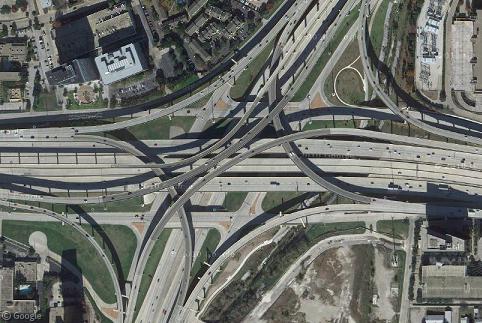

The idea that there's a trade-off between centres of high culture and highway interchanges is entirely absurd.