Fantastic read! Now why can't all technical and scientific journalism hold itself to this standard? Instead of making the prevailing assumption that your average reader has the I.Q. of a parsnip and the scientific literacy of a kindergartener ;)
Have always felt single-crystal foundaries could be a great driver for building low Earth orbit microgravity factories. There has been extensive research in the labs on ISS dedicated to making highly spherical ball bearings, long macromolecular protein crystals and extreme density refractory metal composites. But is anyone contemplating large scale commercial production? With the cost of delivery dropping, it seems like it might be a idea worth re-considering!
If you liked that documentary, you might love this older one, which features Stanley Hooker. It's amazing to get the perspective of the legendary engineer himself, and it goes much more in depth into the technical problems and business challenges.
Another favorite aviation-related one, though more pop-sci-oriented, is this look at a 747 going through a D ("heavy maintenance") check that basically takes most of the plane apart and puts it back together, covering all the bits and how they need to work:
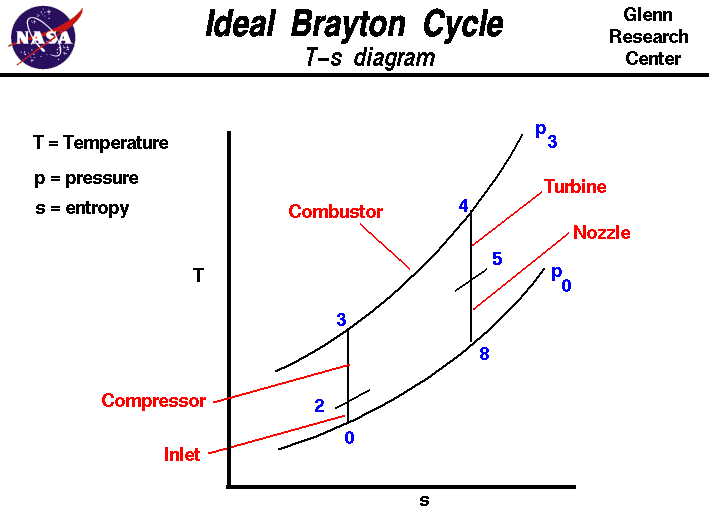
The blade in the first picture would sit in the high-pressure turbine, just behind the combustion chamber. Note that the flow path of a jet engine corresponds directly to the pressure-temperature transitions of the Brayton cycle, which governs the operation of gas turbines: https://www.grc.nasa.gov/www/k-12/airplane/Images/braytonts.....
Also note that difference in size between the XWB's fan in the second picture (of the article) and the turbine blade in the first picture. The XWB is a high-bypass-ratio turbofan, which means almost all the air taken in by the 3-meter-diameter fan bypasses the core of the engine, generating thrust at low exit velocity. Only about 1/10th the air goes through the core of the engine. There, it is compressed, so by the time you get to the HPT, the flow path is quite narrow. As the turbine section removes energy from the hot air, it cools and expands, and the flow path gets wider.
I'd like to note few things: single crystal is the best way to fight creep, but that's it. This is very specific problem with very specific solution. For most engineering problems you would prefer high fatigue strength or high ductility. Single crystal is poor for both.
Another thing is that single crystal metal is very distinct from amorphous metal. Neither has grain boundaries, but single crystal is very strictly ordered structure while amorphic is completely disorganized. As a result, single crystal tolerates high temperatures extremely well, while amorphic is worse than regular metals.
Both are distinct from powder metallurgy. Which in turn has very high amount of grain boundaries.
Interesting thing here is that in regular steel, the grains are single crystals while the boundaries are often amorphic. So in a way you have "composite" material. (It's not technically composite, because both substances have same elements in same proportions.)
Thanks for this. I'd think a metal would fracture very easily if there existed a well defined boundary inside, which is what a crystal is. Seems like a property you wouldn't want inside of a jet engine, but what do I know.
"Grain" refers to crystal that internally has that crystal structure, but externally has whatever shape it just happens to have. Grain and crystal are almost synonyms. Regular steel has grains inside, which then have atoms inside organized in crystalline way. In between the grains are "grain boundaries" which are not organized in any way. Different grains have different directions.
If a crack starts to grow through steel, it first needs to penetrate a crystal. It can go "easy" by following some plane that doesn't have any atoms laying on it. Then it needs to go through amorphic (=disordered) boundary region, but now the crack can't go easy. The next grain extremely is unlikely to have nice plane continuing right after the first one. In practice the crack will have to follow winding path and this long path will consume more energy than short one.
Here is image of steel grain structure. The white are grains, the black are amorphic boundary regions.
Practically making grain size smaller is one of the best ways to resist crack growth (=fatigue strength). Other possibilities is to have different sized atoms in the crystals, so there are no perfectly straight planes for the crack to grow. And it's also possible to several different crystal structures in different crystals. But also different structures inside single crystal.
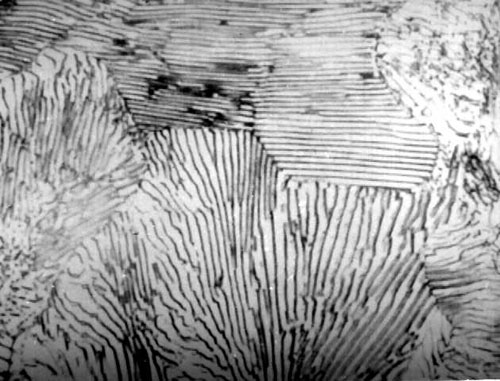
Here is "pearlite" microscopic image. The black stripes are one crystalline structure and the white ones are another. But they are well aligned and therefore don't require any disorganized boundary when they are side by side.
Sometimes you get bullshit like excessive boundary precipitation. Like in some stainless steels in certain heat treatments, the chromium relocates to the grain boundaries. This leaves the base metal chromium free and makes it soft. And also the grain boundary becomes lot more distinct entity. Now the crack can easily travel along the boundary layer, as the pure chromium boundary is not that well attached to the steel grains.
Also normal cast iron suffers from carbon flakes that are easy crack propagating mediums. Metals attach to metals nicely, but carbon is not metallic, so it's automatic weak spot. Broken cast iron can have almost black cracking surfaces. For this reason guys invented "nodular cast iron". The carbon makes little balls inside the iron, so it offers very little ways for cracks. It has almost as good mechanical properties as steel, but is lot easier to cast.
TL;DR Grain boundary is usually not distinct surface inside the material. It's just where one way to organize atoms shifts into another way to organize atoms. But it's still continuous solid.
Okay, it's all coming back to me now. I remember in one physics class we talked about magnetic grains. So this is the same thing.
When someone says "single-crystal", I think of a structure with zero boundary regions, a structure made up of one big grain. This is what was in the title of the article. Does that describe this turbine blade?
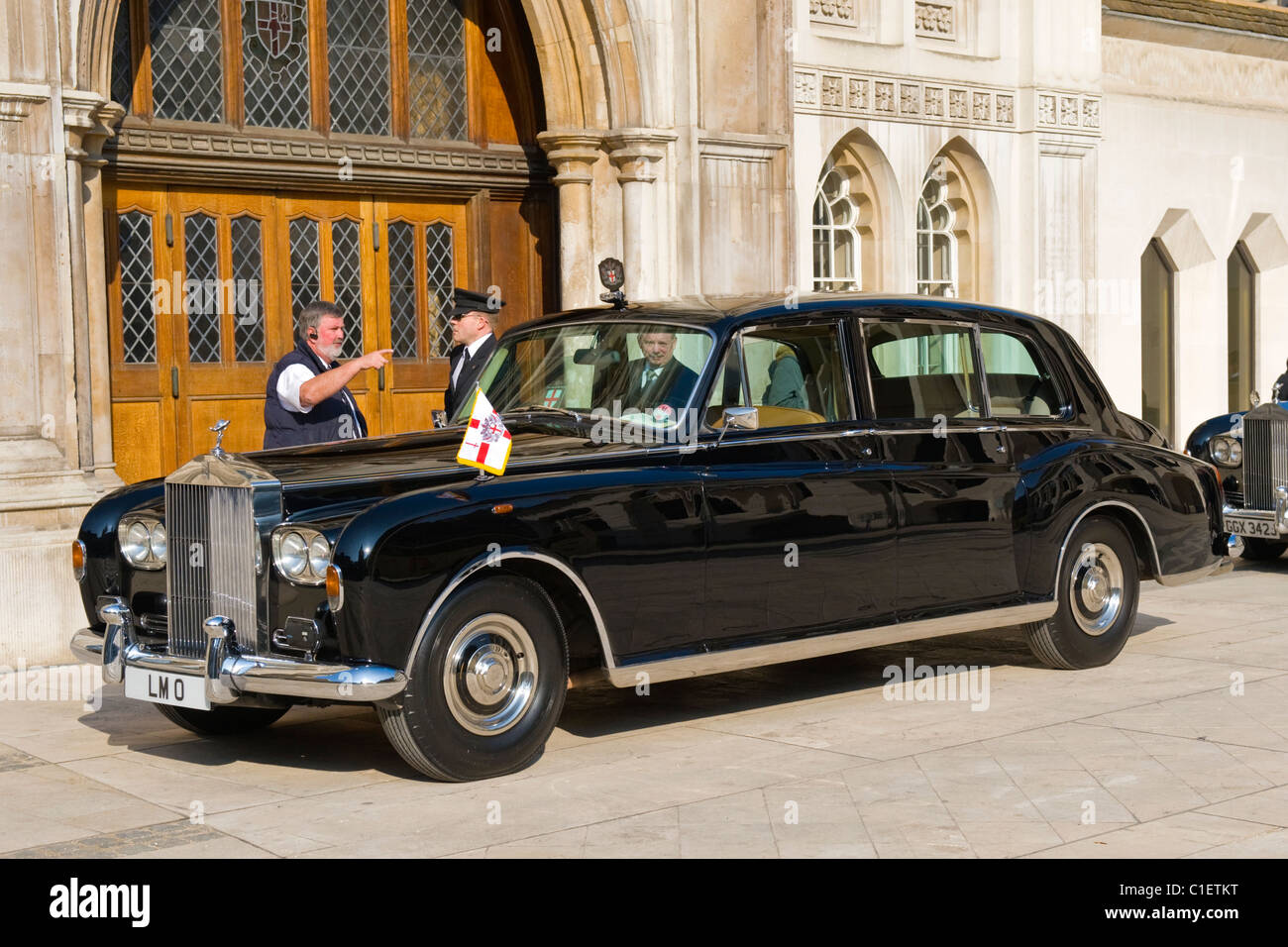
I had the chance recently to see the Mayor of the City of London's (the strange city-within-a-city bit of London) two Rolls Royce's they keep for formal occasions up close. They are super rare (only ~400 ever made), worth a whole lot of money and looked amazing.
I'm not a car person but you can't help but feel a shiver when you see a car like that. The engines where the same as the ones they used in the Spitfire fighter planes during WW2 (6.5 liter v8!), full white leather interior, a retractable partition between the passengers and the chauffeur.
I know this isn't strictly about the article but I thought I would share anyway. Rolls is one of the things that makes me proud to be British.
Ahh, shame, you're right. They where 27 litre as well! That would be a bit extreme. Seems someone was silly enough to put it in a car though: https://www.youtube.com/watch?v=u43pWEwI6xY
This guy, calling himself AgentJayZ, is a technician (not a designer) working on mostly older industrial and military jet engines, and he's showing a lot of the innards, and explaining a lot of the basics of operation of turbine engines. Also: Loads, and loads of footage of running engines in test-stands, which of course gets boring over time...
This was a super fun read, and it felt nice to take the time to carefully read it to understand the very complex processes it was describing.
That said, can someone explain how the pigtail accomplishes the following?:
> "The crystals grow in a straight line in the direction that the mould is being withdrawn, but because of the pigtail’s twisted shape, all but the fastest-growing crystals are eliminated."
By the principle of elimination by bottleneck. As the crystals grow into the pigtail, the lagging crystals hit the already-formed leading ones or the mold surface, leaving a primary, single crystal grain to exit the pigtail and grow across the blade proper. This would be almost impossible to happen without the pigtail because multiple crystal grains would grow in parallel across the blade.
Here's a technical explanation.[1] But here's an example of triggering crystal formation in a supersaturated solution.[2] Classic high school chemistry experiment. Dropping a solid crystal into the supersaturated solution causes the whole liquid to turn into a solid in seconds.
That's the basis of single-crystal casting. The solidification process relies on operating very close to the melting point of the material. The idea is to create an alloy mixture that's ready to crystallize, then starting the process by dropping in a crystal and letting the liquid crystallize in a very controlled way. The heated zone is moved through the liquid, as in zone refining (or the solid is pulled from the heated zone, or gas cooling is used) so that the crystal growth takes place in only a narrow layer.
This is decades old, and one of the reasons jet engines last a long time now.
One other surprising thing about turbofans is that the majority of their thrust is produced by the huge main fans (the blades which are visible as you stand and look at the front of the engine) simply dragging the aircraft through the air as with a turbo-prop (or boat prop). The ultra-high pressure compression and burning stage (being discussed here) produces only 30-45% of direct thrust but clearly powers the spinning of the large components.
My father-in-law started at RR as a graduate trainee and left 40+ years later as its' longest serving member of staff, CEO and Chairman. he took me on tours of these plants when I first met my wife which was an unbelievable treat.
My graduate research was on a corner of the class of ceramic materials that are used as coatings on top of this type of turbine blades. Anything specifically you would like to know?
Generally, single crystal blades are designed for their resistance to creep at high temperatures. If your predominate creep mechanism is sliding at grain boundaries in a polycrystalline material, you can impart creep resistance by removing the grain boundaries. A single crystal is the limiting case of this process.
3D printed parts, so far, are polycrystalline, and would be used in other places in an engine's hot stage.
What sorts of considerations are important for the ceramic coating? I'd assume that the coating is not under the same types of stress as the alloy core, and so thermal properties would be more important. Is that true, or is load as much of a factor there too?
I'm not deeply aware of the specifics of the mechanical loads near the surface due to rotation. Generally the mandates are to match CTE between the substrate and surface as much as feasible, and to insert a "bond" layer to help that match.
The dominant concerns I am aware of are low thermal conductivity, thermal stability, and lack of chemical attack in the environments in question.
Perhaps late to the thread, but turbine blades with internal cooling channels are one of the dream applications for metal additive manufacturing, though I'm not sure it may ever be realizable. If you could lower the operating temperature of the turbine blade in this way, you might be able to mitigate the risk of creep, which as sibling posters point out is the motivation for the use of single-crystal turbine blades and thermal barrier coatings.
There's a lot of buzz in the materials community around additive, but I think 3D-printed turbine blades are basically just a dream right now. People are still wrestling with getting consistent build quality for simple structural components...
I can see how 3D printing can be used for parts with complex shapes, as a replacement for powder sintering, but there is no way you can use it to cast a single crystal, neither for any part where you need to control texture.
Not to take away from the engineering marvel that these parts and process represent, but the timing of this article is interesting - seems PR related. I recently read about problems ANA faced with Rolls Royce engines, specifically the turbine blades failing. There have been at least 3 incidents of engine failure, flights have been cancelled an all 787 engines have to be retrofitted with new blades.
The article was published a year ago; I came across it because I got curious about single-crystal turbines after seeing them mentioned in the comments about the AN-225 story posted earlier today.
Earlier today a story about China buying the AN-225 was on the front page and lots of people were confused about why they needed to buy the full toolchain for manufacturing it, instead of just buying one plane and reverse-engineering how to build it.
Several people then pointed out the difficulty of manufacturing modern engine components, particularly the blades, and it was kind of inevitable an article about that would follow soon after.
Also, ANA's 787s are a bit of a weird case in that ANA puts far more cycles on those engines than a typical operator. Most 787 operators use them for long-haul flights, 8-12 hours airborne at a time and only one or two flights per 24-hour period. ANA, on the other hand, flies 787s on much shorter domestic routes, meaning more cycles of spin-up/shut-down. Given that ANA was the first operator and puts way more stress on the engine than anyone else, it's unsurprising that they would see accelerated wear.
Always clearly remember when I was studying for my commercial pilot licence many years ago. In one class, an engineer took us for a tour of an airline hangar. He stopped in front of an engine on a rig and explained that EACH blade on the intake fan stage cost something like $40,000. That was about 4 times the price of the car I drove to that class!
It's really incredible to imagine blazing hot combustion products, and these blades surviving in that environment for any length of time. Now I feel as though I have a bit of a better understanding of how that comes to pass.
> the Riace Bronzes of Greek warriors found in the sea off Sicily
Well, Riace is in Calabria, not in Sicily. If you want to insert a nice quote in your article, how difficult and time consuming can be to check on the internet it in 2016?
Well, without that mass market of holidaymakers we wouldn't be able to afford to use the technology for more highbrow purposes like attending scientific conferences.




Have always felt single-crystal foundaries could be a great driver for building low Earth orbit microgravity factories. There has been extensive research in the labs on ISS dedicated to making highly spherical ball bearings, long macromolecular protein crystals and extreme density refractory metal composites. But is anyone contemplating large scale commercial production? With the cost of delivery dropping, it seems like it might be a idea worth re-considering!