I'm in HPC now, and the thing I'm interested in is RIKEN's post-K supercomputer (http://www.aics.riken.jp/fs2020p/en/). Fujitsu is building it, and they're going to be producing the CPUs that will be going into post-K, just as they did for K. But, where the K supercomputer used SPARC, this new one is going to use ARM (https://www.top500.org/news/fujitsu-switches-horses-for-post...). Also, Fujitsu are working with ARM to develop HPC-specific architecture extensions to the ARMv8 spec.
Plus, as Applied Micro has been acquired by MACOM, I wonder how that's going to settle out.
So, I'm waiting to see what Fujitsu comes up with. The Post-K supercomputer will be a very good proving ground.
Thanks for the interesting links! But why the mixed feelings? Do you think vendors should hold off on selling a product that makes them money now to see what comes out of a single, highly specific project in five years?
The only advantage I see here is memory capacity. Well in the x86 landscape we have AMD giving you access of 1TB for less dollar then Intel. And if you include the COST of 1TB memory, the CPU dollar saving from a CPU is negligible. Not to mention the additional work that needs to port software to ARM.
I still dont see ARM going anywhere in server or workstation ( In the near future ).
8 DDR channels. Seems like everyone putting 30+ cores on a chip needs to learn this lesson. Memory bandwidth is the bottleneck. Intel uses HBM stacked on the Xeon Phi. Anyone who has the capability should do likewise or maybe try 8 DDR channels, pin count be damned.
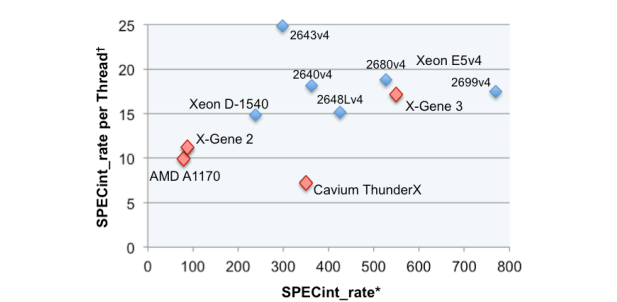
This looks pretty decent in terms of hitting close to the Xeon 2680v4. But every server ARM play so far has been unobtanium until it's grossly out of date.
I might be excessively cynical, but I suspect that most of these ARM server plays are narrowly targeted at the biggest cloud/advertising companies (Facebook, Amazon, Google, etc.), with the publicity being meant more for investors than potential customers. I remember seeing some server architecture (Cavium ThunderX, maybe?) specifically being advertised as good for social media analytics. Are there more than 10 companies in the world that actually buy their own hardware specifically for that?
There was a pretty bad article about chip making posted a few weeks ago. The one great point it made was that the nm was not comparable across manufacturers. So, I guess my question is how big of a deal is this?
I did a bunch of testing with ARM (ThunderX) for an IPC workload using this codebase: github.com/sargun/wat. Unfortunately, it no longer runs on ARM, because I'm using inline assembly.
The ThunderX's power comes from the fact it's a 48-core CPU, which is awesome for web workloads. The problem comes in that inter-core transfer is ridiculously slow. To make a 64-byte RPC (return / response), was in the area of ~1100 nanoseconds, whereas x86-64 was on the order of 500 nanoseconds on a 2 generation old CPU. Testing on a more modern CPU cut the time further.
I'd love to see ARM either catch-up in single-core performance, or multi-core performance, but until then I don't feel like it's viable.
According to the article this CPU as compared to the ThunderX has 80% faster integer performance for the whole CPU and 2x faster integer performance per core - so major a improvement:
Interesting! Cavium's network processors running bare-metal have features to ensure no core is ever idle. Maybe at the expense of latency. The idea probably doesn't translate to running a bunch of virtual servers. You probably do better with a shared-memory abstraction than a network. Or, disappointing numbers may just reflect the fact that individual cores are slow. Bad news either way.
When I went to the site, I got a fairly insidious takeover ad: The ad took over the whole page, displaying a 10-second countdown timer and a "Click Here to go to site" link. The "Click Here…" link triggered another pop-up ad (it never took me to the site), and when the timer expired, nothing happened. The URL bar had been changed, so reloading wouldn't help, and the back button took me to a blank screen.
Anandtech has been a mainstay for professional hardware reviews and opinions for more than a decade... I actually just made a HN account to tell you that you might want to check your browser for malware because I've never seen anything like that on there.
Never seen anything like that. Ads, sure, but nothing that obnoxious. I suspect any ad network has the occasional mistake, but generally anandtech is pretty good.


I'm in HPC now, and the thing I'm interested in is RIKEN's post-K supercomputer (http://www.aics.riken.jp/fs2020p/en/). Fujitsu is building it, and they're going to be producing the CPUs that will be going into post-K, just as they did for K. But, where the K supercomputer used SPARC, this new one is going to use ARM (https://www.top500.org/news/fujitsu-switches-horses-for-post...). Also, Fujitsu are working with ARM to develop HPC-specific architecture extensions to the ARMv8 spec.
Plus, as Applied Micro has been acquired by MACOM, I wonder how that's going to settle out.
So, I'm waiting to see what Fujitsu comes up with. The Post-K supercomputer will be a very good proving ground.