Perhaps I am biased because although my English is quite decent it isn't my native tongue.
I'm not sure if we're discussing the same thing here. I am talking about learning.
Yes, there's also a lot of people who believe speed reading allows them to read quicker. Sure, it might seem that way, but does the information stick? Do you think anecdotal evidence to test if information was learned counts as evidence?
Dr. Barbara Oakley and Dr. Terrence Sejnowski didn't mention your proposed learning method in their Learning How to Learn course [1]. They also debunked speed reading in that course. If your proposed learning method works well, they should incorporate it in their course. However, it seems to go against the principles of chunking and overlearning.
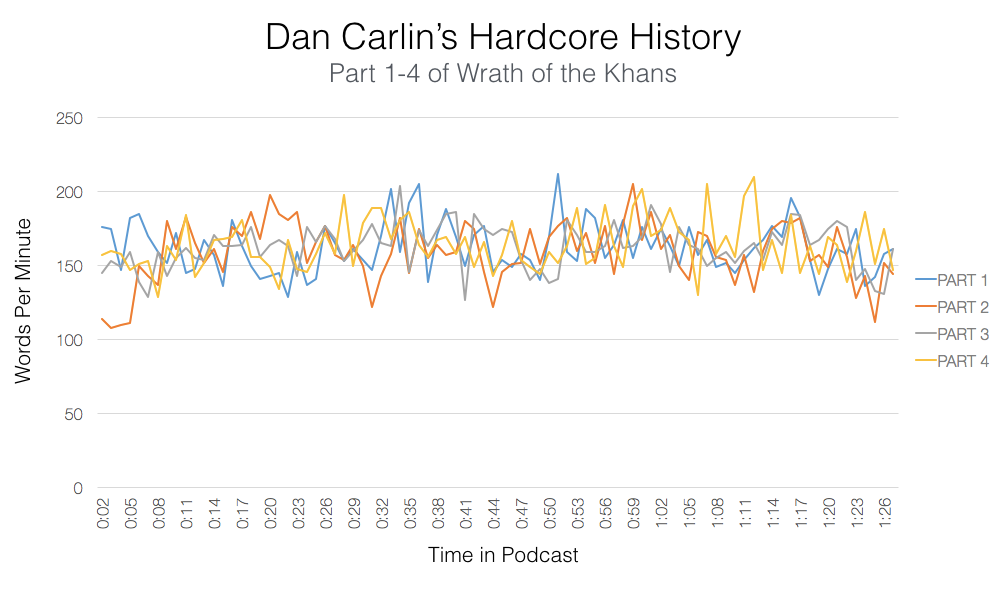
I can't find a definitive source, but the average adult reading speed seems to be around 300 wpm. Popular podcast Hardcore History hovers around ~175 wpm (https://cdn-images-1.medium.com/max/2000/1*_PUpCqAQyCQ-Whf02...), so you'd need to almost double the speed to reach a normal reading pace. So I don't think arguments against speed reading really apply to this.
Of course it all depends on the host. If you find a podcast where the host is already reading at 250 wpm, you'll probably have a hard time catching everything at 2x speed.
Maybe they're catered to the lowest common denominator (the elder).
I've been thinking a bit more about it and I don't remember audio-speedreading being mentioned in the Learning How To Learn course (which I followed, and I hold both teachers in high regard). I think I am biased from the text-speedreading shenanigans.
> Of course it all depends on the host.
Point taken.
My theory is it also depends on the reader. As I grow older, I find it is more difficult to follow things. Sure, my vocabulary still slightly increases but I also think things through more, am more experienced, and eventually I'll end up with Alzheimer's. Hence my suggestion it is catered to the elder. Certainly not for HFAs. (I used to talk very quick as well as child. It was annoying as fuck to everyone, not in the least my parents.)
Reading is not listening though, i'd imagine there's differences in how our brain parses them. This is a very interesting, but exceedingly complex issue.


I'm not sure if we're discussing the same thing here. I am talking about learning.
Yes, there's also a lot of people who believe speed reading allows them to read quicker. Sure, it might seem that way, but does the information stick? Do you think anecdotal evidence to test if information was learned counts as evidence?
Dr. Barbara Oakley and Dr. Terrence Sejnowski didn't mention your proposed learning method in their Learning How to Learn course [1]. They also debunked speed reading in that course. If your proposed learning method works well, they should incorporate it in their course. However, it seems to go against the principles of chunking and overlearning.
[1] https://www.coursera.org/learn/learning-how-to-learn