My first computer was a Heathkit H89 that my dad assembled about 1980. It had a keyboard microcontroller (I don't remember, maybe an 8048), but it also had hardware debounce: the keyswitches snapped together a solid copper electrode, on one side, and four copper "fingers" on the other. The idea (as he explained to me) was that the fingers would bounce out-of-sync with one another (although they looked pretty identical, maybe there was a subtle difference I couldn't see) and there wouldn't be any time when all four of them were out of contact at once.
That's really interesting. Although it may not be the so much the out-of-sync bouncing but the flexibility of those fingers absorbing the shock. It would be interesting to see one of those in action with a high speed camera.
And all of that to keep from bouncing switches, which we do in software now in a keyboard controller.
It occurs to me that we have the 6502 -> monster 6502 -> 'tube' 6502? Then we could have 705 -> transistor 705 -> FPGA version? Sort of like playing Mozart in different styles.
But I really liked the giant programmer console for the machine. Not sure why but that sort of design ethos calls to me some how.
The IBM 705 came in a bigger version, the IBM 709, and there was a transistorized version, the IBM 7090. The IBM 7090/7094 powered much of the US space program of the 1960s and 1970s, and some of those machines were used into the 1980s.
Those big control panels were mostly for maintenance use. UNIVAC separated the operator and maintenance panels on their transistorized machines, and in normal operation, nobody was near the maintenance panel. IBM kept a lot of lights, buttons, and knobs facing the operators well into the System/370 era. By that time you could debug the OS inside a VM, so all those manual controls were unused, but it took IBM a long time to get rid of them.
So true, because no doubt somewhere there was an engineer inside IBM that liked the blinking lights :-). One summer when I was working for IBM in high school I got to work at the 'operators console' for a System 370. Pretty much everything you did happened on a light pen enabled 3270 terminal, except the IMPL (initial microprogram load) button was still a real switch, and the 'load meters' which were pretty neat analog meters that read out system load were useful for tuning the batch queue that was filling in batch jobs when ever the meters showed less than 50% utilization. When it got over 95% the operator was supposed to pause one or more batch jobs. At the time, IBM felt there was no way the computer could know which batch jobs were "important" and which could be pushed off.
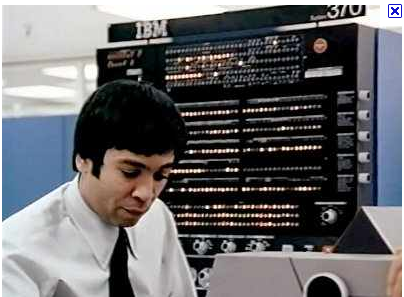
The most striking difference to me as an operator was that the Series 370 console was more than just the terminal/screen. You had switches and lights right out of a sci-fi movie, right down to rotary dials to set the address of the boot device.
With its successor, the 303x, the console was a glorified terminal. (My favorite command there was quiesce[0], where you could bring activity to an orderly freeze without ruining programs in process. I half-expected to hear it sing "Daisy, Daisy" in slowing decrescendo.)
I've done some image searches (to no avail) hoping to find images showing the distinctive built-in screen and keyboard.
The screen displayed characters using a "font" that I've never seen elsewhere, more resembling characters a human would handprint than a modern fixed font. I was hoping to find images of that. I did at least find a partial image[0] of a S/370 console with the light arrays that triggered my sci-fi comparison above.
> an engineer inside IBM that liked the blinking lights :-)
I can relate. I bought my first personal computer shortly after the IBM PC came out - but I did not get a PC. It had no lights or switches! How could I debug my code?
Instead I got an Ithaca Intersystems DPS-1 S-100 system because it had all the lights and switches.
Not one of my wisest technology decisions! But a few months later a friend bought a PC and an Apple II, decided there wasn't enough software for the PC, and gave it to me figuring I would write some kind of software on it.
I wouldn't call the IBM 709 a bigger version of the 705. The scientific machines (701/704/709) and the business machines (702/705) are really entirely different systems: completely different architecture, console, word size, instruction set, physical construction, and even basic internal circuitry and voltages. You're better off thinking of them as unrelated systems that marketing tried to turn into a coherent product line (see also Intel 4004 and 8008).
At one place i worked awe had a brand new state of the art supermini from PR!ME. Oneday we had a film crew turn up but they filmed our old PDP/1140 as it had lots of blinking LED's
The 705 wasn't related to the 709->7090/7094 at all, being a variable length word machine. The 702 and 705 are close relatives with the 7080 their transistorized descendant. The 709's predecessor was the 704.
An FPGA 705 would be much, much easier than a tube 6502 (which would be kind of crazy). I know of FPGA versions of the IBM 1130 and 360, so putting old computers on FPGA is possible. An FPGA 705 would be even easier since it is a fairly simple machine. A TTL version would also be an interesting project.
It's interesting how supposedly identical tube models look rather different. Part of that is the getter depositing metal onto the top of the tube, and part of that is probably that some tubes with the same number could come in slightly different packages: different plate colors/sizes, different glass size, etc. So while it looks like the Trigger 1 and CF1/2 tubes have been swapped around they're probably correct. It's a bit like having parts in both TO-92 and TO-18 packages, for the same part.
The metal deposition inside the tubes is to get rid of the last of the Oxygen. A bunch of Barium powder and an igniter would be placed in a small cup like construction inside the tube during manufacturing called a 'getter', firing the getter would vaporize the Barium which would then attach to the remaining Oxygen molecules and subsequently deposit on the inside of the glass, the largest and coolest surface.
Yes, I was convinced at first that the tubes were shuffled around. But after carefully checking the model numbers I found they were correct.
On the other hand, I studied a different tube module that had random tubes plugged into it. This caused me great confusion when trying to figure out how it worked. I assume someone had been using the tube module as a desk decoration, broke the old tubes, and plugged in random new tubes.
One of my first TVs had vacuum tubes. When it failed, you took he tubes out and tested them at a drug store or radio shack for a failure. You could also take it to a repair store or call a rech to come. Very few vacuum tube tvs were easily portable.
Whenever I repair a old device, I cringe when I put the cover back on. I always say to myself, I'm going to encase the old radio, or vibrograph (watch timing machine) in clear plastic, but I'm always just too lazy.