The Mona Lisa is the leader product for the Louvre, which is, btw, a public entity whose goal is to educate. Bring the tourists for the Mona Lisa (also very well known to a smaller extent are the David, the Venus of Milo and Samothrace Victory) and then they still are in one of the largest museum of the world, with many things to discover.
When I brought in my teenager niece, 16, she did not know what to expect, but WANTED to see the Mona Lisa, despite my warnings it was really underwhelming, but she wanted her selfie.
And then she marveled for the rest of the day in the middle of the antiquities and learned about civilization she had not even heard the name before.
Many years ago, my partner and I took our 7 year old daughter to the Louvre as we were in Paris anyway. Expecting her to get bored we planned on a couple of hours inside in the morning, and then move on to somewhere else...
8 hours later, and one unexpected lunch in the Louvre's restaurant, we literally had to drag her out, as despite having seen so much of the museum, she still wanted to see more. Even to this day she remembers it very fondly. We did see the Mona Lisa. It's surprising how small it actually is in person. Luckily we weren't there during peak tourist season so it wasn't the chaos that the pictures in the article depict.
My daughter went on to develop a deep love of history, and has just graduated from a top tier UK university with a Honours degree in Ancient History. Her love of museums never abated either.
If you have kids, take them to museums - it will always pay off.
I think VR tech can have this profound effect in history knowledge. Assassin's creed games seem to have already interested thousands of people in its historical settings.
Age of empires (original and rise of Rome) grew a deep interest in ancient cultures, particular the non-Roman empires. I played the game primarily for the competitive multiplayer. But the ancient cultures and way of life (and war) inspired the imagination. I still find ancient history the most interesting period.
There is a French startup called Opuscope (Minsar) which is producing AR & VR experience with various museum. I don't know how they're advancing because the founder don't speak to me anymore but the company seems doing well.
I think it's reasonable to create a separate room for the mona lisa and establish a digital queue system where people sign up for a specific period of time to visit the Mona Lisa. That would solve all of the author's issues and still give you all the benefits your niece gained.
Similar issues exist for major paintings across the world. Not a big problem to spend too much collective brain power on though.
Three of them, in fact. The original in Galleria della Accademia; the (marble? plaster?) copy in front of Palazzo Vecchio in Piazza della Signoria; and the (bronze?) copy in Piazzale Michelangelo.
I learned this the hard way when I was going to meet a friend there. Neither of us were locals, so we wanted to choose an unambiguous place to meet. What could be more iconic than "let's meet by the David"? Hilarity ensued.
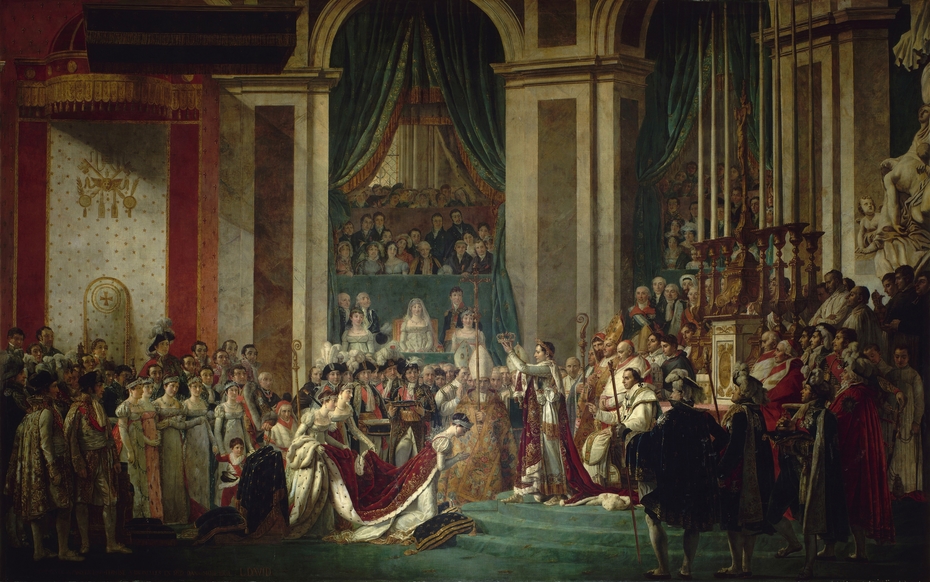
Pretty sure he did mean the statue given the context. Jacques-Louis David is a well-known French painter and there are works of his in the Louvre. (Some of which are monumental in size; I forget what all by him is in the Louvre.) But the average Louvre visitor probably has never heard of him--especially if they aren't French--and I doubt he's a big draw in general.
But I'm at an age and temperament, where I no longer want to idolize the rich and powerful. Its just a shame that such talent went to aggrandize rich white folk with life-and-death power over millions, because of an accident of birth.
Also, that painting you linked to as being "powerful" was painted by William-Adolphe Bouguereau. He painted in the style of Italian Renaissance painters, though he's French and lived in the mid-1800's. I guess that's cultural appropriation. He also married one of his students, which of course is a big no-no nowadays, since he was a man in power over her. Looks like you can't like this painting any more now.
You see how dumb it is to apply 2019 political correctness to past history?
Napoleon Bonaparte wasn't emperor by accident of birth. He was emperor because he was the most brilliant general of his era, perhaps in all of history, as well as a clever politician and an extremely charismatic person, and he lived in a rare moment in history when someone could rise to the top from nothing.
And what's the point of pointing out that he was white? Almost everyone in France was back then. You're projecting modern American politics back into an era in history that was very different. As a Corsican, Napoleon actually had to deal with a fair bit of prejudice.
"Nothing" is precisely that: a social non-entity. A member of a minor nobility family, regardless of their financial situation, belongs to a distinct social class, with attendant benefits such as social contacts, etc.
How did the nothing son of a poor man end up in Royal Academy? Who were his classmates? What social class did his classmates belong to?
"Thanks to documents proving his family's nobility, Charles Bonaparte was able to send his son Napoleon Bonaparte to one of the twelve military schools created by Louis XVI, reserved for young nobles."
Do obvious (and universal) social matters such as this really require debate?
> A member of a minor nobility family, regardless of their financial situation, belongs to a distinct social class
Not one which would ever have been able to rise very high under the ancien régime. Minor, impoverished nobility from Corsica (then a backwater in France) were not in line for the throne. As a Corsican, he was barely even considered French (and spoke the language poorly when he was young). The fact that someone from such a lowly social station would be able to rise to be the head of state was astonishing. It would have been completely impossible, of course, without the Revolution, and for someone without great ability.
Napoleon wasn't a peasant, but he wasn't anywhere near the ruling social class - which is what the GP implied when they said they weren't interested in "white folk with life-and-death power over millions, because of an accident of birth." Although, in one sense, I could grant that Napoleon did come to power due to accident of birth - the accident of being born shortly before the Revolution, and perfectly the right age to rise through the ranks of the military during the Revolution, and then take power just as the Directorate was becoming unpopular. If he had been born 10 years earlier or later, that would have been impossible. But nevertheless, without also being possibly the greatest general in history and extremely charismatic, he wouldn't have come to power.
He was, imo clearly, a very capable and intelligent man.
But sans his education, exposure to an exclusive social tier, and thus his subsequent study at École Militaire, and finally being commissioned as an officer, he would not have had the opportunity to shine.
So the point is, if he were indeed a "nothing", regardless of his substantial qualities, you and I would not be discussing him couple hundred years later on hacker news.
> what the GP implied
I am very clearly focused on the notion of "nothing". Per my reading of history, almost all of the major spiritual and secular figures in history, regardless of period or locale, belonged to (or were closely attached) to the upper classes.
> I am very clearly focused on the notion of "nothing".
You're taking "nothing" very literally. My point was that he was not born into the crown, and that based on his birth, he could never have hoped to wield much of any political power, had it not been for the Revolution.
> an exclusive social tier
It wasn't nearly as exclusive as you're making it out to be. There were hundreds of thousands of people with higher social rank than Napoleon.
> his subsequent study at École Militaire, and finally being commissioned as an officer, he would not have had the opportunity to shine
That's probably true, but not because studying at the military academy at Brienne was anything particularly prestigious. It's because the Republic was in desperate need of competent officers and under extreme military pressure, so people from fairly low social stations and with little military training were being put in command of significant forces. Lots of people from outside the ruling class rose to high stations during this time. Napoleon was simply the most extreme example, because of the seeming military miracles he pulled off and a great deal of political shrewdness.
What you're arguing is a bit like saying that Albert Einstein was just lucky to be born to a family that could afford tutors. But being born to decent circumstances were just the beginning, and the vast majority of people born to those circumstances go nowhere near as far as Einstein did. Napoleon wouldn't have been who he was had he been born a serf. But he was also probably the greatest military mind in history, and without that we wouldn't be talking about him here.
> almost all of the major spiritual and secular figures in history, regardless of period or locale, belonged to (or were closely attached) to the upper classes.
I don't think that's true at all of the era we're discussing. The people who rose to prominence in France during the Revolution tended to be decidedly middle-class: lawyers, penniless minor nobility, journalists, army engineers, minor clergy, and so on.
Please don't post in the flamewar style to HN. This comment breaks many of the site guidelines. Would you please read https://news.ycombinator.com/newsguidelines.html and stick to the rules when commenting here?
Yes its a pretty picture, I get it, I know what its about.
Rich folk like them, of course, deserve worship because of what they are (better than everybody else).
So what? The accident that some folk got to run roughshod over everybody else is quite an un-American viewpoint (we abolished the monarchy here). I understand if others still ascribe to these antique notions. I just have decided, after decades of being drenched in rich-and-powerful hero-worship in media and art, that I would opt out.
Keep all the superior feelings to yourself, thank you. I have none. Kind of my whole point.
I get your feeling, but that's a mistake to placate it on that painting. Napoleon probably abolished more monarchies than anyone else in Europe.
The moment it captures is when Napoleon (who took power, he was not born into it) broke the supremacy of the church over European leaders. A definite moment for secularism.
It does mimic the crowning ceremony of kings, but it actually breaks the supremacy of the church.
Whitewashing Napoleon, another power-hungry European absolute dictator who killed thousands, is disingenuous. He took the thrones of those he deposed. Not a hero.
So do you just close your eyes and ears and pretend history never happened, since history is mostly about rich and powerful people? Is looking at history through the "woke" sunglasses of 2019 even enjoyable? You pass judgement on an artist who painted an event 200+ years ago using 2019's latest politically correct talking points.
Only the trolls are judging. I'm just now select people of the time to study, and admire art about them. I quit obsessing over the rich and powerful.
All this angst over what I choose to admire and study is curious. A powerful emotion was triggered by my decision, I can see that. It says more about the trolls than about me, for sure.
Your comment may not have been intentionally trolling but its content was trollish and provoked predictable effects. Please don't post like that to HN, or like these follow-ups, which just keep the flamewar going.


When I brought in my teenager niece, 16, she did not know what to expect, but WANTED to see the Mona Lisa, despite my warnings it was really underwhelming, but she wanted her selfie.
And then she marveled for the rest of the day in the middle of the antiquities and learned about civilization she had not even heard the name before.