All: since people feel passionately about this, if you comment in this thread please make sure you're doing so thoughtfully and following the guidelines. Avoid flamebait, don't fuel flamewar, and definitely don't do personal attacks.
(I'm not speaking for any of my current or past employers, just for myself, and how I've seen this play out. One employer being a telescope impacted by Starlink, and the other being SpaceX, I want both sides to succeed.)
First, astronomers know that satellites can disrupt observations. They've known for a while, and have had to deal with things like flares from Irridium satellites, which were probably when these problems were first taken seriously. (It was a design defect where shiny panels would reflect the sun in a very efficient way).
Astronomers use all sorts of image processing, because satellites aren't the only noise in the picture. The CCDs have to be kept cryogenically cool, and there's all sorts of electrical noise as well. There's not a lot of photons being collected in the grand scheme of things, so dealing with the noise floor is a real problem. There are all sorts of ways for removing tracks. And don't forget weather!
Now, that being said, even I was confused why this would cause a problem. The satellites are in low earth orbit, so low that they won't be able to reflect the sunlight, since they are in earth's shadow. Only during twilight and dawn will satellites be in the right position to reflect the sunlight back to the ground off of some panel.
Now, these are not prime observing hours for many people, since it is still not as dark as it could be. So most people point into the darkest parts of the sky (up) rather than at parts where there is still twilight (like nearer the horizon).
But for some types of observations, like near earth asteroids, you want to point into the evening sky to look for them, since that is one of the places you want to look, and the sky conditions should be good enough. In these pictures you'll get streaks of light as the satellites pass through.
Even if there is no light reflecting, these satellites could occlude a distant star or galaxy momentarily. You wouldn't see a streak as much as the light would go away and come back. This would affect how bright you see the star, since over the time of the exposure (let's say 30 seconds) you'll collect less light while something is blocking the light. This can also make it a bit more tricky to look at variable stars, where the light gets stronger and dimmer naturally.
I would say that astronomers definitely knew about these problems, since they have to deal with all sorts of similar problems, but the pitch didn't get fevered until people saw the first set of Starlink satellites and just how bright they were. SpaceX moves a lot faster than astronomy.
As for SpaceX not thinking about the astronomical implications of Starlink, I could believe that. I think most of them were more concerned with if it is possible rather than the implications of doing it. As much as I would think the two fields would know more about each other, I find they are very different and run in different circles it seems (launch vehicle industry vs astronomers), so I could easily see not much cross pollination between the two. For example, there were lots of NASA astronauts and air force people visiting SpaceX, but I don't remember one astronomer (not that I met everyone).
This sounds to me like a new technology and a way of operating has come and we're trying to make it accommodate the old way of doing things.
If we really have a way to launch thousands of satellites easily, can't we replace the terrestrial functionality with that? Let's launch hundreds of satellites observing near earth asteroids.
If a private company can do it, governments definitely can
So while it sounds good that we've fixed the launch industry and can launch everything cheaper, that we should only have space based telescopes, space telescopes are a very different game from ground based telescopes.
First, as others have pointed out, is size. Ground based mirrors are very large, in the 10s of meters, and those mirrors are extremely heavy, like tons. You can't lift one of those mirrors up on one rocket, so you'll have to figure out some kind of in orbit construction. Not impossible, but we haven't assembled a lot of things in space, probably the biggest would be the ISS. But telescopes have tricky tolerances...
Which leads me to the next issue: not only is it heavy, but telescopes are fragile. They have to be very carefully calibrated and put together. Launching something into space tends to be a very bumpy ride, and making something that can withstand that kind of vibration for launch, and then the thermal problems while in space would be certainly not trivial.
But let's say you could build something and get it to work in orbit. Then it's still hard to service. Servicing the hubble to fix the optics was a very hard mission, and the hubble is relatively close to the earth. And that was when we had the shuttle, which we don't now.
Cooling is very tricky for both telescopes and space. Since there's no air to radiate to, you can get big thermal gradients over the length of your craft and you have to be very careful how you point it. Same for the optics and the camera, you want to make sure they have as little thermal gradient as possible.
Unlike a lot of commercial satellites, many scientific probes and telescopes are constantly refitted and reused. Ground based telescopes frequently reuse the same expensive (typically one-off) mirrors and put better cameras on them all the time. This is pretty hard to do in space.
That being said, being in space does have a lot of advantages, the most obvious one being a lack of atmosphere to mess with your observations. But assembling large telescopes in space still isn't exactly easy.
I think over time though, we will be heading to more space based telescopes as the cost comes down. But many slower moving telescope projects (mostly slow due to government funding) were started before Starlink was even announced.
The large telescope mirrors aren’t single parts even in terrestrial telescopes. We have to assemble and calibrate them on their isolated mountaintops, starting with the giant support structures intended for suspending the mirrors against the pull of gravity with minimum distortion regardless of orientation of the telescope.
We then add active optics to compensate for atmospheric distortion, alter airline routes and city lighting to help improve conditions, and then pray for no clouds on the nights we want to observe.
Constructing telescopes in space will become a reality within the next decade, while terrestrial telescopes currently in planning will be finding it harder and harder to navigate the mixture of light pollution, accessibility and indigenous rights. I expect there are terrestrial telescopes already in planning and even at early stages of construction which will never be finished. Between the ever-growing forest of red tape and the ever shrinking cost of building space telescopes in orbit, there will be an inflexion point where it makes sense to dedicate the remaining budget of a terrestrial telescope project to building its spaceborne replacement.
> Ground based mirrors are very large, in the 10s of meters, and those mirrors are extremely heavy, like tons.
Seemingly fantastically - SpaceX is currently constructing a system designed to launch 100 tons to LEO, for as low as $35/kg [1]. Musk says this capability is what the Starlink business is to pay for. It appears lately, more realistic than it has sounded.
One of the things I'm most excited about related to Starship is its landed mass capability for science purposes. Imagine being able to build radio and optical telescopes in the Daedalus crater on the central lunar far side. They'd be shielded from the optical and radio noise of the sun for 2 weeks out of 4, and permanently shielded from Earth. Or imagine infrared telescopes at the bottom of permanently shadowed polar craters, where ambient temperatures are even colder than in interplanetary space. No need to design and deploy a complex sunshield and worry about maintaining spacecraft orientation. The science potential of reusable heavy-lift rockets can't be understated.
Terrestrial telescopes are huge. Hubble is comparatively tiny, and launching a telescope the same size as the ones we use down here would be completely out of the question with any near-term launch capability.
Well let's figure out a way to assemble them in space.
Hubble is thirty years old, and is being used now as a reference. I don't understand all this negativity. Had we had this mindset, Hubble would not have been there
Part of the negativity is who benefits from the problem versus who has to pay to fix it. If SpaceX were causing a problem for astronomers while also for free launching radically better space-based tools, it wouldn't be nearly as big a deal. But instead SpaceX hopes to pocket a lot of money, while the harms are falling on other people.
and SpaceX customers hope to pocket a lot of use for that money. So taking that point literally - tiny astronomer's society is against the whole Earth load of Spacelink customers, and of course those customers' needs on average trump astronomers' ones.
You're also confusing money with value. If we only go by market price, air pollution should be fine, since lots more people buy electrical power than die from coal plant particulates. But market price only captures a relatively narrow slice of value, and it's heavily biased in favor of people with money.
True but to their credit SpaceX's launch prices are substantially lower than pre-existing options and they have been a leader in a step change in competitive launch options coming to market.
Hubble's mirror is 8 feet in diameter, and you aren't going to be assembling something as high precision as that in space, at least not from a few components. If we had the manufacturing capability to make it from scratch in space, maybe, but that's a much larger enterprise.
There is a question of whether 100 a foot diameter telescopes can work as well or better than one 8 foot one. Or 500. If it's about photons hitting the lens, do enough lenses in an area and post-processing make up for the fact that they aren't connected?
Well let's make the manufacturing capability to do so. It's as if the "manufacturing capability" is some limited rare earth metal. What is the actual limited resource other that ingenuity and engineering?
That's a good point. SpaceX could be the key to launching a horde of new Hubbles. However that's not so likely in the short run because everything is going towards the JWST.
JWST is a great project and a type of project we should strive for. I'm personally just annoyed why the conversation is so defensive and negative.
I don't know much about astronomy, but from what I understand the Earth's atmosphere is hard to deal with, why aren't we talking more about what can be done with this new tech, and not how it makes current things more difficult
Earth's atmosphere is annoying, yes, but for huge swathes of observational science it's not a deal-breaker. Not having massive telescopes on the ground where you can fiddle with your instrumentation and take advantage of apertures and construction techniques simply not possible in space _is_ a deal-breaker.
The required precision for construction of telescopes is incredible, and doesn't translate to space well, especially once you start talking about apertures that even folded won't fit into even the largest Starship SpaceX is proposing.
Ground-based astronomy is here to stay and with good reason. SpaceX needs to avoid or minimise the harms to these users of the night sky.
There is another aspect of harm, too - the casual observer. The night sky is a precious resource and shared by all. Introducing huge constellations which in many parts of the world will be visible year-round (and in some quite heavily populated areas like northern Europe, even through the night at some times of year) is like building a huge mobile phone mast outside someone's window and expecting them not to complain, but on a much larger scale.
Light pollution is a huge issue, and satellites can pollute just as well (if not more effectively) than ground based sources - it needs to be an ecological consideration of any launch.
I live in a very large city in Europe. I think the number of stars you can see is less than 20. Ground based pollution is horrible, I don't know how you can compare those two.
... it's named Observatory Hill, in the middle of Cambridge Massachusetts, quite near to downtown Boston, because it has an observatory that used to work great before light pollution.
> Not having massive telescopes on the ground where you can fiddle with your instrumentation and take advantage of apertures and construction techniques simply not possible in space _is_ a deal-breaker.
Why do you think telescopes in space - where they don't need to fight gravity just to stand - can't soon, with reasonable development, surpass land-based ones in capabilities?
As an expert would you be able to comment on my speculation:
It seems like this whole hullabaloo is because a SpaceX launch happened to coincide with a rare event at an inopportune time:. The alpha monocerotids have a narrow band with a long recurrence time (2h window, with a peak recurrence on the order of 10 years). Moreover, some monocerotid observers are in parts of the world where they will appear near Dawn or dusk, so yes some of the starlinks will flash (as you mentioned). In general, the SpaceX launches will only cluster in that fashion a few days after launch as they haven't disperesed into final formation yet. Any other time this wouldn't be a problem.
“No one thought of this,” she said. “We didn’t think of it. The astronomy community didn’t think of it.”
I really have trouble believing that nobody mentioned adding thousands of satellites would go unnoticed. It is damn near impossible to take any image of the night sky without having a satellite streak through the frame. I have plenty of images with multiple satellites visible at the same time. In wide angle timelapse sequences, they are just small dots that move against the natural movement of the stars. In longer lenses/telescopes, they appear as long straight lines totally ruining the image.
The first time I heard about thousands more of lower altitude satellites, my first thought was about this very thing. We had already had the discussions from the giant disco ball that was launched. It was planned to be short lived, but it caused quite the stir. Saying people at SpaceX didn't think about it is one thing, but to claim nobody in the astronomy community didn't is hard to take. Maybe they didn't have any way to voice those thoughts in a way that SpaceX could hear.
> From Table 1 it is clear that since 1985 the annual mean number of trails has risen from 2.5 to 2.9 in a 60
minute exposure, an increase of 16%; the number of spacecraft on orbit has increased by 39% in the same
period. Since the trail rate data comes from a set of plates not selected for time of night of exposure, the
trail rate is averaged over an entire night. Since trailing is most frequent in the two hours after sunset and
before sunrise, it would be expected that the trail rate would not increase as rapidly as the spacecraft
population. However, the trend is such that it supports the view that plate trailing is caused by spacecraft
and large debris and not by debris more generally. The figures suggest that the satellite population is
doubling approximately every 14 years at present launch rates. The concern of the astronomical
community is that due to the advent of large satellite constellations such as IRIDIUM and, further in the
future, a TELEDESIC network, there will be a sudden increase in the numbers of satellites capable of
causing trailing. The time available to find a solution is thereby reduced.
It even foresees SpaceX's "solution" that they are trialing:
> The Space Agencies
could also assist by reducing satellite albedos.
It's also discussed in similar terms in "Adverse Environmental Effects on Astronomy", D. McNally, 1992.
You can find early 2000's complaints about Iridium-spoiled optical observations.
You can find late 1960's papers analyzing the impact of satellites on optical astronomy... that point to exactly where we are now.
It's hardly a "surprise to the optical astronomy community." If there's any surprise, it's that people are actually willing to listen to their concerns.
That's a bit of a strange assumption. Height doesn't have too great of an impact, other than reaching eclipse from solar illumination a little earlier. Given that Iridium has been a nuisance and they're at 780km, versus Starlink at 550km and 1150km...
A quote from a user above who worked for both SpaceX and the astronomy community:
"Now, that being said, even I was confused why this would cause a problem. The satellites are in low earth orbit, so low that they won't be able to reflect the sunlight, since they are in earth's shadow. Only during twilight and dawn will satellites be in the right position to reflect the sunlight back to the ground off of some panel.
Now, these are not prime observing hours for many people, since it is still not as dark as it could be. So most people point into the darkest parts of the sky (up) rather than at parts where there is still twilight (like nearer the horizon).
But for some types of observations, like near earth asteroids, you want to point into the evening sky to look for them, since that is one of the places you want to look, and the sky conditions should be good enough. In these pictures you'll get streaks of light as the satellites pass through."
I think the issue is more that no one has previously been launching constellations of literally thousands of satellites.
It's just not a thing that seemed like it would actually happen. I can very much imagine that it didn't get a lot of attention until they actually started going up.
Yes, it might be that the astronomer community didn't expect Starlink to actually happen. A lot of people still haven't learned that SpaceX isn't just hyping things up.
Off topic: I mentioned to someone at StarLink the idea of equipping their gear to perform global RF interferometry, will let you know if it turns into something!
That's not a new idea, and it's a lot harder than it looks.
It would be awesome if Starlink would donate bandwidth for the Greenland and South Pole EHT telescopes. Right now there's no "first look" capability for them.
They've now launched 120 satellites (there's been 2 launches of 60 satellites). The test has already proved successful. They're heading on to production now.
Software should be able to account for this. If photoshop can remove people from photos, why can't astronomy software remove satellites? Orbit is already pretty cluttered and we can't remove much that gets stuck up there already.
This isn't just about astrophotography, this has to do with real science too. Remember, most science work is already on a tight budget and now they will have to waste some of that budget sorting through the added visual clutter.
Yes, and SpaceX seems to be actively downplaying that fact.
>. “We want to make sure we do the right thing to make sure little kids can look through their telescope,” she said. “Astronomy is one of the few things that gets little kids excited about space.”
Software can make a picture look pretty, but it has very limited use when you are fighting against the limits of information theory. You want an actual new measurement, not a guess of what a reasonable measurement would look like based on past measurements.
It's not a dot, in a long exposure photograph, it's a line. You don't delete it spatially, you'll want to subtract off the extra photon counts along that line so you can retain whatever was in that part of the image. Now, I think that's possible - find lines one diffraction-spot wide, fit to its brightness and subtract it off. They should be damned near straight lines of constant brightness given how fast satellites move, and the transverse profile should be exactly given by your telescope's point-spread-function, so you should be able to locate them and model them for subtraction very well. I think it can be done.
Photon shot noise is sqrt(N) though, so even after the subtraction you're left with more noise along that line than elsewhere. So that's not ideal. But increased noise is less of a concern that "totally ruined data".
Another caveat is that the lines have to not be so bright as to saturate your CCD, otherwise you truly have lost data that subtraction won't help with.
Edit: it turns out astronomers take many shorter exposures [1] and simply reject the pixels that are too far away from the mean in any given exposure when combining them. This seems mostly better than what I was proposing, though it does mean increased readout noise since you read out multiple times and so for very sensitive measurements I would still expect astronomers might want to do true single long exposures.
Depends how bright, I do it every day in a different context and it can work pretty well. The brighter, the more of that noise I was getting at. Sunlight is very, very bright
, but satellites less so. I'd need to know how bright to know if the resulting noise would swamp the signal. Perhaps the fact that astronomers aren't doing this is evidence that it does.
Actually, you kind of do, because how do you know it's an anomaly and not something you want to observe? Especially if it's just occluding things in its path, and you can't see it. It's really helpful to know where everything is.
They have enough propellant to change their orbital height by quite a lot, more than the typical satellite (other than GTO-to-GEO thrusters.)
OTOH you can just ask SpaceX or the Air Force where they have been in the past, SpaceX uses GPS and the Air Force radar is accurate enough for knowing where they were.
If the astronomer community requested it, I'm sure spacex would give them a real-time (or even a few minutes ahead of time) feed of satellite positions accurate to less than a pixel on these telescopes.
Yes, I’m an astronomer and I can tell you this SpaceX statement is pure BS. The astronomy community absolutely thought of this before any of these satellites were launched. I’ve personally talked about it at public outreach events (and it was members of the public who brought it up) and topic has definitely come up at professional meetings...but there is just a general feeling of powerlessness, both from the point of how do you fight a company like SpaceX and a charlatan like Musk, and also from the point of many members of the public don’t care.
I also know a lot of people directly involved in SSA and all of them are very concerned with how much these new constellations are going to increase the risk of collisions, and they all think it’s completely irresponsible when the SpaceX cultists just dismiss the concerns with, “space is a big place,” or, “they’ll deorbit in 20 years or so.”
It's very unlikely that SpaceX, who has to be concerned about space debris every time they launch, didn't think about the collision risk while they were designing their satellite system.
In fact they petitioned the FCC(?) to lower the constellation's altitude for the very reason that, in the case of a malfunction, the satellite's would orbit would degrade more quickly. A carefully tracked constellation of satellites would be much easier to avoid than the random chunks of shrapnel left behind by other mishaps.
Adding more ground stations and building more satellites does reduce latency, because there will be a satellite closer to "halfway between" you and a ground station, which defines the shortest possible path.
If there is just one (non-stationary) satellite in your sky, the geometry is probably pretty crummy, so light-speed delay is greater. Also, link budget is worse, so probably data rate is lower too.
Yes, once you have a ton of satellites, adding more doesn't improve latency much.
Having more satellites lets you communicate in a straighter line. Lower altitude lets you hug the Earth more closely. Higher altitude lets you see more neighbors. I'd wager the low altitude satellites are for last mile communication moreso than global linkage. I mean, otherwise they'd have no use for the higher altitude ones? An optimal low latency link around the planet would mostly alternate low-high-low-high-low in sequence, if there aren't enough low altitude nodes to use them exclusively. But maybe you could crush this argument by doing the actual math in this case.
You are referring to the ISL in these satellites, that are not in the first batch, nor are there any plans to change that soon from what I've seen. So without the ISL, their latency is certainly not lower by adding more satellites. The difference in latency from different altitudes LEO is negligible.
It makes a difference there, sure, but SpaceX lowered orbits from 1,150 to 550km. Half the latency, but only by about as much as traffic between LA to SF incurs.
I was a bit wrong in my initial estimate. More satellites can't improve latency by much once they get dense enough, and it looks like Starlink has enough such that the altitude would be on the same scale as distance. Still doesn't matter for the typical home user. Like, I get 21 ms ping to servers in my local city.
The funny part is that by providing low latency service to them, they are (hopefully) going to be able to fund SpaceX longer to build rockets to get human colonies off-planet.
550km vs 1,150km might not matter, but it matters a ton vs 40,000km. Even without the bandwidth limits, I wouldn't be able to use geostationary internet for my normal usage.
Starlink has been LEO since it was first announced, so how bad geostationary internet may be is not relevant to the discussion about why SpaceX lowered the altitude.
I was under the impression that Starlink latency is actually very competitive with terrestrial fiber. Why do you say it wasn't or isn't? Everything I find suggest Starlink will have low latency.
For most usages yes. For gaming though it's right on the edge: theoretical minimum at 350km orbit is 40ms roundtrip, which would work for most games. But many complications, including position of the satellite, latencies within the networking components, packet loss etc, can easily slow this to 100ms+, which is unsuitable for many online games.
No, the round trip for electromagnetic waves at 350km it’s about 2 ms not 40.
The lowest orbit of the satellites though would be 550km and not 350km, but it would still be less than 4ms.
From where did you get the 40ms figure that it’s wrong by an order of magnitude?
I don't know where they got that figure from, but it is unrealistic to not also expect a decent amount of latency to be introduced by the transmission hardware, particularly under load. I have no idea how much, but this has generally been the case with most systems of this sort.
Electromagnetic waves travel at essentially the speed of light. The speed of light is roughly 300km per millisecond. So if they are 550km up, that’s roughly 4ms round trip. Even with horrible inefficiency, it won’t likely increase that by 10x.
If Musk was a charlatan, we wouldn't have this problem. Musk would have failed to put spacelink satellites in orbit and we wouldn't have this problem.
The reason why we have this problem is precisely because Musk isn't a charlatan.
> I also know a lot of people directly involved in SSA and all of them are very concerned with how much these new constellations are going to increase the risk of collisions
Just because they are concerned doesn't mean they are against SpaceX or Musk. Every venture is open to concern.
> SpaceX cultists
Is NASA and the US government SpaceX cultists? You act like Musk just sent this satellites up there without any warning or government approval. He didn't.
All you've done is toss ad hominems at Musk, SpaceX and those who support this venture.
I call Musk a charlatan because he tries to pass himself off as something he isn't. His physics and engineering knowledge is nowhere near the level he boasts about, and he often states things that an SME would find laughable were they not eaten up without question by so many ill-informed cultists. It's dangerous, and unfortunately it's probably going to result in even more harm to people before he's reigned in.
And to clarify, the SSA folks I was referring to are against these types of constellations particularly in the context of the speed and lack of oversight (and no, FCC/ITU spectrum approval has nothing to do with oversight and regulation of the physical objects in orbit) of these ventures.
> Yes, I’m an astronomer and I can tell you this SpaceX statement is pure BS. The astronomy community absolutely thought of this before any of these satellites were launched. I’ve personally talked about it at public outreach events (and it was members of the public who brought it up) and topic has definitely come up at professional meetings...but there is just a general feeling of powerlessness, both from the point of how do you fight a company like SpaceX and a charlatan like Musk, and also from the point of many members of the public don’t care.
Why aren't you talking about any of the other constellations that are being built? They're all planning huge numbers of satellites, many of which are larger or in higher orbits than SpaceX's satellites. You can't single out Elon Musk's companies just because of a personal vendetta if you're actually trying to be fair and attack this from a technical perspective.
I'm not a fanboy by any means but the guy built two companies and launched a car from his factory into space from a rocket his other business built. He's personally spearheading the early stages of commercial space exploration. I don't know that I'd describe him as a charlatan.
Starting companies, even successful, relatively technical companies, does not preclude a person from being a charlatan. The charlatan part comes when he publicly dismissed the concerns of experts and claimed there wouldn't be a problem, but of course there was a problem.
Maybe 'charlatan' is unfair, but he's certainly more of a sales-and-hype man than a real engineering type. I don't understand why so many technical people are snowed by his razzle dazzle.
What I have observed over the years is that Musk routinely burrows into engineering considerations, for better or for worse, most especially at SpaceX but also with regards to manufacturing, specifically, at Tesla. He is an engineering enthusiast with a well documented skillset.
Regardless of how we characterize Musk, however, reducing the issue at hand to a pro/anti Musk ad hominem argument is a distraction and a waste of time. It is suddenly relatively cheap to put a huge number of small satellites in low earth orbit. This creates a conflict with astronomical interests. What remains is a policy debate worth having.
SpaceX's statement may be ignorant, erroneous, or even deceitful. I have no doubt that the astronomy community identified the problem immediately and has been trying to bring it to public attention. However, as with light pollution at both optical and radio frequencies, they are relatively powerless compared to the interests with which they are in conflict. If the FCC is the arbiter of how many satellites a company can launch into LEO, they have already lost. This was a regulatory and legislative battle that they needed to be fighting, and probably were fighting, and basically had very little chance of winning unless they were somehow able to mobilize public support for earth-based astronomy against the telecommunications industry.
And so what? founding a company is the easiest step (a little bit of money and paperwork). executing to make it the world leader in electric mobility is what really matters. So your point is really irrelevant.
It's not clear to me how active Elon was with PayPal, I really think it was much more Peter Thiel that made it successful (although I am not claiming expertise). Elon founded x.com which merged with what become PayPal, but as PayPal started to become successful it was Peter Thiel at the helm. That doesn't mean Elon wasn't instrumental to its success, only that I cannot find much evidence that he was instrumental to its success.
> In October of that year, Musk made the decision that X.com would terminate its other Internet banking operations and focus on the PayPal money service.[25] In the same month, Elon Musk was replaced by Peter Thiel as CEO of X.com. The X.com company was then renamed PayPal in 2001,[26] and expanded rapidly throughout the year until company executives decided to take PayPal public in 2002.
It's fun to watch people up and downvote me for just relaying what Silicon Valley founders have actually been doing for decades. I totally agree that it's a surprise to most people how it works, but I don't think "they" are going to change. It just is.
I agree. I remember hearing/reading about similar problems from previous satellite constellations. Nobody thought of this means that SpaceX spoke with nobody who could tell them about this issue.
> “No one thought of this,” she said.
> “We didn’t think of it.
> The astronomy community didn’t think of it.”
Oh Really?
In 1979, NASA founded the Orbital Debris Program to adopt mitigation measures for space debris in earth orbit.
Apparently heaven forbids a web search on Astronomy & space junk. Or checking with astroimagery software to detect & mask frames contaminated with existing satellites streaks
That program's purpose is entirely different, though. It's focused on crashes between satellites, not avoiding impacts on astronomy.
SpaceX's constellation is already specifically set at a low orbit to prevent buildup of space debris. That impact was absolutely considered and mitigated from the start.
>“No one thought of this,” she said. “We didn’t think of it. The astronomy community didn’t think of it.”
That is absolutely ridiculous. The Iridium satellites were decommissioned recently and it was a big deal because, for the longest time, you had to check for "iridium flares" if you were using any type of sensitive equipment. Basically, the entire class of iridium satellites was highly reflective and they tended to create shooting star type phenomena, sometimes really really bright, bright enough to be seen during the daytime!
Maybe she didn't think of it, but to say the astronomy comunity didn't think of it is just blatantly absurd on its face.
On another note, I miss spotting iridium flares and I'm looking forward to a new class of satellites being added into my weekly observations.
They announced their plans years ago. The astronomy community could have raised concerns then. The fact that they didn't would indicate nobody connected the dots.
> The fact that they didn't would indicate nobody connected the dots.
Or that nobody knew who/where to contact someone to raise their concerns. A lot of people will think that if I just had this thought, then it must be pretty obvious so that others will have the same thought as well. No need for further action. Others will just not feel the need to spend their time/effort trying to look up the complaints department. Others might not even feel like it is their place to say anything.
> nobody knew who/where to contact someone to raise their concerns
SpaceX had to get approval from the FCC to launch these satellites. There was a comment period intended to provide an opportunity to voice these concerns. I looked into this the last time it was in the news (late May?), and could not find any petitions that raised concerns about reflecting light. There were several from other satellite companies requesting that the FCC deny the application based on concerns about increased risks of collision and/or radiointerference with their licensed bands.
FCC isn't going to reject a radio license based on reflection of unregulated frequencies (light).
But IAU publicly decried satellite constellations in January, months before May-- and this public statement followed literally years of IAU discussions and discussions with SpaceX, etc.
Despite that, years later, SpaceX is only just getting around to taking small mitigation measures now, after two launches.
It wasn't a "radio license." It was an authorization to "construct, deploy, and operate a proposed non-geostationary orbit (NGSO) satellite system comprising 4,425 satellites for the provision of fixed-satellite service (FSS) around the world."
I don't see why the FCC wouldn't consider impact to visual astronomy, when they did consider increased collision risk (also unrelated to any regulated frequencies).
> IAU publicly decried satellite constellations in January, months before May
Yup, they are supposed to evaluate orbital debris and collision risk, too, 47 CFR 25.114(d)(14). That, and equitable service (for some services) to Alaska/Hawaii are the only non-radio concerns they are permitted by regulation to consider.
Where is the restriction to only those concerns? 47 CFR § 25.156 has some pretty vague language about "the public interest, convenience and necessity."
Thanks for pointing out that the FCC is required to evaluate orbital debris and collision risk, but I don't think the FCC is prohibited from considering other concerns (and i might be wrong on that).
OK, OK, insert "explicitly" in front of "permitted by regulation."
The public comments relate to the adequacy of the application, which is required to address those points.
Yes, users of radio frequency spectrum do have public interest obligations. Thus far, for spacecraft this has been entirely confined to coverage requirements (aka, helping out Alaska when it's not infeasible).
It would be highly unusual-- and likely to be overturned in judicial review-- if the FCC were to decline to issue a radio license because of secondary impacts of the business. (Outside the specific areas where the FCC has been granted oversight-- environmental impacts of radio towers, space debris mitigation, safe operation of radio facilities, etc).
Your theory is that corporate responsibility ends when you make the first press release? That if specialists everywhere aren't paying attention to the business news, we've arrived at "who could have known"?
User 'twtw asked the following, with no responses:
> Why didn't the IAU petition the FCC during the comment period for SpaceX's application? Seems sorta weird to wait for the first launch to express concerns when the application was submitted to the FCC many months ago (and I think I recall an earlier version years ago).
I think this is an interesting question. There are a number of commenters criticizing SpaceX's claim that "no one thought of this." I'd be interested in their response to this question. If so many people knew it was going to be a problem, why not raise those concerns to the organization tasked with regulating this stuff?
As an astronomer once upon a time I follow a number of my former colleagues on Twitter and pretty regularly see them posting images that have been ruined by Starlink. Here is one from just 12 hours ago:
This definitely wasn't ruined (it's amateur video) but if anyone wants to see Starlink photobombing an astronomer, this amateur video of a recent meteor shower is an example:
(an astronomer friend thought I'd be able to identify the satellite amongst all the meteors, which was sweet... I think it's a bit after the 2 minute mark)
Aside note: I didn't imagine one could see / film that much meteors during the night in some city. If I remember correctly, I saw 2 or 3 my whole life, and was driving at some road.
I know you can see the Leonids in San Francisco, at least if you're not standing directly under a streetlight. Some years are brighter than others. A lot of it is making note of when to go outside and look.
Also do not forget that SpaceX is not the only company that wants to launch low orbit satelites. I do not think it is possible to find any other real solution other then to move telescopes to space.
With James Web having an decently sized mirror on a space telescope that's not as ridiculous as it once was. Still we should search for cheaper solutions first.
Not every country has the resources or desire to lay nation-wide fiber. Satellite internet could beneift millions of people who don't have access to reliable high-speed connections.
This is, in my opinion, kind of a myth. In the markets where the average revenue per user is high (Europe, USA, Canada, Australia) there is already (or there will be very shortly when Viasat3 is fully launched) high-speed reliable Internet connectivity through GEO satellites. And yes, the latency is huge and there are data-caps (which are pretty low if you want to binge-watch Netflix). But I am not sure that LEO constellations will be able to compete with GEO vHTS in price (not to mention the huge challenge of getting the price of the phase array user terminals cheap enough), so I am skeptical they will be able to capture a significant fraction of the market share.
In the rest of the world, the ARPU is so low that it's hard to have a viable business model for broadband satellite connectivity (for all orbits GEO, MEO, or LEO). Furthermore, 90% of the population is currently covered by 3G/4G networks, so I would argue that for most of the 3.5 billion people currently unconnected, the issue is not infrastructure (but other factors such as affordability, relevance, or readiness). Finally, populations in those countries connect largely using mobile broadband (i.e., in Southeast Asia 75% of the population only use cellphone to access the Internet), so I think that fixed-broadband will have a limited impact in those places. (Maybe they can get a higher share of the cellphone tower backhauling market, but it will depend on the price per Mbps/month they can offer to MNOs).
First starlink is better than fiber because it will have lower latency.
Second and more important it doesn't destroy astronomy at all, it adds some small temporary inconvenience for some types of observations, but at the same time makes space launches cheaper allowing more space telescopes, which is going to help astronomy greatly.
Your reaction would be totally justified if starlink was really disrupting astronomy, but it is simply not true.
It will only have lower latency when they have the inter-satellite links. Until then, they will have the latency of fiber PLUS the RTT from the user terminal - satellite - gateway path.
Satellite internet has indeed existed for decades, but via small numbers of geostationary satellites (Iridium only has 76 active satellites; Starlink launches about that many in every launch). That means severely constrained bandwidth, and high latency given the ~50,000 mile round trip the data has to take. It's also expensive to get a satellite out there.
Low Earth orbit constellations have both lower latency (a couple hundred miles for data to travel instead of tens of thousands) and dramatically more (and cheaper) satellites = more bandwidth available.
I'm well aware of the scale of starlink, but the speeds delivered by starlink won't be any faster than the existing GEO satellites at the time, not will it be cheaper. The OP talked about high speed internet, which, in most cases, the latency doesn't matter.
Every cost estimate made by people in this industry say it will be much higher than geo to deliver a bit. If you have a source that says otherwise, please post it here.
Iridium currently offers a handful of megabits at best, doesn't it? Starlink's loading 20 Gbps on each satellite, and has successfully tested up to 610 megabits on a connection with a military plane. (https://spacenews.com/spacex-plans-to-start-offering-starlin...)
> Every cost estimate made by people in this industry say it will be much higher than geo to deliver a bit.
I'm not clear on whether you're referring to the ground station, the satellite constellation, or the cost of service here.
That said, industry laughed at the idea of reusable rockets, and Blackberry thought Steve Jobs faked the iPhone pre-release. Industry estimates have been known to be badly wrong.
The ground system is what will make or break starlink. Every phased array antenna to date is at a price point that would put starlink selling exclusively to enterprise customers. This means consumers won't be able to get it unless you're in the 1% and living very remote.
SpaceX will not realize 20Gbps per satellite in useable bandwidth. It's more like 5Gbps.
Even if it winds up being more expensive, you might see a neighborhood getting an antenna and distributing it to a group of houses.
> SpaceX will not realize 20Gbps per satellite in useable bandwidth. It's more like 5Gbps.
Based on guesses made prior to the first launch of production hardware, and speculative guesses on the number of SpaceX ground stations? Your slides are from 1 October 2018. The first batch of production hardware went up 24 May 2019.
I am the author of the slides/paper. The analysis was done with the best data available at the time, but I am interested in knowing what parameters you think are off / have changed substantially since then.
I can say that the mass and volume of the satellites has changed quite a lot, and therefore the number of rocket launches required is pretty off in the paper. But I have not seen much info to invalidate the rest of results.
Correct me if I'm wrong, but I thought the mass estimates increased? either way, that should only affect how many that can launch at a given time. I didn't think that number had changed appreciably either.
In their original FCC filing, they were estimating 386 kg per satellite. The ones launched in May were 227 kg each, and those last month 260 kg (they added the Ka-band antennas).
I am not sure how much heavier will the satellites be when they integrate the ISLs (if they do), but I believe that in any case they will be under 330 kg.
These are not guesses. These are calculations based on FCC filings with things like EIRP, PFD, etc, all included. SpaceX cannot simply transmit hotter than they filed for just because the filing is old.
If anything, they're worse than those calculations since there's no ISL, and there were reported propulsion system problems.
I personally can't see a neighborhood going in on satellite internet since they still need to transmit between each other, which would mean more equipment.
NSR estimates for SpaceX are higher than what SpaceX claims (Gwynne Shotwell just claimed some Morgan Stanley estimates of $1M launch + $1M to be way off [1]), but still, I wouldn't expect them to be able to launch the 4,409 satellites of their intial design for less than $10B. And it's not clear that they will be able to raise such amount of money without a clear path towards profitability.
I agree with the shaklee3, Tim's blog is very legit. As full disclosure, I am the first author of the MIT study he mentioned, and the more I look into LEO mega-constellations, the more skeptical I become.
Streaming uses lots of bandwidth, but it's not necessarily the majority of browsing activity. High latency is painful if you're doing things like browsing Reddit.
The blog you're citing claimed Starlink was getting canceled a year ago, so I'm a bit skeptical of its use as an oracle.
> Another hint that Starlink is going away was the statement that BFR is expected to consume the majority of engineering resources after the commercial crew development has been completed for NASA next year, despite Starlink supposedly costing more to develop than BFR ($10B+ compared to ~$5B) over the next 5 years.
Browsing Reddit is perfectly fine on satellite internet. It's obviously not as fast as cable, but it's not the satellite internet of 10 years ago people judge it on.
TMF is probably the most accurate consultant in this industry if you read the whole blog. He tends to be opinionated, which you won't find on places like spacenews.
Either way, it's not productive arguing. It's like the Tesla versus anti-tesla camp, and that certainly won't be settled anytime soon.
The current bottleneck to broadband access isn't the fiber backhaul, it's last mile delivery. That part is expensive and labor intensive.
Solutions like LEO satellites and 5G wireless internet allow broadband access to be more quickly expanded to places where it's not feasible or profitable for companies to lay hundreds of miles of cables to each individual home.
If you frame your comment as "My astronomy hobby is more important than internet access to all", it doesn't sound as great.
> The current bottleneck to broadband access isn't the fiber backhaul, it's last mile delivery.
The "last mile delivery" problem is easily covered with 4G/LTE already. High licensing cost of spectral bandwidth are more relevant than labor costs at this point. A pure political problem.
> If you frame your comment as "My astronomy hobby is more important than internet access to all", it doesn't sound as great.
If you frame your comment as "A filthy rich[1] billionaire getting even richer is more important than a clear night sky and litter free LEO", it doesn't sound so great.
And by the way "hobby" astronomers make much more contributions than you are obviously aware of. E.g. Earth endangering asteroids will most likely be detected by hobbyists because looking in many directions with weak telescopes will have success with higher likelihood than a single specific scientific survey catching anything accidentally.
You broke the site guidelines badly with this flamebait and generic tangent, which predictably started a wretched flamewar. Then you perpetuated it.
You do a lot of good for HN with your interesting submissions, but you've also been vandalizing HN with destructive comments for years. We've asked you not to do this many times.
Eventually the cost outweighs the benefit. I definitely do not want to ban you, so would you please review https://news.ycombinator.com/newsguidelines.html and fix this? All users here need to have self-control, and experienced contributors more so.
"The idea that private companies can just do whatever" distorted the other comment into something ideologically inflammatory (which the site guidelines explicitly ask not to do), and took the thread on a generic ideological tangent. Those routinely turn into flamewars. Posting something that predictably induces a flamewar is flamebait.
I was also surprised but then I read up on the rest of The comments from that account in this thread as well and think that it something like that might be justified.
I also read the rest of the comments linked as examples and some of them where obvious to me and some were not.
I'm not a native speaker though and I realize dang has a huge advantage there as well as access to see detailed voting statistics to see what riles people up.
What does an Internet access satellite network do for science? Those scientific uses SpaceX talks about are speculative and clearly secondary (or tertiary behind military use).
By contrast, earth-based telescopes are doing lots and lots of science right now.
> Amundsen-Scott South Pole Station uses communications satellites that serve as relay stations, receiving radio signals from one location and transmitting them to another. The United States Antarctic Program utilizes the satellites for the transfer of South Pole science, operational, and weather data, as well as Internet, telephone, and email services.
Nobody has jurisdiction over space. We can try to create an international agency and get all space fairing nations to submit to its regulations and rulings, but even if that was politically viable it would take years. Meanwhile Starlink will be deployed mid 2020 if no major delays happen
I was thinking about what would be the easiest way to destroy those satellites. A highly collimated microwave beam could do the trick. Or may be a really high powered Argon Ion Laser which are rather easy to build. Maybe somebody can come up with a neat DIY solution.
It was launched on a SpaceX rocket by those "greedy entrepreneurs", at a cost that likely permitted the professional astronomers to save a bunch of money versus launching with a competitor like ULA.
Musk has been excessively clear the goal of Starlink is to allow SpaceX to self-fund a manned mars mission. You're welcome to downvote all you want, but this does not negate the fact Musk has directly said this (in several interviews). Many people tend to agree with him on this possibility:
Professional astronomers would rather use a swarm of large and better working telescopes in space instead of dealing with clouds, city lights, and the Sun not allowing to work at normal hours.
> Not the greedy entrepreneurs littering the sky with Internet access satellites.
The "littering" will be done not just by "greedy entrepreneurs" but by millions of people who will pay for faster internet, and by astronomers who want better telescopes.
Uh, being up above the atmosphere is great and all. But we also like having big apertures and lots of light gathering, which space telescopes don't have. We're not going to have a 39 meter scope with a high quality mirror in orbit anytime soon.
Also, space telescopes are very expensive, so we have a very small number-- we're not going to ever have enough to look at as much of the sky as we'd like to look at. We've got hundreds of thousands of 0.3 meter scopes out there, employed by everything from outright amateurs to citizen-scientists to auxiliary observing and discovery for research astronomers. We can't give all these people time on orbiting telescopes.
The more satellites are launched the more money SpaceX gets to develop starship, starship reduces the cost of launching satellites and increases the maximum volume of the satellite, with cheaper launches and cheaper mirrors that do not need complex folding launching space telescope becomes cheaper than building a telescope on the earth, which means that new telescopes will be built for space.
How does it work? By building rockets spacex learns how to build better rockets, by selling weapons it would only learn how to build weapons. If you mean someone could start another company selling weapons and redirect all profits to SpaceX, that could work, but why would anyone do that if there is a better way of selling network connection?
SpaceX directly profits from space enthusiasm, and having their in-house satellite team design such satellites (during downtime, as practice or testbed, etc) and launch them using unused capacity on existing launches would be way cheaper than anything NASA could do. It's not as absurd as it seems at first glance. Not a good replacement for a proper solution, but a nice idea for something they could do in any case.
Could you imagine the enthusiasm from amateur astronomers, kids in school, etc where they could schedule time on a space based telescope? Sure, they won't be anywhere close to Hubble, but even a 6"-12" mirror in ~0% atmosphere would be very cool. And if it were a true constellation, you could schedule time on a satellite in the night time part of the sky during normal daytime class room time rather than trying to take a class field trip to a typical astronomy facility. You would also eliminate the most frustrating thing about astronomy: cloudy skies. And you'd also be able to see parts of the sky that you wouldn't normally based on location, ie Northern/Southern hemisphere.
Yeah there’s a ton of other engineering skills you could teach in parallel. It really isn’t that crazy of an idea. If SpaceX is putting them in orbit on excess capacity from scheduled flights I’d hope they’d give away the time for free. Or they could invent their own market here for scheduling time.
Why is it not a valid solution? It is actually a much better solution than using small low quality telescopes. If starlink is successful in a few years launching satellites will become cheap enough to allow us to launch multiple telescopes better than hubble, and we'll have equivalent of google earth with high quality images of night sky. Combined with VR why would anyone even want to use telescopes? (Maybe people who have personal memories linked to telescopes, like watching night sky with parents, but then even their children would prefer to use the VR version instead).
Because there is a difference between things that could maybe happen, and things that are almost certainly going to happen. Especially when the "maybe" is relying on the largesse of somebody else to fix the problem they created.
History is full of disasters and situations where that absolutely does not work out.
Pinning the near-entire future of astronomical observation on Musk's good will is ridiculous.
First it doesn't depend on Musk's good will at all. It depends on companies making profit by selling space launches. Second "the near-entire future of astronomical observation" is a gross exaggeration, the satellites only add a bit of inconvenience, which is a much smaller issue, than existing issues like light pollution from the cities. The benefits of starlink, and the slight inconvenience for astronomers are simply not comparable.
I mean it is a small inconvenience for telescopes on earth, and not that "it is a small inconvenience in general because there are space telescopes".
Genuine question: is your opinion about these satellites based on working in some related field, or simply on dislike of greedy capitalists? I have a phd in physics and have friends who work as astronomers, with whom i've talked about this. Of course there is always a chance that we misunderstand everything, but i have never seen any plausible arguments for why are some people considering starlink to be the end of world for astronomy, and i don't understand why are there so many people on hn defending "poor astronomers" from "The Evil Corporation".
I have worked on high-end telescope controls and imaging systems.
For some types of astronomy --- especially larger fields -- heavily increased use of LEO may reduce the effective hours of observation by 4 hours a night by spoiling most exposures, while creating some impact at other hours. This is more than a 33% reduction in throughput.
Even with a smaller satellite population, there's been losses of valuable data. Two images in an early sequence of SN1987A had a (amazing improbable) perfect satellite streak right down the middle.
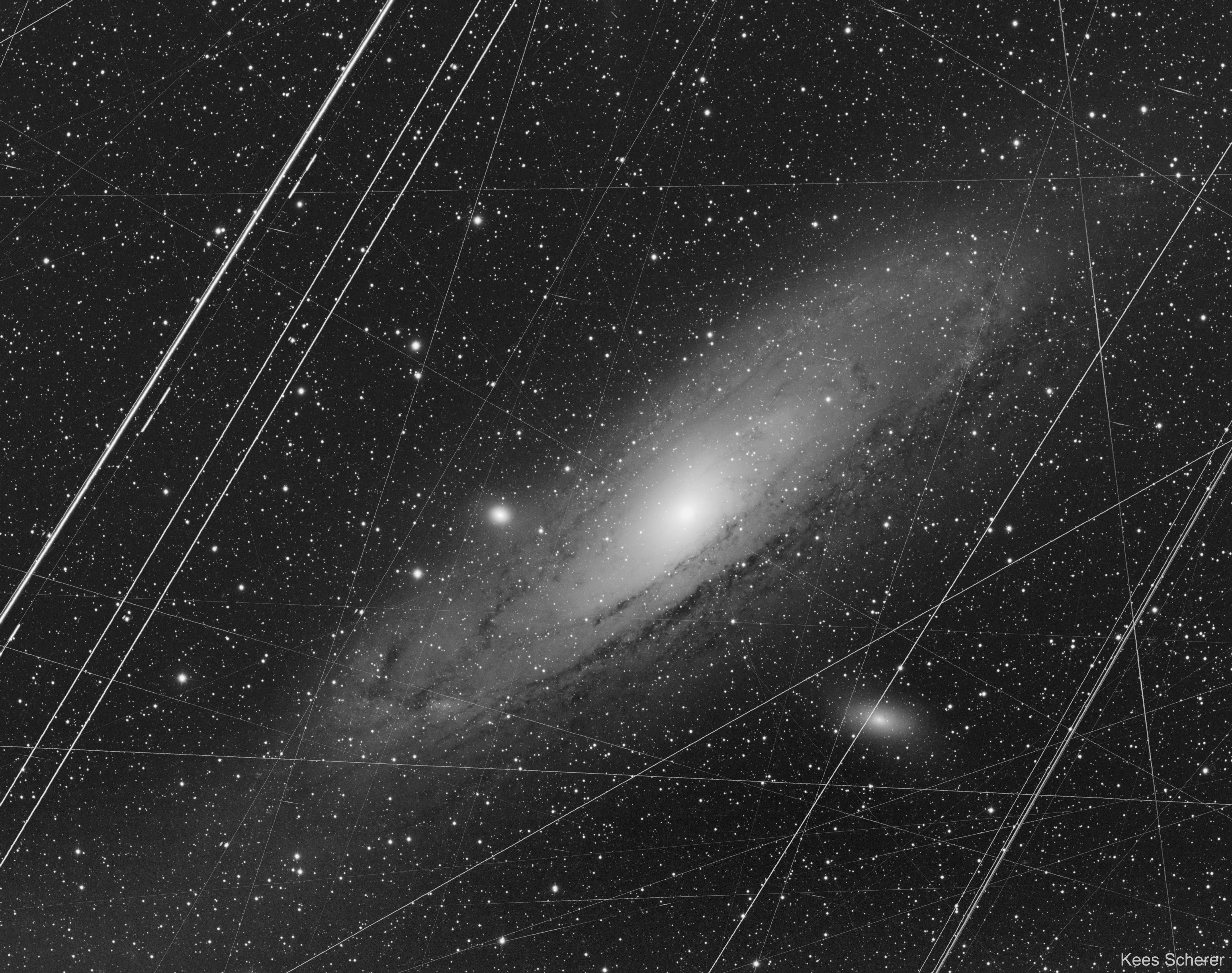
Or there's this past APOD https://apod.nasa.gov/apod/image/1910/M31Before_Scherer_4298... where we see the effect of the current satellite population (and a few planes with the ~10 parallel lines from upper right to lower left) on a big stack of images of Andromeda. Zooming in makes it obvious there are many more trails than leap out -- including a few neat tumbling objects's with periodic brightness changes (not the plane strobes).
What's tripling the number of satellites going to do?
I am concerned about increasing satellite counts for a few reasons (including the potential debris problems) I don't think it should preclude progress, but existing and future stakeholders (astronomers, people who enjoy dark skies, current/future users of LEO) should be considered.
> “No one thought of this,” she said. “We didn’t think of it. The astronomy community didn’t think of it.”
This implies the community was asked or involved in such a discussion and no objections were raised, which is unlikely.
Whenever some "armchair specialist" commented about Musk's plans to put people on Mars and the challenges with the radiation, the magnetic field, the etc. the answer was always "Do you think a room full of scientists haven't thought about that?". Well there you have it, straight from the source: sometimes they (claim they) do not think about "that". Question everything, worst case someone already thought of that.
Yeah, that's why Musk always asks people to come to him if they have a better idea. Even in large groups, or maybe especially in large groups, things can be overlooked.
He recently said in a video that if anyone can convince him an aerospike is better than their solution, he wants to know.
Just to be clear, because I'm aware objecting what your (potential egomaniacal) CEO says is as career-limiting as it gets, I suggested that everyone else should publicly question everything. Having the objections out there makes plausible deniability claims a lot harder.
There is a cultural risk involved though - we don't know how comfortable SpaceX employees feel raising objections given how aggressive Musk has been against concerns in the past (see the somewhat credible reports that Musk angrily rejected yellow safety markings on equipment based on personal taste: http://nymag.com/intelligencer/2018/04/tesla-workers-getting...)
I've heard similar reports from former Tesla employees. They found it stressful working with him in many cases (his brilliance/openness to feedback aside) which could impact this a lot.
Hoping i can get an answer here from somebody who actually knows, and not just a spacex fanboy or hater: what's the actual scope of the problem here?
Shotwell's response and other comments i've seen seem to imply starlink satellites are primarily impacting amateur astronomy ("kids looking through telescopes") and that scientific research is performing post-processing to the recorded images which can mostly eliminate the effects of the starlink satellites. Is that accurate, or is this also impeding telescopes at the big observatories?
Shotwell's comment is extremely patronising under the circumstances. This doesn't affect kids looking through telescopes at all. If it's bright enough to see through an amateur telescope, it's bright enough to ruin a precision observation from a real instrument. A large part of the outcry is lack of tact from Spacex.
Satellites in images is not new and has caused astronomers problems for a while. It's not common, but most people in the field know someone it's happened to.So now the issue is there will be an order of magnitude objects in space.
Any kind of time series where you observe brightness over time would be affected by a satellite impinging the field. Spectroscopic measurements would also be affected. Astronomers use incredibly sensitive instruments looking for very faint objects - if a bright object is in the field of view, it can saturate the detector and ruin the image.
For context some measurements, like imaging exoplanets, are so precise that you have to block the light from the (already faint) target star to see what's around it.
In reality it's amateurs that can compensate with post processing. Professional astronomers are likely to just trash the data and try again.
Then there are upcoming survey instruments like the LSST which take very wide angle images (I expect they already have some mitigation strategy becuase of other spacecraft). That said, the smaller your field of view, the lower the chance of a satellite impinging.
One solution could be a mechanical shutter which could be activated when a satellite is about to impinge the field, or triggered by a database of satellite ephemirides.
Isn't it obvious that this will happen? It's like taking a picture of nature and having airplane evidence in it, or take a picture of a city or even countryside and there are cars in it.
I'm sure the same was said about cars and planes. It will be weird and things will drastically change - but so have things the last 2000+ years.
You can easily get yourself between cars and whatever natural thing you're trying to observe on the rare cases that what you're trying to study is anywhere near cars. The only way to do the same for Starlink is to launch multi-million dollar+ space telescope.
But in that case you have to travel to a remote location (most likely using a car or plane ironically).
Hence, is it so far fetched that if you want to explore space in future you will do it from a different vantage point? Like via a satellite, or maybe in 50 years you go to a space station or the moon directly to do so.
With tech it has always been this way- it's nothing new.
The costs are orders of magnitudes more than simply travelling to study nature where it is and will continue to be hugely expensive for a long long time.
Regarding "The astronomy community didn’t think of it"
I think just because we have public spaces does not mean one can do whatever one wants with them.
1) There has been disturbances in the past of radio astronomy spectrum from communication equipment, this limits our ability to learn and observe space.
2) There will be visual disturbances if we launch of satellite constellation for visual astronomy
3) There will be space junk when these satellites run out of service.
It will be interesting how they solve it without causing thermal issues. Just absorbing all light won't work, the energy has to go somewhere and the only viable way to loose it is through radiation (not much air around even in these low orbits). Maybe the satellites will be black on the earth-facing side and radiate heat on the other side?
My impression from the article is that they launch one coated satellite just to see if the coating helps at all, and how bad the thermal issues get, so SpaceX is still in the early stages of solving this. But if they keep up with launching 60 satellites every 2-3 weeks for the next months they have to make progress fast.
> “No one thought of this,” she said. “We didn’t think of it. The astronomy community didn’t think of it.”
It seems probable that this is one of the things that can be ruled out. I find it inconceivable that none of the thousands of brilliant heads in SpaceX never thought of this.
I'm not an expert, so take this with a grain of salt, but isn't this fixable with mirrors and angles?
For a satellite in LEO most of the light is coming from the sun and a much smaller amount is coming from earthshine and perhaps the moon. If your solar panels are on an articulated arm it should be possible to place them so they reflect the light upwards and the satellite's body is in the shadow of the panels. Now the only light on the satellite (and the back of the panels) will be the earthshine, and you can perhaps combat that by painting the satellite black. If it's always in the shadow of the solar panels then heating shouldn't be a problem, right?
As I say I'm not an expert and there are probably multiple reasons this won't work.
I think the lowest possible reflectivity is desirable. Space isn't perfectly black but very close to it. Any reflectivity means you sometimes reflect something very bright like the sun and sometimes nothing, so you have the wrong brightness no matter what you do. Black dots are at least fairly unambiguous.
That is often considered, but the light is absorbed and turns into heat. Where does that heat go? It would fry the electronics with no way to get rid of it.
You could use some mechanisms to convert and dissipate the heat, though that doesn't come for free. Though the atmospheric pressure at that altitude is pretty low, you might be able to rig up some sort of peltier cooler setup to dissipate heat. Alternately if you can convert enough of the heat to electricity some other way, you could convert the heat back to light using LEDs or something and only turn on the ones facing away from earth, perhaps?
Plenty of other orbital devices have to deal with heat so I'm sure this is something that has existing solutions.
Peltier coolers won't do anything but draw power and create more heat you have to dissipate, they're not magic you have to remove the heat from the hot side too which means you need radiators for them too plus more than you'd need originally because peltier coolers are quite inefficient.
Same thing with the LED idea converting that heat into electricity requires some heat differential which requires... a radiator.
reflectivity/aborbtion is more than a percentage value. it's also a hemispherical distribution. if you glued retroreflectors to the surface most of the light would go back in the direction of the sun and thus never hit the surface. Those are probably too costly or bulk for satellites. If specular reflections are the problem they might just apply a more diffuse coating.
Since there are folks here in the field, does anyone know what the feasibility of building something similar to the VLA, but with thousands of smaller satellites? If doable, seems potentially possible to cover a lot more sky at once with less terrestrial interference. No idea if this is practical or not.
There's a number of problems w/ doing interferometry in space, which vary a bit depending on the frequencies you're working with—
Thermal: Parts of the detectors need to be very cold. Depending on what you're doing you may have to cool parts of the satellite down to 5 kelvin (-450°F) or even lower. You need to use a cryocooler than won't vibrate too much and impact your measurements.
Power: Each VLA antenna uses about 18kW just for cooling. That's a lot of juice— back of the envelope math says you need a lot of solar panels for that. An area smaller than a football field but bigger than a tennis court. It's manageable if you're only building a few of these, but less practical if you want to build 64 or even thousands.
Positioning: Most proposals for space based interferometry didn't actually consist of individual satellites. They're typically one big satellite with telescopes sticking out on different arms. If they're free-flying, it gets a lot harder to know the precise relative positions of the different receivers.
> Each VLA antenna uses about 18kW just for cooling.
That’s likely at minimum partially proportional to the size of each VLA antenna, no? Each VLA antenna is larger than any antenna ever put in space I believe.
> If they're free-flying, it gets a lot harder to know the precise relative positions of the different receivers.
That’s exactly what I thought would be one of the biggest challenges, but wasn’t sure if we’d solved that problem or not yet.
True that 18kW isn't a totally fair comparison. On one hand it's easier to cool because you don't have to worry about the air warming you up. OTOH it's harder because sunlight is way stronger once you get out of the atmosphere.
I don't understand why SpaceX is allowed to make this decision nearly unilaterally. This is so similar to how the modern tech companies treat data extraction: they find something unregulated and push until they get pushback.
On the plus side, Starship will be able to launch more and bigger space telescopes for lower prices, to places beyond the Starlink constellation. That doesnt help ground based observations though.
SpaceX sabotaging earth based astronomy sounds like yet another business trying to create a market/demand for itself.
Herefore I bet my ass they'll do just too little to fix things and just enough in order to not be prosecuted.
I would bet that there will be no more than 1,200 (if they raise the money needed to launch and manufacture that many).
And I would also bet that even in an 8 year time-horizon, they will not launch 12,000 satellites for Starlink because simply, there will be no market for so much capacity. In my opinion, we are heading towards an Iridium, Teledesic, Globalstar 2.0 scenario.



https://news.ycombinator.com/newsguidelines.html