Botter Reeves, one of my best friends and a great all-around computer guy (back when that meant being as comfortable with a soldering iron as a keypunch) had a hand in building this. He has fantastic stories of those days. I hope he gets around to writing them down.
I'll try and relate one of them from memory. I apologize in advance for getting details wrong.
Back in those days you didn't just put out a help-wanted ad for programmers and start filtering resumes. Programming as a professional barely even existed. Instead, you had to find people with the right mindset and train them from scratch. And you had to be willing to look anywhere for the right people. IBM had created the original Programmer Aptitude Test (PAT) and was giving it to college students, teachers, and just about anyone they could round up. The best-scoring testers were immediately offered a job in California as trainees for what was to become SAGE.
This was, I think, an office of Federal Systems Division and the job was really a boot camp where the trainees had to learn the principles of radio, radar, tracking, computers and programming. It was quite hard on most of them and people would wash out of the course as it become progressively more difficult.
No one outside knew what was really going on at FSD (even the trainees didn't know what they were really learning) but it was getting quite a reputation for itself.
It seemed a little cruel to send someone across the country (a big deal in those days) for a job that didn't last more than a few weeks. Botter assured me it was no problem. Even the wash-outs were in demand. Software Development Corp. had a recruiter outside the IBM building to offer them new jobs when they quit IBM.
The final, carefully-chosen test prior to graduating boot camp was to understand and explain how a certain subroutine worked. This subroutine was special. It was granted exclusive access to the tiny amount of core memory that was available (most of the memory was probably drum, iirc.) Its purpose was to monitor the results of the radar signals as the antenna dish spinned and piece them together to associate the individual signal samples with the correct objects (planes or missiles), and identify their altitude, speed and direction as quickly as possible. It was unusually complex, self-modifying code.
Botter said that few people could understand that code and fewer still could successfully modify it. Those who passed were ready to graduate and move on to work on SAGE.


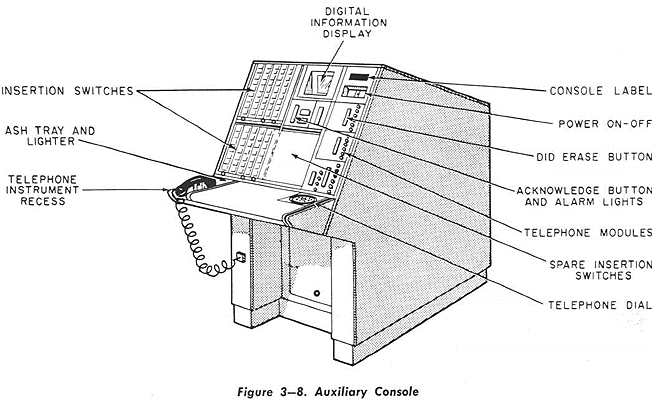
I'll try and relate one of them from memory. I apologize in advance for getting details wrong.
Back in those days you didn't just put out a help-wanted ad for programmers and start filtering resumes. Programming as a professional barely even existed. Instead, you had to find people with the right mindset and train them from scratch. And you had to be willing to look anywhere for the right people. IBM had created the original Programmer Aptitude Test (PAT) and was giving it to college students, teachers, and just about anyone they could round up. The best-scoring testers were immediately offered a job in California as trainees for what was to become SAGE.
This was, I think, an office of Federal Systems Division and the job was really a boot camp where the trainees had to learn the principles of radio, radar, tracking, computers and programming. It was quite hard on most of them and people would wash out of the course as it become progressively more difficult.
No one outside knew what was really going on at FSD (even the trainees didn't know what they were really learning) but it was getting quite a reputation for itself.
It seemed a little cruel to send someone across the country (a big deal in those days) for a job that didn't last more than a few weeks. Botter assured me it was no problem. Even the wash-outs were in demand. Software Development Corp. had a recruiter outside the IBM building to offer them new jobs when they quit IBM.
The final, carefully-chosen test prior to graduating boot camp was to understand and explain how a certain subroutine worked. This subroutine was special. It was granted exclusive access to the tiny amount of core memory that was available (most of the memory was probably drum, iirc.) Its purpose was to monitor the results of the radar signals as the antenna dish spinned and piece them together to associate the individual signal samples with the correct objects (planes or missiles), and identify their altitude, speed and direction as quickly as possible. It was unusually complex, self-modifying code.
Botter said that few people could understand that code and fewer still could successfully modify it. Those who passed were ready to graduate and move on to work on SAGE.