When I was a kid I helped my grandpa move out of his office when he retired. He was a senior engineering fellow with Monsanto, specializing in bubble trays in refinery processes. He worked out of their big campus in St Louis, and gave me a tour as a thanks for helping him with the boxes and such. There's several things that have stuck in my memory from that tour.
One was seeing their Cray. I forget which specific model it was. It was gray and mauve, and had the fountain with the logo on the unit that pumped the coolant. Monsanto had a dedicated computer room for it with glass walls so you could see it. The overall effect was to make a very strong impression that this was something very special.
Another thing that stuck in my mind was seeing their bio labs. These were long concrete hallways dug halfway into the ground, I assume to make climate control easier. They had row upon row of corn plans under artificial light. These were the labs that developed roundup ready seed. I had no idea at the time the significance of what I was seeing or how contentious it would be now.
Last thing I'll mention is when we were walking outside and he pointed out the separate building the CEO et all worked out of. It was literally a bunker with earthen birms and such around it. My grandpa bragged that it was built to be bombproof in case terrorists attacked the CEO. At the time I was somewhat mystified why anyone would bomb the CEO of a chemical company. I certainly understand why now.
But anyhow, it was a cool experience and seeing that Cray probably helped inspire my interest in learning to program later.
Edit:
Random other thing I'll mention is an email exchange from a mailing list back in the late 90s that focused on APL style languages. Someone told their story about how back during Cray's glory days they worked in a lab where he did interactive APL programming on a Cray machine. I can only imagine what that must have felt like at the time, typing arcane terse syntax into a prompt that would execute them shockingly fast.
Thanks for sharing. I worked on the UIUC campus for some time right by the greenhouses where they experimented with cultivars of corn and other grasses, always funny to see giant 8 foot tall plants lit with sodium lamps through the winter.
As for APL, I haven't really got past an orientation in the language but it's held a total mystique to me since seeing this video circa 1975 [0] walking through the language with a Selectric teletype acting as a REPL, totally flipped my understanding of computer history, I assumed it was all punchcard programming back in the old black and white days xD (I am born 1990 for reference, trying to catch up with what happened before me)
Re APL I totally know what you mean. I've never done anything with that category of language that wasn't just golfing / goofing around, but conceptually it's made an impression. Once the big picture concept clicks you look at the way we write most code and see so much bookkeeping that's just managing names and values of iterators and indexes. Lifting that up to bulk transformation of multidimensional objects is powerful, and much closer to the intuitive picture of what's going on I have in my imagination.
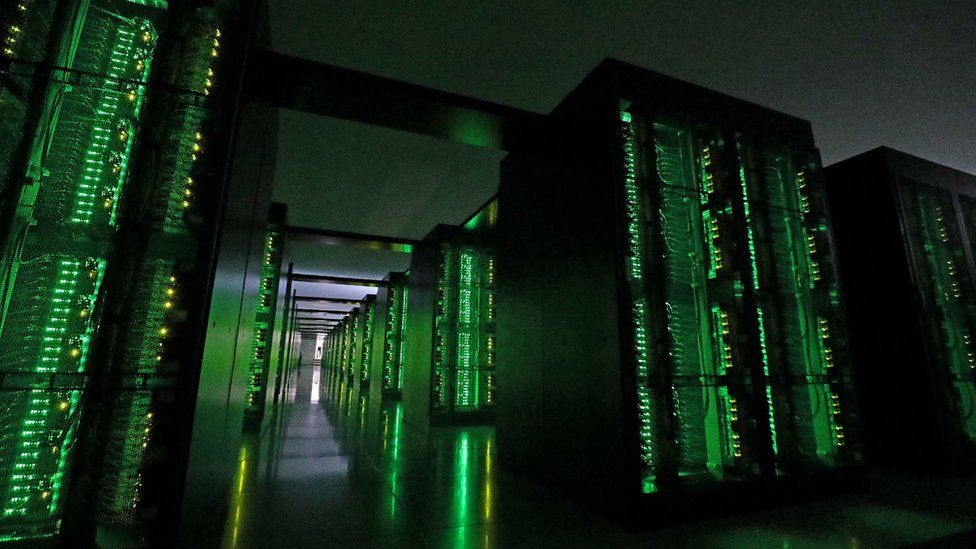
To this day, whenever I hear the term "supercomputer", I can only visualize the Cray. I don't want to know what the latest supercomputer looks like, because I suspect it's just another boring bunch of rack aisles. Maybe with a snazzy color end-cap or blue LEDs on the doors.
Bring back the impractical, space-eating circular design! I don't care about space efficiency. It's supposed to look cool.
This is an area where I wouldn't mind a little splurge in design. These are supposed to be the greatest computing machines made, they should look fabulous and mysterious.
Well, a bunch of racks with green LEDs is more practical, cheap and functional, I guess.
Haha so green LEDs are cool again? I made a call back in 2004 that after blue LEDs became commonplace and white LEDs had their turn as the new hot thing, red would make a comeback. And it did. ;)
I imagine there have been multiple cycles through the spectrum since then…
Isn't that due to green being the highest energy of light for an LED available at that time?
IIRC, everytime a new material was created to get the increase in band gap for a higher energy photon (i.e. blue or violet), there was a Nobel prize given out.
Tuning the band gap with a new material back then was difficult I think.
green has a lower band gap relative to blue/white, ~2V depending on chemistry, but there's something like that going on - IIRC human eyes are most sensitive to green around the ~500/550nm wavelength that green LEDs emit, so you can get good brightness out of low power.
At the 1990 TeX Users Group meeting at Texas A&M University, one of the events was a tour of the computer center where we got to be in the room with their Cray. I think I sat on the bench.
You do know that there's one in London at the Science Museum (the one that was¹ in California was built at the same time for Nathan Myhrvold).
⸻⸻⸻
1. It was on loan to the Computer History Museum from Myhrvold and returned to him in 2016. It's unclear whether he did re-loan it or if he's busily calculating the values of polynomials with it.² The Computer History Museum website makes it sound like it's currently on display but I can find no news stories about it going back to the museum.
2. Just kidding about him calculating polynomials—it's (I think) on display in the lobby of Intellectual Ventures.
I have a picture of a cray been serviced as an A2 framed print on my living room wall, it predates the missus which is why it was on the living room wall ;)



https://cdn.britannica.com/11/23611-050-81E61C8A/Cray-1-supe...
So happy to be able to find a picture of the wirewrap inside: https://s-media-cache-ak0.pinimg.com/originals/e2/d2/47/e2d2...