It's a fair question, but our quality guidelines have been quite consistent for the last decade or so. Our team takes action without regard to whether a website is an advertiser, partner, or competitor. The long-term loyalty/trust of our users is worth much more than any sort of short-term revenue that a sneaky deal would provide. And Google's culture is such that anyone inside or outside of the company can claim that a particular practice isn't in line with "Don't be evil" and kick off a fair amount of self-scrutiny.
Ultimately though if you don't trust Google, we don't lock your data in, so you can use a different search engine or service just by entering it in the address bar. That's the ultimate check on Google: if we start to act too abusive or "evil" we know that people can desert us. So it's in our enlightened self-interest to try to act in our users' long-term interests.
That's the ultimate check on Google: if we start to act too abusive or "evil" we know that people can desert us. So it's in our enlightened self-interest to try to act in our users' long-term interests.
I hear this line thrown about quite a bit. And while it's true with regular users, it's certainly not true for webmasters or advertisers. Google controls around 67% of all US search share. If an advertiser doesn't play by your rules, they forfeit a significant amount of natural search traffic.
All good for most of your policies but there are some real gray areas. I had a site years ago that got hit with a javascript hack on an obscure page. StopBadware found it within a day or two and suddenly we were blacklisted... virtually all organic traffic disappeared overnight. It took weeks to get the warning lifted and that was only as a result of a significant viral PR campaign (such as this).
Maybe this has been addressed, but there are other areas. Affiliate sites are also penalized quite heavily by Google. It's one thing to take a stand due to the supposed quality of many of these sites (which frankly has little correlation with the presence of affiliate links... most sites suck). It's quite another when Google has a large affiliate advertising practice in house and a significant investment in an affiliate link tracking/cloaking company.
I mention this with all due respect and I hope you take it as constructive criticism. I think the organic side of the house does a great job overall. The paid side is another story IMHO. Part of this is organizational stupidity... I struggle with this every day and I have a much smaller organization.
Like Google, webmasters like us also try to improve quality of their web pages, but sometimes we fail to understand what actually "Quality" means to Google. May be the angle from your see, is not easy for us to catch. It would be better if Google can publish some Dos and Don't list for the Panda.
For a keyword like "dating", only top companies are being given space on the first page. Well, if you see dating.com, they have nothing like dating in their site and also the articles are nothing but crap, but they managed to be on top and survived in Panda, while small fish like us are no where. Having a far better site, useful contents, more than 200000 active users has no use.
You do not expect a "Dating" website to hire 10 content writers and keep posting fresh articles, because those are the "Contents" Google consider as content. All niche can not be put under one "Quality" guideline.
Matt: This is a lie. I have seen you talk about quality at SMX and it is laughable. These quality guidelines you speak of might pertain to others, but they do not pertain to Google's own content.
1. When I search for a restaurant, 99% of the time Google places shows up before Yelp. So you are telling me that Google places always has better content than Yelp? Look at these reviews for Gary Danko - http://maps.google.com/maps/place?num=100&hl=en&biw=...
"love it" and "our favorite restaurant" Does Google Places have much better quality content 99% of the time?
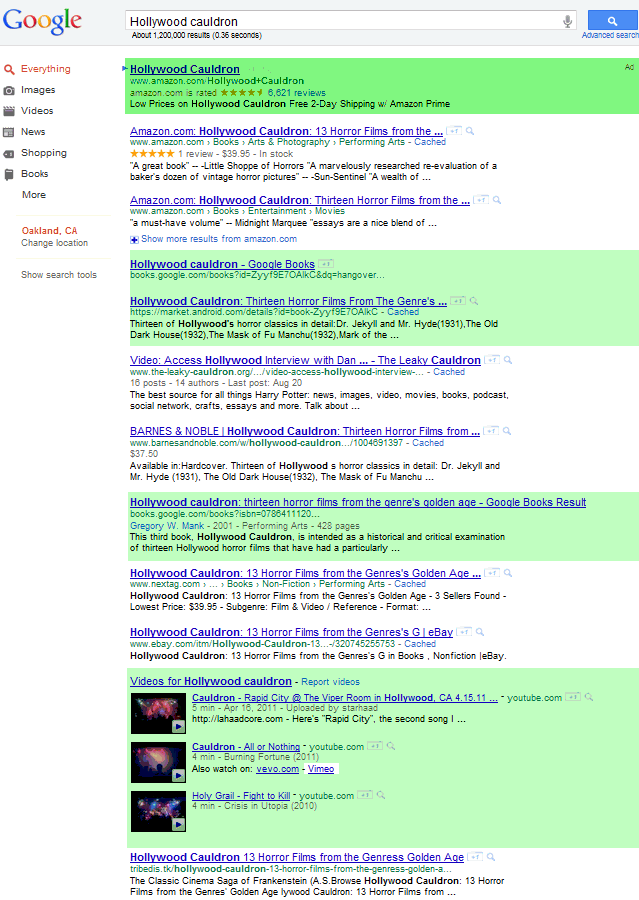
2. Look at http://www.seobook.com/images/google-google-google-google-go.... A. Look at all of Google's sites in the results. B. What are those Youtube videos doing in these results? Every other result in this set has the words hollywood and cauldron right together(except the leaky-cauldron domain result), but since Youtube is a Google property it shows up. It's funny. Do this search on your own and you will see that the top 40 results have "Hollywood Cauldron" in its title, but the ones in Youtube do not.
So your results are all about quality unless it comes down to your own content. Then, it doesn't matter.
By the way, I can't wait for Google Plus to start hogging space in your results too. We all know how important "social" is to you guys. Even more important than "local." So we shall assume the results will be even more crowded google content. If we are lucky, maybe Robert Scoble will mention the words hollywood and cauldron in one of his wordy posts and we will see at the top of the results! And by the way, no one buys that don't be evil thing any more... long gone.


Ultimately though if you don't trust Google, we don't lock your data in, so you can use a different search engine or service just by entering it in the address bar. That's the ultimate check on Google: if we start to act too abusive or "evil" we know that people can desert us. So it's in our enlightened self-interest to try to act in our users' long-term interests.