Well, if you knew it was easy, why ask? A request like that implies you think it can't easily be done, which is why you excluded someone you thought I'd want to name up front.
I'd love for you to be optimistic! But it's unclear why you're not, beyond a perceived failure to convince other scientists. That means virtually nothing though. The position of these scientists I named is "the temperature wanders up and down, most of it is natural, a bit of it is artificial, it probably doesn't matter much". Of course you can't convince climatologists whose entire career, funding, labs, and self-identity are pegged to the idea that climatology is of critical importance. What would they say exactly? Oops, sorry guys, we realized we made some mistakes and there's no real climate crisis, stand down, false alarm? They could never do that! The social pressure to only ever ramp up their predictions and never down is overwhelming in that sort of role.
So the people who need it to be true due to their prior commitments are the last people you should care about whether they're convinced or not. It's people who are new to the topic, neutral, or who have taken the "climate realist" position despite the strong social pressures not to, who are worth paying attention to. And if you do, well, they make a lot of good points. The end result is kinda unsatisfying though. You can't feel good about saving the climate by doing tokenistic things like buying offsets or going to marches, if you come to believe there's probably bigger environmental problems out there.
Or you know, you could just watch the news and see the predictions coming true faster than the models said they would...
Also I don't buy the whole "self-identity...pegged to the idea that climatology is of critical importance" thing - a) climatology is still fundamentally important regardless of how much a problem AGW is b) plenty of scientists are pretty keen to stand out in their field and be remembered historically for being the one that demonstrated the current consensus was wrong. Lindzen tried to do that, and had a pretty decent hypothesis, but it just hasn't stood up to the testing that's been done (even he still only considers it a hypothesis).
You can't see predictions come true by watching the news because, as climatologists love to say every time there's a cold snap, climate isn't weather. And they're right. Climatology is all about long term averages. Unfortunately whenever there's a fire or hot spell somewhere on Earth, they stay rather silent whilst the media and even their colleagues ignore this and use it to ramp up the fear factor yet again. For example the recent hot weather in western Europe should be recalled with colder/wetter than average weather last year, and in other parts of the world this year. Also note that the news never reports on climate-related good news (the recent coral growth being a rare exception).
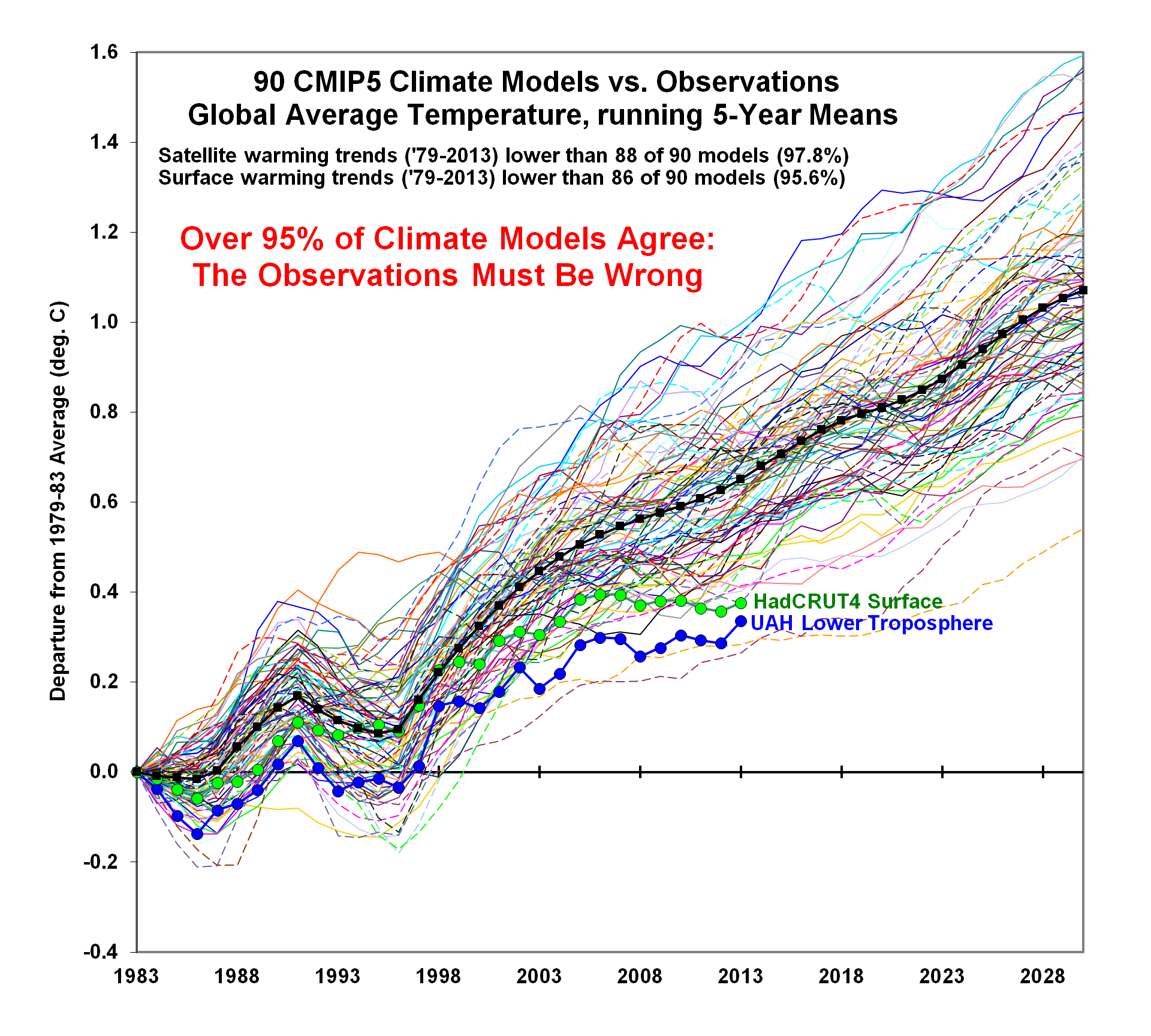
The models have always over-estimated warming. Things haven't been warming faster than they predicted, they've warmed slower. Claims to the contrary are the sort of retroactive rewriting of history that makes climatology seem so untrustworthy. If you plot model predictions against reality you get charts like these:
The blue dotted line is satellite observations. The green dotted line is temperature as measured by averaging surface level thermometers from weather stations. Notice how those two measurements don't agree at all. That's because the surface datasets are heavily corrupted by various factors (ask for details if you're curious). But also notice that both are running well below the average of the models, and in fact observed temperatures from satellites are below basically all (>~95%) of the models.
"climatology is still fundamentally important regardless of how much a problem AGW is"
Do you really believe that? More importantly, do you believe other people believe that? How many people would care about climatology if they were reporting that nothing much was happening, the climate was pretty stable actually and humanity didn't have to change much of anything? I think if that was their consensus position climatology would have the same status as people who study butterflies, or people who study obscure metals. Yes there'd be some funding and a small number of scientists would be passionate about it. But the field would be tiny, they'd never be in the news, politicians wouldn't care.
"plenty of scientists are pretty keen to stand out in their field and be remembered historically for being the one that demonstrated the current consensus was wrong"
That's a very nice idea and I really wish it were true. I've been following how science works very carefully as an outsider for the past few years now, and less carefully for about a decade before that, and I just don't see this at all. Nothing special about science in this regard. Going against a convivial agreement of your peers is always hard in any context, especially when what you're arguing is bad for everyone involved.
Consider the following story of what happened when Remote Sensing Systems published an independent satellite temperature dataset that contradicted the "consensus" surface datasets:
The video demonstrates two things: (1) scientists who take the realist position immediately predicted that RSS would come under immense pressure to rewrite their results to remove the contradiction, and that within a few years the data would have been altered, (2) that's exactly what happened.
If you disproved the idea there's a climate crisis (which has been done! many times!) then this is what happens:
1. Other climatologists will claim you're wrong, a minority, outside the consensus etc. They will not care what your argument is. They will instead tell everyone that listening to you is dangerous because to stop believing in a crisis means the world will end.
2. Journalists won't want to report on your work because of (1). Instead they will smear it, believing themselves to be doing the right thing.
3. You won't be able to get papers published easily or at all. That in turn will eventually cut off your funding.
4. If you did somehow succeed against the odds, well done. Funding would drop like a stone so you just wrecked the careers of all your colleagues, many of whom are friends, also your students who are doing their PhDs and so on. Also you are now hated by the public who are asking themselves why experts were wrong for decades in such a catastrophic manner.
There are no benefits to being the guy who is right when your colleagues are all wrong. Not in climatology or any field, really. That's why our culture has so many social norms designed to protect the contrarians like freedom of speech, freedom of the press and so on. Unfortunately in recent times and especially in academia these norms have broken down completely. There are some outsiders and especially retired people who are willing and able to say things that are true, but within the field it's hopeless. Anyone who points out the magnitude of the exaggerations and corruptions is directly attacking the people who control their own careers and success.


I'd love for you to be optimistic! But it's unclear why you're not, beyond a perceived failure to convince other scientists. That means virtually nothing though. The position of these scientists I named is "the temperature wanders up and down, most of it is natural, a bit of it is artificial, it probably doesn't matter much". Of course you can't convince climatologists whose entire career, funding, labs, and self-identity are pegged to the idea that climatology is of critical importance. What would they say exactly? Oops, sorry guys, we realized we made some mistakes and there's no real climate crisis, stand down, false alarm? They could never do that! The social pressure to only ever ramp up their predictions and never down is overwhelming in that sort of role.
So the people who need it to be true due to their prior commitments are the last people you should care about whether they're convinced or not. It's people who are new to the topic, neutral, or who have taken the "climate realist" position despite the strong social pressures not to, who are worth paying attention to. And if you do, well, they make a lot of good points. The end result is kinda unsatisfying though. You can't feel good about saving the climate by doing tokenistic things like buying offsets or going to marches, if you come to believe there's probably bigger environmental problems out there.