There are also some nice, human-controlled (although I believe they can be automated using stuff from DIY Drones) open-source units from Quadrocopter: http://www.quadrocopter.us/
This kind of reminds me of the Danish Christmas calendar (a TV-show with an episode for each day in December until the 24th). In this show all characters were played by the same actor, Anders Matthesen[1], a Danish stand-up comedian, actor and rapper.
The show was named "Jul på Vesterbro" and in many of the shots characters sit side-by-side and interact. Along with this, there were camera movements and minor visual and sound effects. To do this, the camera was mounted on a robotic arm which could move in the precisely same way. For each scene and for each character, Matthesen would do the acting and then in the editing room they would cut the performances together.
I can't really find any sources on it, I only remember a Danish documentary about the creation of the show.
I think it's very scary standing next to a moving robot that close. It doesn't stop when you get in the way. Hope someone is holding a emergency stop button.
I don't think the feedback of the servos will detect a human body part. These servos are very very strong. Maybe when it hit the concrete it will skip a step noticeable in the feedback but that's about it.
They have envelope protection, in software, so if you tell the controls the size and shape of the camera and the surrounding objects they wont drive the camera through the floor whatever path you program in.
But they don't have proximity sensors - like the saw capacitance sensor. It just doesn't work in the real world with large objects and longer distances.
You have to rely on the actors staying on their marks if you want to do a very close approach.
Yes, this thing looks dangerous. I cannot identify any security measurements except that guy in the background who probably has an emergency stop button.
I wrote a few comments earlier about this device, but I thought I'd try and sum up my thoughts on it in one post.
This is terribly dangerous. Thus far, they've been lucky - nobody has done something wrong or stupid. That said, it cannot last. Putting industrial robots like this on a moving track, and then putting them close to humans at high speed is a recipe for disaster. This system has a 6 meter by track length operating envelope and moves over 4 meters per second. It also has control over 110kg of material - putting its weight in the 2000kg range (minus the track).
There are safety systems available, but none that are commercialized that will allow humans and robots like this to exist in incredibly close proximity with any expectation of safety. Some of the recent research we completed at Carnegie Mellon points to a future where this is possible: http://www.youtube.com/watch?v=-_Xc4yq-rz0
Sadly I dont remember the details anymore. I can just remember that the system was by a german company and judging by how it behaved was still in a kind of beta-stadium.
See my prior post. This is nothing new. Systems like this have been used in the motion picture industry for decades. As far as I know the safety record is perfect. They take that stuff very seriously.
Except the examples you gave are both NOT what they're proposing here. You had robots well away from humans with hardware systems preventing them from impacting human space. The first example didn't even involve humans.
This system is meant to be used up close and "in the action".
That is not true at all. Milo and its little brethren have been used for many years, in place and with the actors. In case you missed the notes about it, these systems come with detection, fail-safes, and kill switches to prevent issues. And -always- have a human operator in final control of them.
I just gave two use cases and you chose to generalize from there. MOCO rigs have been used in just about every application you could possibly imagine. I once worked on a system that got dropped of a cliff on cables, next to a stunt guy, all computer controlled.
That's because both are descended from a common ancestor. GLaDOS is designed to look like contemporary robots, and IRIS is clearly very much based on existing robot designs used in manufacturing, like this one: http://upload.wikimedia.org/wikipedia/commons/8/8a/Automatio...
Animators have used motion control rigs for decades, they had the same range of motion but were optimized for extremely slow but the incredibly accurate registration required for repeated animation shots. The lightness of contemporary cameras also is a significant advantage.
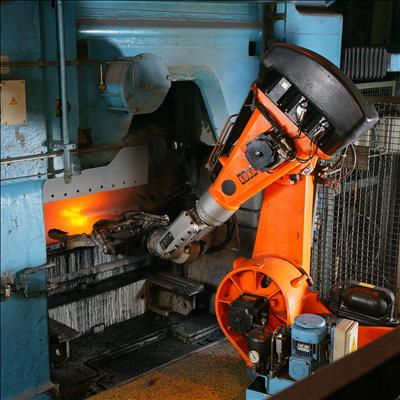
This is a huge Kuka robot. While Kukas have a good position-precision they are not the best in motion-precision. However this is used for motion/action/movie recording. Unless Kuka improved the servoes and gears, I doubt it will produce much usable material.
My friend tried it with Kukas first and ended up using Stäublis with modified gears.
http://www.rtleaders.com/de/broadcasting-automation/robokam-...
Nevertheless safety is still an issue. In this regard "hits Hollywood" nails it.
Looks like he's gone full-on sad Keanu. Which is too bad, I'd be a lot happier if I had one of those cameras. That thing has some really incredible reach. I wonder how it's controlled and how they make sure it doesn't collide with the actors?
They likely don't make sure it doesn't collide with anyone. There MAY be some local safety systems in place, like virtual light curtains and exclusion zones...
If you're filming a kung foo scene, you're already very careful to not collide with who you're "fighting". I don't see how this would be any different other than the robot is perfect and your opposing actor is not.
It's an interesting competitor for Mark Robert's Milo. Smaller slider/dolly and pan/tilt companies come out of the woodworks right now and are very popular accesories, there're even a couple of small open-source shops in the industry. Obviously none on that scale though. (Dynamic Perception, eMotimo, etc.)
This is nothing new. Special effects companies have been using MOCO rigs (Motion Control) for decades.
I worked on some of this hardware many moons ago. One such rig was a cartesian robot the size of an entire warehouse. It was used to fly a camera over (and through) a miniature mockup of a city. The rig had XYZ axis that were measured in tens of feet and the end-effector (where the camera was mounted) had various rotation and translation capabilities as well as computer control of focus and other camera functions.
I was also on set for some software tests of a rig used on an Arnold Schwarzenegger movie. It was impressive to see this rig programmatically approach the actor at high speed on a rail system while the camera was going through various programmed motions. The thing was easily over 500lbs. They had massive stop blocks at the end of the track prevent a run-away condition and protect the actors.
Agreed, one trip around NAB will show you a lifetime's worth of imagining on cinematic robots. I think the interesting thing they've done here is tie everything in together with a single point control that's perhaps nicer than Flair. Of course, it's also competing with an endless array of multi-million dollar systems - so I'm not sure how exactly this one stands above the fray, except maybe getting written up in HN =)