They are of course heavily sanctioned by the US for stuff that happened in the ancient past. That will not affect natural resources but it will affect the equipment to harvest them.
What equipment is needed for Cuban's to harvest fish?
People have been harvesting fish from the ocean for thousands of years. They have been making bread for even longer.
Sanctions are not why Cuban's aren't able to eat. Cuba can and does trade with the rest of the world.
Cuban's can't eat because of how poorly their government allocates resources. This is the problem with all centrally planned economies - they eventually stop being run well.
The problem they face is a shortage of wheat flour, not bread-making technology. Wheat doesn't grow in tropical climates (though the Brasilians are working on this). There are 10 million people on the island of Cuba. There weren't 10 million people living there and baking bread thousands of years ago.
There are very limited options for doing business with Cuba due to the trade embargo laws the US has passed. US sanctions in general basically cut a country or organization out of the international banking system. There are limited exceptions for food etc but where are they supposed to get the money to pay for that food with the other industries being embargoed?
It's shocking the lack of credit you're extending to the decade's long embargo for doing it's job of keeping Cuba poor.
Russia is the single largest exporter of wheat in the world, followed by the EU, Australia, the US, Ukraine, and Argentina. China is a top producer but also a top consumer; nothing for export.
Still, plenty of it out there, at this point it's more due to local disfunction more than anything.
To harvest fish at an meaningful scale for a population of a bit over 11 million requires a lot of equipment and that's not what they're having trouble with. It's bread.
Kind of, but they can't do any business with a US based company. Many specialized products are only produced by a small handful of companies, and if all (or most) of those are US based, Cuba's SOL. They've also had problems where a supplier was bought out by a US based company, so now they can't buy that product anymore.
There's also the fact that it's far cheaper to ship goods to Cuba from the US then it is to ship goods from Europe or China. This means that even if they can buy some goods, they're often much more expensive then it needs to be.
The cost of shipping is more than made up for in the cost of labor and capital that goes into the products. Which is why most other countries use China as their number 1 trading partner. There is also nothing critical manufacured by the U.S. for Cuban agriculture that is not available elsewhere. They are a tropical island with one of the most ideal climates on planet Earth, food grows virtually all year there, nevermind the abundance in the ocean itself.
No, because they are under heavy sanctions that threaten any country that dares trade with them.
The origin of the sanctions goes back decades, to Cuba's land reform, where the government took back land from private corporations, such as United Fruit Company, who then lobbied the US to go after Cuba on their behalf.
The United States has threatened to stop financial aid to other countries if they trade non-food items with Cuba… Despite the existence of the embargo, Cuba can, and does, conduct international trade with many countries, including many U.S. allies; however, U.S.-based companies, and companies that do business with the U.S., which trade in Cuba do so at the risk of U.S. sanctions.
This article is about bread. Bread, perhaps the most simple, easily manufactured food on the planet. It doesn't even take fancy modern equipment to make - people have been making bread for thousands of years all across the world.
Cuba was settled 6,000 years ago according to Wikipedia - long before importing goods was even a concept. They did not, and still should not need to import anything to feed their population. The resources are misappropriated by their government - it's that simple.
Cuban's rely on the government to ration/provide ingredients to make bread. And just like the USSR, the government eventually fails to provide and the population - who became entirely dependent on the government - are left with no alternative means to support themselves. It's a tragedy that has bestowed damn near every single communist nation that has ever existed.
There is no valid excuse for not being able to make enough bread.
They can’t build equipment themselves? You’re saying socialist countries can’t feed their citizens without relying on equipment invented, designed and built by capitalists?
It is hilarious how the US uses sanctions as a weapon while simultaneously trying to use tariffs to build capacity internally, but yes, access to the best of the world and the benefits of specialization is very helpful.
This article is about the ingredients for bread. If you can't get water and flour without "access to the best of the world and the benefits of specialization", that's on you.
Of course they can't make competitive CPUs. That's perfectly understandable. But provide ingredients for bread?
Agriculture is one of the most technological and oil-intensive things that modern civilization does. Combine harvesters are intricate devices which cost millions, and the US happens to be one of the countries with the best relative advantage in growing food due to our climate. For reference, the USSR industrialized to near capability parity in the 60's, but never closed the agriculture gap.
Growing a little grain is possible with ancient technology, but a lot of people starved back then, as they do now when agriculture is practiced without oil, pesticides, herbicides and advanced (keeping in step with population growth) machinery.
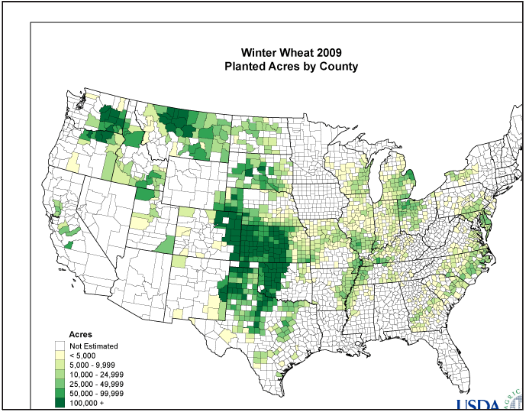
Wheat doesn't grow well that far South, it's too warm. [0] Just look at the map of wheat production in the US. So it's a trade item and that's where the embargo and all it's effects come in.
The United States can’t survive on what we build alone, either. We’re dependent on resources and equipment made by communist states (e.g., China) and worse (e.g., Saudi Arabia). It proves only that the world is connected.
Cuba is an island nation that has full political and trade relations with industrialized countries around the world. Plenty of other island nations have no trouble in their agriculture sector. Cuba's inability to make their economy work has everything to do with their lack of democracy and excess of Marxism, and nothing to do with their neighbor, the US. We have seen food shortages after Marxist takeovers pretty much everywhere that has suffered that fate.
They can buy whatever they want from China and most of the "global south" our sanctions are not followed by them. They are on some of the most fertile ground on planet earth. It's just late stage communism doing its thing.
Wheat is not an essential thing. It is useful in cold/temperate climates because it grows there and has an extremely long shelf life. But in the tropics you have fruits and vegetables growing year round including alternative carb sources like bananas, yucca, sugarcane, avocadoes, mangos, rice, etc.
They are as close as it gets- the "economic calculation problem" makes an actual centrally planned communist economy impossible, hence the mass famines. Cuba also in practice has a free market capitalist economy nowadays. From what I've heard, in practice North Korea also feeds people through a capitalist black market.
Even the USSR tolerated small business like mom & pop shops. Historically what we've seen in communist countries is that major production is under extremely heavy government control. Things like raw materials, shipping, energy, banking, agriculture and manufacturing are what the dictators care about.
This is echoed by contemporary left-wing thinking in "the West." Small business is often championed while "big pharma", "big tech", "banking" and other industry giants are derided and viewed as shady at best, criminal at worst (note I'm not calling all left-wingers communists! I'm just saying that this dichotomy in left-wing thought is very common... heck, it's even common among many right-wingers).
I'm not defending communism by saying that, while "black markets" undoubtedly exist, small trade is not typically looked at as "black market capitalism." As I understand it the idea isn't to prohibit trade itself but to "control the means of production" in an attempt to achieve prosperity by removing the profit motive from industry.
I'm going to interpret your comment as "Venezuela is starving because of US sanctions"
We actually have a really nice unintentional experiment. The Biden administration removed sanctions from Venezuela, they still had starvation after sanctions were removed.