This post completely reflect my thoughts on the whole saga - but there's one more thing which sticks out for me, something briefly touched upon in this article: filling up a petrol car to do 500+ miles takes <5 minutes. Charging a Model S to do 500 miles takes over 2 hours. I think that's one of the main issues people have, that to do a journey which would typically be insignificant, it requires a large amount of preparation.
If I woke up in the morning and went to my car to drive to work and I found I didn't have enough mileage - despite it having twice as much as I needed the night before - I'd be pretty annoyed. Yes, everyone says that you should leave the car plugged in over-night, but it's such a different way of working with cars and something which feels like it shouldn't be required, which I think makes people a little unsure about buying electric cars.
Most people regularly drive short distances to and from work. An electric car charged overnight perfectly fits that model and covers 99% of most people's driving habits. Just like most people don't need to own a pickup truck. They borrow one once a year. Most people aren't driving hundreds of miles in a day on a regular basis. And if you do need to drive hundreds of miles? Then an electric car isn't for you.
I ski most weekends which is ~350 miles of driving and plugging in the car really isn't a huge deal. I did it when I had a diesel with an engine block warmer.
The exception receiving so much focus is kind of baffling. People seem really invested in finding faults with electric vehicles.
This has always bugged me about people complaining about the rage of electric cars. How often do you really drive 150 miles in a day? Not very damn often. If you do then maybe an electric car isn't for you. It doesn't have to be perfect for everyone.
If you are travelling long distance in a gas car, do you put in just enough gas to get to the next station? Hell no, you fill that sucker up.
It takes longer to charge a car than it does to put in gas. Duh, we all know that. If anything having to wait an hour between charges is a great opportunity for restaurants and shopping centers.
One scenario where extended charge times is a huge weakness is in an evacuation setting when you have hundreds of thousands of people hitting the road at once to avoid a hurricane or some other disaster. I can imagine the queues at the chargers being ridiculous.
Holy hell, did you even read the post you just responded to? How often do you fucking evacuate? That is even more of an exception than the occasional ski trip.
I think what you'll see in the future is battery swapping stations, where they'll take your uncharged battery and replace it with a charged one. Certainly some logistic issues, but I still think this would be more efficient than driving giant trucks of gasoline around the country.
We got used to it with laptops (think back to when they were mostly desktops - "I have to charge my computer?") and we'll probably get used to it with cars, assuming the same value to be gained is there (probably is).
I think of electric cars a little bit like smartphones. I used to leave my old Nokia uncharged for a week. I used to use it in the rain. I used to stick it in my bag and not give a damn about scratching or damaging it.
The two main problems that electric cars have are a) image: it's simply not cool to have an electric car. To the majority of people, they're seen as an expensive compromise done to save Gaia and b) they don't offer any obvious functions not achievable by ICE.
Electric cars need metaphorical angry birds and social media apps if they're going to smash ICEs the way smartphones did dumb phones.
I would imagine you would be unplugging your car in the morning before your commute to work, just as i unplug my phone from its charger when i wake up.
Also living on the east coast (near DC suburbs) and having made a similar road trip to NYC many times, i cant remember the last time i did not spend 1 hour + at a rest stop to eat. refuel, relax, pee, etc.
What car do you drive that does 500+ miles per fill up? My civic will do maybe 450 miles of only highway driving on a 13 gallon tank, and my E350 will do barely 400 on an 18 gallon fill up.
It's roughly 250 miles each way. Unless you are just trying to do laps, you take a break when you get to the destination and fuel up before leaving. I do the trip from union square to falls church all the time in a 335 IX and a panamera without having to refuel on the way.
> What car do you drive that does 500+ miles per fill up? My civic will do maybe 450 miles of only highway driving on a 13 gallon tank, and my E350 will do barely 400 on an 18 gallon fill up.
Ah, no wonder you think 'filling up a petrol car to do 500+ miles takes <5 minutes.' You've only ever owned go karts with lawn mower engines that have weaker emission standards compared to their US counterparts.
Just like with any disruptive technology, it's important to remember that while there will be some great advantages, for the first 5-10 years at least there will also be some big drawbacks, too, which make it not suited for a majority of people (especially in the beginning), and if you don't think the positives are worth the negatives, then you're probably not one of those early adopters, and you should identify yourself as not being one.
For example, even 5 years ago I remember friends telling me that laptops will never replace a PC for them, because they are "too weak" performance wise. What do they use now 100% of the time? Laptops. I also remember how virtually everyone I talked to in the first year of the iPhone or so told me that the iPhone is an "inferior" phone because of its lack of good "good specs". The first iPhone had only 2 MP camera while mainstream ones already had 3 MP cameras, no video recording, and much smaller battery life than other "smartphones" at the time, and I think we all remember how much of a big deal the lack of MMS was made to be.
I also remember just a couple of years ago people saying how the ARM chips are just too slow and can't possibly compete with Intel in a consumer product. Now, even people on HN are saying that Tegra 4 is "too fast"/has too much performance that is not needed.
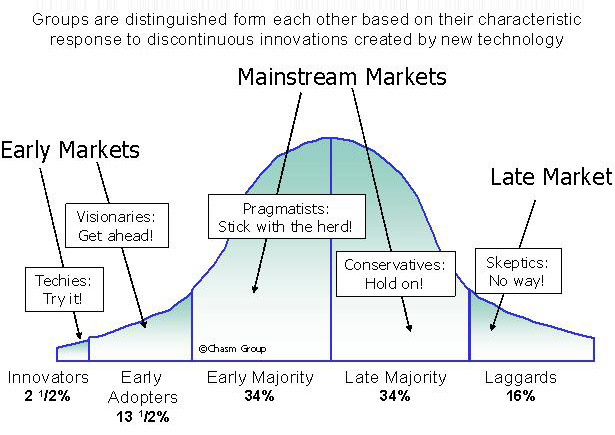
So my point is that if you're saying stuff like that about Tesla right now, you're probably not going to be one of the early adopters, but one from the early majority or late majority [1].
For the early adopters it's not going to matter that it takes hours to charge the car fully (mostly at night for them, so they won't consider it such a big issue), or 30 minutes to charge half of it. It's also not going to matter that they can't find charger for hundreds of miles at a time right now. For them it's all about "living the future now" and the potential of the technology. You know how they say that the future is already here, just not evenly distributed? Well they aren't the type of people that wait until it's "evenly distributed". They are the pioneer customers.
For early adopters it also won't matter that the car is still quite expensive right now, and doesn't have a "mainstream price". Also early adopters are not exactly known as the "pragmatic" type.
Now the early majority people, are quite the opposite (which is why the "chasm" can exist, because they have almost nothing in common in terms of how they look at technology, so an early majority guy, also known as a "pragmatist" won't use the early adopter that much for reference. They will look at the situation in a very pragmatic way. "Can I charge the car fast? Does it cost a reasonable amount of money? Can I charge it pretty much everywhere I want? How reliable is it? I don't want to be a 'beta' tester". These are the type of questions he's asking himself. You're probably in this group.
And the late majority customers or the "conservatives", are the people who will buy electric cars after they are almost dirt cheap, after almost everyone they know has one, after all the "issues" of electric cars have been fixed, and they are at least "good enough" for evertyhing they need, and from their point of view, at least as good as gas-powered cars. They won't buy them until all those criterias are met.
I think it's important to identify people like this, especially as the founder of the disruptive company, so you don't necessarily take the criticism as "maybe I'm just not doing something good here", but as a "these people are just not ready for it yet". And it's important to identify this so you don't immediately think that just because there's a lot of criticism in the beginning, it means it will fail. Of course even disruptive technologies can fail, but if they keep the early adopters happy, and keep improving it until it becomes good enough for the rest of the market, then it should be fine.
There are already chargers that charge in 5 minutes I believe, but they might be too expensive right now. It's only a matter of time before Tesla and others are using them. Tesla also promised that within 5 years they will cover the country with their free-charging (another big plus of Tesla's electric cars) superchargers (I believe every 80 miles? and they should expand them even further later on). Within 5 years the batteries should also get 50% or so more efficient, so longer range, or a cheaper price. Tesla also intends to introduce a $30,000 model in 2 years, and probably an even cheaper one 3 years later.
So they're getting there, and they are going to make their cars "good enough" for most people within 5-10 years. And I do believe they will also have a sustainable enough business and market to keep them growing until then. I think that by 2020 almost everyone in US will at least seriously consider buying an electric car. Between 2020 and 2030 electric cars should become fully mainstream and almost completely replace gas-powered cars (of course a minor part of the market will probably buy gas-powered cars even in 2040 - the laggards).
Disruptive technologies will have disadvantages (assuming it's a disruption from the bottom) but they need to have practical advantages too. "Living the future now" is cool -- I buy tech based on that -- but it's not a practical advantage. Compare this to the low cost hard drives of the 80s.
I think Tesla is actually trying to be disruptive from above, which is a perfectly reasonable strategy. Unfortunately, to be disruptive from above you have to be better than the existing tech, because you have to justify the premium price.
I may be nitpicking here, however. I completely agree with your point on how to take and evaluate criticism.
"Perhaps most worrying is the single-mindedness of the Internet hive mind that has, over the past few days, eaten up every word of Elon Musk."
Very untrue. From the beginning, a lot of people found fault in Musk's twitter and CNBC performances, and its clear in ensuing discussion here and elsewhere that people who initially sided with Musk are adjusting their views based on the blog post and the NYT defense.
This isn't to say that there aren't Elon evangelists, but the response wasn't as uniform as the visceral reaction to SOPA
It's hard to read these sources to determine the nature of the hive mind because the sorting algorithms gives higher weight to a few people with a lot of karma or popularity, so if you just looked at the top post you would see those people and erroneously conclude that the Internet agreed with them.
On twitter, for instance, you are most likely seeing tweets from popular people (which is not really representative). On reddit and HN the position on the page isn't representative of the pool's view.
If you see it from ppl who have lots of karma/popularity or popular ppl on twitter is exactly the point. These people are singled out because they have been promoted by others who agree with them. Just the same if someone who had the opposite view were upvoted/popular they would be singled out.
The claim was that he saw very few people question musk. And I am saying that its true if all you did was look at the first few comments. If you actually read the comments deeper in the discussion, you find a bevy of critical posts.
I don't disagree with what you are saying in general but I am refuting the claim about the quantity. My complaint is really with the algorithm used to determine what shows up at the top here.
I think there's something to be said about all the critical thinkers that have simply not yelled loudly about their opinion on the subject either way. And I think everyone who's yelling should consider that before they generalize entire communities.
Both you statement and the authors are based on there field of scope. Without knowing each it cant really be said ether way which is true. Here on HN it has been pretty 50/50 as far as i can tell.
Given that the author posted it here, I assumed HN was part of this scope. And if you think it's 50/50, then at least one part of the hive mind wasn't zealously defending Tesla.
We shouldn't mistake the HN hive mind, which is pretty firmly pro Elon Musk, with the internet hive mind which is pretty firmly indifferent to (a) Elon Musk, (b) the NY Times, (c) Tesla.
It's been strange to watch this saga unfold and see how quickly the idea that this data unequivocally discredits Broder has propagated. All the data shows me is that humans aren't as precise with data as computers can be. The one solid point of dispute is that Broder says he was cleared by Tesla representatives to leave Norwich with a very low charge, and Musk says he was not. Unfortunately, unless there are recordings of the conversations released, we may never know the truth of that.
I don't find the original article damning for the Model S- it just shows that the range is definitely affected by the cold, and that there are some additional factors that need to be considered that are different from gas engines. Any person who is considering an electric car should take those factors into account- for some they will be dealbreakers, and others they won't.
tl;dr: They take too long to charge so clearly nobody should wait 58 minutes instead of 46 or whatever.
Hell, why even bother charging for 46 minutes? Charge it for however long you estimate it takes you to fill up the gas in your other car, and complain when the car runs out then, too.
Not a good piece at all; can't say whether that reflects on the author too or this is just him/her being mindkilled over, of all things, charging time.
The point is that the author /did/ charge the car sufficiently. The car told him he could make each leg of the trip, and why would he waste an hour to charge the car completely? It would be silly to not spend 30 seconds to finish filling up a gas tank, but -- in my opinion -- it is perfectly reasonable to fill up an electric car to 50% above the necessary range and spare yourself significant waits.
Maybe a 58 minute charge at the last leg would've spared him the tow. But how could he have known? He had 125 miles to drive. He took the car to 185 miles of battery power.
That's like saying "I put just enough gas in the car to drive to the next station. I don't know how I ran out of gas early!"
There are a lot of factors in driving range. Tesla should be more conservative on their estimates, but realistically you don't fill a car just enough to get to the next station. And you definitely don't ignore low fuel warnings (even if you should have gotten a longer range.)
I'm not saying Tesla is perfect, but I do believe the NYT author wrote the article to make the car look bad to the average reader.
Assuming that the Model S uses the HV pack and a DC/DC to power the 12 V bus all of the time (like the Roadster), it would make sense that parking the car overnight in the cold would cause issues.
All other EVs that I know of shut off the battery contactors when the car is keyed off, and rely on a 12 V SLI battery (usually lead-acid) to support the vehicle when the power is off. The roadster did not do this, which is explained in Tesla's BMS documentation [1]. This means that any quiescent current consumed by the 12 V system will drain the main battery pack.
Honestly, the only fact that should matter is that Broder tried to drive 60+ miles when the car told him it could only do 32. The rest is just silliness because we don't really know the actual facts, its just heresy from both sides, until both raw data logs and call logs are released, which I doubt they will. Sure, that Broder is the NYT oil guy certainly doesnt help him though, and his lack of common sense and lack of basic understanding of physics may be the nail in the coffin of this issue, imo.
I'm learning that if my product or service does something very well don't risk making it look bad by chasing a use case that isn't (today) critical to our success. As nice as that car is if I'm going to do a long road trip I'm not going to inject 45 - 60 minute for recharging stops. I'd still buy one!. Just if I needed to do a long trip it'd be a rental/plane/train/second car scenario.
I am learning a lot about how not to respond to criticism (not to say i didnt know it beforehand, but its far easier to appreciate after seeing it happen to someone else) And the more responses we see, the more we can break down individual aspects and talk about what's right and what's wrong.
A mighty fine vehicle. My next vehicle will be either a diesel or electric for sure. Diesel engines were the highlight of the Chicago Auto Show a couple of weeks back so they're definitely making real inroads.
To be fair, UK gas mileage numbers are always higher than US numbers, for two reasons. 1) US and UK use different gas mileage verification (we have EPA, they have...). 2) A gallon in the UK is bigger than our gallon. It is not precisely the same unit of measurement.
When you convert the gallon sizes for US, it gets 52 MPG. No major engine servicing required until over 200k miles - why is the 5 series diesel not for sale in the US, seems nuts. Top Gear claimed last year that its pretty much "the perfect car"...I want :)
Do we really need these third party people chipping in? Tesla has provided their side, Broder has given his responses, and even CNN has done a story taking another Model S through the same overall route.
Everybody can take in the info if they're interested and decide for themselves.


If I woke up in the morning and went to my car to drive to work and I found I didn't have enough mileage - despite it having twice as much as I needed the night before - I'd be pretty annoyed. Yes, everyone says that you should leave the car plugged in over-night, but it's such a different way of working with cars and something which feels like it shouldn't be required, which I think makes people a little unsure about buying electric cars.