I agree with the basic argument that economic growth has a weakening correlation with job growth. However, the idea often proffered that you solve this by making people with jobs work less is silly. First, at the limit spreading the work around over more people still results in the same outcome. Second, it also assumes that the real problem is a shortage of jobs when the problem is actually a shortage of people capable of doing jobs where it makes economic sense to employ a person.
The problem is that we have a (figurative) glut of job openings for neurosurgeons and a severe shortage of neurosurgeons. The answer not to make the existing neurosurgeons work fewer hours; they are serving a valuable, irreplaceable (in an availability sense) function every hour they work. You can't give a lawyer, janitor, and accountant a crash course in neurosurgery, split the job between them, and expect a comparable result in the aggregate even though you created more jobs. At some point we will have to come to terms with the idea of decoupling a job from a decent life in the same way that jobs are being decoupled from economic growth.
The limit of this scenario is interesting as a hypothetical. When we get to the point where only 5% of the population is employable and they are all employed with very valuable skills that are in extremely short supply by definition, how are those people treated once the vast majority of the population depends on their continued work while 95% of the population no longer needs to work and is not usefully employable in any case? Can the 95% not working force the 5% to work long hours because there is a desperate need for their skills and talents which are not easily replaceable? It is a different political dynamic than when the majority of the population is contributing to the economy that supports society.
You're using examples that are fundamentally flawed, as the high end jobs you named tend to be folks more likely to be partners or principals in their own businesses.
For a good part of the 20th century, white-collar, salaried jobs were 40 hour jobs. Blue collar or non-exempt jobs were 40 hour jobs with overtime. Today, we declare almost everyone to be an exempt employee, work them ragged, and run as lean as possible. We do this because unlike in the 1960's, companies bear no cost -- those burnt out 45 year olds don't get disability pensions or insurance anymore. Those costs are borne by the public at large via social safety net programs.
If you mandated that most workers work only 40 hours per week, you would provide companies with a powerful incentive to deal with the high fixed costs associated with hiring an employee. It doesn't make "economic sense" to hire people because the law has been changed to make that the case. Now it makes sense to hire freelancers, contractors, etc who are easier to abuse.
I was not intending to name any particular high-end jobs. In fact, I picked "neurosurgeon" randomly so as to pick a profession far outside most people on this forum. The point that you missed is that the people who will still have jobs in this scenario are likely to be people in professions where the demand exceeds the supply and is not easily replaceable (or the demand would not exceed supply).
To bring it back to an HN audience, consider high-end software engineers. There is ferocious demand for them and they can demand wages that is an integer multiple of the average wage in the US and employers will pay that. Most of these companies hiring high-end software engineers are essentially in a price war with other companies. The pool of new software engineers capable of the job does not grow fast enough to fill the growth in demand. When a company poaches a software engineer from another company, all they have done is move the demand to a new company. Forcing people to work less does not create a vast pool of highly skilled workers with deep technical expertise, nor does it make it any easier to develop that expertise. The number of jobs increase on their own. The number of workers qualified to fill those jobs does not. As the average skill required of those jobs continues to rise, the number of qualified people will diminish.
Software engineers earn a multiple of the median wage, but not an order of magnitude more. The jobs our work displaces are order of magnitude material. If anything, compared to the value we create, we're grossly underpaid. I think this is due to the inability of employers to see us as fundamentally different from the workers our automation displaces. The perception remains (and i've seen this first hand) that developers are replaceable, and this means that there are limits to how much you're considered entitled to.
I would agree that some software engineers are underpaid. However, it is not legally enforced in the US unlike many countries, it is more of a statistical phenomenon. Many software engineers grossly underestimate the other costs associated with their efforts, which I state as a software engineer by trade with P&L responsibility. Most software engineers find pay that is at the level of their value to a first approximation.
The reality is that "developers" are replaceable, it is not just a perception. And by "developer" I mean developers that have a few years of experience under their belt but no real differentiating skills. This is an important distinction; I've met developers in their 40s with no differentiating skills despite decades of work history and developers fresh out of school that could materially differentiate themselves from ordinary developers. It is an important distinction. Developers with interesting skills are a lot less replaceable.
To be honest, I don't need any "developers" in the generic sense. My company does not hire them. We hire people with material skills that (1) we need and (2) are not widely available in the pool of people that call themselves "developers". I literally can't use the rest no matter how the conversation is framed. We pay well above the median wage for the developers we do hire because we know we are hiring them for their unique and valuable skill set. We absolutely pay for talent but have no interest in average talent.
US median household income in 2012 was $45,018 [Wikipedia]. There are certainly two-engineer households that make an order of magnitude more; actually there are individual engineers at large successful companies who make that much if you include stock and option grants (which you should, because the IRS certainly does).
Most engineers aren't so well-compensated. Most doctors aren't neurosurgeons, either.
Where are these developers at, and do they have decent working conditions and hours? $450k may not sound so glamorous if you work 80 hours a week in a hell hole.
I looked at Jane Street in college but it seems they start their developers at $100k with no bonus, i.e., less than Google, Facebook, etc., even though Manhattan is even more expensive than the Valley.
Finance is a bad example because the traders that software replaces make an order of magnitude more than median wage. So, the software deeloper in finance could be underpaid making an order of magnitude above median.
The best example of this is revenue per employee. Google and Apple have close to $1,000,000 revenue per employee. How many of their engineers are bringing home more than 20% of that?
> Now it makes sense to hire freelancers, contractors, etc who are easier to abuse.
I imagine it's different for software developers than, say, graphic designers or copywriters, but why do you feel freelancers/contractors are easier to abuse? In my experience, W2 is more likely to turn into "hey work 60 hours a week for free!" with little I can do about it because the employer is my sole source of income.
With contracting, I have my eggs split into multiple baskets. When one client tries to take advantage of me, their work is put on the back burner until they pay up / shape up / whatever and I still have a half-dozen other sources of income. So long as I'm semi-diligent about marketing, I'm now in the position of power. And sure, 60-hour weeks still happen, but I get paid for every hour, so there's that.
The reason for smaller pensions and so on aren't internal factors alone.
Often the fact is that some nation abroad can salary and staff workers, with fewer regulations, more health risks, lower costs and almost equivalent products.
If you mandated that most workers work only 40 hours per week, be cognizant that many companies would just throw in the towel. (And now you have two problems.)
This was the thesis of the original blog post. What do you do with a world or nation where 95% of the jobs are uneconomical to perform locally?
When job growth is no longer linked to the economy, how do you employ people?
Honestly the hard answer is "bring the standard of living around the world to the same level". Arguably the easiest way to do this is to lower your own.
The easy answer is to tax the wealthy. All that money generated through economic growth ends up somewhere. This is in fact what the the g20 are working on right now by developing a global tax on financial transactions.
Update: reflecting on this a bit more, if capital now is more economically useful than labor, this just means that 'jobs' have shifted from labor to capital. Instead of building a tax base on top of the labor force, we would need to build one on top of the capital force. It's quite unlikely that this can be done though.
Finally someone states the obvious. Find a way to globally tax all this profit. Take that tax money and use it to create free education, health care and much earlier social security. Devote tax money to public transit, research institutes, recreation. In short realize that all this capital growth should be used for something good.
Good luck with that "global" tax on financial transactions; there are numerous markets in second-tier countries which see this as an excellent competitive advantage, and those countries are motivated to resist pressure to implement the tax due to past histories of humiliation and exploitation by developed countries. The wealthy have a much higher ability to rearrange their lives and businesses to avoid taxes than average people, just ask Eduardo Saverin. As a practical proposal, taxing the wealthy is likely to result in a much less significant result than you would expect.
I don't think this is true. Will stock trading move to senegal because the NYSE has a per-trade tax? Will the rich move to chile because they're taxed less there? Wealthy people still have to live inside the system, they ony escape heavier taxation because they're allowed to.
>When job growth is no longer linked to the economy, how do you employ people?
Better yet, when job growth is no longer linked to the economy why do you employ people? At some point we will reach a point where there just isn't any real reason for most people to work. They won't be qualified for the work there is left to do and resources won't be scarce enough that we need an artificial determining factor like salary to decide who gets them.
Everyone devoting 40+ hours of their week to earning a living won't be a requirement forever so at some point humanity will need to think about that.
If by "throw in the towel" you mean "work diligently to find ways to replace workers with technology in order to remain profitable," then I fully agree with you. Heaping more burden on employers simply accelerates the process. It's all going to the same place in the end, so we're just talking about adjustments to the rate at which we get there anyway.
bunch of wimps, I grew up on a farm, still know people who farm. I work in an office now, its air conditioned, its heated, I sit all day, how is my forty hours or more being worked until ragged? Burned out at 45? Really? How about it being that your leaving so many productive hours on the table is what really is burning you out?
I am not saying you have to work fifty or sixty hours a week, I know some successful and happy people who have, but I am saying most people shut down at the end of their day as if work is all they are. So yeah, that forty and out is going to burn you out. Stay active, even if it means more work.
Get a second job, get a hobby. Do something. Sometimes I think that farm life was better because there was always something to do. People turn off more than their job when they adapt that forty hour mindset.
Horrible comparison. Software development could hardly be further from working on a farm. Farm is physically demanding but not remotely mentally so. Move hay from the barn to the cattle feeding areas. Sow this part with the currently planned plants, etc. It will wear you out physically but your body will get used to that and you can push yourself quite far. By contrast, if your mind won't work on a problem anymore then no amount of pleading, begging, yelling, etc. will force it to.
Software development is closer to writing fiction novels. Now how many fiction authors do you know of who write 40+ hours per week for months on end? Has it ever been done at all?
That wasn't what was being said... What was being said was "leaving the office and watching tv for 5 hours will run you down". Or that people should be active for more than 40 hours per week.
"most people shut down at the end of their day as if work is all they are"
I think lack of exercise is a large part of this. Regular exercise gives you more energy. I'm afraid I have no references for this, but I'm reliably informed that there are.
So I would modify this as "Do exercise. Not to much. Then do what matters to you".
I think at the point where it is 5%/95% it will become apparent enough that there is a problem that a solution will have to be proposed.
Though you could end up with an interesting sort of inverse slavery where the unemployed masses resort to coercion to force the highly educated/intelligent minority into doing the work for them.
    What I think is scarier though is thinking about
    what happens if the unemployment rate hits say 20%
    and starts moving towards 30%.
The majority of people will still be in work, so those who are unemployed will still have a stigma attached and you will have the usual arguments about "why should I have to work to pay somebody to stay at home?".
These arguments will become louder as the amount of money that will have to be collected through tax from those who are working to support those who are not will become a huge sum.
At that point a far right wing party who campaigns on the basis of removing all government support from those who do not work could gain considerable traction and possibly be elected.
At that point you have a huge section of the population without any means at all, this will naturally lead to massive crime and civil unrest. At which point the government will have no choice but to respond with strong force against a large section of the population.
There's another official rate rate you can check out. The "real" unemployment rate, which measures everybody considered unemployed plus a lot of others who are falling through the cracks. It's called the U-6 unemployment. The government publishes this data in the same monthly report as all the other official employment numbers, and anybody can find it on the Internet. In the US the U-6 unemployment is [b]16.2%[/b] and counting. You could also just count the "Americans-on-Food-Stamps"number. It's 46 Million.
The national monthly [1] and state annual average [2] "alternative measures of labor underutilisation" stats are easy to find, but do you know where to get monthly or quarterly data by state, or better, by county?
People still do have work, though. They just work "black" and eventually receive unemployment benefits at the same time. The official numbers just don't reflect reality. That said, the economic situation in Spain is not great at the moment, but still not as bad as reported by the media sometimes.
Inverse slavery won't happen because the minority will simply leave. This is what happened in Eastern Europe before the fall of communism, and what currently happens in places like Cuba and Venezuela. This is even happening to Western Europe right now; I've personally met several intelligent, ambitious 20-something French expats who indicated that they have no intention of returning to France due to excessive taxation and lack of opportunity.
> Can the 95% not working force the 5% to work long hours because there is a desperate need for their skills and talents which are not easily replaceable?
Indirectly, perhaps via taxation. You can look around (at least here in US/CA) to see what may happen. The unemployable ones will be voting for increasingly larger government to "employ" themselves while simultaneously raising taxes on the working to pay for unemployables' retirement.
As Spooky23 pointed out below, their very "unemployability" is also a function of public policies (like employer-linked retirement accounts and health insurance) that continually increase the fixed-costs of each marginal worker, discouraging hiring.
You're neurosurgeon scenario is interesting because healthcare is the one industry where there are proven models where we can deskill jobs and by this create many good jobs for people with less training.
One example is that of minute clinics where nurses + computers are doing the job of a physician.It's cheaper , it's a good job and the nurses can afford more time per patient , so this creates more jobs. And the u.s. don't steal doctors from the this world this way , which is nice.
There is/could be plenty of stuff like that in healthcare.
Did you think about this at all before responding? The majority of health care is routine stuff that a nurse + computer can easily do. The nurse+computer combo can also determine if the issue is beyond their skill level.
Why are we wasting valuable doctor time with routine issues? That's not an efficient use of anything.
Not true because if the profits aren't high enough, you won't be able to pay these workers enough money for it to be interesting to them.
If you can make 2 cents/hour by employing someone, that doesn't mean someone will accept the job. People will prefer not working (and maybe resorting to crime to survive) at all rather than not making enough to live properly.
I believe we are already at the limit here. Many people work for less than enough to live properly. In France, we know what happens when people start starving to death while others are fat and rich.
The social measures are meant to prevent the poor population from killing the rich. It's the price to pay for peace and security.
>>Second, it also assumes that the real problem is a shortage of jobs when the problem is actually a shortage of people capable of doing jobs where it makes economic sense to employ a person.
As someone who holds a degree in economics, I can tell you with absolute certainty that the problem is not a lack of people who are capable of doing the jobs, but rather a lack of demand for the products and services that the said job would provide.
If a job provides products and services for which there is no demand, it doesn't make economic sense to employ someone to do that job. So the fact that such jobs exist, and there are people capable of doing them, doesn't change the point of what you quoted.
Ok, but you're thinking in circles here, aren't you ? If you only count jobs that make economic sense then
1) any kind of job that is merely self-sustaining doesn't count. That might not be much in the US, in many countries it's 80% or more of the population. You can interpret this in many ways, starting at including only subsistence farmers, or you could be fair and count any job that doesn't provide disposable income.*
2) any kind of job that is merely checking others, or some form of administration or social program doesn't contribute to the economy. This means most government jobs, and for example any healthcare job that is paid for mostly by medicare.
3) Things like police and military ... ditto.
So what are the figures now ? I'm willing to bet that worldwide, >80% of people do not have an economically useful function. That number is rising, fast. That's what everybody is complaining about.
Making all these people retrain, and actually become good at an economically useful function, assuming it is possible at all, is not going to happen. About that assumption : know any industry sector that could use >4.6 billion people ? I know we could use maybe 1-2 million extra developers, but that would cover everything pretty well. The employment provided by that, worldwide, is but a rounding error.
You also assume that, when push comes to shove, those 80% of people are going to let you have your economically profitable position at all. When I look at my own lifetime, that seems so obviously true ... it seems insane to question it. When I read the history of the 20 years before my birth or talk to my father, that seems a risky proposition. When I read the history of the last century or talk to my grandfather, that idea quickly becomes entirely ridiculous. The amount of work the entire economy can usefully provide pales to what war can provide. Of course, those jobs come at a cost you might find you're not willing to pay, but this is a choice that will be made for you.
* You could even be extremely cruel and take that any job inside a country that's not running a trade surplus obviously is not economically useful to the world. It's just spinning around at best. But that would take us so close to 100% uselessness it's hard to argue that. Also keep in mind that the net economic usefulness of the entire world, of course, has to be zero. Once you pass a certain scale the economy's only remaining function is to keep humans busy.
Someone said "the problem is X", someone else said "the problem is Y", and I said "Y is a subset of X". You seem to be attributing many thoughts to me which I have not expressed.
The question isn't whether the 95% can do neurosurgery. It's whether there's anything they can do better than a robot that other people want.
Given the overall flexibility of the human mind, and the complete failure of general-purpose AI, I bet there's something. I could be convinced otherwise, but it would require much stronger evidence than a half decade of unemployment that could easily come from economic or political causes.
Do you really believe the success (at this time in technology) of general-purpose AI has a strong correlation to the potential for human labor to be replaced by machine labor?
It would seem with the plethora of startups being created every day at providing services and products in different markets by utilizing technology means that there will be plenty of different companies willing to focus on a particular market / product / service to develop their AI. Does the success of general-purpose AI really limit the possibility of developing specialized machine labor AI? I can see how it will be slower to reach the point of replacing all of these jobs than if general-purpose AI worked well, but I don't think it really limits the possibility.
So long as humans can do general purpose thinking and machines can't, any task that requires general purpose thinking will require humans.
Many of these tasks may be things that go undone now, but will become affordable when machine-made stuff gets cheaper and removes expenses from people's budgets.
Assuming the economics doesn't mess everything up. Which it easily could. But the fundamental problem is self-solving until we run out of applications of general purpose thinking.
The failure of general-purpose AI is simply the failure of general purpose robots. We've already seen the future: specialized "appliance" robots that do one job to perfection. They don't need to duplicate human conciseness, they need only enough AI to accurately do one specific job and nothing more. I don't think that's hard at all, just currently expensive.
That only encourages people to work the minimum at X shitty job, and then leave. Then when you get unemployment, you also work contract jobs and other cash jobs.
Like hell anyone would report it, considering how bad unemployment insurance is. "you were paid 102k a year, but were downsized. Now get paid 446/mo."
"when the problem is actually a shortage of people capable of doing jobs where it makes economic sense to employ a person"
I would argue that there's another way of looking at it, there are actually a lot less jobs that need doing that unskilled people can do. When food production and manufacturing become largely automated, and there are only so many people can go into the service industry, what happens?
It's a very difficult problem. Thankfully not one that I (as a skilled worker/business owner) am going to be on the sharp end of.
Please stop the emotional diarrhea. You have an intellect, so use it.
Reread my comment again and this time think about each word. You will find that "kill" or an equivalent word does not appear once.
What does appear is "genetic engineers". What do genetic engineers do? They create new organisms with genetic sequences chosen to encourage particular traits. Traits like intelligence and creativity.
Then we simply sit back and wait for the wild-type organisms to go extinct. No killing is needed, as even a few seconds of reflection would have let you find out for yourself.
Why hello my old friend, the Lump of Labor Fallacy![1] I get why people think this in theory. But they never seem to notice that we have been living in an age of untold abundance for quite a while.
From the perspective of anybody who grew up in a subsistence agriculture economy (which is the perspective of most people in human history), we developed-nations types live better than kings. And all the agriculture jobs are gone! From that viewpoint, none of us should need to work.
But we still mostly have jobs. Why? My take is that, as the Buddha said, desires are numberless. People find new things to want, and other people find ways to satisfy those needs. This will always happen.
Sure, it's possible that this time machines will actually eliminate all the jobs, and we'll live like the lillies of the field. But that has been failing to happen for the two centuries since the Industrial Revolution began. And people have been fearing machine-induced joblessness since the beginning. [2]
"But that has been failing to happen for the two centuries since the Industrial Revolution began. And people have been fearing machine-induced joblessness since the beginning."
What has actually happened is that as labor was replaced or reduced in one industry, jobs moved to others. The agricultural revolution reduced the cost of food, thereby reducing the amount of "money" that a human had to earn to survive. They could then be employed doing something else. During the industrial revolution more goods were produced cheaply, making them more affordable, and allowing more people to buy them. The industrial revolution increased production but still required people. Each innovation created a new opportunity that required people to do the work.
At each stage, we dealt with hierarchy of needs. Food. Clothing. Shelter.
The assumption made in the quote above is that there is an endless list of jobs, and that the fact that we've had 200 years without the end of society proves it. Analysis of the data, however, suggests that at each stage, the "revolution" has left less jobs available, and/or those jobs have paid lower salaries. The trend is that at some point in the future, human labor and, some time later, human thought will have such tiny value as to be worthless.
A robot or an AI will be vastly more cost effective than paying a slow moving, slow thinking organic entity that requires money in order to purchase proteins, carbohydrates and increasingly rare elements like phosphorus.
Just as for millennia, smart people have been attempting to fly, so too have smart people been attempting to eliminate humans from production. Why are we surprised, why do we deny, that they are succeeding?
The evidence is right here. Nobody here on HN is forming a startup to automate some aspect of our lives with the express goal that the labor saved be used to create new jobs. Nobody is saying "My start-up automates X so that the people who were paid to do X can get a new job doing Y". That last part is just not on anybody's radar. Does PG ask this in YC interviews: "And what will the people who are made unemployed by your new startup do?" No. So why are we surprised that the world is turning out exactly according to all our plans?
The article is correct and asks the right question: "The jobs are not coming back. What are we going to do about it?"
It is entirely possible to invent technology that both saves on labor costs and creates more jobs in aggregate. A historical example was the very thing the luddites protested: weaving machines that replaced expensive weavers with greater numbers of ultra-cheap immigrants.
Usability can make it so normal untrained people can do something that used to require expensive experts. It's also a kind of technology we can all agree on, and many of us work on it every day.
Why are you assuming all productivity increases are reducing labor needs? Look at your YC example: AirBnB's entire premise is to make use of capital that would otherwise go to waste (unused residential real estate). When you lower the cost of capital, you increase the value of complimentary labor. If nothing else, I'm sure it's boosted demand for the local housecleaners. Given how elastic vacationing is as a whole, the dollars saved by the travelers are almost certainly being shifted into other goods and services at the destination.
Nobody says it now. Nobody has said it at any point in the past, either. But here we are, all as busy as ever.
I look forward to seeing your data, but looking at historical workforce participation rates and average wealth suggests that the singularity has not quite happened yet.
Well, except for the unemployed people who're the starting point of this whole discussion.
Fundamentally, even if we can keep finding more jobs for people to do, is that what we want? We keep buying ever more frivolous and unnecessary trinkets, egged on by expensive marketing ('The perfect gift!'). Then when money is tighter, we remember that we can actually be quite happy without all that, and jobs that were sustained by producing cheap tat dry up.
At some point, the sum of human happiness must be increased by having more leisure time, not by inventing yet more economic activity. But our society is structured so that, if we reduce labour needs by 10%, 10% of the workforce are left with nothing to do, and the other 90% resent the 'scroungers'. You can see this in the 'makers vs. takers' rhetoric of some politicians.
What if we could, instead, share the available work out so that everyone did 10% less work? Obviously that would be very difficult, but it's something to aim for, as an alternative to the constant hunt for jobs.
I'm just going to go out on a limb here and say the current rise in unemployment might have something to do with the largest economic crisis since the Great Depression. One triggered by a giant real estate bubble and financial "engineering" that was, at best, criminally negligent. And a current incomprehensible fashion for "austerity".
You've also created a false dichotomy. The choice isn't between massive unemployment and a spiral of consumerism. People can do other things with their time.
What's happening in food is a fine example. People are intentionally spending more money on slow food, on organic food, on local growth and production. That's creating a lot of jobs. And even better, a lot of entrepreneurs.
We aren't out of growth opportunities until we're out of problems. Education, the environment, entertainment, the arts, parks, public safety: all have problems that people want to fix. The solution to increasing wealth isn't to force people to work less; it's to find valuable things for everybody to do.
Food is an interesting case. People are, in a way, turning industrialism backwards - making a conscious choice to support economic 'inefficiency', in part because of the social problems we feel it has brought about. I'll have to think more about that kind of 'slow capitalism'.
I was of course playing devil's advocate to an extent. I agree with you that there's still plenty of important things to be done. I note, though, that most of the problems you list aren't going to be solved by cutting back and hoping to stimulate for-profit corporations. Market forces aren't going to fix the environment, for example.
Some people have proposed a 'green new deal', a major increase in government spending to tackle those kinds of problems and provide jobs. I'm not qualified to say whether that would work, and at the moment it seems to be politically impossible to even discuss.
I agree with you that many problems aren't currently fixable by existing markets, which is often why the problems are still problems. But a lot of environmental problems go away when you stop allowing negative externalities and treat them as market problems. Overfishing, for example, has a bunch of great examples of improvement. The same is true for pollution markets.
Positive externalities are harder to fix with markets. Improving society's level of education, for example, benefits everybody; it's not clear who to charge.
But I certainly agree that existing politics in the US makes it hard to solve any of these things. Or even admit that there are problems. I look forward to the pendulum swinging back toward sanity.
The singularity isn't profitable. The end-game for humans (distributed consciousness without death) is too equal all around to ever become a reality so long as greed rules us.
For a closer look at that endgame, and why it in fact would be very far from egalitarian, check out http://vimeo.com/54714736 ... Essentially, variable time perception is the key.
"human labor ... will have such tiny value as to be worthless"
Hairdressers. Here on HN there is the background assumption that face to face office work is useless and sitting at a desk at home works just as well. Its so entrenched that occasionally you'll get an ultra-extremist counterreaction that of course we all need to work in offices because no multiple office multinationals exist, or some such nonsense.
Anyway, Hairdressers. There's a large fraction of the population who like driving 30 minutes, waiting 30 more minutes, gossiping with the hair lady, and paying $30 for the privilege, and spending 30 minutes driving back home. And they call it relaxing and "spa like" and a privilege blah blah. Personally to show my HN street cred I do the equiv of work at home and spend 5 minutes with a buzz-cut thing and a #3 attachment every two weeks which means my Imperial hair is always between 3/8 and 1/2 inch long. But the world is full of people who wanna spend enormous amounts of their limited time and money for someone else to F around with their hair.
Ditto investment advisors (duh, just push the highest commission), Insurance salesman (duh, figure out the most they can spend, convince them to spend a little more, and be a data entry clerk), real estate (see insurance salesmen, but without the data entry skills). XXX personal services.
If you've ever read the HHGTTG the "B Ark" is not a current social commentary (well, mostly) its more a blueprint for the future. When I/everyone can no longer make money slinging code I'll probably be running my buzz cut hair trimmer with #3 attachment for a line of you goofballs going around the block, for $30 a piece and it'll take you 2 hours and you'll be just thrilled at the privilege of getting a genuine VLM haircut. And I'll take my dough and do equally stupid things like ask my life insurance salesman if I'm spending enough with him, followed by a nice $50 restaurant dinner cooked and served by genuine humans blah blah blah.
Sorry, but the B Ark was a satire on Thatcherism. It was supposed to show what a fucking stupid joke it would be to condemn 1/3 of the population as "useless" and kill them off.
"This will always happen." I am dubious. It seems a lot of econ people hold this notion with almost religious faith. And I may be mistaken in my doubting and you may be correct. But I wonder if a paradigm shift is on the horizon that will wash some old truths away for good.
I see new kinds of jobs being created all the time. For example, look at the explosive growth of the entertainment industry. How about the car customization industry? People pay a lot of money for personalized cars. The fashion industry. Comic book conventions are a big industry. Sports, sports equipment, trainers, etc. How about that minor industry to escort hundreds of amateurs up Mt. Everest each year?
The increasing wealth of society and the decreasing costs of food/shelter enable all these more frivolous demands.
> The increasing wealth of society and the decreasing costs of food/shelter enable all these more frivolous demands.
Where do you live? Real wages haven't changed, spending power has dropped significantly, and inflation has multipled quite a few fold the costs of basic goods over the last 30 years. At least in the US.
The inflation adjusted wage hasn't gone up. Housing and food have gotten tremendously more expensive due to land scarcity and the dramatic inefficiencies of housing and food distribution. We have superfluous tech advantages because they are untapped resources, like silicon transistors and graphene, but until we have automated farms, or skyscraper farms with artificial lighting, or molecular fabrication to such a degree that printers could print proteins and aminos, it is a real problem.
Land scarcity? Where do you live? The EU population density is something like 4x the US, admittedly we don't have inhospitable desert wastelands but there's a lot of space still left.
America has laws that restrict you from building dense European-style or Asian-style apartment buildings, effectively forcing everyone into quarter-acre land plots in the suburbs. This is actually considered a major driver of inefficiency and waste in the American economy.
While they have running water, electricity, lights, internet, all kinds of fresh food on demand, Health Care that actually works, all kinds of abundance like that.
Assuming we are talking about people living in a Developed nation.
GP probably meant effective medicine, not a 'health care system that is shiny and fair'.
If you measure historically, being able to buy a bottle of aspirin is some sort of miracle. Never mind vaccines, treatments for disease or antibiotics (many vaccines and antibiotics are more or less free).
The problem is that "shiny and fair" is linked to the "miracles". Vaccines mostly work to eliminate disease by means of herd immunity. If vaccines because an individualistic economic luxury-good, they will stop working and we will return to the dark days of mass plagues.
Meanwhile one of the wealthiest men ever to live is (one of the many people working towards) making sure that polio vaccines will not be necessary in the future. How bleak.
You replied sarcastically to someone that labeled access to effective medicine a problem of abundance. The fact that it is true seems a little relevant.
Compared to a subsistence agriculture economy? You must be kidding me. Good luck finding somebody tilling a few acres of land in sub-Saharan Africa who wouldn't instantly trade places with pretty much anybody in America.
Yes, people in the first world end up dissatisfied with what they've got. But that's my point. Desires are numberless.
It isn't that ALL of a fixed number of jobs are going away: that is not what the article is saying. it is saying that the need for good paying manual labor is changing faster than societies' ability to cope with it. Not only that, we are pretty much doing the exact opposite of what we should be doing.
Depends on what you're looking at. Look at the credits for modern films. These days they use more people, not fewer.
Or look at food. We've already figured out what a future of minimum-cost food looks like. There's a lot of growth in more human-intensive agriculture, production, and cooking. The best restaurants aren't the ones with the most automation.
Sure, if Strong AI Jesus ever descends from the clouds or comes up from the labs, some things may change. But maybe not. Humans are evolved to deal with other humans. They like doing it.
True, there are certainly jobs for skilled filmmakers , chefs etc.
But on the other hand there aren't any jobs for tellers at video rental stores (they are probably replaced by a lower number of software developers at netflix).
The difference is there was a rational reason to put people to work as capital and rational incentives were established to get people to work. What happens in a hypothetical when the only "numberless desires" unmet are those that are literally astronomical in scope due to abundance?
I was pleasantly surprised to read this and not get thrown into a crazy post-scarcity singularity hugfest. I was really worried about that.
Anyways, I think the novelty to almost anyone here of the idea of decreasing job availability has worn off--as the author states, job and capital growth are decoupled. I don't think anyone would really argue that point.
There are, though, some questions that suggest themselves, a few of which have even already appeared in this thread:
* Is there some kind of morality involved in electing not to work, if the option is available but not required?
* Do we want to work towards establishing a society where leisure is the default, guaranteed state?
* If we do want to work towards that state, what then does it mean to live a good life?
* If we don't want to work towards that state, what is our justification for inflicting toil upon future generations?
* If we manage to eliminate all non-creative jobs (stocking, cooking, manufacturing, etc.), what do we do with all those folks? Is it reasonable to ask them to retrain?
Some of the great questions of life, while perhaps not unsolvable, are neatly sidestepped in one's pursuit of the lower levels of Maslowe's hierarchy; being unable to make rent has more than once gotten me out of a funk caused by a girl, for example.
If leisure becomes the default (which job trends would tend to suggest), it becomes a lot harder to punt on these existential issues--you don't get the shelter of the daily grind or shitty retail job to protect you.
"* If we do want to work towards that state, what then does it mean to live a good life?"
We solved that a long time ago. Rich people's offspring (ancient equiv of trustafarians) got an education to learn how to live the good life. Aka the liberal arts. Philosophy, etc.
There is a long corrupt history afterwards where at least some businesses wanted the aristocracy in their corporation, so suddenly "gettin an education" becomes an aspirational good for the middle class and down. Then it turns out a world owned by very rich philosopher kings works pretty well, you can't have a world operated by philosopher peons, so "education" is very carefully conflated with "training" and for prole-schools has completely replaced education with training (see vocational and tech schools) Then the middle class has to have ALL kids pay ANYTHING at all, ANYTHING, in order to keep up with the other kids who are already paying ANYTHING they'd like to charge as tuition. In fact the .gov has their backs, raise tuition sky high the .gov will guarantee the loans.
So kids (aka 20-somethings) today are poor, because for generations they've been willing to pay "anything" for credentials so the monopoly-ish providers are more than willing to charge "anything" (kinda like health care). All because GGG-Grandpa lost his job to Sir Earl Duke of BumbleF and politely blamed it on his lack of .edu rather than being a peasant where Sir Earl is a Duke. Its the long term effect generations later of monarchy-phillia or whatever its called.
>Do we want to work towards establishing a society where leisure is the default, guaranteed state?
Leisure will not be the "default, guaranteed state".
Slums and ghettos with huge masses of devastated ex-middle class left to mostly rot and a much smaller semi-middle-class and extra rich leave in closed guarded communities will be the default.
A leisure-filled society is an inherently stable thing. It's just not a direction we're headed. But perhaps those of us with long-term vision can steer things a little.
After all, those slums aren't a stable thing. They're a civil war waiting to happen.
The future is already here, just not evenly distributed. SFO doesn't look like Detroit... yet, but give it time for the brush strokes in the paint to smooth out.
LOL what makes you think he's not living in Argentina or Greece or Detroit or (insert pretty much any 3rd world) today?
You'd like to Think it can't happen to you, maybe even make fun of people who suggest it could happen so you'll feed better. That doesn't mean it won't happen to you anyway.
The startup lesson here is its OK to have your illusions, especially if they're fun or make you feel good, but making decisions based on illusions being true leads to disaster more often than not.
>People love to believe the sky is falling. Fortunately, it rarely does.
Survivorship bias. That and (if an American) living in a country with a shortish history (mostly upwards until now).
The sky has fallen tons of times for lots of cultures and even whole empires.
Once there was a Babylon for real and an assorted thriving empire with millions of people. Once the Roman Empire ruled the world. Once Native American Indias lived and roamed their land as they pleased. Once there was a thriving Jewish community in Germany and Europe.
If leisure becomes the default (which job trends would tend to suggest), it becomes a lot harder to punt on these existential issues--you don't get the shelter of the daily grind or shitty retail job to protect you.
My mother always calls that "a better class of problem". God willing humanity should someday have to confront its existential "issues" like a bunch of spoiled schoolchildren rather than going cradle-to-grave without confronting anything more important than how to reach next year!
The way you put issues in quotes and use the word 'spoiled' implies that even though you call it a "better class" of problem, you still look down on it and wouldn't want it.
I'm using a little bit of sarcasm in acknowledgement to the fact that one person's existential issue is another person's frivolous rant. We generally look down on teenage existential angst, don't we? Well how are they experiencing anything other than a real look at human life unconstrained by the need to earn your bread (since someone else already buys theirs)?
I think it's easily possible to reorganize society around higher goals than material production (many societies have been so-organized), but that also requires a bunch more effort than just instituting mass leisure and letting everyone figure it out for themselves.
There's also a level of Yiddish sarcasm in the statement: I talk like I look down on something to sarcastically praise it. (I realize this sounds stupid, but you would never just praise something, because that would bring bad luck on it.... is the thought. It's a thing.)
To be honest, capital vs job growth has been delinked locally, but I suspect it is still linked globally.
A huge number of people in India and China are now employed for example. The tablets being bought and sold around the world are being manufactured somewhere.
I am a bit surprised by the comments here, which constantly look temporally, while the issue really is geographic.
China/India/Brazil and the third world workers endure horrible conditions to create work.
They are cheaper than automation.
Its only once they start unionizing, and fighting for their rights (after they have been able to improve their country in the first place), that the automation starts appearing in their countries.
In essence, isn't work going to those most capable and efficient at working at it, with lip service being paid to labor and human rights?
> that the automation starts appearing in their countries
Well automation is already happening there - do you think the ipads are built entirely by hand? Automation will continue to increase globally whether they unionize or not, those types of things will only accelerate an inevitable process.
I'm looking at a plant to manufacture/assemble gen sets in India, and over time its been moved slowly from manual labor to slightly automated.
China is far from fully automated though - witness Foxconn finding that its workers are asking for more, and their search to replace people with machines.
I don't think the decoupling argument has been made as conclusively as everyone seems to be assuming. Look at the source in the OP for this [1]: These are some seriously misleading graphs.
First, plotting both labor productivity and GDP doesn't make much sense, as the former is almost exactly determined by the latter. They're just measuring GDP.
Secondly, they zoom in on the post-WWII era, then proceed to ignore the biggest long-term economic issues of the time period: The hangover from WWII, with the corresponding stable demand for US infrastructure and labor as the world rebuilt itself, and the housing/derivitaves bubble, as a combination of fraud and self-delusion caused the computed GDP numbers to shoot off into the hypothetical-wealth stratosphere even as the economy was faltering.
Once you account for the elephants in the room, there's nothing surprising left in the graph that would lead you to believe that the robotic obsolescence of labor is around the corner.
I think Maslow's hierarchy implicitly answers many of your questions. "Keeping your head above water" would be defined in terms of navigating existential nihilism and meaningful self-actualization not unlike we navigate our more fundamental needs.
Maybe capital growth is decoupled from job growth, but why is it that Apple and Google and Walmart and Target and Whole Foods and Starbucks and GE and your local busy restaurant and market and machine shop are still hiring like bananas?
Demand causes job growth. No amount of automation is going to prevent an Apple Store from needing a genius or a Gap from needing shirt folders. We still need plumbers and nurses and CNC machinists and spot welders and longshoremen.
Why is Kia still hiring in West Point, Georgia? And, where are those robotic unbuttoned-shirt baseball-cap-cocked-to-the-side douchebag bots that greet my nephew at Abercrombie? Oh, right, they're still human.
A lot of industries and companies are still trying to climb out of the 5 year funk we're arguably still in. A lot more companies realized that they could simply work their remaining people into the ground, create an atmosphere of uncertainty and abject fealty, and pocket the difference rather than increase headcount.
My theory? We're in a whole new ballgame full of the following people:
* Those who are willing to get their hands dirty
* Temporary workers and those who like part-time work for the flexible hours and variety of gigs
* Those smart enough to get degrees and certification past their high school diploma or GED, and get those in-demand technical jobs in manufacturing, healthcare, technology, and services
* A bunch of people who are either unwilling or unable to accept any of the above and/or are still looking for Dilbertesque nothing jobs in cubicles in office parks overlooking other office parks in positions at whatever companies and having longer titles than responsibilities (e.g., Assistant to the Regional Inside Sales Manager, Northeast US [except NY]).
Abercrombie isn't going to buy a robot greeter to a replace a human employee, they are just going to close more stores and get rid of the greeter, the folder, the cashier, the manager, the janitor, and the driver.
Think about how many human hands would be displaced if when I ordered an Abercrombie shirt online, it was shipped to my house directly from a factory in China. That may not be happening yet, but there is still that potential level of disruption ahead. You'll probably still need your barrista though!
I think this is a major revolution coming. The entire service industry is built off people having to drive to stores, interact with humans, and buy things there. It is much more demand reactive and inventory efficient to ship from the source the things we want, planning them in advance, and delivering them directly.
I mean, I would personally never have a waiter at a restaurant. Put a touchscreen on the table, let me pick what I want, and either I'll go to the kitchen and pick it up (and why can't a robot do the cooking?) and take it back, or even better, have it delivered to the table.
Why am I in a restaurant ordering? Why can't I just order take out and have an automated car delivery service drop it off?
Its much more expensive to have human restaurant staff, and fundamentally doesn't matter if you're willing to admit it or not but dating and "conspicuous consumption" already drives those expenses. Unless you've never gone on a date fancier than a picnic or perhaps McDonalds and then bragged about it to friends...
The startup lesson for today is the first SUCCESSFUL game changing industry altering automated restaurant is going to sell $500 steaks out of a vending machine not $0.50 hamburgers. And its not solely because of simple marketing buzz either. It needs to be the most expensive place in the market. Look at peapod, by far the most expensive possible way to get a bag of cheetos in my cabinet, even though its probably the cheapest to supply (aka the most profitable way). The ipod did not succeed because it was the cheapest player on the shelf at walmart.
They will always exist because the presence and demeanour of staff on the restaurant floor sets the expectation for social interaction in the immediate environment. One function of the waiting staff is to provide a degree of protection from unwanted interactions from other patrons in the restaurant. One of the reasons you go to a restaurant (rather than eating at home) is to experience the pleasantness of being part of a communal group without the risks of eating beside random strangers. The staff provide that mediation (and contribute to the milieu) and are not going to be replaced by robots any time soon.
Why can't a robot do the cooking? Because cooking is an art and we continually demand novelty.
No amount of automation is going to prevent an Apple Store from needing a genius or a Gap from needing shirt folders.
Really? You can't imagine a robotic shirt-folding device could ever be invented? Whatever tech news you're paying attention to is about 70 years out of date.
That's not counting that if shirts were on hangers and you could easily get a hanger of "everything that fits me well" then they wouldn't need folding at all.
The Apple example is interesting, when you consider their market cap vs the number of people they employ (around half a million in the US according to http://www.apple.com/about/job-creation/).
Now, I imagine that most of these jobs (in the US) are going to be store workers. Consider that Apple used to exist without any Apple stores at all. There will come a point when they have a store in every town that matters and they will mostly stop hiring store staff (apart from as replacements).
In fact you could even consider the possibility that they could probably close all of their stores without damaging their market cap that much, but it would be devastating from a job creation point of view.
Think of the other tech giants like Facebook, Google etc. How many jobs do they create vs their revenue?
Exactly - those companies are hiring because they're successful. Why are they successful? Because they have better margins than their competitors. Sure, they're hiring, but they have the most attractive (from their perspective) ratio of employees to revenue.
Well said, with one caveat: that ballgame isn't new; it's the same ballgame that's been played, with the same players, since the dawn of the Industrial Revolution. The sky has been perpetually falling for 300 years, yet here we are, banging away on our keyboards in our climate-controlled abodes with full bellies, worrying about whether we'll get rich or merely live comfortably.
The capacity of people to believe that the end is nigh via any of a seemingly infinite number of imaginative scenarios despite the historical precedent to the contrary is simply stunning.
I understand what you're trying to say, and I agree to some extent, but you're making some very big assumptions.
> The sky has been perpetually falling for 300 years, yet here we are
Maybe the sky takes 300 years to fall. Did you think about it that way?
> The capacity of people to believe that the end is nigh [..] despite the historical precedent to the contrary
What historical precedent? Come on, tell me what happened to the last human civilisation to go through industrialisation and computerisation and, lastly, robotification. I'm dying to know what happened to them and see what lessons we can learn from how they handled the utter demise of manual and low-skill labour in their societies.
Don't be obtuse. I'm referring to the historical precedent set by the last million times some group believed that the world was going to shit, and that their group knew exactly how. Historical precedent clearly tends towards continuation and solutions for the problems that plague us rather than death and destruction because we could not figure them out.
Of course I've thought about it that way, but now let me ask you this: why do you want to think about it that way? What is it inside of you that drives you to believe that THAT way is the correct way to think about it? Doesn't the fact that you are worrying about it mean that the problem is comprehensible to the majority of the human race, that there are probably also millions of other people worrying about it, that the more of a problem that particular problem becomes, the more people will think about it, and that a solution will probably be found? How many times does that situation have to play out before people no longer listen to that demon inside of them which says that the unknown will destroy all of us? Answer: never I hope, because it is that demon which saves us, time and time again.
Stop trying to cast people's legitimate arguments as mere products of some deep-seated fear of the unknown. If you talk like that we can't have any kind of proper discussion. I could just as easily retort that your rose-coloured reassurances are nothing but a manifestation of your inner child's need for a comfortable continuation of the status quo.
And I don't know why you keep pointing to history as a source of solace. History is nothing but an endless procession of empires and civilisations falling in tatters, no matter how many of their plucky young problem-solvers were united in worry. Just because people tend to cry wolf doesn't mean there's no such thing as wolves.
Anyway, no-one is arguing that humanity per se will not survive the emerging tech tsunami. We are, I hope, trying to calmly and rationally discuss its profound implications for the socio-economic structure we know and enjoy today, what we can do to prepare ourselves and others, and what roles we might seek or try to create for ourselves to do the greatest good in the coming era.
The technologies are different, but the argument that bad things will come of technological advance is always the same. Luddites are nothing new, and just as their argument is the product of a deep-seated fear of the unknown, so too is yours.
When civilizations fail, they do not fail because of technological advancement. I challenge you to name an example which did.
These arguments are not being raised by Luddites! These are not the vague grumblings of displaced union laborers, but well-articulated concerns of the people actually bringing about these changes to society. You're fooling yourself if you think "society" will magically fix itself when nobody has to work and thus nobody gets paid. That nebulous "society" is right here, looking for the answers to difficult questions.
Now, remind us what happened to Rome once there was abundant free bread and entertainment? You can't say that technological advancement never causes societies to fail, because we have exactly zero historical precedent.
A Luddite, as it is commonly used, is someone who believes that technological advance will cause harm to some segment of society, and the term is applied independent of whether the fretter believe they will be harmed by that advancement or not.
>You're fooling yourself if you think "society" will magically fix itself when nobody has to work and thus nobody gets paid.
If no one has to work, then there is no shortage of goods to supply everyone's needs. If there is no shortage of goods to supply everyone's needs, then no one HAS to work. Or are you worrying about a small group of people controlling the vast majority of automated production, and thus being able to enslave everyone else?
Seriously? No, really... Are you seriously worrying about this? You DO realize that even if such a scenario were ever to actually occur, it won't be in our lifetimes, or even in our children's lifetimes, right?
Worrying about this is akin to worrying about an asteroid slamming into earth 200 years into the future. It's kind of silly.
>Now, remind us what happened to Rome once there was abundant free bread and entertainment?
Oh, correlation, how often you are confused with causation!
The Roman Empire most certainly did not fall due to overabundance.
> This discussion has gone from bad to ridiculous.
Indeed - at this point I can't even tell what your argument is. We are not Luddites, no matter what you erroneously believe the definition to be.
You do realise that you are not the first person to have imagined the post-scarcity society, right? Well, yes, of course it would be nice to live in a socialist utopia of plenty. The trajectory we are on does not appear to lead to such a utopia, however - hence the conversation.
And I believe we will see the beginning of this within our lifetime, absolutely, in fact we are seeing it right now. In 20 years' time it may well be much too late.
Wouldn't it be good to manage the transition gracefully, rather than risk 200 years of near-feudalism, fighting to regain something akin to democracy in the face of an immensely empowered capital-class aristocracy?
A Luddite, as it is commonly used, is someone who believes that technological advance will cause harm to some segment of society and then wants to stop that technological advance.
We're talking about creating technology, within our own lifetimes, that will make most human labor obsolete. This will require a massive restructuring of society. I'm aware of one local company that is laying off over 100 manufacturing jobs and creating a small number of engineering jobs in their place. The way our society is currently structured, if those 100 people can't find some other labor to perform in exchange for money before their unemployment benefits expire, they will go without shelter and starve. It doesn't matter how much food there is, if they don't have the money to buy it.
Jobs were the secret sauce that made capitalism work. If your neighbor was wildly successful, there would be some modicum of trickle-down that would benefit the community. Now that success and job creation are almost entirely decoupled, the world is looking a lot more like the private enclaves of Snow Crash. I'm not sure how capitalism stays socially progressive in the global banana republic of the future. The post-scarcity crowd talks about the better life everyone will have, but I suspect the reality is that the ultra wealthy will have little to no reason to support others when most jobs are automated. Some claim that they will require someone to buy their products (a la Ford), but really that's only for the economically mobile. The established money will be able to live on their 10,000 acres with enough toys to think they're living life, while the newly urbanized global population fights for a couple dozen square feet to call home. It doesn't seem pretty to me.
>Jobs were the secret sauce that made capitalism work
Based on what I have read and seen, I would say that a scarcity of workers was what made capitalism work so well for so many in the US up through the 70s. [1]
Don't you imagine that the 99%, instead of fighting each other over a couple dozen square feet would simply go kill these established money people and take what they had?
That's a great question, possibly the defining question, and I think the answer is a resounding "No". Humans seem to rarely buck the system, so it's much easier to deal with the occasional seed individual before the problem becomes systemic. And "deal" doesn't mean remove, as it's pretty easy to destabilize revolt when you have the right information. And boy do we have access to lots of information.
Plus, how would a revolution change anything? The newly powerful would behave the same way the old guard did.
"This argument is wrong because it ignores the impact of war and corruption has on our economy. The economy can’t grow when trillions of dollars are lost to fighting wars and bailing out wall street. Inefficiency does not add value to society, technology never killed a job that is of great value to society. Advance technology has not replaced the highly skilled worker, craftsman, engineer or artist. "
Somewhat related to the mention of 95% of the population being unemployable anyway in this future, The Last Psychiatrist on unemployed graduates:
When we see a welfare mom we assume she can't find work, but when we see a hipster we become infuriated because we assume he doesn't want to work but could easily do so-- on account of the fact that he can speak well-- that he went to college. But now suddenly we're all shocked: to the economy, the English grad is just as superfluous as the disenfranchised welfare mom in the hood-- the college education is just as irrelevant as the skin color. Not irrelevant for now, not irrelevant "until the economy improves"-- _irrelevant forever_.
Gerry already had a living wage-- he spent it on the University of Chicago, 41 years of food stamps in 4 years. If everybody knew in advance the outcome was going to be unemployment and living wages, then why doesn't Frase challenge the capitalist assumption that college is money well spent-- could have been used differently? He can't. This thought cannot occur to him, not because he is dumb, he clearly isn't, or because he is paid by a college-- money is irrelevant to him. He can't because his entire identity is built on college, academia. He is college. Take that away, he disintegrates. So in the utopia he imagines, college still exists AND people get living wages. Call me a Marxist, _that's what we have now_.
Glad to see someone repping van Parijs on HN... while we're at it, I feel like I should recommend his longer and more systematic treatment of the subject, "Real Freedom For All" ( http://www.amazon.com/Real-Freedom-All-capitalism-Political/... ). Parts of it are sort of obtusely written (he spends a lot of time responding to other thinkers, e.g. Marx and Rawls, along the way), but there are good arguments scattered throughout.
Green energy is a scam. Government-directed economic activity is a scam. Jobs will come and go with cyclical economic activity. Right now, most of the developed world is suffering from the effects of cronyism and socialism, which are economically inefficient. The massive debt situation in Europe, Japan, and the United States will have significant effects on politics and economics sometime in the next 10 to 20 years. Might get better, might get worse. We'll find out when it happens.
There is not one single socialist (worker control of the means of production) country on Earth. Please argue from something other than the blatantly religious bunk of the Austrian "economists".
Just because you ethically or morally disagree with someone's politics (like social democracy, or Keynesianism) doesn't mean they must always fail or caused all our problems. The world is largely engaged in trying or pressing-for approaches that are actually quite non-radical and known to work at least some of the time, if not always.
Firstly, there is no need for an ad hominem attack on Austrian economics (which matterhorn did not identify in his small para) and so you cannot say it will not work since you obviously never tried it, and you never gave a reason for it to not work. Keynesianism has had control of the economy for the last 5 years atleast, and look at the result. Yet, you say it will work. I say it can only create bubbles. Bring on the attacks.
And yes, I agree with matterhorn that government directed economic activity is essentially malinvestment. It is production that is important; most government activity has been focussed on spending/debt.
EDIT: No socialist controlled economy? Which world are you living in? India,my country has strict labour laws for about 85% of the businesses, including all in manufacturing, textiles etc. You cannot make a profit without offering workers a fair wage as decided by them & the GOVERNMENT first. Have you heard of autorickshaw pricing here? Who controls the prices? Customers? No, rickshaw unions, & the GOVERNMENT. So, all investment into autorickshaws, clean cars is distorted by these disincentives. That is one of about a million examples.
The only place where there is no intervention (or less intervention) here is IT, which is why you see so much progress in IT. Have you been to Vietnam? Sri Lanka? I have, and I know business owners and I do know workers as well in these nations. No more ad hominems please.
I have not been to India, but I live in Israel. It used to have a inefficient, bureaucratic, and stifled economy that could actually be called somewhat socialist (many worker-owned cooperative enterprises) before it privatized many things. Now it has an inefficient, bureaucratic, and stifled economy with private capitalists making all the money. Big difference!
Socialism is worker control of the means of production. There can be state-socialist economies, and there can be stateless ones. However, not all state intervention in the economy is socialist.
Austrian economics (which matterhorn did not identify in his small para) and so you cannot say it will not work since you obviously never tried it, and you never gave a reason for it to not work.
The problem is that Austrian economics literally does not have a proposal other than "completely destroy all government programs, convert your currency to a gold standard, and the Free Market will solve everything." Every single economic problem is then blamed on state intervention in the economy, starting at central banks controlling interest rates on capital and extending all the way down to unemployment insurance and bread subsidies.
Thus, just as a completely state-socialist economy is a Bad Idea, so is a completely stateless-capitalist economy.
I have many measures in mind for people to try, and they are mostly not actually Keynesian. I think Keynesianism mostly patches the problems without solving them, and I predicted moral hazard when governments started bailing out their banks.
What we saw after the 2008 was not real Keynesian Economics. This was Keynes: During a recession/depression do:
1. A reduction in interest rates (monetary policy), and
2. Government investment in infrastructure (fiscal policy). By reducing the interest rate at which the central bank lends money to commercial banks, the government sends a signal to commercial banks that they should do the same for their customers.
He didn't say: Prop up the banks, to big-to-fail, save Wall Street and screw main street. Apart from that he advized paying off debt when the economy is doing well. We haven't seen that for the last 40 years or so.
In other words arguing Keynes vs. Marx and whatnot is a waste of time. The powerful always manage to skim off value for themselves and when the system collapses they laugh all the way to the bank while the rest of us argue about whether or not it was real communism or real Keynesian policy.
True. But Keynes is tought at every high school in the Western World and parotted in the news each and every time as the best thing to do, so say clever minds. Propaganda, nothing more.
Agreed, but I think Keynes "doesn't go too far enough". We ought to be simply erasing bad debts and bubble-driven debts to let various markets (particularly real-estate and stocks) revert to the natural price levels where real buying power can pay for the assets.
I found the entire piece pretty tiresome as well. A lot of redistributionist ideas being sold with a good dose of FUD.
How are we going to structure a society that needs radically less human labour?
"We" can't even come to an agreement on federal spending for the NEXT YEAR. Do you really think anybody in government is remotely capable of tackling a question like that? If they did, do you think anybody in that dysfunctional alternate reality has any chance at all of arriving at a workable answer? I know what I think.
Society will, if allowed, figure it out on its own.
It's great to see this topic finally getting more attention; it's going to be a defining issue for decades to come. The entire structure of our societies will need to change to acommodate populations with far smaller labor forces, and all its attendant effects. The most important place to start will be with culture, particularly the cultural belief in the "Just World Fallacy"; the old ways of thinking about social justice, and the idea of "deserving" will need to be radically altered.
The Economist has another good article on the subject:
This is why social security needs to be rebranded as "citizen's pay" or some such, funded by progressive taxation and bound to the relative GDP of the country, or even the planet's. And tax loopholes obviously need to be destroyed.
The current model of humiliating an ever-growing lump of people into a state of depression (both mental and financial), while growing the richest's wealth vastly beyond what's useful for them is not going to end happily.
And a lot of rich people don't contribute their wealth at all.
At the end of the day, we will have, out of ~9 billion people, ~8 billion who have nothing to do, be it they are not capable or skilled enough to take on the most ultra-high-skilled positions that will still require human labor. We will have the means to create the food, shelter, and power for all those people, for no human effort, but tremendous capital investment. It will be a transition towards post-labor, where people pursue their interests, passions, and innovation rather than money. I wonder how that will go.
Also, those wealthy will probably own all the automated farms, factories, etc that create this stuff. It is, from the capitalist perspective, the best deal they can make - they have lots of money, and they can make things that infinitely print money for almost no cost and no human labor involved. But productivity without humanity involved breaks capitalism.
"Technological advances make workers more productive every year. In the mainstream view, these labor efficiencies make goods cheaper, which leaves consumers with more disposable income—which they invest or spend on more stuff, leading to more hiring to fulfill demand. By contrast, the no-growthers would do things differently; they would use those efficiencies to shorten the workweek, so that most people would stay employed and bring home a reasonable salary. If new technology continued to drive productivity gains, citizens in a nongrowing economy would actually work less and less over time as they divvied up the shrinking workload."
Because for the latter scenario to hold true every society and organisation would have to agree to stop chasing growth. How would that even be done? Have a universal law that sets a ceiling on the amount of work one is allowed to perform in a week? That is unrealistic.
Or some form of socialism. Even a guarantee of some minimal income, even for the unemployed, should do the trick. With this method, you can think of the economy as a sliding scale of jobs that need to be done, and people willing to do them. As you increase the minimum income, you decrease the people willing to do the jobs, and as you decrease the minimum income you increase the people willing to do the jobs. The trick is to find the income that makes the two numbers equal. Now, as technology allows people to work more efficiently, the economy can support a higher effective minimum income.
We can see how this could work even in our current system. At the moment, we have people willing and able to work who cannot. If we start giving every citizen some amount of money, either the unemployed will stop wanting to work, or the employed will decide that they would be happier working less because the additional money is no longer worth their time.
Interesting point. Thinking it through for myself, it seems important that the money be sent to everyone, not just the unemployed. Otherwise you'd get a weird situation where taking a job might not increase the amount of money you make - or even decrease it, if the rule is that you only get money if you have literally zero income. Giving money to everyone makes it much easier to view jobs as a sort of sliding scale where you work harder and get more money.
Alternatively, you could set the minimum wage such that every job pays more than the base wage. But you'd still need a rule to deal with part-time work.
We do already have this problem with high marginal tax rates (counting the drop in available welfare as part of that 'marginal tax') at the border between unemployed/low-income/middle class. This article gives some good examples of where it happens currently: http://www.heritage.org/research/reports/2013/01/effective-m...
The other side of that same problem is that people who fall into lower levels of income have a very hard time proving they deserve access to the meager welfare programs that keep the permanently destitute from burning down society in a fit of lumpenproletarian rage.
And where would the money for this "minimum income" come from? It's either printed, which simply inflates prices, or it's taken from the people who are actually working, which is not only a disincentive for them to work but also causes them to be resentful of the people who are sitting around on their couches being given an income.
Socialism doesn't work. It's against human nature.
If you read my post, you will see that distinctiveness people from working is half of the point. Our current problem is that our population is currently willing to do X amount of work, but we only have Y amount of work to do. If we make income (which I am using as a proxy for 'stuff') directly proportional to how much work you do, then a small percentage of the population will attempt to gain as much economic power as possible leaving the rest of the population without. If we decouple income from the amount of work you do, then we do not have sufficient incentive to work, and do not have enough stuff to go around (although I think we will reach a point where this is no longer true). If we have a minimum income, we can increase it until our workforce still has the capacity to do all the work available, but does not have such a surplus in capacity that people who want to do more work but cannot find any do not suffer. If we get to the point where their is work that is not being done, we would need to decrease minimum income.
The resentment you are speaking about is a cultural problem that would simply need to change along with society. Also, in my basic implementation of this system, every individual would receive the minimum income in addition to whatever they receive from their job.
The alternative is that we keep increasing the amount of work we need to do. Unfourtuantly, work is expensive and a key strength of capitilism is that it encourages minimizing the work that needs to be done. I believe a minimum income is a comprimise that maintains an economy that improves efficiency by being capitalistic at the micro level, while at the same time providing the best quality of life it can support to all of its citizens. If it ever falls into pure socialism, it would be because everyone is content.
Here's a notion for us to think about: why not start structuring a basic-income system in a "capitalist" way by reforming the way companies pay out dividends?
I mean, how does it make sense that, on the one hand, American business corporations are sitting on record-sized heaps of cash, but on the other hand, most gains for investors are made via buy-low, sell-high capital gains and almost all stock is owned by the investor-capitalist class, institutions, and retirement accounts? Why not transform our existing paper certificates that theoretically place a legal claim on a stream of profits into a real, enforceable claim on a stream of profits?
So we could maintain our notions of "labor" and "deserving" by radically shortening the lifespan of a person's mandatory career. You work until you build enough wealth to start living off capital income, then "retire" into the rest of your life with a standard of living that remains linked to the work you actually did. A sovereign wealth fund could distribute social dividends through ownership of society's common assets for those who don't have much else.
Practically, how would a minimum income even be feasible? There are ~250m adults in the country, and ~150m are employed. If all adults got a minimum salary of $25k, you'd have to tax every employed adult $40,000 to pay for it (in addition to the normal taxes that pay for government). It wouldn't be worth working, so you'd just drop out and collect the check, which would increase the burden on those still employed causing even more to drop out.
True, so the minimum income would not be $25k. Consider that 23k is considered the poverty line for a family of 4. If currently employed people decide that it is no longer worth their time to work, then we still do not have a problem, because we have plenty of people who not only think it is worth their time to work, but do not currently have work. Surely one of them would be willing to take your job.
Well what do you think the minimum income might be?
The labor problem is much more complicated than: there are more people than want jobs than jobs available. The unemployment rate for people with bachelors degrees is now down to 3.7%. My leaving the labor force isn't going to help a high school drop out who use to manufacture furniture in North Carolina.
You're missing something: the people who are currently working don't always want to work as much as they're working.
So yes, you could get low-productivity workers transitioning off their 30-hour barrista workweeks to sit at home drinking their own damn coffee.
However, the threat of workers leaving their jobs for a guaranteed income would also improve the terms of bargaining for highly-skilled professionals. So imagine a computer programming or scientific research profession (to name my own fields) where we stop working 50-to-60-hour weeks all the damn time!
Imagine a software engineer who can actually say to their boss, "Give me comp-time when I go over 40 hours/week, or I'll quit and collect a government stipend while writing open-source code that will advertise me to my next employer, who will treat me rather more nicely!" When you think about it, it's really quite similar to what we have on a very-hot job market right now, with employers at least claiming to offer unlimited vacation or half-time, work-from-home programming jobs (I actually saw one of those advertised just this month on Hacker News) because there's just that much demand for software engineers that employers have to take their licks, at least until the current crop of college kids graduates.
So yes, Basic Income Socialism runs against the human tendency to not want to subsidize lazy other people. However, it also brings the benefit that hard workers get better bargaining terms for reaping the rewards of their/our labor.
You don't actually need socialism to have a minimum income. Instead, you could institute some form of Georgism. The total land value of the US (not including any improvements) was estimated to have been a bit over 5 trillion USD in 2000 ( http://www.lincolninst.edu/subcenters/land-values/price-and-... ). Allowing for growth, call it 20K per capita. The distortions in real estate markets are left as an exercise for the reader.
I agree. If jobs of the pass are supplanted by automation that'll just give the markets the energy to reflect on new opportunities with demand and then jobs.
The jobs the OP is referring are not coming back and that is good, but new jobs will be replacing them. I don't see why for any reason why new jobs will not be generated.
If meaniful work does go away what does that mean? Everybody has everything they can imagine?
I don't see why for any reason why new jobs will not be generated.
Because economic productivity is no longer translating cleanly into increased buying power and demand (expressed, usually, as a rise in real hourly wages). Without that link, productivity growth through, say, automation just becomes increased capital accumulation, because the people doing the automation, by self-selection of their choice to invest in automation rather than eating their profits, already have a lower marginal propensity to consume than normal.
The result is that new stuff gets invented, but little to no-one can buy it, because "you're not entitled" to wages sufficiently high to make discretionary purchases (like a private car) or personal infrastructure upgrades (like passivehaus insulation to save on heating costs).
What you're saying doesn't make sense. If nobody can afford to buy anything (no demand) then nothing will get made. If automation beyond a point actually decreases demand for the outputs, then its self-limiting.
Imagine that you have two companies producing pens, and society currently uses X pens/year. If company A can find a way to automate production, they can sell pens cheaper than B (and/or at a higher profit margin). Because A laid off people, society no longer consumes X pens, but the difference is distributed between both A and B (and other pen companies, and non-pen companies would also see a loss). Assume every company acts in their own best interest.
If company A instead uses their extra money and gives it away to their now unemployed former employees, then society would be back to using X pens/year, and demand is maintained. But that is clearly not in A's best interest, so they do not. Now we have the ability to produce more stuff as a society (not just pens, because the unemployed can be used anywhere). However, all this gets us is people who can no longer afford what they once could.
The world isn't full of Dell Computers. This year's tomatoes are grown based on last year's demand or this year's demand for out-of-season import tomatoes. There's a time delay and someone gets stuck with the risk, belly-up if demand collapses.
If automation beyond a point actually decreases demand for the outputs, then its self-limiting.
Yes, but it will grow and then self-limit into an equilibrium state where humanity has a much lower real standard of living because it can't "earn" the output it's easily capable of producing.
Automation makes human labor more efficient. Efficiency of a resource doesn't reduce its consumption; it increases it. That's the Jevons paradox: http://en.wikipedia.org/wiki/Jevons_paradox
And yes, it does apply to labor. That's why the cotton gin made slavery worse, not better.
The whole issue is the difference between the human definition of "meaningful" and the economic definition. The former can easily create work in a downright post-scarcity situation: a new Act of Creation, a new playground or painting or programming language, will always be meaningful as long as one person other than its creator invests meaning in it. It's the economic definition that decrees "Work is meaningful if it generates Economic Value equivalent to the costs of housing, food, health insurance, and profit margins for the providers of each."
Once you've got rid of "cleaning" as an entire class of job, using new non-stick surfaces, roombas with steam cleaning attachments and so on, you don't just invent a new thing that needs manual cleaning, a good-enough universal cleaner will clean anything a person can.
Same with self-driving vehicles - once you solve that class of problems, nothing needs hand delivering again.
Same with automating any kind of fast food, manufacturing, warehouse loading and moving.
What are you going to invent in this future which needs to employ millions of people but doesn't involve then making or moving anything, typing or calculating, translating or pattern recognising?
>We are headed towards untold abundance with little need for actual human labor. Examples like people who transport things (ie truck drivers, taxi drivers etc…)
I've been considering a blog post along the lines of 'Jobs that today's Kids should not consider'. Obviously Truck and taxi drivers are high on the list (along with Pilots, Train drivers, etc.)
Perhaps less obvious (to a non techie) is a Family Doctor. For generations being a Doctor has been up there with being a Lawyer as a safe, secure, well paid career to be proud of and hundreds of very bright kids are encouraged to pursue this as a career by their pushy parents. Now though, a Doctor seems top of the list of jobs to be replaced by technology. What does a Doctor actually do? They look at symptoms and make an educated guess (A prognosis) as to what's wrong. The internet, or a machine will be able to do that very shortly. When you get to analysing DNA and blood samples at home, then you don't need a Doctor at all!
So what jobs will survive? Ones that require human interaction of creativity. So Surgeons and very highly skilled doctors will remain because they're on the cutting edge of medical science. Drama and sports teachers will remain but perhaps generic, non-interactive subjects like Maths or History, could be better served by online courses?
"Player Piano, author Kurt Vonnegut's first novel, was published in 1952. It is a dystopia of automation, describing the dereliction it causes in the quality of life. The story takes place in a near-future society that is almost totally mechanized, eliminating the need for human laborers. This widespread mechanization creates conflict between the wealthy upper class -- the engineers and managers who keep society running -- and the lower class, whose skills and purpose in society have been replaced by machines."
I read the book as a young person and was convinced. Now, I'm not so convinced.
Technology automates and thereby destroys jobs, but there is always value-producing work to be done beyond the reach of technology. Unless disincentivized to do so, the displaced will seek out those jobs. That may mean a new economy where 45% of people are technology creators or maintainers, 45% of people are in the service or entertainment industries, and 10% are transitional.
But we are not going to see 95% unemployment (the Player Piano scenario IIRC) or anything near that, ever. If there's anything certain in life, it's that there's always more work to do.
I'm sorry but where did the jobs go, did they get taken by computers or robots? No, they didn't.
Is capital growth decoupled from job growth? No it isn't: all the jobs are simply being shipped off to places with forced/slave labor, abysmal working conditions, and don't even think about benefits.
Green jobs might help, sure, but why can't we manufacture clothes, computer chips, smart phones and tablets in america?
Reading the Wealth of Nations gave me a new found appreciation for Capitalism. At the beginning, the ability to profit from improvements was the motivating factor, and helped to achieve some of the freedom people enjoy today. Unfortunately, times have changed, so your average worker does work on something that they cannot increase their personal profits by improving. Wage-earners are indentured servants, with little incentive to improve their output. Most people think Capitalism is all about the man at the top, but Smith's theory was that the power of the individual to retain the profits of their work was the main cause of the destruction of the feudal system.
Smith actually believed late-stage Capitalism would look like all the profits were generated by financiers and bankers, and once that happened it would destruct as unsustainable.
So at some point, labor becomes valuable in some manner, or we won't be Capitalists anymore.
Possibly we are in a blip, where a couple of decades from now labor-intensive jobs will be spread around the globe more evenly again, when labor in China etc. isn't as easy to arbitrage (which is where the real profits where labor involved come from).
If you're interested in this, are willing to contrast your view on things, and have the time and stamina for it, I'd recommend you to take read Marx's Capital. In the books, Marx accepts the premises of a free market capitalism utopia as laid out by contemporary economists, and logically derives the contradictions and instabilities that arise on a societal level. Whether you remain a free market believer or not, the books will deepen your understanding and enrich your view of the world.
It is an intellectual challenge to get through. David Harvey has produced two free video lecture series that can help: http://davidharvey.org/reading-capital/.
I freely admit I know little of Marx's work other than what other say, I will have to read it at some point.
I used to be the same way about Smith until I read Wealth of Nations Volume 1-3. Overall I found Smith's writing to not reflect the modern day free marketer's mantra as much as though.
Here's an interesting Smith quote P. 358 in my edition:
"The interest of the dealers however, in any particular branch of trade or manufactures, is always in some respects different from, and even opposite to, that of the public."
I don't think Smith thought Capitalism resulted in Utopia at all, as I said, he believed that once late-stage Capitalism arrived, it would self-destruct. Early Capitalism involves craftsman and merchants, so everyone is fairly productive, the craftsman creates, the merchant gives the craftsman money or credit so the craftsman can continue to craft. Then the financiers arrive, and at first it's very helpful, the merchant has more credit, the craftsman always has a buyer for the craft, the financiers are like oil for the gears. Unfortunately, the profits at the financing part are disproportionate to the profits from crafts and merchants, so eventually Smith assumed the greatest part of profits would all one day be tied up with the financiers, but since all profits have to start with crafts and merchants, this is unsustainable for the long term. In Smith's view financiers don't actually add to the "capital" of a country, interestingly enough.
So, when I say I have a new found appreciation of Capitalism, I'm really referring to the early stages of Capitalism, specifically how Smith explains it in 1776, and not how it portrays in say Stone's Wall Street.
> Possibly we are in a blip, where a couple of decades from now labor-intensive jobs will be spread around the globe more evenly again, when labor in China etc. isn't as easy to arbitrage (which is where the real profits where labor involved come from).
For one, several companies are already moving their "jobs" out of China and back to the US, but they are just investing a few million in an automated factory with half a dozen overseers and a contracted out engineer corp to fix broken things.
It isn't magic or far future. We can, right now build a machine to do almost anything. For the last decade, it was just more economically feasible to just use slave labor in China than pay the upfront costs for a factory that takes in raw materials and pumps out a car.
The only thing we don't easily reproduce in machines is the human ability to react to unnatural circumstances. Adaption in machines is still state defined limited or dependent on a lot of machine learning try and fail scenarios. That will probably be a solved problem really soon™.
> or we won't be Capitalists anymore.
I don't think we have been for a while. Like you said, working for fixed pay for fixed hours is much more feudal than reaping the profits of ones productivity. A extremely small fraction of the population actually (or even can) engage in entrepreneurship, and almost all ventures always end in a few taking the profits and the rest taking fixed pay.
I can't think of almost any companies where the shareholders are the staff. Besides really tiny tech startups, they always devolve into fixed wages. I also think the tech startup is a fleeting passion, in a decade the app boom will be saturated. Taking a new software idea and a couple friends will be prohibitive in an era where all the best ideas were exploited years ago and now are super massive, and taking advantage of the laxing of big business to jump on opportunity just isn't as big a market as a completely empty field of untried creations.
Bob's Red Mill is now employee owned, and I think maybe SAS shoes? When I worked at 7-11 they had a profit sharing program you could participate in if you worked there long enough (a year I think), although that was years ago they might not do it anymore.
But yes, I think those are exceptions. In technology I still tend to get stock options and an employee stock purchase program, so there are still niches you can get in, but for the most part the people who can leverage their position is much smaller (I'm certainly not in the 1%, but easily in the top 10%, even though I don't feel like it) these days.
There are some news of companies moving back to the US, but so far finding something actually made in the US is still a rarity, especially something cheap.
Machines certainly improve our productivity, but that's been happening for a long time. Smith uses the example of nails, a skilled blacksmith made at most a few hundred nails in a day, an assembly line of a few specialized people makes many thousands.
At some point maybe robots do everything, but at this point in time I think it still has more to do with cheap labor arbitrage. It's a lot easier for people to blame robots or something rather than their pursuit of profits, though.
> I can't think of almost any companies where the shareholders are the staff.
The famous example in the UK is the John Lewis Parternship department stores. Their workers own the company, they receive fixed wages and then a share of the dividend at the end of the year.
Kellogg at one point realized they didn't need very many people-hours to produce their cereal, so they opted to move to 6 hour shifts 4 days a week. The point is that you don't have to cut jobs, you can cut hours. The side effect is that those workers have more time for their family and leisure activities. Since leisure is the basis of culture, such an arrangement would be helpful to society as a whole, even if the workers had to take an overall pay cut.
In such a situation you can cut hours, but you can also cut pay rate. Eventually both. The end result is surely economic contraction. The masses will not be able to continue paying the same amounts for the luxuries they currently enjoy, but the newly found efficiencies might enable lower price points.
There's another link between climate change and jobs, but it's a lot less pleasant. If we fail to do anything about climate change, chances are large chunks of the planet will become uninhabitable for humans. The rich and useful will move where they can live and work in comfort, and those countries that become uninhabitable will slowly become unable to afford the social welfare necessary to keep their population alive. Climate change will thus 'fix' the joblessness problem by causing widespread death of immobile humans.
I hope we do something about this because it sounds fucking awful.
> chances are large chunks of the planet will become uninhabitable for humans.
That's a pretty big assertion there. We really don't know what will happen, but certainly some places will become more habitable (the Arctic and Antarctic). Heat doesn't necessarily mean desert, either. The tropical areas are great for plant growth. Also, historically, warm periods of global history had pretty abundant life. The Cretaceous period, for instance, was hotter and had more CO2 than the current amounts, but had huge plants and reptiles (dinosaurs). A warmer climate with more CO2 might make plants grow even better, giving better crop yields, for instance. I wouldn't mind a larger availability of tropical fruits, either.
I've been re-reading Tim Flannery's 'The Weather Makers' again so perhaps I'm in a more pessimistic mood than usual. And yes, some places will become more habitable, but it seems fairly clear that these will be fewer in number than the areas that become less habitable. Not only this, but if (for example) all the areas that can currently grow wheat later cannot, but an equally large area subsequently can - we still won't be as well off as we are now due to the switching costs.
It's very simple to describe, but rather challenging for us to solve. The situation is that local comparative advantage has been eroded by outsourcing, and the demand for human labor (both local and remote) has been eroded by automation. Now, this has been happening for hundreds of years, and the luddites are rightly laughed at today for trying to stop the progress by breaking the machines. But they do have a point -- if the net effect on the labor markets is that the workers will be in a race to the bottom, then who really wins?
Of course, we can tax the capital just enough to subsidize the consumption activities of the population, making a permanent welfare state for everyone. This will release people from the effects of market discipline which may otherwise very well ruin the lives of many people and towns who are out of work in the new economy -- as happened in the Great Depression. But is this really the solution? Research has shown that crime goes up in disenfranchised neighborhoods where people hardly help each other. On the other hand, crime goes down when everyone is locked away at home on their computer and independent of everyone else. The situation we will have is somewhere in between, being out with smartphones and google glasses, iWatches and other things, interacting with each other, but mostly contributing as consumers and not producers. It's a scary world where most people will be the equivalent of poets or other liberal arts majors -- trying to find a meaning for their existence, ever more plugged into the collective hive, which provides for them.
Humanity is doing this to itself. I wonder if we will ever become the Borg :-P
When I started reading this post (and honestly, I haven't finished reading it), I began to think about jobs, and that ideal human world that's written about. The one where people don't have jobs, robots do all the work; and most of us just play and tinker and all of our lives' necessities are taken care of.
Along the path to that place, I wonder if there was a period where there honestly weren't enough jobs for people to fill. Mass unemployment just because, honestly, there really wasn't a need for those employees. The entire world functioned and provided enough food WITHOUT those workers.
Is it possible that, at least in the first world, we're beginning to approach that place? (Honestly, probably not. I have arguments regarding greed and the 40 hour work week and underpaid employees and managers that don't know how to schedule their workers, and businesses that don't believe everyone in the business deserves a percentage (however small) of the net income of that company, rather than a flat, functionally minimum, wage)
Or, at least, that a rise in unemployment rates and an honest difficult of finding jobs due to robots/etc IS the beginning of that 'fewer jobs, more playtime, fewer NEEDED jobs' world, where humans act more like otters than ants?
Certain local infrastructure jobs will always exist. These are the basic jobs that exist in every country on Earth: Food workers (farmers, waiters, cooks), medical people, and personal assistants (beauty salons, clerks, holy priests, etc).
When a country exports a product or service that other countries want, such as cars or silicon chips, that country gains a robust economy and that industry thrives.
When a country ceases to export the desirable product/service, or is out-competed, then the industry weakens and jobs are lost. The U.S. built its robust economy on innovations in many industries. Now many of those industries have waned, and the computer industry is what's propping us up. The other tent poles have collapsed or weakened.
The only thing that can revitalize our economy (and job market) is more innovation from within. We need to export superior products and services, and/or create new industries.
The US is still the third largest exporter in the world (in USD), and has the second largest manufacturing output, which has more than doubled since 1975.
We will soon be able to produce food, houses, energy and tools automatically. We will soon be able to enjoy leisure all the time, and not work at all.
Except the doctors. Medicine is, AFAIK, nowhere near being automated. But the doctors won't accept a situation where they are the only people still needing to work where the rest of us are out having fun. That's why the rest of us still have jobs, even if they are pointless, and will continue for the forseeable future.
Much of medicine could absolutely be automated. Most doctors these days just work out from your symptoms all the possible things you could have, then generate a list of all medications that deal with all those problems, filtering out medications that fight with each other. Sounds like it would be a short Haskell program connected to a big database.
The reason the rest of us will still have to have jobs, especially pointless ones and will continue to for the foreseeable future, is that there are very rich people who wish to continue being in a much higher class than the rest of humanity and have their fingers in exactly the right pies to ensure this stays the case.
Ok, my mistake.. whenever I say medicine, I mostly mean ER, surgeries, etc., as that's the only things I've been in contact with. You're completely right, though; Most doctors that just prescribe medication could easily be replaced by AI.
Whether or not we get the same number of jobs back out of the economy, the newer jobs are unlikely to be equivalent to the jobs lost. In general, the new jobs have different and higher skill requirements than the original jobs did.
In the long term, this all balances out with new workers and education. In the short term, if this is a large enough disruption, it's probable that the actual people who are unemployed will either need long-term support of some time, or subsidized retraining (if even possible).
While it's often neglected in these discussions, the short term disruption does matter for both moral reasons (we don't like to let people starve, or let them sit around doing nothing when we could retrain them); and for practical reasons (large numbers of unhappy and needy people can cause major social disruptions).
I think the premise of the article is that goods will be extremely cheap to produce.
It's not as simple as that. We need to make them extremely cheap to produce, for people to find them, select them, and distribute them.
I think the distribution is one of the hardest challenges ... how do you automate distribution and have a robot take the place of a UPS worker. I thought about it the other day. We already have self driving cars, so why not self driving UPS vehicles?
I think it is possible (but not in the next 10 years) to have a logistics company that delivers items to the consumer's door using robots. Self driving delivery van, robot gets out of the van, goes up to the door and rings the doorbell, asks for the person. Signature not necessary (they just take a photograph of the person accepting the item).
By far the most insightful little tidbit in the blogpost:
"In the 21st century, the rules of the game have changed. Capital growth has become decoupled from job growth,"
Right now we're just approaching the middle of the curve though. It's not quite decoupled yet, it's just less solidly coupled. We still need lots of people, we're just starting to have the ability to replace them through slow and tedious optimization. With currently big disadvantages, like lack of flexibility. Soon we won't need people to begin with, and robots/programs will be more efficient, even when starting a company and they need to be agile and adapt fast. We're going back to the job situation of the middle ages : there is no economic reason to have >90% of the population at all. We're at the beginning of the slide back into 90%+ joblessness.
Nothing can change that, not policy (except maybe genocide), not "green", nothing. We just need to deal with it somehow. Preferably better than in the middle ages, although, making them all build churches decorating every last little square centimeter of stone might actually not be that stupid a proposal. Certainly preferable to how the middle east dealt with it, starting a global war of conquest.


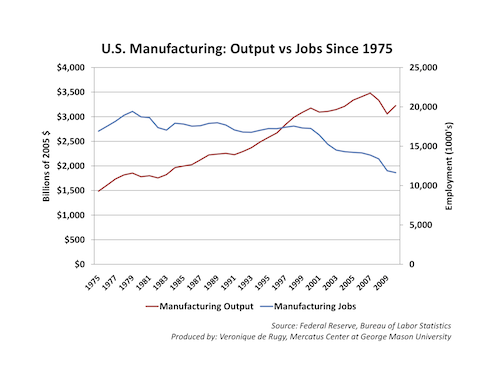
The problem is that we have a (figurative) glut of job openings for neurosurgeons and a severe shortage of neurosurgeons. The answer not to make the existing neurosurgeons work fewer hours; they are serving a valuable, irreplaceable (in an availability sense) function every hour they work. You can't give a lawyer, janitor, and accountant a crash course in neurosurgery, split the job between them, and expect a comparable result in the aggregate even though you created more jobs. At some point we will have to come to terms with the idea of decoupling a job from a decent life in the same way that jobs are being decoupled from economic growth.
The limit of this scenario is interesting as a hypothetical. When we get to the point where only 5% of the population is employable and they are all employed with very valuable skills that are in extremely short supply by definition, how are those people treated once the vast majority of the population depends on their continued work while 95% of the population no longer needs to work and is not usefully employable in any case? Can the 95% not working force the 5% to work long hours because there is a desperate need for their skills and talents which are not easily replaceable? It is a different political dynamic than when the majority of the population is contributing to the economy that supports society.