It still amazes me that analysts fail to see Pixar films for what they really are: Aimed at everyone, not just children. This is why the franchise aspect of the films is a little harder.
Here is the basic recipe for a Pixar film. The main character has to "grow" throughout the film while facing what are essentially adult problems - using animation as the vehicle for story telling.
Compare that to Dreamworks - who's style is heavily influenced by Jeffrey Katzenberg who is responsible for Disney's great run of films in the late 80's and early 90's (Who Framed Roger Rabbit, The Little Mermaid, The Lion King, Beauty and the Beast & Aladdin) before leaving in 94 and founding Dreamworks with Spielberg.
Dreamworks animations are aimed directly at children because of this influence, the stories are often not as complex and the jokes are simpler. They're geared for pumping out 2 films a year instead of just the 1 and are heavily backed up by merchandising. Their marketing teams absolutely blitz the public and this is probably why Shrek 2 is still the highest grossing animated film of all time, even though several films from both studios are better.
Now if the NY Times really wants to make an article about Pixar's future success, they should perhaps write about how the next few films after UP won't be directed by Pixar's main stable of directors (Stanton, Lasseter, Bird and Docter) instead seeing a generational change with new directors handling old franchises.
As Brad Bird of Pixar said during their documentary The Pixar Story
"This is an anomaly, this place is really freakishly alone in this hit after hit aspect"
It's not really a case of if they will make a film that fails, it's when - I personally hope that it never happens, but I'm not that naive.
I don't know, I disagree with a couple of these points.
Here is the basic recipe for a Pixar film. The main character has to "grow" throughout the film while facing what are essentially adult problems - using animation as the vehicle for story telling.
I think that can be said about most stories with a non-tragic hero.
Dreamworks animations are aimed directly at children because of this influence, the stories are often not as complex and the jokes are simpler.
Of the several PDI/Dreamworks films I've seen, I would say they are at the same complexity level as Pixar's stories. These stories usually have a couple of layers of depth to them, and you only need to follow the obvious one to get the main points. In my opinion, the Dreamworks films are not articulated as well (in both plot and characterizations) as the Pixar films and actually end up feeling more convoluted.
I first saw Toy Story as a child. Looking back on it as an adult, I remembered that I had a pretty good grasp on the plot and characters as a kid, so I was assuming it had been a simplistic film. When I watched it again, I saw lots of things I didn't notice as a kid.
Their marketing teams absolutely blitz the public and this is probably why Shrek 2 is still the highest grossing animated film of all time, even though several films from both studios are better.
Definitely.
Now if the NY Times really wants to make an article about Pixar's future success, they should perhaps write about how the next few films after UP won't be directed by Pixar's main stable of directors (Stanton, Lasseter, Bird and Docter) instead seeing a generational change with new directors handling old franchises.
True. One thing Pixar has going for them is that they haven't made any movies even close to bad. I would say that they haven't even made any movies that aren't great. (Though I'm kind of on the fence about Cars.) They've built up a pretty solid momentum now, and it would take a series of bombs (like Disney after the mid-90s) to shake it.
The people getting upset about Up not being as marketable as past Pixar films will have to get over it. If you're going to get great creative types together and have them make stuff, you have to give them freedom – otherwise you end up like PDI/Dreamworks. In summary:
http://farm4.static.flickr.com/3472/3398960470_05527c04b1_b....
I think that can be said about most stories with a non-tragic hero.
Except that it's relatively unique to the animation field.
The thing is, Pixar's process is more story focussed than other studios, A typical Pixar film usually has a 4 year production cycle in which the first two of those are spent primarily on writing and rewriting the story to get the "feel" right. Even then, they have no problem with changing the story at the 11th hour.
Case in point - WALL-E's ending was originally very different with WALL-E originally saving EVE from the trash compactors (essentially larger versions of WALL-E for irony). After the film was complete and was screened in Portland, Andrew Stanton changed the ending to what it is today. The story flows better.
Compare that to something like Dreamworks or Blue Sky Studios. Dreamworks focusses on making films which are more technically proficient and aimed at children (Kung Fu Panda was astounding from a technical standpoint) and something like Horton Hears a Who or Ice Age are heavily stylised films.
Dreamworks are more focussed on the business side, rather than the entertainment side of the process.
I first saw Toy Story as a child. Looking back on it as an adult, I remembered that I had a pretty good grasp on the plot and characters as a kid, so I was assuming it had been a simplistic film. When I watched it again, I saw lots of things I didn't notice as a kid.
That's Lasseter's influence as one of the Pixar co-founders. This style has permeated throughout the whole studio. Creativity comes first at Pixar. Ironically, he was actually fired from Disney in the 80's for trying to introduce 3D to their production pipeline and Disney ended up buying Pixar for billions...
They've built up a pretty solid momentum now, and it would take a series of bombs (like Disney after the mid-90s) to shake it.
Funnily enough that's a result of Katzenberg leaving Disney after a disagreement with Michael Eisner (then CEO of Disney) and he ended up co-founding Dreamworks.
(Though I'm kind of on the fence about Cars.)
Yeah, each of the studios has those little outliers. Monsters vs Aliens has very many adult jokes in it that children just wont get. If you haven't yet seen it, go see it.
For example: This is a quote from one of the US Military Advisors says to the President in a secret strategic meeting to deal with a giant alien robot.
"We need our top scientific minds on this project... Get India on the phone!"
I absolutely laughed my ass off at that joke and I'm sure most people didn't "get it".
Except that it's relatively unique to the animation field.
I still disagree with this :)
I agree with the rest of your points though. I should probably check out some of these Dreamworks movies I've passed up over the last couple of years. I didn't like Shrek so I was kind of turned off to them.
I think that the biggest difference between the two companies is that Dreamworks doesn't attempt to make lovable characters. Shrek in the original movie is an exception. They make identifiable characters, but rarely are their characters deep and human. Froo and I argued Kung Fu Panda versus Wall-E on IRC, if I recall correctly, and while I'm not nearly as knowledgeable about the animation world as he is, it's pretty hard to say that Jack Black in KFP is a more relatable character than Wall-E. Pixar makes people that you really feel like you know. Dreamworks is willing to make caricatures and as a result, their movies feel shallower from a story point of view. Even if Pixar follows a formula, it's a complex formula with deep permutations so that Mr. Incredible and Woody and Nemo's father and Wall-E are all very different people, even if the one recurring thread is that they all feel real to us.
This is actually the one problem I had with Annie Hall, which I saw recently for the first time: Woody Allen has a brilliant style, but the characters he made all seemed like caricatures, and so despite being a genius movie, I didn't love it. (I thought of this because back when I was a kid and there were two camps of children, the Ants kids and the Bug's Life kids, I was an Ants kid, thought Woody Allen in that was terrific, and thought the movie was stylistically and conceptually beyond Bug's Life, but going back to them I realize that Bug's Life, for all that, still has the more realistic characters, the ones that feel real, and so Ants's clever and detailed world falls apart at that one big seam.)
I realize that Bug's Life, for all that, still has the more realistic characters, the ones that feel real, and so Ants's clever and detailed world falls apart at that one big seam.
Do you know why that is? It's actually a fairly simple answer and one you might not have realised visually.
Antz tried to make characters more realistic, IE 6 limbs (2 arms, 4 legs), whereas A Bugs Life anthromorphised their characters and gave them 4 limbs, 2 arms and legs. This is so that people watching could identify with the characters more readily, even though it was technically unrealistic.
They also did this with Finding Nemo to an extent, giving the characters mostly forward facing eyes and eyebrows which fish don't have but allowed for more expression. In fact, the characters were heavily influenced by Dog facial features as that is something people would be relatively familiar with.
EDIT - I also figured I'd argue another point unalone made :)
Froo and I argued Kung Fu Panda versus Wall-E on IRC, if I recall correctly, and while I'm not nearly as knowledgeable about the animation world as he is, it's pretty hard to say that Jack Black in KFP is a more relatable character than Wall-E.
Well it really depends on your perspective. One can relate to WALL-E as an adult audience more easily than to Po (Jack Black's character). This is why when we were arguing, it's difficult to argue one in favour of the other as the stories have two seperate markets.
Po's story arc is essentially this: He loves Kung Fu, He learns he is the Dragon Warrior, He learns kung fu while learning to believe he IS the dragon warrior, he defeats Tai Lung - it's simple and linear.
WALL-E's story arc is a little more complex. He first struggles with becoming self aware of his environment and learning about it (the first scene where he's collecting objects). The story then goes ahead and emphasises his need to be loved and his loneliness (the guys and dolls TV scene where he holds his own hand). His daily grind (when he wakes up and struggles to put his tracks on which adults relate too and after being curious (the landing marker) he learns of eve and starts to fall in love. He then goes on a voyage of discovery and then goes through a back and forth process between love and bravery (saving eve and the plant) in which he ends up saving humanity and getting the girl.
So WALL-E has a more complex story arc and has elements with which adults relate to more readily. But both have eye candy, so kids enjoy them both too.
From a visual standpoint, Andrew Stanton and his team discovered early in the process that WALL-E's binocular-like eyes and the little eyebrow things (which have no actual use except for expression) were all they needed to articulate emotion. Ben Burtt's sound effects reinforced that. In fact, during WALL-E, sound was a part of the production process and not an afterthought in post production like it normally would be.
Po's character really didn't break much ground in this respect. KFP's biggest thing was how they managed to do so much cloth on fur which is fairly computationally intensive.
I believe one of the things that helps make WALL-E appeal more to the adult market is that the story tows a very narrow line between Comedy and Tragedy. It wouldn't have taken a big change in the script for WALL-E to have been a tragic love story.
Well, I guess my argument is really based off watching all of the films from all studios with the directors commentaries turned on and taking notes of what they emphasise and then looking at all of the information in aggregate. There will always be cases where there are outliers.
I'm working on a version of a 3D animation startup of my own to apply with to YC later this year so I take notice of these kinds of things (and actually have many pages of handwritten notes when studying animation in detail as a hobby).
Anyway, that's neither here nor there
If you want to watch some good Dreamworks Animations, I would recommend the Madagascar's (very reminiscent of the traditional cartoon style, squash and stretch is prevalent in these films), Kung Fu Panda (visually stunning) and Monsters vs Aliens (just plain funny)
Except even Pixar characters make the 'tude face. But I usually see that crapola only on box art.
One thing the investors didn't seem to notice is that the acquisition of Pixar seems to have spillover effects into the rest of Disney. With Lasseter in the driver's seat as Chief Creative Officer, their quality seems to have improved a tick. <i>Bolt</i> was an outstanding film, not <i>The Incredibles</i> great, but funny and fun to watch.
> The main character has to "grow" throughout the film
There are certain archetypal personal growth stories, like overcoming a loss, learning to be more selfless, learning to trust your friends, etc. The most popular is the bland "learning to persevere," like Luke from Star Wars (this isn't a great example, anyone have a better one?)
Pixar's personal growth stories tend to be more imaginative: I feel like the protagonist is wiser at the end than he was at the start, but I'm not always sure how.
I don't think that the wall street folks have figured out yet that Pixar's unwillingness to make commercial films is a strong contributor to their success. They have imagination, story, characters, and not a lot of cliches, unlike most Hollywood lacklusters.
Those make them better movies, not worse movies, but at the same time, they're not executive-friendly movies. That of course implies that the executives are unimaginative and out of touch with what the audience wants, but that's hardly news.
Up is an amazing film. It's funny, endearing, classic, and artistically excellent. The film breaks out of the mold of 3D animated film art direction with stylized characters and it prefers graphic shapes over the hyper-realism so common in the genre (you'll have to trust me).
While the characters are not toys, cars, or fish (which are easily merchandised) they are still cute. It will probably sell (at box office and toy shelves) at the same level as Ratatouille, but that is still a major success for any other studio on the planet.
Pixar used to be lauded for its originality and commitment to high quality. Suddenly, it's being panned for those same things.
The film breaks out of the mold of 3D animated film art direction with stylized characters and it prefers graphic shapes over the hyper-realism so common in the genre
They did this with WALL-E first, with the juxtaposition between the two main characters.
WALL-E was a square, while Eve was essentially a circle (Andrew Stanton's words, not mine).
Same thing is happening in UP, Carl Fredrickson (the old guy) represents the square, while Russel (boy scout) represents the circle and it is really more prevalent, even with Carl's finger's having a rough rectangular shape.
Pixar used to be lauded for its originality and commitment to high quality.
A little anecdote on just how committed they are.
During the production of Finding Nemo, a couple of Pixar artists climbed inside the mouth of a dead beached whale in California just to get a good idea of the textures inside of it for the scene between Dory and Marlin when they were inside the mouth of a whale.
John Lasseter has instilled an intense commitment to research in the studio’s creative staff. To prepare for the scene in Finding Nemo in which the fish characters Marlin and Dory become trapped in a whale, two members of the art department climbed inside a dead gray whale that had been stranded north of Marin, California.
I am starting to wonder how long people will care what wall street thinks. Surely that day is coming (it will be somewhere else that we care about, not wall street).
I'm not sure what that means. Financial analysts don't expect this to be as profitable as previous Pixar films, and they see this as a trend in Pixar films. It doesn't reflect upon the quality of the film, no one currently care's what wall street thinks in that respect.
Well - I guess my point kind of remains. Public companies are kind of taking leadership from "the street" wherever it is, yet it can barely look past the next weekend (as recent markets have shown us).
This is another example of how if you go public people will try to kill anything that makes you original. How long before we start seeing stories about how Google needs to end luxuries like 20% time?
The 20% time is not really a luxury. Google owns what ever you make, so it's all just work.
My understanding is that Google is already cutting the real benefits. Microsoft doesn't have a co-pay on their insurance, but Google does. There is a waiting list for child-care. There aren't as many meal choices in their cafeterias, etc.
I have some friends that work at Google, and it sounds like the average corporate job these days.
With the Fast & The Furious posting record (and surprising) numbers this weekend, I think Hollywood is about to flip the bit from fear to greed. Whether (or how) that will affect this particular movie, I don't know. It looks good though.


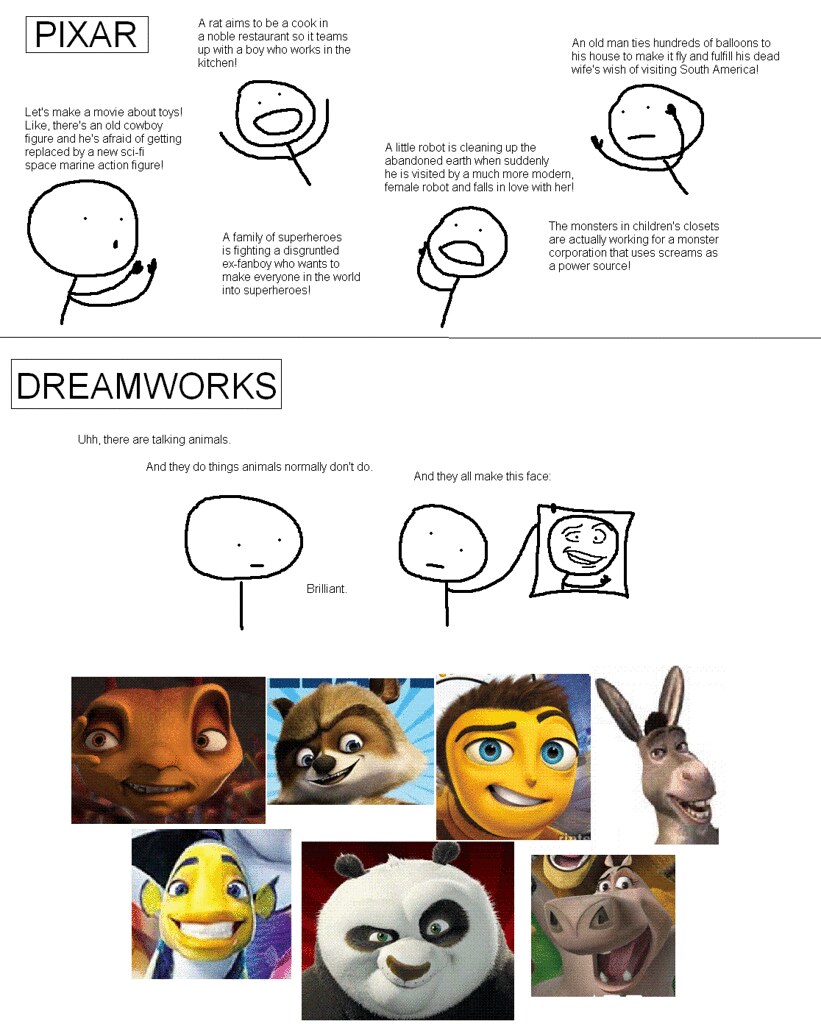
Here is the basic recipe for a Pixar film. The main character has to "grow" throughout the film while facing what are essentially adult problems - using animation as the vehicle for story telling.
Compare that to Dreamworks - who's style is heavily influenced by Jeffrey Katzenberg who is responsible for Disney's great run of films in the late 80's and early 90's (Who Framed Roger Rabbit, The Little Mermaid, The Lion King, Beauty and the Beast & Aladdin) before leaving in 94 and founding Dreamworks with Spielberg.
Dreamworks animations are aimed directly at children because of this influence, the stories are often not as complex and the jokes are simpler. They're geared for pumping out 2 films a year instead of just the 1 and are heavily backed up by merchandising. Their marketing teams absolutely blitz the public and this is probably why Shrek 2 is still the highest grossing animated film of all time, even though several films from both studios are better.
Now if the NY Times really wants to make an article about Pixar's future success, they should perhaps write about how the next few films after UP won't be directed by Pixar's main stable of directors (Stanton, Lasseter, Bird and Docter) instead seeing a generational change with new directors handling old franchises.
As Brad Bird of Pixar said during their documentary The Pixar Story
"This is an anomaly, this place is really freakishly alone in this hit after hit aspect"
It's not really a case of if they will make a film that fails, it's when - I personally hope that it never happens, but I'm not that naive.