When you show overt contempt for sports you are showing contempt for most everybody and that is problem with your social skills.
It's called being a snob. The disdain for working class culture among academics was part of the reason I choose not to pursue a formal higher education. I suspect this overt snootiness keeps many gifted working class kids from participating in higher education.
I grew up working class and was a boxer. I love Ice Hockey, Football, UFC, NASCAR, Motocross, and heavy metal, but I am also an academic and an intellectual. Many highly educated people have told me so, I just don't have the paper to prove it.
My oldest son is highly gifted earning math test scores putting him in the top tenth of one percent and placing 1st in regional Math Masters competitions. He also plays ice hockey so he interacts socially with the 'jocks' and the 'brains' preferring the company of the 'brains.'
Most of his 'smart' friends show contempt for sports which is a social problem since he is an athlete.
When a kids says, "Hockey. Meh. It is a bunch grown men with sticks chasing a black piece of rubber around a sheet of ice" he is saying in effect "What you love is obtuse and low brow and I don't care how that makes you feel." And that is just rude.
I think this is getting cause and effect backwards. Many (not all) kids who became intellectuals were the last picked for the team in sports and generally suffered due to it. I went through school dreading gym class. Deciding that sports was not important to me and spending time on things I was better at was in part emotional self-defense.
Of course, dividing up into different tribes is not healthy. We should ideally try to leave such things behind and try to get along with everyone. But the nerds versus jocks thing lingers even in programming with the "brogrammer" meme and also in many programmers' expectation that everyone else should put in the hours to learn programming on their own because that's what they did.
Rather than indulging in moral shaming, I think better to say that the folks who are good at sports and at intellectual activities are in an excellent position to build bridges.
Ha, yeah. Some of us were abused mercilessly by the "jocks". On top of that, the school administration, and wider town culture didn't give a shit, because to them the young sports players were local superstars, and could do no wrong.
And if a few young nerds kill them themselves because of the abuse, what harm right? As long as our school sports team is on form it's all cool.
If not liking sports makes me a snob then ok, I can live with that. but let's not pretend working class sports culture is all good clean fun. It can be as venomous as any other culture.
> If not liking sports makes me a snob then ok, I can live with that. but let's not pretend working class sports culture is all good clean fun. It can be as venomous as any other culture.
As evidenced by the top comment in this very thread calling out non-sports fans as being elitist snobs without social skills. What a joke.
There's a big difference between not being a sports fan, and going out of your way to be an elitist snob about it (even if that "going out of your way" stems from emotional self-defense).
Same thing happens with math, or programming, or various other intellectual pursuits. People will specifically talk about how bad they are at math, and wear it like a badge of pride. Or, they can just not enjoy it without being rude.
> There's a big difference between not being a sports fan, and going out of your way to be an elitist snob about it
This entire line of reasoning strikes me as such an epic straw man. What is the difference between not being a sports fan, and being an "elitist snob"? It's completely subjective.
In my school, bullies even at the time justified picking on nerds by saying we were elitist and snobby. It really annoys me when people make unfair attacks against nerds or intellectuals, because it doesn't just hurt adults, it hurts children.
And my experience was exactly the same as yours: people developed a kind of snobbery as an emotional self defense.
This is a bit tangential to your post, but I think there's an important distinction that's being missed in most of the comments on this thread:
Not liking watching sports and not liking _sports_ (i.e. playing) are very different things with very different causes (though they are, to a degree, correlated).
The article is primarily talking about watching pro sports, so IMO what you're describing doesn't really give a complete picture of the topic at hand. As a single example, playing sports is one of my favorite things to do, despite finding watching pro sports to be extremely, extremely boring (regardless of the context: Soccer is my single favorite sport and even at a World Cup party I found myself bored out of my mind).
I suspect that most kids who become intellectuals have parents who are intellectuals.
Admittedly, my parents openly disdained pro and school sports, and rock music, when I was a kid. They are scientists, and into classical music. Today, I'm a scientist, I love classical and jazz, and am a performing jazz musician. Whatever "signaling" I might have received, I can't escape the fact that I love those art forms today.
But I wouldn't have stood a snowball's chance in hell of getting onto the hockey or football team. Today, I'm probably in better physical health than most of my classmates who actually played on those teams.
Oddly enough, when my musical interests become a topic of conversation, nobody ever feels any qualms about stating how much they hate jazz and classical.
I wouldn't say that's true. I had a father who pitched college baseball, and tried to instill the same values in me, and it only drove me further away from it. I'd rather we consider the alternate view, and rather than discussing how those who don't like spots are somehow infringing on those who are, select the MANY occasions (as in the parent post of school gym classes) where the opposite is certainly true; those who chose to abstain from sports are shamed and learn that laughing about their stance as a joke to both sides is a good way to disarm that.
The takeaway being, there are infinitely many different reasons to like or not like something. The fact that this comes up in particular for sports communicates to me that there's a different dynamic at play here. Do we often see this conflict for things like soy? Ballet? Curling? Sports in america seems to stand alone in that any deviance from the norm gets picked apart with a VERY fine toothed comb, perhaps as a factor of societal norms. I wonder if we'd see the same examination of soccer non-fans in the broader world or if this is a more american phenomena, I honestly don't know, and it asks many interesting questions.
Even beyond that though, I "enjoy" (sarcastically) how there's a tendency to turn differences into conflict. Anecdotally, choices around interest in sports seem to cue more dissent than as mentioned in many other areas, but I see similar trends in the "big three" of politics, religion, and money. Similar patterns have sparked in other areas (gender differences; and I'm probably risking a hailstorm for even mentioning this) as well, there are certain topics people seem to be less willing to "live and let live" about.
This turned into such a ramble. I may edit it later, I hope there are some useful thoughts in there somewhere.
Interestingly, as an alternative to the "big three," a feature of talking about sports is that it risks no enmity because the taking of sides is assumed to be good natured.
It's interesting you bring that up, since going out drinking with your boss in certain cultures is also a venue in which some degree of "friction" is assumed because "oh we're drinking of course it's all good natured" so that people can be more open; but has a reputation for some of this same "if you don't like it there's something off about you" effect for those who chose not to I was mentioning re: American football.
Not that I can't see the proposed appeal, I just mean to comment on the somewhat unique additional pressures these interactions carry with them.
(Deleted following post due to accidental double reply-click)
I love playing sports and always have. But I have major issues with categorizing everyone who has issues with them as elitist.
Some of us dislike them because they're destructive to society. I'm sure I'm not the only one who went to a high school where athletics were more important than academics, and not going to the football game was worth a couple nitpicked points off on your chemistry quiz or some teacher who became a teacher solely to coach had you spend their class taking notes from a text book every day while they jawed around with other coaches in the back room.
I feel like sports culture deprives lots of regular public high school students of an education, and I don't think it's elitist at all to dislike professional sports for their contribution to this mess.
I love sports, but every time I watch or support them I feel like I'm destroying civil society and undermining democracy and helping to destroy the last vestiges of effective public education.
> I feel like sports culture deprives lots of regular public high school students of an education, and I don't think it's elitist at all to dislike professional sports for their contribution to this mess.
While I respect your position I feel that you really don't understand the perspective of sports from the athletes side.
You're completely glossing over the positives that sports bring to the lives of people involved in them, especially those who take it serious. I've been writing code since I was 13-14 years old, but I've been testing myself physically and mentally since I was 8, thanks to a life long 'career' of playing baseball. Nothing in my life has taught me more about who I am and what I'm capable of, both mentally and physically, than my time spent in team sports. And that's saying nothing of the social growth and life long friendships and connections made.
I'm just a middle class white kid who had far better options in life than to pursue professional sports...but for those less fortunate, the education they get from their sports teams/coaches/careers my very well be the best 'real life' education they'll ever get.
Calling sports destructive to society seems so completely asinine to me that it's comedic. Then again, my perspective is quite different than yours.
That's not his point though. His point is that for every bit of handwringing of how ghastly some people's comments on sports are, there's the reality that the football coach is the highest (in the millions of dollars range) paid position at almost every university in the US, how the sporting department despite those figures manages to be a net budgetry drain on almost every school which has one, and the reality that college-level sports is hugely abusive and exploitative to the players which actually play it.
>how the sporting department despite those figures manages to be a net budgetry drain on almost every school which has one
And so are music departments.
Which I think is part of the point here. I firmly believe that playing right tackle can teach you just as much as playing the oboe, yet intellectuals tend to look down on former and praise the latter. Organized sports are not only a hobby and social gathering, but they can also serve as part of a greater learning and education experience. There is a reason why a few of the Ivy League schools rank near the top of all universities when it comes to the number of varsity athletes.
>that college-level sports is hugely abusive and exploitative to the players which actually play it.
You need to be specific here. Big revenue college sports (basically only Div I basketball and Div I-A football) are definitely exploitative, but most college athletes participate in sports that generate little revenue and it would be hard to argue they are being exploited.
Music departments are budget drains since when? The arts and humanities are actually rather cheap, they need nothing more than buildings, staff and a library. Science and engineering are the real whoppers, and as a rule cross-subsidized by A&H. Tuition per credit hour is the same, after all. The dean of the School of Arts & Sciences at a certain state school is on record saying that for the price of a chemistry professor she can pay a whole department of English.
That isn't the point. The point is that the mission of universities is academic pursuits, not athletics. If anyone wants to practice sports, power to him, but let him join the sports club, or let him start an inofficial intramurine league.
The wider point is that in America you can't earn much social capital by being knowledgeable about any academic subject, you have to be wealthy instead. That's a problem, and probably also explains many things about American society. Universities finally getting rid of organized sports might perhaps be able to change that.
Music departments tend to be expensive in terms of faculty, sine most of their time is spent in private lessons. If an oboe studio has 10 students, that's essentially 10 hours a week in lessons alone. In that same 10 hours, an English professor might teach 60 students (if you figure 15 students/class with 2 hours MWF and a different 30 students Tue./Thu.). Those are numbers for a small school; at larger universities an English professor might lecture to 300 students a week in 10 hours, but that oboe professor is still seeing just 10 students.
Huh? Are you talking about college? I thought the OP was talking about high school. We never had any private lessons. "Band" class was... 35+ kids in one room at a time, all playing at the same time. Band was almost always the largest single class I had, relative only to gym class. Sometimes gym was larger (40-50 at a time), but I think I had a year with more people in band class than in my pahys-ed class.
Like you say, a distinction has to be made between big and small schools. I did my undergrad at a college where the starting quarterback was a physics major. There were no athletic scholarships.
Where I went to grad school, that would have been unthinkable. There was a special major that most of the football and mens basketball players chose, one of the departments of "studies."
There's no university where the oboist in the orchestra has to be given a fake education. Indeed, most music majors these days wisely pick up a second major.
> >how the sporting department despite those figures manages to be a net budgetry drain on almost every school which has one
> And so are music departments.
If the band directors made millions of dollars, you would have a good point.
If band directors brought in millions in revenue and PR value to a school, then YOU would have a point. Nobody would have ever heard of Gonzaga university if it weren't for basketball. At the schools with million dollar coaches, they bring in millions in revenue in both tickets, licensing as well as intangible PR value. I am not defending or disparaging college sports, I am making the point that a school's band program isn't generally adding revenue. It rarely attracts big donors. While Div I sports might have an operating loss (maybe,) the net income to a school, through donations, PR value, etc far exceeds the cost. How many kids want to go to Florida State that don't live in Florida? By attracting more national applicants, a school can charge out of state tuition that directly benefits their bottom line. There are many benefits to a school that aren't measured with the myopic view of "athletic income - athletic cost = profit of the program."
If the donations go to the athletic programs, then it doesn't matter. There are also numerous hidden costs associated with athletic programs, like law enforcement and extra tutoring for athletes. On top of that, most schools require ALL students (even those who don't attend sports games) to pay a fee, which acts as an additional subsidy. Even further, many public universities use part of the money they receive from their respective states to fund athletic programs.
The band students pay tuition to be there. If the football players paid tuition to be on the team and the sports teams were subsidized at the same rate as the band program, I wouldn't care.
There are a handful (maybe 20?) of schools that probably make an overall profit from their sports teams, but the rest of the thousands of colleges and universities in the US operate their sports programs at a loss. Those are really the schools I'm talking about.
I can't speak for every school, but I will share my own insight on a big football university
I attended a state school where the "highest paid public employee" was a football coach. I was lucky enough to marry a then student president of the professional students (Med, Vet, Opt, Dentist, Pharmacy, Law) and as part of her duties she sat on the athletic counsel. Our tuition did not go to the coaches at all, the athletic dept was entirely self funded and donated the excess to the school itself. They helped fund a library renovation while we were there, among other student oriented needs.
Also, because of the success of the football team they are able to fund (again without student money) all the other sports "no one cares about" eg men's badminton or women's olympic weight lifting or something... The majority of THOSE student-athletes truly are students then athletes.
Take away the good football and the other things become harder or impossible to achieve. I'm not saying sports should be considered a loss over academics, but some people enjoy both and are not going to the NFL
In contrast, at my university the football team had two 1-11 seasons in a row, and the head coach was finally fired after losing the first four games of the next season. It took so long because the school was wary of the $1.4 million cost of letting him go early. (He wound up getting paid for the entire third season, and $150,000 each for the next two years.)
Somehow I doubt UNM’s football team is able to cover the cost of the athletics department. The coach in question was Mike Locksley.
Sports is a huge financial drain on the school? Do you have any data? What I heard was that college football tends to pay for all of the other sports at a school. If anything sports creates a lot of opportunities for students that otherwise could be done due to budgets.
> What I heard was that college football tends to pay for all of the other sports at a school.
Yeah, at the most successful football schools. That's a minority among schools that have football programs. [1] [2]
>If anything sports creates a lot of opportunities for students that otherwise could be done due to budgets.
No, sports diverts scholarship funds from scholars to athletes, and the athletes rarely take full advantage of the academics in college, going for easy classes and easy majors. It actually destroys a lot of opportunities, particularly at schools that are losing money on their sports programs.
Feel free to search that image from other sources too.
And the data backing it.
And yes, this is not the same as it being paid for by academics...but then you have to deal with the fact that most top-tier sports departments also fail to break even, and it's extremely murky if they contribute anything back to academics at all - whereas it's pretty visible that they are allocated money out of the academic takings. [http://www.ethosreview.org/intellectual-spaces/is-college-fo...]
EDIT: All of which again, would probably be worth turning a blind eye to if it were a good thing for the players...except it isn't. Because they don't get paid.
I didn't say anything about coaches with million dollar contracts. I was responding only to the claim that football pays for the rest of the sports, which, other than men's basketball, are pretty much universally unprofitable.
If only a few schools' football programs fund the other sports, and all schools have a lot of sports, it only follows that most schools are losing money on sports, no matter how much money they pay their coaches.
That said, many unsuccessful football programs still have coaches with multimillion dollar contracts, so you're still wrong.
>It's a nice bait and switch you constructed. A "trick play" if you will.
This added nothing to the discussion and wasn't even a fair accusation, since I wasn't arguing anything like what you suggested I was. If I were being uncharitable, I would accuse you of intentionally misunderstanding my argument for the chance to be snide.
Scholarship money comes from a lot of places, but usually from wealthy alumni.
It definitely doesn't come from sports at most American universities.
There's something for the argument that sports attracts students who will become wealthy alumni and donate after graduation, but AFAIK, there's no data proving it, and some that contradicts that notion.
I loved playing basketball, too. But then in high school I could choose between taking advanced math classes or basketball PE, which was required to play on the basketball team. That kind of choice shouldn't be the kind of choice a high school student should have to make.
There were many more example of trade offs like this, almost all of which undermined any ostensible focus on education.
These kinds of things have nothing to do with whether playing sports (on a team or not) can be a positive experience or is good for people.
I love sports, but every time I watch or support them I feel like I'm destroying civil society and undermining democracy and helping to destroy the last vestiges of effective public education.
I'm not a big sports fan, but pro sports does serve a purpose.
Sports in general is ritualized hunting / warfare. A civilized and less brutal version of war, but the roots are clear. The skills used are the same as our ancestors used to survive: running, throwing, tackling, hitting things with sticks. That's war.
Watching sports is a celebration of those ancient survival skills, though they don't have much place in modern society. These urges exist within many of us, and need an outlet. Sports is highly preferable to the small-scale skirmishes that frequently occurred in centuries past.
Many people feel the strong call of tribalism too. Us versus them. Rooting for the home team, and feeling their ups and downs as your own is also wired into us at a deep level.
It would be a lot more effective for society if we were pitting city governments against each other, seeing who can deliver the best services at the lowest taxpayer cost. But I'm not holding my breath for someone to set that league. :-)
> Sports in general is ritualized hunting / warfare.
Ritualized, sure. Hunting / warfare? Depends on the sport.
Dancesport is a thing, and its assuredly not ritualized hunting / warfare.
> Sports is highly preferable to the small-scale skirmishes that frequently occurred in centuries past.
Sports is -- and has been for quite some time -- a frequent focus of the small-scale skirmishes much the same as those you paint it as an alternative to. I'm not sure its much of an outlet.
> It would be a lot more effective for society if we were pitting city governments against each other, seeing who can deliver the best services at the lowest taxpayer cost. But I'm not holding my breath for someone to set that league.
Actually, before those "small-scale skirmishes" were so frequently outbursts about sport, they were often outbursts between the backers of different political factions, ideologies, or groups striving to shape society (we still sometimes have those, too; sport may have kept the violence while removing the social purpose to a certain extent, but not entirely.)
Dancesport is a thing, and its assuredly not ritualized hunting / warfare.
The main topic of conversation is the widely popular professional sports such as Football, American Football, etc. These sports have attackers, defenders, and so on.
Sports is -- and has been for quite some time -- a frequent focus of the small-scale skirmishes much the same as those you paint it as an alternative to.
I don't see that as the proximate cause of most conflicts throughout history. Mostly, it seems to be about resources, and sometimes ideology too.
> I don't see that as the proximate cause of most conflicts throughout history.
No one said it was the proximate cause of most conflicts throughout history. Nor have conflicts in general stopped since sports became popular, nor were conflicts in general part of the discussion.
What was asserted upthread was that sports was an outlet that prevented "small-scale skirmishes". I simply pointed out that, in fact, professional sports are -- and this is true globally -- well-known as focuses of small-scale skirmishes and social violence, rather than an outlet which prevents them.
Ah, are you talking about modern-day football hooligans?
When I say "small-scale skirmishes", I'm talking about relatively small border conflicts and the like that last less than a year and kill tens to hundreds of people. As opposed to regional or national conflicts where the casualties get into the thousands or much higher.
Are you talking about football in the American sense or to describe soccer?
I can't speak for the rest of the world, but in the UK football hooligans are a dying breed. There have been a few Hollywood films made about UK football hooligans, but it's more about the situation at it was in the 70's/80's.
I'm not an expert on it, but it strikes me it was born out of boredom. You'd travel to an away match, see some goalless draw, and had wasted your weekend. The scrap may have started as some sort of consolation prize. Anyway, now the games are televised, prices are more expensive and the audience has become broader so the environment that bred it has gone. Some firms still have a reputation, but it's increasingly irrelevant.
I wonder what fuels the hooliganism where you are.
Are you talking about football in the American sense or to describe soccer?
No, I was asking if dragonwriter was referring to football (soccer) hooligans from the UK or other countries. Argentina guys in particular seem to get pretty rowdy, and there have been murders too.
But there isn't any sort of hooliganism where I am, I was just trying to figure out what dragonwriter was talking about with regards to pro sports being the focus of conflict. Which I don't see being anywhere close to the level of conflict (like actual war) that I was talking about.
Okay then, in that case I'd say sports aren't the focus for conflict, they're a convenient excuse for it. Fighting is always its own domain, other surrounding factors are just window dressing.
> When I say "small-scale skirmishes", I'm talking about relatively small border conflicts and the like that last less than a year and kill tens to hundreds of people.
Football skirmishes that kill people on that order aren't unheard of, and I know of no evidence even suggesting that the popularity of professional sports even correlates with (much less causes) a reduction the kind of small-scale skirmishes you discuss (even before considering whether the degree of such effect is offset by violence directly associated with sport.)
Swimming is ritualized warfare? That argument sounds like something one might come up with if they had a freshman philosophy paper due the next day. We could say that grocery shopping is ritualized hunting or that a piñata is an encouragement of ritualized torture. There comes a point when the intellectual threads holding together an argument approach absurdity.
High school athletics is a problem in some ways, but don't throw the baby out with the bathwater.
Robert Putnam is a political scientist of some renown. One of his major contributions was a study he did in Italy over 40 years. His question was why was government in in the north generally more efficient and just all around better than politics in the southern portion of the country.
His conclusion was that northern Italians were much more heavily involved in civic clubs like religious groups, labor unions, and ... soccer clubs, which created social capital, and horizontal networks, unlike the hierarchical networks in the south which created clientelism and gangs.
Sports fanhood and clubs may actually make democracy better. They certainly foster community. There are bigger problems in this country.
>I love sports, but every time I watch or support them I feel like I'm destroying civil society and undermining democracy and helping to destroy the last vestiges of effective public education.
Hyperbole. In a lot of ways, sports can bring a city or group together in ways that other events can't.
I feel like this is where I have to make the usual acknowledgement that yes of course the NFL is run by a bunch of morons and yes of course head injuries when you're a young kid are a bad thing.
It's the coming together / tribalism part that unnerves me. There's no rational reason for people to get so excited about it, so it rubs me the wrong way the same way most political rallies do. Small scale sports don't have quite the same effect on me, but large heavily marketed ones do as there is a pressure to conform (i.e. care, participate, hold certain opinions that positively reflect on the enterprise).
>It's the coming together / tribalism part that unnerves me.
Why? Is community bad? I need that argument to be unpacked a bit more, because for me my experience living in several different cities as their teams make a playoff run has been a fun, electrifying experience. Neighbors are hanging out. Kids are having sleep overs watching games. There's a (usually very) healthy bump to the local economy. For all the room-for-improvement there truly is with managing the sport, the sense of community is what's actually valuable to me.
I think those effects are good, but I also recognize that because these effects are unmoored from anything real we're dealing with nearly pure social signaling amongst a mass responding to tribal tendencies.
Of course, having something that serves as a community focal point that crosses faith boundaries is invaluable - nearly any time new people meet powerful things happen.
However, I take issue with your point about the economy: A local bump means that there was a withdrawal from somewhere else in the economy. If it came mostly from savings rather than from shifting consumption from other locales, then it generated increased consumption, which depending on the macroeconomic condition, could be good or bad (though during the latest recession, inducing an overall increase in consumption sounds like the right thing to do). It's not clear whether this is a good thing or not. Why should I prefer the shop owners in your town versus some other town to temporarily enjoy increased profits? There might be a good reason, but for a disinterested third party, odds are it's a wash.
Your argument is cogent and expresses my own thoughts well.
>> having something that serves as a community focal point that crosses faith boundaries is invaluable
This is true up to the point that team allegiance is weaker tribalism than faith. Growing up in Manchester and not swearing fealty to red/blue, admittedly less so than orange/green in Belfast, was still more troublesome than it needed to be.
Yet all this seems a matter of identity development. My younger brother felt the opposite pressure of having to grow up in a family uninterested in sports. Each of us were yin surrounded by yang (or vice versa).
I feel the article's writer may have given up something more valuable when he arbitrarily adopted another identity for the sake of broader communication. Unless he had a latent need to belong to a group more deeply and is merely rationalising it in the article.
>> There might be a good reason, but for a disinterested third party, odds are it's a wash.
That's the nub of it. Tribalism in any form wants adherents to reinforce that there are no disinterested parties. You are either with us or against us. Depending on your starting assumptions, that's either valid or completely spurious.
I think that's a very sad and depressive way to look at sports fans, and indeed I think the argument that they're part of some fascist tribal conspiracy is silly and immature. I guess my experience growing up as a baseball fan was less "tribal" than football fans in Europe, but I don't think that's reason to decide that the whole experience is without value...which I think is what's being implied here and elsewhere on this thread: that if you haven't experienced this terrible tribal nature of sports fanatics then you've been duped and don't know it yet.
On the whole, I think everyone is reading into this wayyyy to deeply. If anyone wants to enjoy a beer and a hotdog at the ballpark of their choosing, let's do it. 20 days until pitchers and catchers report.
I deliberately delimited my position to mitigate counter-arguments like this. We do agree that, to the extent following sports is low or completely non-tribal it is innocuous. Presumably, baseball was/is like this for you. I also allowed that for some people such as my brother and, perhaps for the article's writer too, belonging is a deep need which can be satisfied by some form of tribalism.
My next point might be a bit of a stretch, but I would invite you to consider the possibility that your comment is itself a weak exemplar of the tendencies I disliked growing up in Manchester.
"othering" the others :
>> I think that's a very sad and depressive
Appealing to the in-group for emotional support :
>> If anyone wants to enjoy a beer and a hotdog at the ballpark of their choosing, let's do it. 20 days until pitchers and catchers report.
deliberately misrepresenting outsiders and making a loud noise doing it :
>> the argument that they're part of some fascist tribal conspiracy is silly and immature
Baseball is... much slower than european football. I grew up as an american baseball fan, but could never understand the fascination with american football. Ever. It's just a weird game, but it tends to be faster than baseball, and certainly more physically intense (tackles, etc). And soccer, basketball and hockey are even faster. The speed tends to hype people up, I think.
It feels easier to watch a baseball game from the stands without getting "worked up". I can easily watch a bb game and be relaxed. I never felt able to relax at a basketball game (by comparison). I imagine it's easier to relax at a cricket match vs a soccer/football match too.
I guess I grew up always thinking about the math aspects of the game (dad was a bond trader), so even hockey for me, which is probably the least deterministic of the professional sports, is fun to watch. American Football has always been my least favorite...but probably because that sport's been immune to the kind of deep-level analysis (at least until recently) that a sport like baseball (and even basketball) are subjected to. So, I guess I agree with your perspective insomuch as it involves how "deep" someone can get emotionally involved with a game. Soccer though to me is just mind-numbingly boring - so the "tribal" nature and violence associated with European soccer fans is a complete mystery to me.
I also have the same reaction, but not so much for the irrationality of being excited. Generally it feels good to win, and it feels good to watch someone you like win, regardless of why you like them. What I really really dislike about the affair is group signaling. (Which is a signal of my belonging to the small group of people who detest group-signaling, but nevertheless...) Enjoy watching the game all you want, even as a crowd, but the moment the "we" comes out I have that reaction. I see so many society-wide problems stemming from mere classification of people into groups, and the so-natural next step of individuals of those groups making the group part of their identity. One of the creepiest social experiments I know about is the Robber's Cave experiment: http://lesswrong.com/lw/lt/the_robbers_cave_experiment/
Is there a 'rational reason' for anything animals do by instinct? Perhaps you are entirely rational, but most homo sapiens are not so different from our primate ancestors who lived in tribal groups.
I have the same almost instinctive reaction. I think we're probably guilty of it as well, just not as aware of the shape it takes (just look at the emacs vs vi folks, perl vs php, .net vs j2ee).
You said Nuremberg, not me. ;) That's an extreme case.
It's more that when I see that effect, I have an uneasy feeling that a trigger could set things off the rails or shut off critical thinking or modify social standards for certain acts. I'm a bit of a contrarian at heart, so it's something of a non-specific mental immune response.
In fact, at (EU) football events, soccer hooligans are widely known for being violent. In the US, commercial and government propaganda are often dispensed in a socially validated environment. An alarming trigger (or a home-run that lands in the stands) can cause a stampede at stadia. I recognize that the more extreme examples are relatively rare occurrences, but they are more common than on say the street per square foot.
The irrationality of the crowd is something that unnerves me. I've been to games, so it's not like it's some paralyzing anxiety, but I feel some creepy crawlies at times.
Let me give you an example of a cohesive social situation that wouldn't creep me out: A town coming together for disaster recovery, where the people signaling cohesiveness are actually directly affected or are participating in the recovery effort. On the contrary, when people that are totally unaffected come together, it feels more uneasy to me because they are responding to a story being told on the news and are in a condition where simple manipulation is possible as they are not responding to advance their own interests (so certain sanity checks are disabled) and they do not have a good way to verify the story they heard.
That's an interesting perspective, in a similar wheelhouse to my own, but I don't blame professional sports for the many ills caused by school sports. You picked on high schools, but the problem is far worse in colleges. I much prefer the european model, which focuses on clubs rather than schools.
The clubs model brings a different set of problems, especially in populations already divided by religion or class. See the sectarianism and tribalism that have developed around the Old Firm derby in Glasgow, for example.
If sports weren't the basis for cliques, it would be something else. Eliminating sports would not make high school any better, people would just organize into different exclusionary groups.
>The disdain for working class culture among academics was part of the reason I choose not to pursue a formal higher education.
I don't have statistics, so this is all anecdotal, but most Professors I have gotten to know well have a favorite team or sport etc. The reality you present sounds more like movies than real life. For example, I can see Dr. Epps from Numb3rs being snoody about sports in a way I have never seen a real Professor be.
Is it possible that it was the popular culture image portrayed of academic attitudes is what stopped you, rather than actual academic attitudes?
> but I am also an academic and an intellectual. Many highly educated people have told me so, I just don't have the paper to prove it.
Do you have problems getting published without "the paper to prove it"? Anyone can be an intellectual if they are intellectual, but at least in my mind, being an academic implies peer-reviewed novel research.
> Anyone can be an intellectual if they are intellectual, but at least in my mind, being an academic implies peer-reviewed novel research.
I thought this as well. I had always thought that being an intellectual was just something you were regardless of education, but an academic is a vocation marked largely by publishing peer-reviewed research and (most likely) having advanced graduated degrees and/or a professorship of some sort.
> I don't have statistics, so this is all anecdotal, but most Professors I have gotten to know well have a favorite team or sport etc.
This has been my experience, up to and including a stint at a top tier American university where during the World Series I couldn't have a conversation with anyone, including my elderly Swiss-American academic supervisor, that didn't have a long preamble about how things were going for each team.
I grew up in an (American) football-loving family and still enjoy the game, but knew (and still know) almost nothing about baseball. But I watched that Series just so I could communicate with my American colleagues.
So to describe academics as sports-hating snobs is wildly at odds with (anecdotal) reality.
I think even among those who don't necessarily care for sports, calling them 'sports-hating snobs' is often at odds with reality.
I grew up in an academic family. My parents were at the top of their respective fields, and their work, to them was as much a labor of love as it was anything else. I found that really very few things competed in their eyes with the fun/enjoyment of doing their job. Sports didn't really make that cut, but pretty much nothing but family made that cut. Their friends (and colleagues) seemed to be similar.
It was not so much about "Eew sports" as it was "Do I want to watch sports? Or would I rather read a book?" and "Read a book" won 99.99% of the time.
That being said, I did see a lot of disdain for sports among some of the more intellectual students at my university.
I'd be willing to bet that who acts like a sports-hating-snob can be predicted by simple signalling theory: professors/academics are unlikely to have their 'intellectual credentials/worthiness' questioned. They usually wouldn't need to signal "Disdain for sports" as a way to differentiate themselves from the non-intellectual working class. Being interested in sports also probably doesn't have any potential impact on other's perception of them, but probably doesn't benefit them particularly either--so you'd see academics with an interest in sports and academics who just don't really care, but you probably wouldn't see lots of academics decrying sports. (Outside of the critiques you'd expect of the NFL/NBA/FIFA/etc.--probably focused on the organizational ethics rather than the idea of sports as inherently bad.) On the other hand, in the case of students or middle class, non-professorial individuals, the differentiation between them and the working class is less immediately obvious to them and their peers, particularly on the things that someone aspiring to appear 'intellectual' would care about. (I think this also includes people in tech.) For them, decrying sports signals that they are decidedly not working class/non-intellectual, and alleviates the risk of being identified as such.
Your signalling theory misses out the extent to which it seems to be okay to signal disdain for 'intellectual' interests like art and culture.
Bottom line for me is that no one has ever had to worry about getting beaten up by a stadium full of Mozart fans, or humiliated in high school by a feral gang of science nerds.
I think hatred on reddit is a complicated mess of legitimately bizarre people being given a forum for the first time, trolls, signalling, and groupthink, depending heavily on the topic and subreddit.
Signalling of social and political grouping is particularly prevalent and obvious on the internet because you can't rely on extrinsic or physical factors to demonstrate your social groupings. In the real world someone can rely on their appearance to telegraph a lot of things--clothing and grooming choices alone can hint at sexuality, politics, social class, and a variety of other things, to say nothing of existing social structures and bonds (who you surround yourself with also telegraphs a lot). On the internet, you either need to explicitly say these things ("I'm not straight", or "I came from a well off family" or "I'm a conservative") or signal them somehow, and there are areas where it's less acceptable to overtly announce your membership in a group, so implying it through general biwords for it is socially necessary. ("I'm filthy rich" or "I'm really, really smart and intellectual" or even "I'm really, really, really ridiculously good looking" all likely fall under that category. I think that generally the more desirable the category, the more it requires either actually costly signals--e.x. displaying expensive artwork in your home or donating lots of money in the case of wealth--to do 'acceptably'.)
You see some of it on HN, too, although I think it's generally much less accepted to negatively signal here--but especially in the more social-justice-y threads, you see a lot of signalling of people picking sides going in both directions, because that's something that HN doesn't really have any sort of unity on but individuals here feel strongly about. In this thread there was a perhaps unsurprising backlash against the author (usually backed up with some logic--which is thankfully required by the etiquette here) about why the posters were justified in their active dislike of sports.
In my experience most social signaling/biwording is fairly well summed up by the basic theory of "You will only expend effort signaling if there's (a) a chance you'll be mistaken for someone in a group you don't want to be mistaken as, and (b) there's a chance you'll be seen as being in the group you want to be in because of it."
"When you show overt contempt for sports you are showing contempt for most everybody and that is problem with your social skills."
That's nice. What other corporate products must I consume in order to be a validated member of your social caste?
How about this: "when you show overt contempt for fast food, you are showing contempt for most everybody, and that is a problem with your social skills."
If I don't eat at McDonalds because I care about my health, am I unfit for socialization?
That's nice. What other corporate products must I consume in order to be a validated member of your social caste?
Whats funny is that you could actually bring up this topic with fans of mainstream sports (especially for the NFL) and probably get a decent discussion going. Just mention things like TV timeouts and you'll probably get some level of agreement on how annoying things have gotten these days.
Of course, if you phrase it in a way similar to how you did above, people will most likely just think you were an asshole.
The difference being the parent made a valid point that you're not even willing to entertain - the notion that people can enjoy a sport, at the highest level, without enjoying the crass commercialization that might accompany it. But you couldn't respond without an indictment of how brainwashed he is, in your opinion.
I love basketball. I grew up playing and refereeing it. I lost interest for about a decade, because the culture got to be too much about the personality and antics, and not the game. I've only just gotten back into it in the last year because it seems to have shifted back. And there is a lot of fun to be had attending a game.
"That's nice. What other corporate products must I consume in order to be a validated member of your social caste?"
Go ahead, say, with a straight face, that such a remark was not effectively a paraphrasing of what I said and was a non-loaded question asked with sincerity. To claim that you were not implying some corporate brainwashing in what you said is, frankly, disingenuous.
Your characterization of a product successfully marketed to people as "corporate brainwashing" whenever you don't like someone pointing out that a thing is perpetuated by corporate profit motives is also disingenuous.
I think the commenter was being a bit of an ass too, but I think he still has a defensible point, and it's not the absurd point that you're making it out to be.
I'll agree. There's a healthy middle ground and I was exaggerating for emphasis.
Suffice to say, this: I think that it's possible to enjoy sport at a professional / high level (or local for that matter), in itself, whilst still having something of a disdain for overly crass commercialization (which varies between sports).
Having a valid reason why some activity is intrinsically bad (e.g. fast food) is very different from disliking such activities because they are "beneath" you. Sports are widely loved and not intrinsically bad. (I'd even argue that fast food itself is not intrinsically bad, but that's a different discussion)
However, even expressing contempt for intrinsically bad activities can be interpreted as offensive and hostile. There's a difference between saying something is bad, and saying that someone is bad because they participate in or enjoy it. Making people feel bad for eating McDonalds is unlikely to make or keep friends and is therefore by definition a problem with your social skills.
> Sports are widely loved and not intrinsically bad.
Professional sports are also incredibly problematic in multiple ways. One can argue against those issues--from the corrupting influence of money to the homophobia (now finally breaking down just a little bit) to the willingness to use up players to the normalization of violence (in hockey, in particular). In the same way, one can argue that fast food has virtues that make up for its supposed "intrinsic badness" (which I don't see at all: nothing is "intrinsically" good or bad... it depends on how it is used for what for.)
> However, even expressing contempt for intrinsically bad activities can be interpreted as offensive and hostile.
You say that like it's a bad thing. Having strong and forthrightly held tastes and opinions is a virtue and a delight.
When I see the vast amount of money and time that is dedicated to professional sports it makes me despair of humanity. Do I want to hang around people who spend a good part of their lives on such activities? I do not. This is not a problem with my social skills.
It would be a problem with my social skills if I did hang around with them and bitched about it. But saying, "I'm glad you're having fun, but I think it's completely crazy to spend so much time and money on the activity of being a fan" is not.
And just to be clear: no one has ever been shy about telling me how far beneath contempt I am for caring more about science, art and poetry than sports. So perhaps problems with social skills exist outside of stereotyped groups that it is currently fashionable to berate regarding them.
They know the risks and accept them. If it were dogfighting there might be an argument. I don't like football simply because I find it a bit boring. However, perhaps ironically to some, I like baseball; it's like fishing, mildly hypnotic with occasional bursts of excitement.
> Sports are widely loved and not intrinsically bad.
"Sports" are not the issue. The currently-popular set of professional sports brands is the issue -- this discussion isn't about sport in the abstract, but the particular professional sports brands with which tribal identity is a major factor in contemporary American culture, and how people who aren't with the masses on this should shut up and join the masses, or else they are snobs. Or something.
Specifically, "Claims that the NFL is using a tax exemption to avoid paying the tax due on these revenues are simply misinformed. The confusion arises from the fact that there is one small part of the NFL, unrelated to all this business activity, that is tax-exempt: the NFL League Office. The league office is the administrative and organizational arm of the NFL and does things like write the rules of the game, hire referees, run the college draft, negotiate the collective bargaining agreement with the players, conduct player safety research, and run youth football programs."
The fact that NFL teams get taxpayers to foot the bill for new stadium construction and then the team retains the facility as private property, now that is what I have a problem with. Those facilities are bought with public money and should be public parks.
I generally agree with the principal you present but you have to acknowledge that the government (and therefore, theoretically, tax payers) gain value through the stadiums presence in the community. More directly through sales tax and tourism but possibly other less direct means like property values and property taxes.
Furthermore, if that's what people want to be done with their tax money, that's their business. If enough people felt the way you do, the story would be different. See the San Diego Chargers situation for example. They may end up relocating because of lack of political backing on building a new stadium.
We only establish or change what "people" want done with their tax money by public discourse on whether we think it's a good idea. That something is done by the government is hardly a reason to not question it.
Why do the Chinese streams exist? The Chinese streams exist because Chinese people are interested in watching the games. Why are they interested? Because they are betting money on the games. Why are they doing that? Because their local teams and sport are susceptible to corruption. The obvious result? Chinese organized crime are sending people to influence these teams as well, causing corruption.
So, the Chinese streams may seem like a good thing, but they are a symptom of a bad thing.
But you being a snob about it to other people is also intrinsically bad. Disliking other peoples hobbies that cause no harm to others is intrinsically bad.
> Disliking other peoples hobbies that cause no harm to others is intrinsically bad.
Granting, for the sake of argument, that that generality is true, I'm not sure how it applies to the actual issue here; particularly, I'm not sure how hobbies that are subsidized at public expense -- and therefore at the expense of competing public priorities -- can be said to "cause no harm to others".
Sports are not intrinsically bad? Let's pretend a world without sports for a second. What do you see? I see a world where scientists and philanthropists are common household names. Where kids hero's are astronauts and firemen. I see a world where when someone makes a couple hundred million a year, they don't go immediately bankrupt after retiring because their industry wasn't intrinsically broken. That healthy panhandler who refuses to contribute to society gets no credit and recognition. Why should I recognize an athlete that take illicit drugs to perform well and teaches our youth that to be recognized you need to do something completely arbitrary and useless to society.
Maybe that's the case if you also got rid of the other professions that make up celebrities: musicians, actors/actresses, etc. I doubt removing just sports would suddenly make scientists/philanthropists household names. You'd essentially have to get rid of all forms of entertainment to do that, which seems a bit ridiculous. Besides, many athletes ARE philanthropists, who work hard to give back to their communities.
As to your last points, you shouldn't recognize athletes who take illicit drugs. Focus on the athletes who do things the right way: work hard, take care of themselves physically and financially, take care of their family/community, and so on.
And besides, what makes you a better arbiter of what is useful to society?
> Focus on the athletes who do things the right way: work hard, take care of themselves physically and financially
In many sports this in non-existent. The only people not taking performance enhancing drugs are the ones not getting caught. When billions of dollars are involved it's more than just a gentle suggestion that these professionals take drugs or enhancement.
And besides, what makes you a better arbiter of what is useful to society?
Nothing. I'm not commenting on something as fickle as society, I'm commenting on the future of our species, to which I can say with great confidence that education and ingenuity will affect peoples lives infinitely longer than the contributions of any sport. The fact that some of these professional athletes contribute money is a moot point when we're discussing whether they should exist. Those resources would still exist and the chances they would be distributed to a cause that would have lasting impact would likely increase.
In fact, some of those athletes would contribute more than just money. They may be the very person who makes a mark on the history of mankind.
> In many sports this in non-existent. The only people not taking performance enhancing drugs are the ones not getting caught. When billions of dollars are involved it's more than just a gentle suggestion that these professionals take drugs or enhancement.
That is quite the accusation. Stereotyping at best. Because that incentive model exists in your head does not mean it reflects reality.
Not sure if you've talked to any kids lately then. My son has a small freak-out if we get near a fireman. If he got to meet an astronaut, I think me might pass out.
...and no, of course sports are not intrinsically bad. They're good exercise, a tremendous amount of fun to play, and they take focus to master. It might not be a skill that you appreciate, but it is a skill nonetheless.
All sports, presumably, sprouted from a few folks having fun and then deciding to codify the rules. Imagining a world without sports is imaging a world without fun.
Sports unite communities in way few other human activities can. Plus, at least outside the US, interest in professional sports often inspires children to go outside and play, especially in the case of cricket and soccer.
I'd say sports as an activity are good, but sports as a culture are often bad, it's just the most people don't draw a distinction.
Just look at tailgating -- at any university you can witness loads of adults setting a great example for their children by getting dead drunk en mass in front of them at every Saturday home game.
I'm surprised at the vote swings on this one. Do people think there's nothing wrong with getting drunk in front of 5 to 11 year old children multiple weekends a year? Because I have witnessed this in my city each fall and find it troubling.
It's also a weird double standard when a lot of college campuses don't allow booze except for football tailgating.
>That's nice. What other corporate products must I consume in order to be a validated member of your social caste?
I guess you ask that rhetorically, but I think it is an interesting question. I'd say you have to listen through the music top charts. You also have to watch most popular movies every year. There are more TV-series than there is time to watch, so I'd guess I'll say you only have to watch one or two of your choice. Read synopses of the rest.
Furthermore you should have at least some passing familiarity with the most popular games, but there is no need to go all out. 10 hours each in final fantasy, mario, random flash games(10h total), mobile games(10h total), counterstrike, starcraft, league of legends, dota, wow,
Eh. This is more like just saying that you need enough general knowledge to sustain a conversation if you want to get along with people, and that you don't repeat yourself too often.
The person who is into <extraordinarily specific topic, no matter how interesting> is always tiring to be around after a while (and can create a very one-sided social interaction).
> There is more to "sports" than watching them on TV. How about participating in them?
The context here -- starting with the article, and followed in the thread prior to your response -- was participation in the culture of fandom of popular professional sports.
Obvious, individual direct participation in sports is a completely different thing (and often a thing that competes with participation in fandom culture.)
No, there is a direct relation. At least outside the US, many many children are inspired to go out and try and imitate their favourite sporting heroes, and even if they aren't athletic they usually are included in the larger community and get to play and socialize. This is definitely the case with soccer and cricket.
I haven't seen a single case where being a fan has precluded children from going out and playing.
Perhaps as adults the situation might be different, but their are a whole host of other factors at play there, including health and time issues.
I wasn't talking specifically about children, and there is a big difference between saying an activity competes with another activity and saying that it precludes the other activity.
Exactly. Sports aren't a healthy part of society. They are games mean to occupy the less curious people of our culture so they don't get bored and dissatisfied with their existence. There is nothing healthy about sports culture. The socialization is entirely tribal and the impact on humanities future is non-existent.
Imagine if we game all our attention and praise to teachers and all of our money to successful charities. Imagine if it was a cutthroat competition to become the first team of intellectuals to solve today's difficult problems.
Just because a vocal majority aren't hurting anyone, doesn't mean I have some moral obligation to respect your choices that do nothing for anyone.
Why are sports unhealthy? They are in fact extremely healthy, in the physical sense. Professional sports are simply an outgrowth of more "natural" sporting activities. Sports, even the professional variety, are not carefully engineered social prisons, but an evolution of natural human activities: physical activity and training combined with competition and the desire to observe others who are better than one's self.
We can imagine such an idealistic world, but this is completely unrealistic and crazy. People legitimately ENJOY watching and participating in sporting activities. You cannot (practically speaking) dictate what people should or should not enjoy. Suggesting better alternatives, fine, but insisting that others follow YOUR vision for a perfect world is self-centered and conceited.
I would argue that you do have a moral obligation to respect other humans which includes not purposefully hurting people's feelings for no reason. If you don't like sports, fine, but that's no reason to put down people who do.
Professional sports are anything but healthy, as soon as competition is even remotely recognized and praised illicit drugs come onto the scene.
As for a more idealistic world and my choice, I never even hinted at trying to legislate your ability to do what you want, but if you want me to clap and jump up and down and pick a favorite team because a bunch of grown people make ridiculous sums of money doing absolutely nothing for our future, well, count me out.
I get it, it's comfortable to be in a vocal majority. I understand that in many conversations I'm not welcome if I don't have a favorite team. Humans are tribal creatures. Being in a majority doesn't give you some right to an unopposed position. Just because most everyone around you will agree with you doesn't make what you're doing right.
If you would like to define some criteria and have a discussion about whether sports makes this world a better place I will gladly show you the fault in sports.
Also to the person commenting that you could say the same for any type of entertainment (regarding it being useless). That couldn't be farther from the truth. I love aquaponics, for one. Finding new interesting ways to feed people is entertainment for me. It's not uncommon for people to enjoy creating and learning. That type of entertainment becoming more prevalent could have a significant impact on our future as a species.
I think you misunderstood rinon. He asked why are sports unhealthy, not why are professional sports unhealthy. Sports in general is healthy. You cannot discount the exercise.
Not only that, but sports can teach you a wide range of life skills. It is not simply a display of physical prowess. For example, tennis is not a competition on the basis of physical exertion alone, but of mental fortitude.
> I get it, it's comfortable to be in a vocal majority. I understand that in many conversations I'm not welcome if I don't have a favorite team.
Um, you don't have to have a favorite team. You can still enjoy and talk about the game. For example, I don't have a favorite football team, but I will listen and talk all day about the strategy of the game and if, for example, a QB can execute that particular strategy or choke.
> because a bunch of grown people make ridiculous sums of money doing absolutely nothing for our future, well, count me out.
I think they can potentially do plenty for the future. For example, why does Nadal always put two bottles in the exact same position while playing a tennis match? Hey, maybe this will be useful for some research in psychology. Or maybe a survey of head injuries in football can lead to better health care. These sportsmen are usually at the edge of physical ability. Any attempt to push the envelope gives us the opportunity to learn more about ourselves.
I think your argument would get more consideration if you didn't come off as condescending and holier-than-thou. You should read the article, it's talking about you.
You previously stated sports were unhealthy. Hence he asked why sports as a general activity were unhealthy. You are now only supporting that argument by changing what you said to be qualified as professional sports, without even acknowledging the change in argument. I know it is considered poor taste to call someone a troll here, but this tactic is used almost exclusively by trolls in my experience.
Sports aren't a healthy part of society. They are games mean to occupy the less curious people of our culture so they don't get bored and dissatisfied with their existence.
You could say the same thing of any form of entertainment that humans have ever engaged in.
You sound like the type of insufferable bore this article is expressly written for; it's a shame you seem not to have read it. No doubt you take great pleasure in some other form of entertainment that "does nothing for anyone".
It seems to me that rooting out and shaming "snobs" is becoming something of a cultural pastime. It really bothers people when you don't like what they like. So it must be because you're an asshole snob, not because you just don't like it. It's related to all the anti-"hipster" crap that has popped up in recent years. It's fun because skewering "hipsters" is puncturing pretensions, you're taking cultural snobs down a peg.
I find all this behavior symptomatic - even if someone is being a snob, so what? Ignore them if their opinions are bad.
It isn't about not liking what other people like, it's about being a jerk about it.
I for instance don't care for sports. And that is how I phrase it when asked. If there is a sports related conversation taking place I am generally more upset at the snobs demanding to be a part of the conversation just so they can shit all over sports in general, than the people that are spending an hour talking about a specific player, game, or statistic.
It very much is a social thing where you need to know how to politely excuse yourself from conversations and situations you do not want to be a part of rather than trying to evangelize your view that they suck.
I use the "I'm not a sports guy" variant. It just doesn't interest me. Unfortunately, most movies, music, and tv have lost my interest as well. No snobbery or moral objections, it just doesn't interest me.
> It isn't about not liking what other people like, it's about being a jerk about it.
Well, that jerkiness is often a reaction to the jerkiness of many sports-lovers, who abuse one in grade school and raise one's taxes to pay for their hobbies in adulthood, and spend so much time expecting that everyone shares their enthusiasms.
> It very much is a social thing where you need to know how to politely excuse yourself from conversations and situations you do not want to be a part of rather than trying to evangelize your view that they suck.
I (eventually) learnt that not everyone shared my love of science fiction and fantasy; I don't trot out Tolkien or Asimov every time I'm talking to most folks. It would be nice if folks didn't trot out football or baseball when talking to me. If I had to learn to suppress my enthusiasms except around the like-minded, why haven't they?
A lot of people are gonna say I'm a jerk and think I'm militant if I don't like what they like. Fuck that. People decide they don't like you even if you didn't do anything wrong, all the time.
> It really bothers people when you don't like what they like.
I don't believe that is the reason behind snob bashing. What really bothers people is aligning ones likes and dislikes as to boost perceived social status. People perceive it as grabbing social status undeservedly, so the social instinct for punishing transgressions kicks in.
> even if someone is being a snob, so what? Ignore them if their opinions are bad.
You have missed an important point the author made. It was not about one snob but rather a whole social group.
I agree that seems to be a common pastime on discussion forums, even such a fine one as this. However, I was happy to see that the blog post simply focused on what the author could do to improve, rather than lambasting others.
> he is saying in effect "What you love is obtuse and low brow"
More than that, he is in effect saying "there is no depth to this thing" (which he hasn't studied in depth enough to know). Which is both rude and arrogant.
It's one thing to say you don't understand a thing and aren't interested in it, and then politely discuss things you are (mutually) interested in. It's quite another to distill something you don't understand into an absurd caricature like "grown men with sticks chasing etc." when it actually has a tremendous amount of depth and strategy -- which every sport has at the highest levels (including things like Snooker and Starcraft.)
There's a reason the weakside linebacker positions himself in a different spot against the pistol formation when the backup tight end is in versus when the starter is in. There's a reason the shooting guard makes a hard baseline cut right after swinging the ball out to the wing if he's matched up with a smaller defender. If you show contempt for people who think that stuff is cool (or even for people who merely think the end result is fun to watch though they don't understand the details) that's a serious social dysfunction.
Depth can have a real defined meaning, though. If you're in the context of discovering a process that will make electricity cheaper and cleaner, that is useful to everyone around the world in some way and then to have someone overshadow that achievement or ignore it entirely because 'the game' is on, is ridiculous. I live in the south east where when a college football coach has a problem with the university president, the president is lucky to last longer than a year.
There's obviously nothing objectively bad about enjoying sports, but the ravenous obsession with sports is not exactly uncommon and to pretend we should celebrate it is not in the best interest of humanity.
There is a reason a lot (most?) NFL players go bankrupt shortly after their career of being paid far more than will reflect their contribution to the future of mankind. It's because that grouping of people has a lot of backwards thinking and irresponsibility attached to it.
It's very interesting to me that someone, here, in academia, is having to defend their disdain to the vocal majority about their distaste for sports culture when it does nothing long term for our species good and could easily be argued to be detrimental via opportunity cost thrown away in human potential that grew up believing it was more prestigious to be a football player than a scientist.
So am I annoyed? A bit. Do I generalize based on your taste for sports? No. Do I think your choice to praise athletes over scientists is detrimental to society? Yes, I do.
> There is a reason a lot (most?) NFL players go bankrupt shortly after their career of being paid far more than will reflect their contribution to the future of mankind.
Is the reason because a very large number of them grew up in poverty or with rough family lives and therefore never had the chance to be trained into proper financial management as you were? Because that's a reason for a pretty solid proportion of athletes in the NFL at least.
>NFL players go bankrupt shortly after their career of being paid far more than will reflect their contribution to the future of mankind.
Isn't that supposed to be because of the mental illness brought on by the repeated concussions that players suffer, which causes physical injury to the brain? I'm not sure how you can blame the players for that.
I think a far more likely reason is that they grow up in poverty and have no good role models for how to manage their finances. They're very similar to lottery winners in that regard. As a result, they piss it away.
I'm not blaming the players for anything. It's the institution that society has propped up and praised that puts people in a position where they feel the best way to be validated by society is to put themselves in danger doing nothing of lasting good for mankind.
> More than that, he is in effect saying "there is no depth to this thing"
More precisely, 'there is no depth that is emotionally or intellectually relevant to me.' I'm sure there is lots of depth to the architecture Robin Hood Gardens, but it still should be levelled.
Likewise, while you're quite right that there's lots of depth to professional sports, I don't think that means that anyone should care, or be expected to care.
Contempt is bad, and obviously it's a fact that sports are popular, that most people like sports and that those of us who don't care are, in some pertinent sense, socially ill-developed. Still, what about the contempt which sports-lovers have for sports-haters? I think that's far more harmful, both in childhood and adulthood.
> "More precisely, 'there is no depth that is emotionally or intellectually relevant to me.'"
That's less precise.
By caricaturing the sport, he's not merely expressing that he doesn't care about the depth, he's implying it doesn't exist and that other people who care about the sport care about something pointless. It's an expression of contempt not just for the sport, but for their judgment. Like "the depth this sport may have shouldn't be relevant to anyone".
It's like if someone caricatures computer programming as "just typing" and therefore unimportant -- they're not merely saying that they don't care about pointers and function calls, they're implying that there's something wrong with people who do care about those things.
> "what about the contempt which sports-lovers have for sports-haters?"
I'm glad you prefaced this with "contempt is bad" so it didn't appear to be a tu quoque fallacy.
And you are correct, that form of contempt is also harmful. And the form of contempt sometimes displayed by groups of sports fans for other groups of sports fans is harmful. I don't think there's a lot of need to analyze the proposition "children are sometimes immature" -- I know I dished out and took my fair share of insults about everything from intelligence to looks to athleticism to choice of entertainment.
But for adults, we should rise above. If a friend is genuinely passionate about something, whether it's programming or sports or stamps or butterflies, figure out a way to be supportive rather than dismissive -- listen a little bit, ask questions, and then move on. And when you move the conversation to areas of shared interest, do it in a way that respects your friend's interest in whatever it is you don't particularly care for.
Even the latter isn't contempt. I feel like I don't understand why anyone is interested in watching sports (as opposed to playing), but I certainly don't look down on them for it. At the very least, I know enough people that I respect that are into pro sports that it would be inconsistent to think something like "people who are into pro sports have nothing better to occupy their time and their minds".
It is contempt. It implies that there is no valid reason for liking X. You may not look down on them but when someone says "I don't see how anybody...", that is contempt. Not understanding is vastly different from expressing disbelief that anyone would do a particular thing.
> It implies that there is no valid reason for liking X.
This is completely wrong. You're essentially saying here that "I don't understand the valid reason for X" necessarily means "therefore X has no valid reason". I really hope you're just confused here, as opposed to actually believing this line of thought and applying it to things in general. To use my example again, when I say "I don't understand the appeal at all", I'm literally saying that _I_ don't understand it: I assume there's just something I'm missing about pro sports or some as-yet-unknown difference in my preferences that makes me averse to watching it.
You're essentially saying here that "I don't understand the valid reason for X" necessarily means "therefore X has no valid reason".
The thing that bites me is that I can say something like this and mean it as you do, and yet the person hearing it insists on interpreting incorrectly. I find this is especially true in conversations with a lot of emotional components.
Any time the listener of an assertion on my part that I'm trying to understand fact X, treats it as my asserting that fact X is false, it raises a flag for me to check the emotional content.
In my experience, to understand the appeal of sports (professional or otherwise) you have to understand people who want other people they care about to succeed. Being a parent helped me understand that. Prior to being a parent I was notoriously confused about what the connection was between sports team's success or failure and the outpouring of raw emotion on a large scale.
There's no misunderstanding on my part about what the relationship is between fans and their teams. Rather, I don't understand what motivates that relationship. (by contrast, it's obviously much clearer why you'd have that relationship to your kids).
My best understanding of it is nothing more than the same blind tribalism that is responsible for so much of what is terrible with the world. As I said though, I prefer to think there's an alternative, more valid explanation that I'm just unaware of.
"I don't understand the valid reason for X" is vastly different in connotation from the original statement I commented on, "I don't see how anybody can like X". It is not completely wrong. Words have meaning outside the strict definitions. Have you tried to see how anybody can like X? Have you done the work to understand why other people do like X? The latter comment is full of assumptions regarding viewpoints and their validity.
You've changed the original wording that I was commenting on to mean something different. Telling me I'm completely wrong and that you hope I'm confused does nothing to change that.
You're right I did switch the wording there, but in my view it was only to clarify. I didn't consider the fact that you would see a difference in meaning between the two phrasings.
I literally see no difference (beyond the latter being slightly clearer) between "I can't see why X happens" and "I don't understand the valid reason why X happens" (where X in this case is "people being interested in pro sports"). As such, I didn't consider switching it out to change the meaning at all beyond slightly clarifying.
The connotations you refer to are also ones that I don't think the original phrase is laden with. I really don't see how "I don't see why X" connotes a lack of attempt to do so, any more than "I don't understand why X" does.
I'm aware that now we're getting into differences in connotations where there really are "no right answers" (unlike the denotation, we can't just look up a single source of truth). Apparently we've just been exposed to rather different vernacular, at least with respect to these couple of phrases. I guess that makes us "both right", with respect to the "languages" that we each speak.
> "It implies that there is no valid reason for liking X."
Taken more charitably, it merely implies that one does not understand the valid reasons for liking X.
There's a difference between saying "there's nothing of value here" and "I don't see why this is of value" -- one is phrased as an objective statement, while the other is a statement of perspective.
Long ago, my wife told me she didn't understand why people liked a particular music genre I listened to. I had her listen to a couple of favorite songs and talked about what I thought was interesting about them, and as a result she developed a mild fondness for the genre which grew over the next several years. She wasn't expressing contempt; she was expressing a lack of understanding which was overcome as a result of experience and education.
"Taken more charitably, it merely implies that one does not understand the valid reasons for liking X."
And therein lies the rub. Interpreting others statements charitably and trying to make your own clear and unambiguous can reduce an awful lot of social friction.
This is a really good point. I try to interpret every statement charitably (until the point where it strains credulity). As such I don't tend to think about those who prefer seeing attacks in every comment and thus don't usually think about the "be careful about avoiding ambiguity" part of your comment.
That does work up to a point, although that can be taken too far as well. When people interpret any expression of disinterest as "you must not understand it well enough or you'd like it", that's painfully wrong in the other direction, too.
This article isn't talking about disinterest. It's talking about the contempt self proclaimed intellectuals have - not the "oh I don't really follow NFL" attitude, the "oh, you like sports? Here let me post the tim and eric sports video to show how disdainful I am of sports."
You know the type, they think they're so clever calling sports terms by the wrong name. Really sticking it to society by saying things like, "yay!! our squad scored some touchgoals in the handball match ha-ha-ha!!" People who are too good for non-intellectual things like sports, because in their mind, being intellectual is what sets them apart from the rest of the pack and the rest of the pack are stupid neanderthals who watch sports.
I've had a couple girlfriends who made fun of me enjoying hockey and college football, but after explaining the depth of the strategy, and how the football game is much less about the guys running into each other, and much more about the chess game the coaches are playing against each other, they've all come around and at least appreciated what sports are about.
> I've had a couple girlfriends who made fun of me enjoying hockey and college football, but after explaining the depth of the strategy, and how the football game is much less about the guys running into each other, and much more about the chess game the coaches are playing against each other
That part interests you more, maybe. One of the reasons sports have such wide appeal is that they can be appreciated in a number of different ways. Coaching and long term strategy is interesting for sure, but there's a lot to see just between players too.
Watching a professional basketball game, for example, I'm astounded by the pure, freak strength and athleticism of these six-and-a-half-foot-tall giants as they dunk, struggle for position for rebounds and leap across the court to block shots. I'm in awe of the mental discipline and social coordination the players need to successfully execute a defensive scheme or offensive play: split-second reads of their opponents' schemes, precise spatial awareness of their teammates and opposing players, and the ability to communicate effectively with teammates amid the roar of an NBA arena at full capacity.
Football isn't the same as basketball but the players are doing a lot more than just "running into each other." As one example, wide receivers are often engaged in tactical mind-games with defensive backs, fighting for the millisecond-grained advantage off the line of scrimmage that makes the difference between a touchdown and an intercepted pass. They have to execute cuts down the field on their routes with incredibly precise timing matching the quarterback's or risk causing an incompletion or worse. All players spend hundreds of hours a season in the film room studying their opponents, looking for tendencies and tells to exploit in the coming game.
Have you considered the possibility that this overt faux-ignorance might be in response to a situation where:
a) everyone expects you to know the difference between a safety touch and a free safety
and
b) no one knows the difference between muonium and muonic hydrogen (a difference I myself just learned today)
and
c) if you do know the difference between muonium and muonic hydrogen you instantly get treated with contempt?
I'm not sure that this is the case, but having lived my whole life in a world that treats almost everything I care about with overt and sometimes violent contempt, I can certainly see people who care more about art, science, literature or poetry acting out a bit to give the rest of the world the feeling they have when they try to talk to anyone about anything that matters to them.
You are projecting. Someone doesn't share your interests, or finds sports boring. It really, really doesn't mean they think they're clever, or "too good". That implies that secretly, they like sports but just get off on pretending not to like them to be elitist. But it's simply untrue.
Sorry you have a grievance with your exes who were bored by your preoccupation with sports. Nobody is obligated to share your interests any more than you are obligated to share a certain autistic person's interest in trains. If you find talking about models of trains boring, that's your right. Period.
I kind of disagree with that label, as it imply that its only is a problem with higher education. The working class show the same overt contempt at people who watch e-sports, snooker, and other sports which isn't directly associated with the working class culture.
I think your mistaking apathy for disdain. Just because marinekingprime isn't revered like Lionel Messi doesn't mean there is a conspiracy against egaming. People just don't care, and there is nothign wrong with that.
I just finished my undergrad, and I've realized that the 'jocks hate nerds' has become severely outdated in my generation. Like the parent commentor, I grew up in both worlds; My athletic, frat-boy, 'jock' friends are often loud and obnoxious, but they don't hate quieter, 'nerd' folks. Rather, they just don't really care. On the other hand, I've found that a lot of my CS friends care a ridiculous amount, often feeling persecuted by mainstream social people for no reason. Ive had to hear a ridiculous amount of shit talk about fratboys and sorority girls (who in turn are mostly pretty cool).
Nowadays I've found that the real assholes in the "jocks hate nerds" equation have become the 'nerds'.
>Nowadays I've found that the real assholes in the "jocks hate nerds" equation have become the 'nerds'.
I guess you either die young or live long enough to become the villan.
That said jocks have a lot more social respect despite nerds contributing much more to our society. That seems reasonable to be pissed of about, and being perceived as being treated unfairly by a group and therefore hating it is pretty much what we humans do.
Like rinon said, snobbery isn't limited to academia nor educated people.
It's made worse in these contexts because these are the same people who are asked to comment - and sometimes even make policy - on the working class.
It's a little galling when the educated, wealthy, and powerful show contempt for core parts of the culture of groups they are supposed to represent the interests of.
It's also counter-productive, since these educated, wealthy, and powerful people must necessarily engage in dialogue with the working class if their research, policy, or commentary is intended to be accurate or useful.
I don't know if this reflects one or more widespread trends, but as someone who plays amateur hockey I've found that a very large number fellow players are engineers, programmers, market researchers, or some other white collar professional occupation. At least at non-professional levels, the sport seems to be full of very intelligent people, but not necessarily "intellectuals" per se.
It could just be a self-selection effect due to playing a relatively expensive sport (since income and education are correlated), but given how popular sports of all types are (both watching and playing) among so many different types of people I am amazed that the denizens of ivory towers have been able to maintain the stereotype of sports as "low brow" for so long. Especially given that many ivy league universities have historically had popular and successful teams in sports like boxing and wrestling.
It's deeply, tragically ironic when you consider that the origins of those same intellecutal bubbles are rooted in Greek and Roman classical studies, both cultures that prized a well developed body and mind, and considered a man incomplete if he lacked either:
"No man has the right to be an amateur in the matter of physical training. It is a shame for a man to grow old without seeing the beauty and strength of which his body is capable." - Socrates
> but given how popular sports of all types are (both watching and playing) among so many different types of people I am amazed that the denizens of ivory towers have been able to maintain the stereotype of sports as "low brow" for so long.
I don't think that stereotype actually exists in "the denizens of ivory towers" so much as the stereotype of "denizens of ivory towers" holding that stereotype exists in the minds of people who identify themselves in opposition to "denizens of ivory towers".
Actually academics, whether fairly described as "denizens of ivory towers" or not, seem, IME, to be no less interest in sport qua sport than anyone else -- plenty of them fans of the popular professional sports, and plenty of those that aren't not disdaining them so much as being busier with other things, whether academic/professional pursuits, family, or even their own personal involvement in some form of sport, and not taking time for participation in the ritual of major professional sport spectation.
> It's deeply, tragically ironic when you consider that the origins of those same intellecutal bubbles are rooted in Greek and Roman classical studies, both cultures that prized a well developed body and mind, and considered a man incomplete if he lacked either
I don't think tribal attachment to and spectating major professional sports has any connection to a "well-developed body and mind".
>When a kids says, "Hockey. Meh. It is a bunch grown men with sticks chasing a black piece of rubber around a sheet of ice"
When somebody says that, you just have to rephrase them a'la T-Rex. "It's a bunch of scientists stating their hypothesis that they're the best at using wooden sticks to direct the motion of a vulcanized rubber puck across a surface with a friction coefficient of .15!" [1] and then hockey becomes a collaborative science experiment, repeated twice a week, and broadcast on television.
- At least in America, there is a disdain among the working class for intellectual pursuits, and that manifests itself in their children leading to the more athletic (and therefore more likely to be on a sports team) students pushing the less athletic (and therefore more likely to be into intellectual pursuits) students around. It's hardly surprising that the students on the receiving end of this will reject sports as it seems to celebrate the very people that push them around.
- All of those "small towns" out there where excelling at sports is grounds for even the adults of the community to engage in academic fraud and cover-ups of criminal behaviour so that the sports team (and said students' future sports prospects) aren't affected.
I don't think that this is a good reason to just paint all of sports with the same brush. There are plenty of students that end up on sports teams that aren't necessarily one of the "cool kids" or bullies. To paint them with the same brush by association isn't a good thing, but it's understandable why this happens (and why it propagates into adult-hood).
Cultivating an active ignorance about sports is stupid--knowing more things never hurt anyone. And I definitely see that trend in my peers.
That said, I wouldn't go the further step to say that people should somehow be obligated to like sports. I don't like most sports--for reasons brought up, but not really expanded by the article.
My main beef with sports is the effects sports have on education. My city spends millions annually on the maintenance of stadiums, simultaneously cutting budget for schools. In turn sports figures become role models for kids, and sports talent is a poor indicator of being a good role model. Even when sports figures aren't horrible people, their fame encourages children to seek careers in sports--a field where very few will be successful--at the expense of their education. Even when sports scholarships allow people to go to college who otherwise couldn't, sports scholarships rarely result in good scholars. Professional sports are directly counterproductive to increasing education.
At a personal rather than societal level, I don't see a point in emotionally investing myself in something that has no actual effect on my life. I'm not above having a few beers with friends while watching the game, but I would rather have a few beers with friends without a big screen TV distracting us from actually interacting with advertisements for products I don't need or want.
And I don't need another way to make small talk, regardless of class. I don't want to make small talk about things the person has only a side interest in--I want to find out what people are working on, what they care about. How is your spouse doing? What about your kids? Are you working on anything interesting? Making some progress on a hobby? Getting closer to a goal, paying off loans, buying a car or house? People actually are affected by these things--they're things that actually matter and make a difference in their lives. If you show interest in these things you're showing interest in them, in their lives.
So no, when I show overt contempt for sports I am showing contempt for people. All the reasons I don't like sports are pro-social.
I would say that your comments are exactly what the article is talking about. You've decided to exclude yourself because you feel the existence and importance placed on it by others is misplaced and essentially stupid. So you are in essence calling people who like professional sports at best misinformed and at worst stupid.
That's pretty much the definition of elitism as far as I know it. You think you know more than the common man.
That would be true if I ever said any of this when people talk about sports, but I don't. I just politely excuse myself. I dislike sports but I don't have anything against people who like sports.
The reason I'm posting is that the article attacked my viewpoint.
I don't think people who like sports are misinformed or stupid, I think they value different things than I do. There are plenty of very smart people who like sports.
> You think you know more than the common man.
And this is the PR that sports has, that it's the purview of the common man, when in fact sports fuck over the common man more often than not. You're only looking at the viewers of sports. What about the people who buy teams, sponsor athletes, etc. Are they "common men"?
And yes, I do know more than the common man on this subject, not because I'm inherently better in any way, but because I've taken the time to educate myself on this subject and the average person hasn't. Everyone out there knows more about some subject than I do--that's just how people work. If you think that knowing more about this subject is somehow a bad thing, then who is really cultivating ignorance here?
One of the striking features of classism in America is that the upper class has managed to represent their own interests as being the interests of the common man. Who cares more about the common man--someone who wants to slash funding for the common man's education to pay for stadiums, or someone who wants to pay for education?
Someone could make arguments about how involvement in sports teaches kids about things like work ethic and teamwork. One could argue that the tax subsidies given to professional teams work in the cities favor based up increased revenues at local business and higher real estate taxes from increased property taxes.
The smug "I've taken the time to educate myself on this subject and the average person hasn't" is exactly what I'm talking about. How do you know what everyone else thinks about? Have you asked them? Many people have spent a lot of their lives thinking about sports and the great lessons they've learned and memories they associate with them.
Then combine that with the fact that you actually go through the effort to excuse yourself when people talk about sports? You must be a lot of fun at parties. Do you realize that many times people listen to things you are talking about even when the subject isn't the one they would like to talk about? I do it all the time. Why? Because I'm interested in the person talking about it. Either that or I have enough social skills to know how to not be a smug jerk.
I should add quickly that I agree personally with a lot of what you are saying, but do feel the issue of how important sports should be in American culture as a lot more nuanced. That everyone has a different, and equally valid viewpoint. That everyone has different priorities about the shape of the world around them. Maybe you should consider looking at the opinions of others as valuable as opposed to dismissing them as ignorant and misplaced.
> Someone could make arguments about how involvement in sports teaches kids about things like work ethic and teamwork.
I think grade school sports programs are important for teaching kids how to stay in shape, among other things. That's a very different discussion from the discussion we're having, which is about professional sports.
> One could argue that the tax subsidies given to professional teams work in the cities favor based up increased revenues at local business and higher real estate taxes from increased property taxes.
One could easily disprove this argument, at least in my city. This argument is made, but over the last decade since we built a new stadium, property values around the stadium have gone down, and cashflow from the stadium goes to its owners who pay very little taxes.
> The smug "I've taken the time to educate myself on this subject and the average person hasn't" is exactly what I'm talking about. How do you know what everyone else thinks about? Have you asked them?
You said: "One could argue that the tax subsidies given to professional teams work in the cities favor based up increased revenues at local business and higher real estate taxes from increased property taxes." This pretty effectively proves you haven't educated yourself on this subject.
> Many people have spent a lot of their lives thinking about sports and the great lessons they've learned and memories they associate with them.
What great important lessons do people learn from professional sports? Please do tell. Remember we're not talking about playing sports, we're talking about watching professional sports.
> You must be a lot of fun at parties.
The parties I've thrown are generally pretty packed.
> Do you realize that many times people listen to things you are talking about even when the subject isn't the one they would like to talk about?
I'm socially calibrated enough to know when people are losing interest in what I'ms saying and change the subject. But if people feign interest well, I'd really rather they didn't, because there are a ton of subjects I could connect with someone on, and there's no reason for us to talk about stuff that we aren't both interested in.
> I do it all the time. Why? Because I'm interested in the person talking about it.
This is a ridiculous kind of false positivity does nobody any good. If you're interested in someone, then why settle for a feigned connection over a topic you aren't really interested in when you could create a real connection over a real shared interest?
> Either that or I have enough social skills to know how to not be a smug jerk.
"At least I'm not smug," he said smugly.
> That everyone has a different, and equally valid viewpoint.
This feel-good crap is ruining America. If all viewpoints are equally valid then why are you arguing with me? My viewpoint is valid, right? But viewpoints aren't equally valid. Some viewpoints are wrong.
> That everyone has different priorities about the shape of the world around them.
So you think if people were choosing between their kids being able to read and having a sports stadium, they'd choose the sports stadium? Because that's the choice people are making.
> Maybe you should consider looking at the opinions of others as valuable as opposed to dismissing them as ignorant and misplaced.
Not every opinion is valuable--many opinions are ignorant and misplaced, and it's extremely harmful to treat them as if they were equally valuable. Children die of diseases that should be extinct because people treat the opinions of anti-vacc-ers as valid. Global warming initiatives fail because people treat the opinions of politicians who know nothing about climate as valid. And kids are growing up without proper education because people treat the glamour of sports as a valid thing to spend money on.
I'm not going to pretend this kind of harmful ignorance is just as valid as educated opinions just to make people feel good about themselves while they're around me.
I think you pretty much summed up my point. You are obviously in love with yourself and know there is nothing you can learn from others. I would congratulate you, but it seems like you already do plenty of that yourself.
As I said before, I agree with you stance in many ways in professional sports. Yet, for some reason you felt the need to argue my hypothetical points? Strange stuff. Unlike you, I realize these things are not hard facts but opinions and best guesses bases upon available data.
Whether or not professional sports are a positive thing, depends very much upon what a persons priorities are. Many people would shut down all funding for the arts tomorrow if they had the choice. We could argue that in the same way. These discussions go nowhere because they are based on a person's individual priorities and are also why they are debated to death and never get anywhere. They are not topics with a definite answer.
The "feel-good crap" is people not telling you that the only reason you feel so strongly about this is because you have a bias likely based on some experiences from your childhood about sports. If you were rational you would think that maybe 100,000,000+ Americans are probably not idiots. But judging by the size of your ego, I wouldn't be surprised if you thought they were.
Oh and "So you think if people were choosing between their kids being able to read and having a sports stadium, they'd choose the sports stadium? Because that's the choice people are making.": You realize that sounds insane, right? Are you actually saying that in the US children cannot read because of sports stadiums?
> Are you actually saying that in the US children cannot read because of sports stadiums?
Yes, that is exactly what I'm saying. I've explained in my top post why I believe that to be true.
You're not even attempting to refute what I've said, you're just calling me egotistical and insane. So unless you have anything on-topic to say, my point is adequately defended and I'm done here.
There is nothing wrong with elitism, so long as it is being done by actual elites. Do you want the seal team coming to rescue you to consist of the best of the best (meaning the average Joe has no chance of getting in) or whomever applied?
Elitism is another word for the post modern idea that A isn't A, that nothing is absolute and there is no truth.
There is a difference between playing sports, supporting your kids playing sports and following professional sports. I think there a far more people who have disdain for pro sport fandom than participation in sports.
Sports as a team activity, a friendly space to be physically active and competitive (with varying degrees of physical injury risk depending on the sport), are fantastic. I was a three-sport athlete in high school and consider the lessons learned in that context just as important as some of the coursework. My cross-country team was full of AP math and science kids, while my soccer team had more of the kids who smoked pot and goofed off in class. Even supporting the teams I didn't belong to meant finding common ground with those I might otherwise have never associated with.
When I consider the professional sports phenomenon, I can't suppress my knowledge of its more insidious aspects. The ludicrous salaries in an age when the disparity between rich and poor is becoming more painfully exacerbated, and the effect that this allure has on the American educational system. The reinforcement of racially motivated prejudices. The disregard for players' physical and emotional well-being, as well as other more casual disgraces that Marshawn Lynch could readily identify. The vitriol frequently associated with team fandom (which I am fortunate to have escaped despite growing up in the heart of the SEC).
I don't begrudge anyone their enjoyment of collegiate or professional sports. Once in a blue moon I'll even attend a football or hockey game at a friend's invitation, and I whoop and cheer and critique just like the next guy. But don't ask me to fall in line with the majority and unreservedly celebrate professional sports just so I can "identify with the common man". I don't watch the Super Bowl, despite invitations, not because I feel some elitist need to prove my refinement to others, but because it's difficult for me to support a system that contradicts my values on so many counts.
A. I don't think that whatever tax breaks those industries get, that they compare in scope to the obscenity that is the National Football League.
B. I tend not to go to "tent pole" movies (well, occasionally) nor really consume a lot of blockbuster type music. Those would likely be the largest consumers of subsidies, or at least I'd guess that.
C. Music and movies occasionally intersect with "art" which I mostly support some subsidy of.
You did ask a good, thought provoking question. But as I said, I do like sports, and do use some of my discretionary spending to attend games. I don't support the massive subsidies that professional sports in the US gets.
I think what you're interpreting as contempt for sports is more of a contempt for people not being able to take the hint that not everyone is interested in same things they are.
For every person who proudly says that they don't know anything about the NFL there are 1000 people who proudly say that they don't know anything about math.
Sure, there's some of that. But it goes the other way, too, as exemplified by "The Big Bang Theory". Things "nerds" are interested in are regarded with contempt by non-intellectuals.
I don't care about sports. If you start a conversation with me about sports, it'll be short. I'm not being mean to anyone who likes sports, I just don't care. You don't get to tell me that I'm wrong for not sharing your interest. Liking sports isn't obligatory.
The ability to talk to people about things that interest them but not yourself is a very important skill to cultivate. The intersection of yourself with "people worth knowing and talking to" is bigger than the intersection of yourself with "people who share your interests".
I have the ability to talk to people about lots of things. I talk to all kinds of people about all kinds of things. If someone only has one interest which is sports, I can politely demur or listen depending on whether I have the time, exactly the same as if I met someone who wants to monologue at me about locomotives for 6 hours. But I'm not working in sales, and I'm sure as hell not obligated to anyone to fake enthusiasm about some narrow subject that simply never had any interest for me.
What's awful is that you get to inflict this interest on everyone with general social approval, and you even get to tell people on HN that they are socially defective if they don't pretend to share that interest - but by no means would the same courtesy ever be extended to some kid who wants to talk about Minecraft for hours. That's nerdy and gay, sports is for real men.
Excuse me if I don't take your "advice" seriously.
I would (and do) give the same "advice" about being able to enjoy talking to people with non-mainstream interests. People in general aren't great at being interested in people who aren't interested in the same things as them. Nerds are better at it than most, because nerd-dom is largely defined by having wide swaths of interests, but sports seems to be a widespread blind spot, possibly because of resentment at having their own interests scoffed at by many sports fans (at least I'm pretty sure that's where my past anti-sports feelings came from).
I am not into most sports, and know nothing about football/basketball/baseball but somehow can manage to make conversation with whoever. It's not like the general populace is monomaniacally obsessed with sports to the point that they are incapable of communicating with people who aren't sports fans.
> The ability to talk to people about things that interest them but not yourself is a very important skill to cultivate.
Isn't that a two-way street though? If I must feign interest in the saga of Manchester United or the troubles of Peyton Manning, why mustn't others likewise be expected to feign interest in Njál's Saga or the tale of Luthien & Beren?
Well, the pragmatic reason is that most folks care about sports, and most folks don't care about fantastic fiction. And you're quite right that there are benefits to knowing and connecting with more folks than just those who share one's interests.
But it's annoying to have to conform to their interests and never have them conform to one's own nonetheless. Kinda like being annoyed at gravity, I guess, but it's still annoying.
It's definitely a two-way street, but you can only control your own side of the street. Here's how I think of it: I don't particularly enjoy talking to people who can't find any interest in things outside their normal bubble, so I don't want to be the kind of narrowly-interested person that I don't particularly enjoy talking to.
I wouldn't be surprised if the intersection of people worth talking to/with and people who can't or won't want to talk about sports is pretty close to the empty set.
Many people repeat things without knowing why. Next time you hear someone say they don't like sports ask why.
Personally, I really enjoy sports. What I don't like is the organizations (NFL, NCAA) and owners that sell advertising and broadcasting rights on top of them. There's far too much watching and not enough doing.
I don't believe so, per se. I think though, that if - as there are examples in this thread - you feel compelled to be sure everyone is aware of the disdain you have, replete with remarks like "overpaid gorillas" "getting paid far too much to chase a piece of rubber around with some sticks", then you do veer into snob territory, a la The Onion's Man Who Doesn't Own A TV.
While there are many valid arguments to be made about sport and the importance thereof, it's also condescending for someone (not you specifically) to act like this - there's quite a degree of talent and skill and hard work that I think a lot of people don't quite realize. "Oh, he's a good player, but I could have played college ball, and made it".
No, most likely you couldn't. There's a huge gap in skill.
I played cricket as a teen and we had two international players come to our club for a BBQ and hit around session. The kids bowling to them, they just blocked.
The adults, several of whom played at the state level themselves and to us were "very skilled"?
No. Not in comparison. Everything they threw at these guys was hit out of the park. I'm not exaggerating. Fast, slow, skilled players. Every. Single. Ball. Out of the park without a bounce. It gives you a realization of the level of talent and skill to play at that level.
Yes, this thread has been a bit depressing. I don't see why being a fan of different sports and different teams should preclude people from being also simultaneously interested in science and math and other 'intellectual' pursuits.
Becoming a professional player requires as much (if not much more) hard work and talent as becoming a software engineer. These people dedicate their lives to the task, and are genuinely much much better than 99% of humans at their task, and are getting paid for their ability to entertain.
I don't get why people would look down upon these players and their fans.
You are allowed to dislike sports, even hate sports.
What you shouldn't do is brag about your ignorance or dislike/hate of it as a way of projecting your status.
I don't follow baseball or most sports, but folks might ask me about so-and-so team, and my response is often "Oh, I don't really follow X, but <insert another topic you find interesting and may have common discussion point on>".
As the article points out, for most folks just exhibiting how much you dont care to follow sports ends the conversation, and makes you seem somewhat snobbish and like you don't want to engage on any topic. However, expressing it in a more open way, where you then volley back an alternative topic keeps the conversation alive.
Heck, even if you dont follow or don't care about the topic, the other person apparently does -- so try not to be too dismissive or indifferent..
There is a difference between playing sports and watching sports. I would never think negatively of anyone doing sports. I think it is a very healthy attitude.
On the other hand there are people who watch or read/talk about sports for many hours per day ignoring other aspects of personal growth.
Cultivated: having or showing good education, taste, and manners[1]
Even the title is dripping with disdain and condescension. Seems like he has to spend a bit more time going native. [2]
It's best to avoid judging people's interests, and learning a bit about them can definitely help you interact with people. Faking interest, as many do due to social pressures, is ineffective in the long run as well.
I grew up working class and was a boxer. I love Ice Hockey, Football, UFC, NASCAR, Motocross, and heavy metal, but I am also an academic and an intellectual. Many highly educated people have told me so, I just don't have the paper to prove it.
I hear ya. I wrestled in high-school, did a lot of BMX biking in my younger years (and still ride a little, even now in my 40's), used to dabble in amateur power-lifting a bit, mountain-bike these days, and used to participate in some brazilian jiu-jitsu / submission wrestling / MMA stuff. I also grew up watching NASCAR and Indy Car racing, and I'm a diehard NFL fan (#PHINSUP!!!) But I'm also a pretty well educated (3 college degrees) guy who listens to both heavy-metal and classical music, reads Nietzsche, Schopenhauer, Foucalt, Wittgenstein, etc. for fun, reads The Economist semi-regularly, etc.
I won't use the term "intellectual" to refer to myself, but many of my friends think of me as something of an "intellectual". I just think the whole thing is silly. I'm "working class" in many ways, but I share characteristics, attributes and interests with the intellectuals. So yeah, I would say that this whole "disdain of the working class and working class interests, by intellectuals" me strikes me as pretty stupid.
When a kids says, "Hockey. Meh. It is a bunch grown men with sticks chasing a black piece of rubber around a sheet of ice" he is saying in effect "What you love is obtuse and low brow and I don't care how that makes you feel." And that is just rude.*
It's also ignorant. There is a lot of wisdom and truth to be learned on the hockey ice, the football field, the wrestling mat, etc. Sport is just a compressed version of life in many ways.
I followed sports (pro & college football) when I had access to a television. I went to college when TVs were expensive and bulky and lost the thread of them. Discovering the college library was also a big time sink.
I didn't pursue them again until I got a 1080p television, some ...25 years later. It's still not the highest priority activity.
But to borrow from Richard Feynman , "why do you care what other people think?" Set your goals and do what you need to do to attain them. Some of the best people I met in school were largely autodiadicts anyway. The vast majority of those you'll met are not people of high value regardless of social markers and educational attainment.
While I may agree that it's being snobbish, I would emphatically disagree with your view of it as being a 'problem with your social skills'. In fact, I think it is the very opposite - snobbishness, overt or otherwise, is a form of social signalling, and personal distaste for that form of social signalling does not mean that it shows a lack of social skills (though it may obviously, as mentioned, be problematic for other reasons). Social skills do not merely consist of pleasant components.
I just find that trying to live vicariously through other men is emasculating. I will play a pickup game with any of my working class neighbors any day of the week. But I'm not going to talk about the players like they're people I know (like men do in my barber shop). Call it what you will. I connect with working class folks better still than these (mostly) white privileged bubble inhabiting social dilettantes.
On the other hand, I could not give two shits about sport. If someone wants to take personal offence at this and decided I'm a snob, I'm quite happy about my conclusions of who exactly has the social problem.
It's definitely a sign of maturity to be able to treat sports and people who are obsessed with sports seriously when you know better. The fact is, the truth is unfortunate. Professional sports are a bunch of grown men playing little kid games who receive an incredibly and disgustingly disproportionate amount of money and adult attention.
I believe that children and adolescents playing sports is fantastic. If people want to continue playing into their adulthood for fun and health, that's great too. Casual interest in sports is fine with me. I prefer to see participation to spectatorship.
What I and many other people have a problem with is sports in schools and professional sports being treated as if it is intensely important, more important than direly serious things that keep people alive, fed, free and healthy.
Saying this is about me personally is changing the subject. The alternatives in school and life to which I am referring are pursuits such as medicine, mathematics, programming, electronics, chemistry, politics, business management and so forth.
It's a cliché which I wouldn't think I would have to repeat, but I would love to see people get as excited about mathematics stars in schools as basketball players. I would love to see more people who get as excited about their city council as football drafts. I would love to see the money spent on stadiums and television sports networks spent on improving peoples lives in concrete ways other than entertainment.
It's not that I don't consider sports legitimate entertainment. Clearly people feel that their lives are enriched from participating or spectating. Great. Good for them. The problem I see is a matter of priority. Society as a whole treats watching other people play sports as if it's something as critically important, heck, more important than say, hospitals.
Why is it that so many people who say "society needs to do so-and-so" feel that they are exempt from doing anything themselves? It blows my mind that you see this as irrelevant. It's always somebody else that needs to do it. They apparently don't see themselves as part of society.
Sports get attention because people choose to follow them under their own volitions. If you want mathematics stars in schools to get attention, then why aren't you attending Mathletes contests? Are you attending/watching at least 16 city council meetings a year (same as the number of games in each NFL team's regular season)?
"Don't make it about me personally, it's something everyone else should be doing."
Meanwhile, the very people whose lives you want the sports industries' money redistributed to are generally the ones who are deriving the greatest amount of life enjoyment out of following those very sports.
Why would you think that I don't follow my own beliefs?
I never said I want the 'sports industries money redistributed'. That amount of resources shouldn't be devoted to a complete waste of time for society in the first place.
Anyway, I believe people should focus on helping each other survive and thrive, rather than spending billions of dollars on mindless entertainment. The idea that people woold argue with me and pick on me personally over this is nothing new - sports are popular and opposing them is unpopular, which as far as I could tell is the entire topic of this article.
> When a kids says, "Hockey. Meh. It is a bunch grown men with sticks chasing a black piece of rubber around a sheet of ice" he is saying in effect "What you love is obtuse and low brow and I don't care how that makes you feel." And that is just rude.
Kids who openly show their disdain for STEM disciplines--especially mathematics--are legion. At a societal scale, courtesy is a two-way street.
I have found most people I've me that seemed to want to not like something probably had some deeper issues causing them to do so. My childhood was very encouraging and inviting so I developed many wildly different interests. Every thing, like every person, is interesting once you learn a bit about it/them.
A lot of academia is bullshit, and it isn't always driven by snobbery, just naïveté. But in the light of massive and increasing financial inequality, nerds and academics are NOT the problem. The corporate CEO or jock lawyer who is sucking up all the money is very likely to be a sports fan like everyone else.
Tuition in America is crazy, which is bad for social mobility, I agree, but professors and scientists are less than 2% of the top One Percent. They are completely swamped in numerical terms by the non-geeky categories of executives, medical, finance and law:
http://www.forbes.com/sites/timworstall/2011/12/28/who-actua...
Professional sports are for the dumb - a modern version of the Roman circus to keep the unwashed masses occupied and away from the important things in life - politics, finance, economics.


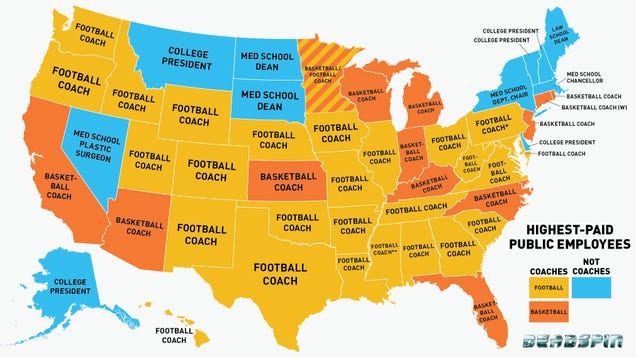
It's called being a snob. The disdain for working class culture among academics was part of the reason I choose not to pursue a formal higher education. I suspect this overt snootiness keeps many gifted working class kids from participating in higher education.
I grew up working class and was a boxer. I love Ice Hockey, Football, UFC, NASCAR, Motocross, and heavy metal, but I am also an academic and an intellectual. Many highly educated people have told me so, I just don't have the paper to prove it.
My oldest son is highly gifted earning math test scores putting him in the top tenth of one percent and placing 1st in regional Math Masters competitions. He also plays ice hockey so he interacts socially with the 'jocks' and the 'brains' preferring the company of the 'brains.'
Most of his 'smart' friends show contempt for sports which is a social problem since he is an athlete.
When a kids says, "Hockey. Meh. It is a bunch grown men with sticks chasing a black piece of rubber around a sheet of ice" he is saying in effect "What you love is obtuse and low brow and I don't care how that makes you feel." And that is just rude.