And, also not very funny, those corps never tell in advance which data they "require". They grab my mail on "the first page" of the registration form. Then, on "the second page", they ask for my phone and my address. Should I decide to agree to this, they will finally tell me on "the third page", that they only support credit card, no PayPal, no direct payment via Bank ...
The PSF is the most recent org which did not get my donation due to this. https://donate.python.org/ X pages, I will not know in advance which of my data is required and which payment option is supported. All this could be on one page, I guess.
Sure! Here you go. Open paint. Set the canvas to FHD resolution. Draw a one pixel thick, gray (#777777) line from one side to the other. You now have a perfect render, with antialiasing.
To me, it would be enough if there existed a search engine which only lists sites which do nothing of the above. But that would require that sites are honestly answering the question "are you tracking?". They won't. Corps have the same thinking as the criminals they try to keep outside.
There would have to be laws which require site owners to answer that question honestly, so that users have a choice and such a search engine can be built. But states are interested in fingerprinting too, so I guess such will never happen.
I always found Django's approach smart. The configuration files are Python files.
That said, TOML is not unsexy.
I hate JSON as configuration format, it is an exchange format, for configuration TOML is clearly more pleasant. VS Code, Sublime, you are doing it wrong.
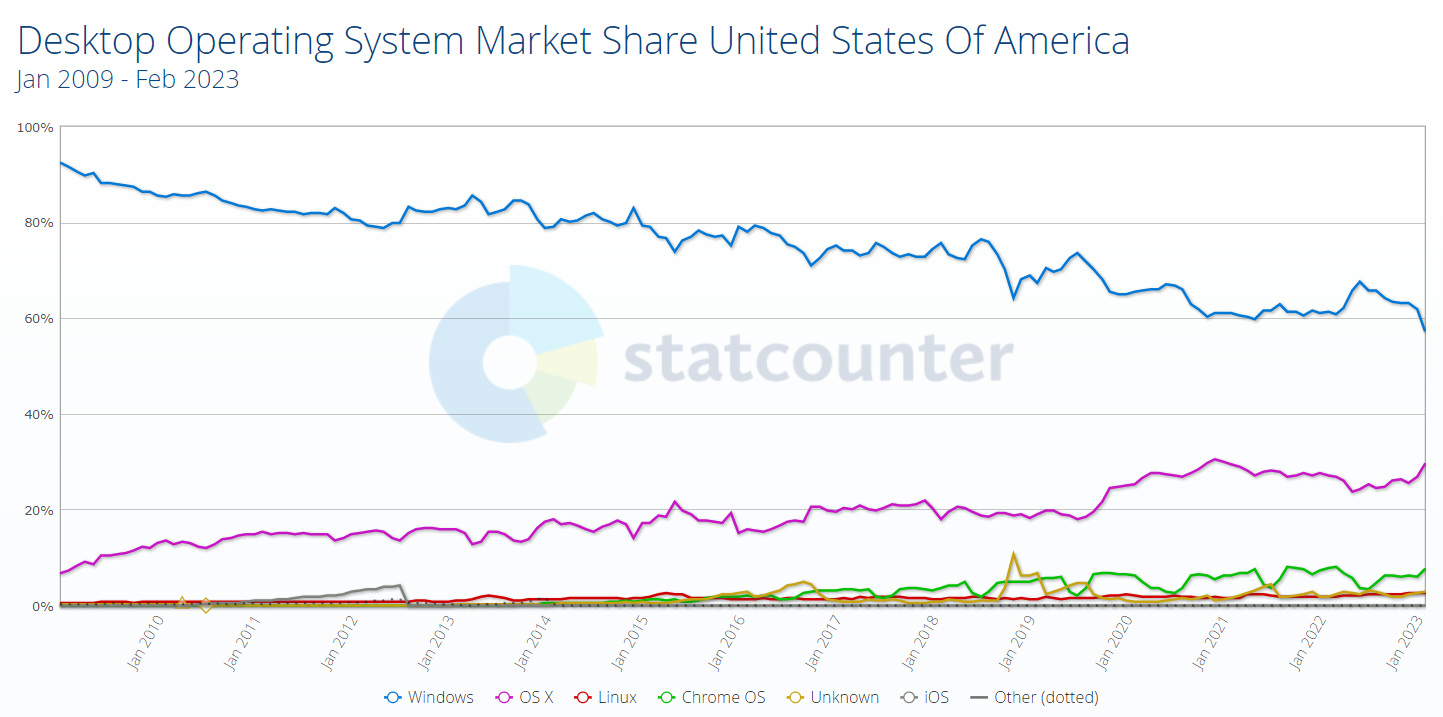
Linux is absolutely ready to spy too! The infrastructure is all in there and non-removable: dbus broacasts anything happening in the system, systemd starts background services by it's own and auto-updates are the norm. Last time I tried Ubuntu, it had popularity-contest installed by default. Apparently the scandal was big enough they removed it. [1]
I do use Gentoo currently, but it's so very hard to keep programs from monitoring what happens in the system via dbus and the only firewall for outgoing connections, OpenSnitch, hard-depends on it. Running every major program in a container is NOT a solution.
So far Linus has kept these things outside the kernel, but he won't live forever.
Popularity contest comes from Debian. Although I see nothing wrong with it. It asks you on install, whether you want to use it, and you can uninstall it at any time.
Honestly I don't know... I'm somewhat skeptical about these "next big thing that will fix all your pains in web development". There is so much fragmentation in JS libraries / frameworks. Angular, React, Vue, Angular, Asto, SolidJS, NextJS, Nuxt, Qwik... The list is so overwhelming. Almost each one claims that it fixes a problem in other framework, a year later the other framework fixes an issue... I think it's better to stick to a big old player, such as Svelte.
Svelte / SvelteKit is very lightweight but probably not a good choice if your app quickly grows in complexity. Angular has a larger community, long term support from Google, more people are familiar with, has rich functionality (including forms, localizations) and is well structured for huge projects. Once NextJS, SolidJS and others were interesting because of SSR, but Angular added this too (and continues to improve) in the recent versions.


reply