I don't have data to support it and I know AD was a gamechanger but I feel like Microsoft pumping free software to educational institutions was the main driver for it's adoption in the corporate world. When every person who kind of knows how to use the computer, can use MS windows and office and has to be retrained to use anything else, it's a no brainer to just give users what they know.
Don't you think this is why alarm bells should be going off right now about Google's complete domination of primary school systems? Google Classroom and Chromebooks are everywhere. Google Docs is the lingua franca, not Microsoft Word
The main benefit of Google Docs is that, at least, Google is a better steward. Not good, but better.
And also, their software is exceedingly simple, which is great for breaking vendor lock-in. Microsoft got away with murder because none of their shit works like it should and every single product they make is the "black sheep" in the category it's in.
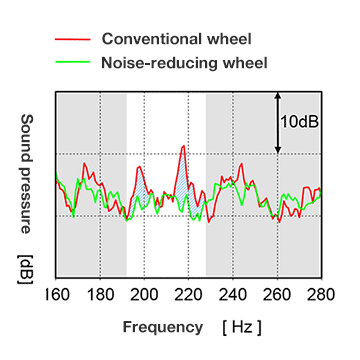
Maybe? It doesn't have a scale on the vertical, so you don't know how loud it is. It only shows that the horizontal bars are about 10dB. It's not a good chart. Essentially, somewhere just below 220Hz, it appear that there is a 10db dampening of the noise. We still don't know what that dampened level is though which makes this a meh chart at best
Since sound levels differ with distance and environment, absolute levels are not all that meaningful without a detailed explanation of their measurement setup. A 10dB reduction roughly corresponds to something sounding about half as loud to human perception.
I can see this point, but a 10db reduction from 90db to 80db is still really loud. A 10db reduction from 40db is even more impressive.
So having some baseline would still be helpful just to get some sort of reference. For science, you'd put the dampened wheels on a car and get readings from inside the car as that's the only thing relevant. You'd then replace the wheels with non-dampened versions on the exact same car, and then take your measurements from inside the car again.
This isn't rocket science. It doesn't need to be any more complicated than taking readings where your target audience will be sitting. The fact that this even needs to be stated explicitly just makes me sad for common sense
I mean, we’re talking half as loud. I would have thought to a layman it would be a lot more impressive to remove half of a loud sound than half of a quiet one. But I’m wrong on that one judging by your comment, which is fine. To a noise control engineer whether the sound is loud or quiet makes no difference to how impressive it is because these are linear systems (unless we are talking extremely loud e.g. >140dB). Good point on the obvious measurement location.
If I offer you half of a pie, you might think I'm being generous. If I then tell you the pie is actually only 5cm in diameter, you'd be disappointed. Receiving half of a pie that is 30cm would be much more impressive.
Telling me you removed half of something with out telling me the size of the something isn't compelling.
Yeah, I guess the reason we're talking past each other here is I'm thinking of the tool; if I gave you a coin that would purchase half of any pie then the pie size is irrelevant. Put this tire on a different road and the absolute sound levels will change, but the sound difference with and without the treatment will not.
At least in Canada, there were multiple researches on the topic and the only benefit of a timber frame is a speed and simplicity of construction. Given that they normally end up with a very similar price tag for new constructions, I don't see why consumer would prefer timber...
because the amount of firms who can build timber frame buildings is far far greater than the amount of firms who can build concrete buildings, which leads to more competition and also more housing being constructed.
Ten years in SAP working on FI, SD and AA. (not anymore, I'm done with that)
The post triggered PTSD and I want to go home and cry. You created your double entry, cool, now let's split it (because of million reasons) and add taxes. So now we deal with a basic 25 line document where some lines are doing nothing but move funds through certain tax accounts. Oh, no, there is a typo, but we cannot just create the reversal because for some accounts, the transaction should stay reflected in turnovers, for some it should not and for most it depends on fiscal period and stuff.
Don't forget that everything varies between countries. With all that let's create a financial statement for eg Walmart (who has every line item sold posted to SAP system when you buy things at store)
On the other hand, people who work on that don't think GPT will make them jobless. Also, I recall how a major client postponed adoption of a new reporting platform because it meant for them layoffs in accounting department and accountants started to sabotage the whole thing...
You can always use an open network to generate passwords for the proper internet connected WPA-EAP network (along with some in-flight multimedia like some carriers do). Extra step for sure but it solves the problem.
PS: I'm a couch expert so I have no idea if there's a problem with this idea.
The first problem that comes to my mind--clients will remember both wifi networks and may continue to choose the open network when e.g. waking from sleep.
The user can go in and forget the open network of course, but most won't know to do that.
QR code to connect to the _open_ but _hidden_ SSID. Instructs user to join WPA-EAP with supplied credentials once they've paid. Remains available to connect via QR in case customer somehow misplaced creds but avoids auto-reconnect during scan.
If you have a process where every commit is well documented, you don't need much comments since you can rely on whatever is your analogue for git blame. It's not a lack of comments, it's actually the opposite but aside from the code base.
When I worked at SAP where VCS for ABAP is ancient and has no analogue for git blame we had a practice of putting a SAP Note next to every code change, since some of the things that we had to implement are dictated by business/legislation, so you need a proper explanation from time to time. Without it, the code becomes unmaintainable.
That requires everyone to have access to the repo, and to wade through it looking for changes to the relevant area of code you're working in. That sucks.
Relying on commits also fails as soon as feature branches start being squashed. And the comments in commits can’t be modified over time. You have to hope readers “git blame” the correct lines of your code.
If your git squash contains all the commit messages, it’s a pain to figure out which commit message refers to which line of code.
A comment goes right there. No tools needed. Mutable. Readable. Contextually in place. And you can even add comments while coding without waiting for the commit.
In which situation would you not have access to the repo? I guess if it's a library or something, but libraries must always be documented in a different way to business code.
Seems like a footage of Patriot system firing out millions worth of ammunition and being destroyed/damaged afterwards by a ballistic missile is a big deal for its sales prospectives.
The Patriot had minor damage. Regardless, all SAM systems, regardless of how good they are, have vulnerabilities to massed attacks. My understanding in this case is that the Patriot performed very well.
not really. If a Patriot systems fires out $5M of ammo, gets destroyed, but shot down missiles that otherwise would have destroyed 5 tanks, that might be an absolute bargain. similarly, if it shot out $5M ammo against $20M worth of missiles fired at it..
Deception is always possible, but both Ukraine and the US have claimed only minor damage to the Patriot, repaired and back in service within a day. Patriot batteries are also made up of a number of different launchers; damage to one doesn't take out the whole thing.
All we have in the footage to go on is a flash. No indication of what kind or how much damage was done in it.