The key missing information here seems to be how many of these satellites would be required to have constant coverage of likely trajectories. This depends on the distance at which the laser remains effective. There would be no atmospheric scattering, but beam collimation is never perfect. It also depends on how fast the satellite can fire a new shot, as any warhead will be surrounded by decoys and other penetration aids. If this requires a large number of satellites, I am very sceptical. While Starlink has shown the possibility of creating large constellations, these sats would surely be much larger and more expensive. Really, Starlink makes me think something like BRILLIANT PEBBLES (https://en.wikipedia.org/wiki/Brilliant_Pebbles) would be a more reasonable alternative.
Also, could an adversary surround the warhead with absorbent chaff as a countermeasure? Or simply an ablative shield, the warhead needs one anyway to get through the atmosphere.
Still, a very interesting read from a very interesting CEO.
Yeah, me too. Bruno, although ex-LM and ULA, is one of those "born-dirt-poor-but-obsessed-with-rockets" kind of CEOs that seem to be hard to find these days. That's one of the great differentiators between now and the days of the S1C; you'd have a hard time finding finance executives doing technical steering in 1967. Which, I mean, fair point, as far as I'm concerned, but I might be a wee bit biased.
From a layman's perspective, it seems like maybe DEWs should be looking at disrupting the extraordinarily delicate aerodynamics/hydrodynamics/plasmadynamics(?) of maneuvering Mach 5+ targets in atmosphere. Why do I say that? Well, if these things get consistent asymmetry in any part of their forward shock they'll spin themselves into bits, that's one. You can't shield the air with ablatives, that's second. Also, third, the sheath might be part of the communication/guidance system, so disrupting that it is good. Finally - somewhat related to second - tuning DEWs to interact with a plasma has TONS of possibilities, which helps to mitigate DEW's many many weaknesses over longer ranges. For the most part, I think DEWs will be short range wunderwaffen - particularly on the defensive end - but there's going to be niche cases.
Referenced: cost of firing a laser is $1 of gasoline run through a generator. That's roughly a liter.
Let's say raw energy content is 32MJ/L, and we have gasoline=>electricity losses of 50% and laser efficiency of 30%, so we expect a little more than 5MJ per shot.
If you can hit a 2m target moving at 5Km/s through 1000Km of space and atmosphere with 5MJ, how much energy can you put on a 1m target moving at 7m/s at a range of 500Km?
The difficulty in killing people from space will be targeting, and the limited availability of fuel and oxidator in space.
Even more so, limited availability of cooling. Overheated laser melts rather than firing, so it will likely need active cooling droplet heatsink for fast refire in case it does miss or enemy fires more than one missile, and that's a limited resource.
> limited availability of fuel and oxidator in space
And don’t forget—-you have to fly up Tory Bruno each time to fire it.
But as a platform for assassination, it doesn’t seem so far fetched. The two main things I can think of that would make it difficult would be the much higher attenuation and scattering from the atmosphere, and the need for a different (telescope based?) target acquisition method.
Maybe, maybe not; self focusing [1] is an active area of research. Optics is one area where secret projects have been shown to be way ahead of what is publicly available [2] so I wouldn't be surprised if they've figured out some scifi way of making orbital lasers more effective.
Brilliant Pebbles seems way more practical today than 1987. Lots of exotic 80s autonomous systems are now commercial and mundane, and launch costs are plummeting.
Sending up a space laser seems particilarly absurd when one could send up 100(?) drone interceptors for the same cost with less R&D, especially when a drone constellation is far more resilient against anti satellite weapons.
Not to mention that this simply moves the initial conflict to space, where adversaries can deploy DE satellites to destroy ours... and THEN launch missiles.
It's incredible that 40 years after Reagan and the "Star Wars" defense plan, we finally have entities doing what seemed obvious even to high-schoolers at the time: just make the missiles zig-zag.
Zig-zagging burns energy. Staying in the atmosphere burns energy. Even without burning up energy on maneuvering missiles are mostly fuel--and the tyranny of the rocket equation applies. (Note that this is not a problem for terminal maneuvering--the missile can trade it's velocity for maneuvering at that point while only incurring the penalty of bringing along the control surfaces.)
Kind of by definition if something is -sonic then it's in the atmosphere. There would be less scattering but there would definitely be some on the target end.
Reentry does kind of by definition enter the hypersonic regime, but it's somewhat unintuitive to the layperson since Mach 5 is much slower at those very low pressures, and it's an entirely different beast than flying at Mach 5 in-atmosphere proper
> could an adversary surround the warhead with absorbent chaff as a countermeasure
That would require a constant stream of chaff (it would get left behind pretty quickly without any thrust), and would need to be shot out in the opposite direction of travel (lowering the missile speed the entire time), and require the chaff and its launch mechanism to be part of the payload (increasing weight).
No! This is as much a conceptual mistake as "interceptor costs 10X as much as the missile it is designed to destroy, so antimissile defense is foolhardy" without taking into account the value of what the missile can destroy.
Maybe the boat will get through; maybe it won't. The ship might be intercepted before it reaches the target. Or security personnel with geiger counters can find it on the dock. And so on. From North Korea's perspective (or the USSR's during the Cold War, or Russia or China now), the uncertainty of the success of such an attack makes it very, very risky to actually deploy, except maybe in a situation where you're already losing the war (and in that scenario, the odds of a successful detection by the target are obviously that much higher).
A ballistic missile, by contrast, cannot be stopped except with great, great difficulty. That's why North Korea has built missiles for its nukes, and not a fleet of cargo ships and fishing boats.
Ships are not currently inspected at sea, and it's impractical to do so. The cargo is in giant stacks, and you need a dock to unload it for inspection.
Finding it at the dock is completely useless. You can set the nuke off while still at sea and still destroy half a city.
There is no mechanism for interception of such an attack at the moment.
You need a neutron detector, rather than a Geiger counter, for nuclear material detection by the way.
That might work as a first strike capability - although sailing a cargo ship from North Korea to Tokyo without garnering any interest from intelligence agencies might be more difficult than you give it credit for.
But the main thing you want nuke for is as a deterrent. Get in a fight with us and we press the button. It's hard to imagine the sneaky boat trick working when North Korea is under blockade by the entire US and Japanese navies. And even if they run the blockade they're going to have trouble getting close to Tokyo.
An interesting "cheap, dirty & dangerous" mode of attack is loitering munitions from commodity FPV drones. Their capabilities have been demonstrated in current Russian invasion of Ukraine, and if any infiltrator can get in a few miles of the target, a "suicide drone" with a few pounds of explosives and shrapnel can be very difficult to defend against.
Yeah but they can't do it now and not for quite a while. And even then, what is the replacement speed. And how does it compare to how fast the US can take out China space based internet.
I always assumed he would end up deploying a weapons system to space. Of course he would have to pretend to be doing something else while he builds up the capability to prevent others from becoming nervous. Something silly like colonizing Mars would work, especially if he really leans in to the eccentric billionaire trope.
The building of the infrastructure needs a red herring, the actual deployment need not be secret because by then it’s a done deed. Once deployed you’d want people to know, to avoid a Dr Strangelove situation. A veritable sword of Damocles.
If the launch capabilities are unbalanced (as they are!) then no, anti-satellite missiles aren't an option - at the moment noone can afford to launch an anti-satellite missile for every satellite that SpaceX can sustainably launch. Like, it was no problem to launch 1500+ satellites in 2022, but at the moment I don't see a credible capability for China or Russia to launch 1500+ anti-satellite missiles per year.
That kind of brinkmanship would still be attractive to a waning hegemon. I was thinking more like 250 tones worth of mini nukes which would be pretty hard to shoot down.
That would certainly destroy the US position internationally as it would be impossible to defend surreptitiously launching '250 tons worth of mini nukes' into orbit. Especially if space was not weaponized beforehand.
In fact it would very likely lead to literally every other country ganging up on the perceived villain, or at least staying on the sidelines.
So I don't see why any launch provider in the US would participate in the intentional destruction of the US?
Nah, people will get over it quite quickly. Before it happens people imagine that others will be all upset and do something, after it happens realpolitik kicks in and the world quickly adjusts to the new balance of power. Much of the world has a vested interest in the US staying the dominant hegemon and militarisation of space won't change that.
No I’m not. I actually consider it a preferable outcome to the alternative which is a great powers conflict (WWIII) that would generate untold, potentially nuclear, destruction. If I found out the US did this I would breathe a sigh of relief and I’m sure I’m not the only one. So long as China thinks they have a realistic chance of dethroning the US they’ll take that chance. If the US fails to secure a Russian defeat in Ukraine that’ll only embolden China further. Ideally I’d prefer for the US to fix its own problems and retake its seat as the undisputed economic and moral arbiter of the world but I don’t think that is likely. My biggest worry is that the US believes its own missile shield hype and picks a nuclear fight that the US then loses (hint; everyone loses).
Not sure if I understand your statement. A deployment of a new unstoppable super weapon would be an entrenchment of power not a dethronement.
Norms are violated all the time to very little consequence, sure, this would be on a whole other level but what could you do… what could anyone do… and that’s the point. I think people are over optimistic about the potential for collective action. I’m not the person who needs convincing that it’s a bad idea, that decision maker, if they even exist, is in the US government somewhere.
Certainly not, but one wouldn't need to catch every satellite launch for space weapon- one or two would be enough evidence to go public and warrant further scrutiny. There are a number of extremely savvy amateur astronomers across the world that track suspected military launches and publish their findings:
https://sattrackcam.blogspot.com
"U.S. has excellent defenses against all classes of ballistic missiles"
This is the first time I've actually read somebody making that claim. Every other take on this topic has been that defenses against long range missiles are woefully inadequate and easily saturated by a low two digit number of missiles with MIRVs.
Those criticisms are not about the technical capability of missile defenses, but the scale at which they are deployed. If you can shoot down anything, but you only have 40 shots, obviously you can be defeated by anyone who can make 41 of even the crudest missiles. Likewise the best tank in the world is much less effective after it runs out of ammo. But if the issue is merely scale, all you need to do is make more interceptors, which is a finite and predictable expense, as opposed to developing a new technology which could be a massive money pit that ultimately fails.
The US maintains a rather small inventory of interceptors because for the past few decades only small strikes by rogue nations or accidental launches by major powers have been considered likely threats, and a large number of interceptors jeopardizes mutually assured destruction, which has been a much more cost effective counter against large scale nuclear exchanges. But there's nothing saying the US needs to stick to the current number if the global geopolitical situation changes.
There's a lot more it to than that. These systems are not only absurdly expensive (Patriots [1] costs about $1 billion for the system, and $4 million for a missile - probably more nowadays on both accounts), but also entail extensive training, operational, repair, and general logistic issues. A single Patriot requires a skilled crew of ~90 to operate with a peak theoretic range of < 100 miles.
And the systems are not invincible. When Russia either damaged or destroyed one recently in Ukraine, it seems they did the most obvious strategy and simply drained its battery (which seemed to hold ~32 missiles) before going after the system itself. Finally I'd also add in manufacturing and other issues. The manufacturing of alot of these systems has major practical raw material constraints (to say nothing of the manufacturing itself) when you talk about doing things at truly large scale.
---
That said, I agree this idea sounds more like a MIC money grab than anything else. You'd need a ridiculous number of these systems to provide sufficient coverage, it'd entail completely scrapping the Outer Space Treaty creating an overt weaponization race, and also create some really juicy targets for relatively cheap anti-satellite missile systems. The reality is that there is no such thing as a perfect defense because it's just so much easier, and cheaper, to create a +1 version of offense, in the scenario of a peer to peer battle.
He is also missing that the each Kinzhal reportedly costs upwards of 10 million USD which is more than 2x the cost of a Patriot missile, its closer to 3x.
It’s not just cost too - they physically cant make a lot of them. But yeah like other commenter had mentioned you fire at least two interceptors for every target
Although they are clearly not coming right out and saying it, the quantity of individual launch-cell-installed ballistic missile interceptors deployed in Alaska right now is clearly meant to deal with a threat from North Korea, not from Russia or China. The technology might exist but we would need something like a modern DEW line of many, many more of the same interceptors installed at bases spread throughout northern Canada to deal with a larger threat.
It is assumed right now that the threat from Russia and China is met by the concept of mutually assured destruction, as neither Russia or China have a vast quantity of missile interceptors that could be truly relied upon to destroy hundreds of incoming US missiles. And the fact that US missiles can come from almost anywhere via submarine launch platforms.
> But if the issue is merely scale, all you need to do is make more interceptors, which is a finite and predictable expense, as opposed to developing a new technology which could be a massive money pit that ultimately fails.
Except it costs many times more to make an anti-ballistic-missile interceptor then the original ballistic missile.
There's a fundamental asymmetry here, because interceptors have to be extremely high performance to be useful but the launching missiles can be as cheap as possible as long as it can throw enough penetration aids into the approximate trajectory.
So regardless of how much is spent on such a program, any country could spend a small fraction to fully defeat it, maybe as little as 10%.
Unless we gradually produce enough interceptors over many years to disarm MAD. Then we could notice some other state building a lot of ballistic missiles and preemptively strike.
> Except it costs many times more to make an anti-ballistic-missile interceptor then the original ballistic missile.
That doesn't sound correct to me. They're both rockets, one is much larger than the other and has a payload (in the case where we're looking at a failure of deterrence) made out outrageously expensive material. I mean, you can construct an argument that one is already built and paid for, or that 70's/80's technology was cheaper inherently, etc...
But from first principles, no. An ICBM is more expensive than an ABM.
Using one principle (nukes are expensive) isn't the same thing as deducing something from first principles. In particular, it's not enough, especially given hypersonic missile technology, to just take an ICBM, reprogram it, and voila you have an ABM. Because the cost of even a single warhead off an MIRV ICBM getting through is so devastating, the cost of a ABM system includes a huge number of missiles to increase the chance of catching the incoming attack. And then, once the ABM missile reaches the incoming ICBM. How does it neutralize the threat? What technology do we have that causes a lot of destruction? Oh that's right, nukes. If the ABM system uses nukes to neutralize the incoming threat, then it's very much not clear that the singular principle (nukes are expensive) doesn't also apply to the ABM system.
Some subjects, like computer science, which is still a very young area of study are very open to learnings from first principles. Others, like the geopolitics of nuclear deterrence, are deeper than any one person can even begin to understand.
Current interceptors do not use nuclear warheads. This makes it both cheaper and more expensive. It requires a more complicated hit to kill system than merely getting the nuclear warhead close enough. However, the system as a whole ends up cheaper. You don't need to get National Command Authority to authorize a launch anymore, because you're not using nukes. You can get that delegated down to whichever officer is in charge of the system that day.
The objective of National Missile Defense isn't to stop all the warheads, it's to make the attacker's job harder. There's a bunch of ways it does that. One is that the defender gets to choose what it stops. So they can stop all the warheads going to one target. But the attacker doesn't know ahead of time, so they need to launch enough warheads at each target to destroy it regardless of whether it's actually defended or not. So 1550 warheads no longer hit 750 targets, but rather they hit 75 targets. It really sucks to be one of those 75 targets, because most of them get absolutely destroyed, but the other 90% of potential targets are much better off, because they didn't get hit at all.
Another way is that ballistic missile accuracy depends on how far away from the target it gets separated from the missile bus that has the guidance system. If they separate too late, the interceptor will hit the bus before separation. Which kills all the warheads. So they have to move it back, which makes it less accurate, which means it's more likely the warhead will miss the target.
A third way is that they may decide they need to carry penetration aids. But there's a bunch of really fancy tricks radars and IR sensors can do to see which is a real thing, and which isn't, which amount to: the penetration aid which is best at mimicking a warhead ends up being the same size and shape as a real warhead. So they might as well just use a real warhead.
The launching missile can carry dozens of penetration aids, each one needing an interceptor warhead.
Plus, the physical structure and fuel are by far the cheapest parts, it's everything else, guidance systems, maneuvering systems, etc., that make up the majority of the cost. Which each interceptor warhead needs but which dumb penetration aids don't.
Control systems are one per penetrator, aren't they? Same with nukes, if we're talking about them.
I'd say that it's exactly the fuel, the engine, and the whole chassis of an anti-ballistic missile what's so expensive. An ABM has very little time to do its job. It has to launch instantly, and accelerates at 100g or so, and then must also maneuver at this circumstances. It should also pack enough punch to destroy a warhead which is a relatively small metal needle, built to withstand the mechanical and thermal loads of an orbital reentry.
As a contrast, an ICBM can start with much more soft acceleration, can spend 10-20 seconds preparing for launch without loss of efficiency, and does not have to maneuver much during ascent and the orbital part.
No, penetration aids don't need any control system, they're literally just dumb pieces of metal. Of course they won't explode or be accurate at all, but that's irrelevant to soaking up interceptors which need to be a launched well before impact.
It's literally sending up some of the most sophisticated vehicles ever made by mankind to defeat mostly chunks of metal. Hence why even the US can't afford it in any meaningful quantities.
Everything on an interceptor is much more expensive because of the much higher performance requirements. But the fuel and structure will still be a lot cheaper compared to the rest of system.
Satellites in LEO and MEO can be destroyed with reasonably affordable conventional missiles nowadays, and it's impossible to hide or maneuver satellites in the few minutes it takes a missile to get up, so it doesn't really make sense to expect that any such system will survive long enough to do anything in a hot war scenario.
Hence why nobody really wants to weaponize space, spending money on military systems that have no survivability isn't very attractive.
Maybe you could cite a reference on the costs of these things instead? I'm just saying I don't buy it. They're both extremely expensive, but ICBMs, even accounted per warhead, are more so.
THAAD interceptors look to be ~$100M each from a google search. I remember seeing a leaked document that suggested up to 3 interceptors would be fired at each target to guarantee a kill, but I can't find the document now, sorry.
A Trident-D5 missile is $30M, and can carry up to 14 (small) warheads (which would likely be a mix of larger warheads and penetration aids). Trident is still in production, but note that it's an economical US missile.
So given this very approximate math, ~$2M on offense could soak up ~$300M on defense. The cost comparison would look worse for the defense if you don't assume the (high) cost of a US offensive missile for parity.
Wiki says that $800M gives you a battery of 6 launchers (each equipped with 8 missiles), 2 tactical centers and 1 radar. So the upper bound for one missile is 16M. Still very expensive of course, but not 100M expensive.
Pretty sure that price for D-5 doesn't include the cost of the W-88 warhead. I would assume at a minimum those would be $10M a piece. Still doesn't make it more expensive than THAAD however.
This is hilariously cherry-picked. THAAD is extremely expensive if that's the case. Wikipedia says you can get a Patriot for just $4M. Also SLBM's as actually deployed aren't using maximum MIRV counts, both for treaty and role reasons. Wikipedia says 4 RV's on average for Trident, FWIW. But the big whopper is that you're forgetting to account for the $4B SUBMARINE (just $200M per missile though) required to deploy those missiles in their cost!
Good job though. Honestly the numbers are closer than I'd have expected. But ICBMs remain more expensive.
I chose Trident because I wanted a fair(er) comparison of costs due to purchasing power. If you want to use North Korean ICBM pricing, it's $30M[1]. THAAD is very expensive, that you're right about...but it's also the only interceptor that has a chance of success against an ICBM. Please note as well, trident is typically deployed with far fewer warheads likely among other reasons because it doesn't need to be an interceptor sponge, per its role. If you're North Korea with a small arsenal, every one needs to count against an opponent with THAAD.
Let's go back to first principles. I launch 3 mortor rounds at you. What would you need to do, to be able to detect, intercept and disable said rounds before they reach you? I don't think anybody would say the cost to intercept and disable (whether by blowing up etc) those mortor rounds is even in the order of magnitude the cost of the 3 rounds and the mortor combined.
Developing the capability to make nuclear weapons _at all_ is outrageously expensive, but once you can make one of them you can make hundreds for not significantly more cost, relatively speaking.
No need to mass produce the nukes, dummy payloads will do just fine. A single ICBM could deploy dozens-hundreds of credible looking warheads. These are inherently cheap relative to building independent missile interceptors.
You don't have to fire more ICBMs, you can put more RVs on the same ICBM. (And you don't have to put warheads on all of them).
And remember that acceleration is what costs, not speed. To shoot down an ICBM you need to hit it with a similar mass at a similar speed, and you need to do it in less time (because the ICBM launched first), so your interceptor needs to accelerate harder.
To intercept a missile you need to intercept it - that's it. You don't need to be traveling the same speed, or have the same mass, you just need to be physically where it is at the time it's there.
ICBMs aren't armored - and they can't be. They're spacecraft of a sort, and doing almost any amount of intentional damage will prevent them from functioning. Nuclear warheads are hard to detonate - the behavior if disrupted is the weapon likely goes inert because you've ruined the implosion mirror or timing circuitry.
The problem is that interception is hard because your engagement times are very short, and you're off-trajectory. Initial deviations in your aiming create larger and larger errors at the target, and any sort of maneuverability on the warhead's part means you're unlikely to be able to correct in time - hence the focus on trying to hit missiles in the boost phase, when they're by necessity more predictable.
There's no ICBM by the time any realistic interception scenario takes place. There's a slightly diverging cloud of warheads, chaff, jammers, light (inflatable metallized film) and heavy (small thingies that produce plasma in the higher atmosphere) decoys. The interception of a single target is hard because of what you said, the interception of any realistic salvo is impossible due to the sheer volume of incoming stuff.
Nope, the MIRVing/decoy deployment is done right after the boost phase, that way you need the least fuel to achieve the same target spread. That's some 5 minutes into the flight and mere hundreds of miles from the launch site. If it's Russia you're talking about, the missiles (or rather what's left of them) are still over their territory, some 200km up.
> But if the issue is merely scale, all you need to do is make more interceptors,
Attackers can choose where to attack. Defenders have to defend every city. For example, THAAD can protect about a 200km radius, so for every ICBM and SLBM, you need to add an additional missile to EVERY one of hundreds of sites.
They also need to all be kept ready at all times, replaced periodically etc.
You're making the single most common misunderstanding of the United State's ICBM defense capability, because you assume the goal is to "defend every city".
The real goal is quite different. The math starts to look very different when the defender can choose where to defend.
Assume a first strike against the US. The US has ~400 siloed missiles and a handful of airbases that can launch bombers. A reasonable goal for a first strike is to destroy those, preventing or substantially limiting a counterattack. Assuming some failure rate, using 2 warheads per silo gives you some redundancy, so 800 warheads needed for this phase of the attack.
What good is 40 intercepters against 800 incoming warheads? The US can choose which of those 800 to target. 40 intercepters can protect 20 silos from two incoming each. And that means the US can counterattack. To guarantee killing every single silo, the attacker must now have 20+2 warheads targeted at every single silo. The attacker has to build far far more offensive weapons than the defender needs to build intercepters, if the attacker wishes to avoid a counterattack.
Protection of the population comes from MAD alone, not by interception. (this of course isn't a reassuring thought, so this case isn't really made to the public).
That is why maneuvering hypersonics are considered such a threat: it removes the predictability of which warheads are going to land where, preventing that kind of choice of where to defend.
Strategically, the ICBM fields are warhead sponges. Each one only has a single warhead, but you'd want to target each of the silos, plus each of the launch control centers with more than one warhead, in order to keep them from launching. So a missile squadron would get hit with something on the order of 110 warheads in order to keep 50 warheads from launching.
But there are other strategic targets in or near cities. And those, it goes from having 2 warheads each, to havine 20+2 warheads each. So for the cities that don't get defended, it really sucks. But now instead of 1550 warheads hitting ~750 targets, it's 1550 warheads hitting ~75 targets. Because the attacker doesn't know what's going to survive to the target and has to choose their top targets that must get plastered.
Except it's worse: AEGIS BMD ships can launch from pierside. They don't have the range to defend the entire US but do for about half the US. So that's another wrench in attacker's plans (exactly how many SM-3 can hit depends on how many missiles are available at that time, which is a much more difficult thing to determine than the number of GMD interceptors).
MAD isn't a military doctrine. You won't see it on any doctrine publication of any service. The problem is the "Mutual" part. We don't want to die for our country. We want the other poor bastards to die for there. It's merely "Assured Destruction".
Silly if military prowess is your goal. Brilliant if funneling money to the military-industrial complex, garnering huge donations from lobbyists and making sure that all your friends and extended family are guaranteed lucrative careers is the goal.
THAAD is what you deploy to a place like South Korea where that 200km radius covers the entire country. For protecting something like the US mainland, you would use GMD, which can cover large sections of the continent.
But even if you did just have to build large numbers of short range interceptors, that's still perfectly acceptable. Likewise for upkeep and maintenance. You don't need to protect everything, you only need to protect the targets that justify the cost.
A single R-36MUTTKh missile from the 80s carries 10 warheads and an unspecified number of light and heavy decoys. A single regiment (10 missiles) will saturate anything and everything.
That's ballistic warheads, add any maneuvering re-entry capability and ABM defences are complete joke. Luckily for the humanity, MAD is alive and well.
This is probably better interpreted as "the US has the best defenses against ballistic missiles". The Patriot missile is proven to defeat Scud missiles in real combat, and THAAD is the most thoroughly tested system against long range ballistic missiles. Is that going to stop 5,000 ICBMs with penetration aids launched against the US? Almost certainly not, and I don't think the author meant it that way.
"The Patriot missile is proven to defeat Scud missiles in real combat" - no it isn't. It quite notoriously mostly failed to intercept Scud missiles in real combat. It has been heavily upgraded since and modern Patriot batteries would likely succeed at intercepting Scud missiles, but this hasn't been proven in real combat.
This was IIRC an issue back in 1990s due to how the system calculated time. So operation of a system continuously for more than 20 hours would cause the system to become ineffective until it was rebooted.
Thanks in major part to Israel, modern patriot systems have been rigorously tested via fire. To equate the current systems to the ones from 30 years ago is very disingenuous.
Patriot missile batteries in Ukraine have so far successfully intercepted all Khinzal Hyper-sonic Missiles launched by Russia. (At least, the ones that entered their Area of Operation)
The comment I replied to specifically said "The Patriot missile is proven to defeat Scud missiles in real combat". That is a false claim, as I asserted, and none of what you mention says anything about defeating Scud missiles in real combat.
Yes - best against moderately complex threats in limited numbers. For reference Recent SM6 test (FTM33) shot down 1 of 2 short range ballistic missiles with 4 interceptors in what's described as "most complex" test so far, but "most complex" hasn't hinted at dealing with anything like counter measures. Reality is, even US missile defense also haven't been seriously stress tested.
"However, according to Jeffrey Lewis, director of the East Asia Nonproliferation Program at CNS, the Saudis failed to intercept the missiles following a malfunction of the MIM-104 Patriot system.[3] One video appeared to show a Patriot missile launch on Sunday night go rapidly wrong, with the missile changing course midair, crashing into a neighborhood in Riyadh and exploding. Another appeared to detonate shortly after being launched in the Saudi capital. "
Pretty much the same failure mode as 30 years ago I would say, so maybe those ancient documents are still relevant today.
We’re watching a hot war where old PATRIOT batteries are downing Russia’s newest missiles. Given that context, this looks more like user error by the Saudis than any shortcomings of the system.
Also a poor example. The Saudi's are infamous for extremely poor training and readiness in there military forces. This is how they lost Abrams tanks in Yemen in a way that would never happen to US forces.
What are you talking about? Russia launched Kinzhal missiles as part of a larger saturation attack on Kyiv earlier this month and they were all successfully intercepted by the US Patriot system, operated by Ukraine. One piece of debris hit a Patriot radar, but no systems were lost.[1][2]
The Russians also arrested the scientists who helped develop the Kinzhal and charged them with treason due to the apparent failure during this attack.[3] Not something you usually do if your weapon system is successful.
You're wrong on that second part. The arrests happened before the strike. I'm disappointed how many media outlets obscured this point in favor of the narrative.
He's wrong on all parts. The arrests were about the technology being leaked to the Chinese, the "kinzhal missile" the notoriously unreliable Klitschko is proudly standing next to in the NBC photos he linked to is a BETAB 500.
The Ukrainian air force itself even denied that any Kinzhals had been shot down:
Your source is from May 5th. Subsequent Kinzhals were confirmed shot down much more recently.
> On May 4, 2023, Ukraine used a U.S.-supplied Patriot battery to down a Russian Kinzhal missile, which Russian President Vladimir Putin had announced in 2018 was a “hypersonic” weapon that could overcome all existing air defense systems. Russia’s state news agency tried to maintain this claim by arguing that the shootdown was a fake report. Yet just 12 days afterward, Ukraine shot down six Kinzhals [1] that Russia fired in an assault on Kyiv. Both shootdowns have been verified by U.S. government sources.[2]
Over a dozen scientists were arrested at various times in the past year, but three additional scientists were arrested and charged with treason this month after the failed attack. Using some critical thinking, we can see how this was a direct reaction to the failure of the Kinzhal missiles to impact targets.
Additionally, an open letter from the Russian scientific community was published strongly denouncing these arrests this month. The "media" isn't being misleading - they are reporting the events as they are happening.
Surely Ukraine, being in the middle of a war, would have no incentive to lie for propaganda purposes. As the other commenter pointed out they were arrested way earlier and the reason was because they sold secrets to China not because of any failure of the project.
The volley was fired at a massed coordinated strike of 6 Kinzhals, 9 Kalibr cruise missiles, and 3 Iskander ballistic missiles all arriving at the same time. All missiles were intercepted but one managed to incapacitate a single Patriot launcher after being intercepted (unclear if there was an actual detonation). A Patriot battery consists of multiple dispersed launchers, radar, and control units. It's hard to imagine better performance than this for an air defense system tasked with protecting a capital city.
The US has a variable capacity for Patriot missile manufacturing but its baseline far exceeds the 300 missiles per year that you quoted.
There was a clear large explosion on the ground while the Patriot was no longer intercepting. This wasn't just debris getting through.
That said, it's not necessarily due to failure to intercept that this happened - we have video of 30 interceptors being launched in rapid succession, and it's likely all 32 interceptors in the battery had been launched and expended when the final strike and explosion happened. So it's more of a successful saturation attack than an interception failure.
Yet they're not that much better. Per Wikipedia (I have edited out successful intercepts!):
Syrian civil war (2014–)
{...}
In July 2016, two Israeli Patriot missiles missed an incoming drone launched from Syria, according to Russian media.
Israeli Air Defence Command fired two Patriot missiles, but they did not manage to destroy the target. Russia Today stated that the drone penetrated four kilometers into Israeli airspace, and then flew back into Syria.
In June 2018, a single Israeli Patriot missile was fired toward a drone which was approaching Israel from Syria. The missile missed its target, and the drone turned back to Syria.
Service with Saudi Arabia
In March 2018, another missile, apparently fired from Yemen, was intercepted by a Patriot missile over Riyadh. Missile experts via news agencies cast doubt on the effectiveness of the Saudi Arabian Patriot defense. According to videos, one interceptor exploded just after launch and another did a "U turn" midair toward Riyadh.
In September 2019, the six battalions of Patriot missile defense systems owned by Saudi Arabia failed to protect its oil facilities from attacks by multiple drones and suspected cruise missiles during the Abqaiq–Khurais attack.
This is a weird set of evidence to pull out when there's a war going on in Europe where the interception rate of Kinzhal missiles went from 0% to 100% under a barrage attack, specifically after the Patriot missile system was installed (and in said barrage where the Patriot installation itself was specifically targeted in essentially the most optimum possible attack scenario).
The salient point about old news about the Patriot system is not about technical capabilities, but about how, years ago, it was first reported as being effective and then as not so effective.
It could be completely different technology today, but still have the same lack of accurate reporting.
How would we know? "Those who say don't know, and those who know don't say"
I think it's important to bear in mind that the Saudi defense forces for decades have been show forces; they buy expensive gear, then fail to maintain and train on it.
Yes, so I've read but still the Patriot they lost to a Houthi drone strike was recently bought from Greece, so I think it was fairly new and well maintained.
I see. We do have good systems, but too few to be of practical relevance in most threat situations.
The North Korea case shows that the step from having one missile to having 100 is extremely short compared to going from having no missiles to having one missile.
I don't think that's a consensus view? Jeffrey Lewis says the opposite,
- "The point is that North Korea is clearly aimed at overwhelming the US missile defense system in Alaska... At that cost, I am pretty sure North Korea can add warheads faster than we can add interceptors."
> even if they got one through, wouldn't North Korea basically be a wasteland 30 minutes later
The idea is if to have a credible threat to keep us from acting first, as well as giving many countries a vested interest in the stability of the regime: if the Kims go, North Korea goes, and so does somebody else.
Congratz, you grasped the facet of MAD that is unacceptable losses - for the US a single warhead getting through is too high a price to destroy pretty much anyone.
Cost of individual military items is often clouded by the need to amortize development cost over a relatively small production run. Making an additional missile beyond the contracted quantity does not cost $5m.
I think the claim is true, I also think that a lot of missiles would get through.
A baseball analogy, an excellent, best in the world baseball batter will hit 4 out of every ten balls thrown at him. that is still an awful lot of balls that get through.
For real world numbers note how well Israel does against all the ballistic missiles thrown at them, also note that these are slow short range ballistic missiles.
The motors on these burn out pretty quickly, after which point they become atmospheric ballistic (not truly ballistic because they have fins and there's atmosphere). This is true of all basic rocket artillery generally.
The guy was the program manager of THAAD. He is not going to write that his work is worthless. That would have stopped his career a long time ago.
Not that it means that what he says is necessarily untrue but you have to take it with a huge grain of salt. While definitely a subject expert, Tony Brunoula is approximately as far from a neutral party as one can be on this question.
And that was recently demonstrated in Ukraine, where a Patriot battery fired 32 missiles against incoming targets[1], but got hit nonetheless. It looks to me like missile defence works well in very unbalanced situations, such as Hezbollah's home-made rockets against Israeli Iron Dome, but is easily saturated when against a roughly equal adversary.
[1] IIRC Ukrainians and US say there were 29 incoming missiles; Russians say there were 6 or may be 9 (unsure). Both numbers are probably made up, and truth is probably in the middle, 12 to 18 or so.
> where a Patriot battery fired 32 missiles against incoming targets, but got hit nonetheless
It also shot down Russian hypersonic missiles [1]. I don't know which variant [2] we sent Kyiv, but this is almost certainly an old PATRIOT battery taking out "cutting edge" Russian hypersonics.
It is hypersonic, but it follows a very predictable high-altitude trajectory, so it's the easiest kind of hypersonic missile to intercept.
I read a good thread about the various kinds of hypersonics a while ago, but can't find it now. Broadly, there are three classes: hypersonic cruise missiles (like Tomahawk but much faster), hypersonic glide vehicles (basically ballistic missile warheads with wings), and classical ballistic missiles. It's the former two which are new and scary. This touches on it, but is rather one-sided: https://www.brookings.edu/blog/order-from-chaos/2023/05/23/u...
Its perhaps worth noting that literal hypersonic “ballistic missile warheads with wings” were developed by the US for ICBMs in the 1970s, and are deployed by many countries on ICBMs or MRBMs (ironically, not the US, whose last MARV-capable missiles were the Pershing II, retired in 1991.)
I think the deal with the Avengard (and the US C-HGB as used on the soon-to-be-deployed LRHW) is bigger wings / lifting body giving it greater maneuvering capacity through a flatter flight phase trading more of its speed for lateral displacement than earlier maneuverable ballistic missile warheads.
Furthermore, it can in principle come from any direction, which was relevant historically when it was expected that Soviet ICBMs would come over the North Pole.
If they are actually glide vehicles these are exactly the hypersonic glide weapons discussed above, if thy “glide” part is an exaggeration, they are just classic ballistic missiles with maneuverable attack vehicles (MARVs), which are widely used, they aren’t, in any case, outside of the three categories presented.
It was unveiled in 2018 by Putin alongside the Zircon anti-ship and Avangard glide vehicle [1]. Within the context of Russian hypersonic ballistic missiles, Kinzhal is the flagship.
You're absolutely correct, by the way. And that's the author's point. (Which I've been partial towards for a long time.) Hypersonic missiles are not the game changer they're claimed to be, and to the degree they open new tactical ground, the United States is well set to at the very least match adversaries' capabilities.
The thing with Kinzhal is that it is not maneuvering, but the Russian agitprop muddies the waters by focusing on the "hypersonic" part. However, as the article points out, an actual maneuvering hypersonic missile - which is something that all major players are working on - is indeed a major threat. It's just unlikely that Russia would have that any time soon, given the overall state of their technological development demonstrated during the war so far.
> an actual maneuvering hypersonic missile - which is something that all major players are working on - is indeed a major threat
I've heard Avangard lacks propulsive glide. That means it's ballistic in space, and only maneuverable (at the expense of range and speed) at the terminal phase. This is solvable because it's old tech–basically MIRVs.
It's interesting how the propaganda story about "intercepted" Kinzhals is being spread together with the official US confirmation of "minor" damage to the Patriot system. Also we have videos which show explosions happening on the ground level (https://www.bitchute.com/video/paRpPOE15Gx4/ 0:33 and 0:42). Even if you believe in the debris story, it means that a rocket got in the range of ~100 meters of the system, which is already can be read as an interception failure for a Patriot-like system.
Of course, the Russian story of "destroying" the Patriot battery is also clearly exaggerated. It's quite probable that the most visible and easily targeted radar module got destroyed, while the rest of the system is fully intact or got hit lightly by debris.
If you destroy a ballistic missile, the debris will mostly remain on a ballistic trajectory, raining down on what would have been the target.
There's no reason to believe that the radar got destroyed at all. The explosions on the ground were confirmed to be hits on the airport terminal (aftermath pictures are available). Obviously, no part of a Patriot system likely to be inside a building.
Last I heard though, those hits were caused by normal Kalibr cruise missiles. It is a bit concerning that those got through, hopefully they learn from it. But not surprising, because it is challenging for a radar to search for objects both above it and at ground level around it simultaneously.
There are zero such missiles. It's all marketing BS. They have air launched ballistic missiles. These are not "hypersonic missiles" by any accepted definition.
(If the Russian definition is valid, then the V2 was a "hypersonic missile").
In fact hypersonic missiles are pretty common. Every rocket that leaves Earth’s orbit is ‘hypersonic’. There is nothing inherently special about being ‘hypersonic’ in general. In space everything achieves hypersonic speed quite easily(ICBM’s and space rockets) are all hypersonic when they enter space. The trick of hypersonic missiles is to do that within the constraints of earth’s atmosphere. The US has them:
It's unclear whether they have any in operational service right now, but the Zircon is certainly a true hypersonic maneuvering cruise missile, rather than merely a ballistic missile or even glide vehicle.
given russia's long history of dishonesty in their claims (e.g. 'we won't attack Ukraine, that's just western propaganda', 'we are the victims and not the aggressors', 'we aren't raping children in Ukraine'), the truth is, by default, most likely to be the opposite of what russia says (but of course, subject to dispute if russia actually has reliable verified evidence of their claims)
it's simply the bayesian prior at this point; the null hypothesis
The Ukraine has its own rich history of dishonesty.
The first day of war: Ukraine says that Russian warship killed with missiles all Ukranian border guards on the Zmeiniy island. Everyone is shocked by this senseless cruelty.
Russian MoD says that guards are taken prisoners. Nobody believes.
Two weeks later: Ukrainian Defence Minister gives medals to the border guards safely returned to Kiev.
maybe, maybe not. Two things are for sure, though:
1. there is no such thing as "The Ukraine" anymore, only Ukraine, as in the independent country with internationally recognized borders [including Crimea]
2. given russia's long history of dishonesty in their claims (e.g. 'we won't attack Ukraine, that's just western propaganda', 'we are the victims and not the aggressors', 'we aren't raping children in Ukraine'), the truth is, by default, most likely to be the opposite of what russia says (but of course, subject to dispute if russia actually has reliable verified evidence of their claims)
again, it's simply the bayesian prior at this point; the null hypothesis
It means what you say might be true, or it might be false, but either way it has no bearing on russia's long history of dishonesty, and thus has no bearing on my comment
indeed, whataboutism itself is a form of dishonest debate which was invented, and is used to distract from russia's long history of dishonesty (here for example).
So you don't bother to google and check if the Ukraine has a habit of lying too, and prefer to believe anything coming from Kiev only because Russia says the opposite.
The word 'whataboutism' is a form of dishonest debate and used to distract from critique of double standards.
"guess who invented it? russia, of course."
I'd say it was invented during Cold War by some American in search of rhetorical device to distract from their double standards.
Theres no evidence it hit anything, other then that of the Russian government who has shown itself in this conflict that it is incapable of doing anything but lying. In fact people found where it was doing deployed and theres not even any scorch marks, everything points to the thousandeth Russian lie in this war more then anything else.
> Even the US says there was 'minimal damage'. [0]
Yes, minimal damage from flying debris from something, but it's clear from that satellite imagery nothing hit any part of an actual patriot.
> There is no evidence to the number of Kinzhals launched and to the number of Kinzhals intercepted.
Exactly, no evidence of anything but minimal damage to a patriot either. Kinda pathetic given the size of the attack that Russia cannot even take out one air defense system that they clear know where is.
the flaw in your logic is that things (!russia) does don't affect the high probability that russia is lying, which is, again, the bayesian prior
only the changing behavior of russia can change russia's history of behavior, and it can choose to change in a more honest direction anytime (but has not done so)
you're thinking about it wrong, they don't have any effect on each other, even if you think you can use one to reason about the other
if russia says A, we can assume !A due to russia's history of dishonesty, literally with no other information necessary
someone else being dishonest, even if true, doesn't make russia more honest, so we can still assume !A
indeed, because russia's history of dishonesty is so long and strong, we can stop right there, unless russia proves its probable lies are actually truthful (such is the fate of a liar)
if they don't like it, they can start being honest and keep it up for a few decades to show they've changed
- The Patriot system is modular, there are pictures of the different parts on Wikipedia[0]. When Russia says they've destroyed a Patriot, what exactly have they hit? The radar? A launcher? Hitting one component of the system is not exactly the same as destroying the whole thing.
- Decoys are used during these attacks. Both Russia[1] and Ukraine[2] use them. Even if no one lies, I assume that the number of targets seen by the defenders will always be higher than the number of missiles launched.
Apparently the Patriot system that got hit only suffered minor damage and is repaired and back up and running now. I wonder if it was perhaps hit by some debris? But it is hard to speculate through the fog of war.
> Patriot battery fired 32 missiles against incoming targets[1], but got hit nonetheless
This phrasing suggests that the only objective that Patriot had was to defend itself, which it failed. However, Patriot system in question was also tasked with defending a lot of critical objects in Kiyv, all of which have not been hit.
Any system can be saturated and overrun. To make an honest assessment, we need to know exactly how many Patriot systems were on the ground, and how many targets were they tasked to protect.
The Patriot certainly is defending some potential target, however it also requires systems to protect the Patriot itself from various kinds of weapons. Air defence is extremely complex and layered when you have to be able to intercept 15000$ drones flying at 150km/h, subsonic cruise missiles, ballistic missiles and gliding bombs of various types and speed, and super/hypersonic cruise missiles.
We really don’t know enough about that incident to draw any conclusions from it. Russians said the Patriot was destroyed by their missile, US said it was minor damage from debris and was operational again within 24 hours. I’m sure at some point we’ll know what happened, but not for quite a while.
Unless the Ukrainians deployed everything in the same area and very close together, I don't see how one or two missiles could destroy a Patriot. Unlike planes or tanks, the system is modular and made of different parts (launchers, radars, etc) that - as far as I understand - are supposed to be spread around.
A bit of a tangential point, but the problem with Ukrainian situation - is that Ukraine doesn’t fire back to where these rockets came from. Any engagement I can imagine involving NATO would not be constrained to such ridiculous, sad, and unfair asymmetry.
> A bit of a tangential point, but the problem with Ukrainian situation - is that Ukraine doesn’t fire back to where these rockets came from.
The lack of adequate deep strike weapons (and possibly political constraints on the use of some of what they have that is externally sourced) is a real problem for Ukraine, to be sure. Given how badly Russia has been underperforming for its on-paper advantages other areas, I’m tempted to say that the deep strike asymmetry is the main reason Russia is able to continue the war at all.
Ukraine has been using what they have to hit Black Sea Fleet ships and fairly deep bomber bases, but their capacity to do either is limited.
> Any engagement I can imagine involving NATO would not be constrained to such ridiculous, sad, and unfair asymmetry.
Well, the launch locations aren't static/fixed sites. The Kalibr is generally launched by Russian vessels in the Black Sea, and the Kinzhals are launched by MIG-31s. You could try to strike their airbases, or ports, but that's a non-trivial exercise, even for a major power.
The Gorshkov class frigates are a much tougher nut to crack than the Moskva was. A well orchestrated Harpoon attack might be able to, but Ukraine lacks enough launch platforms (and no aircraft that can safely reach it).
You probably meant Hamas. Hezbollah has much more advanced rocket capabilities and has just much more of them. While Hamas (and Islamic Jihad) rockets can usually be stopped by the Iron Dome, Hezbollah has orders of magnitude more of them and many of them are precise.
These were short range ballistic and cruise missiles, which are an entirely different category of threats compared to ICBM delivery vehicles. The difference between Mach 5 and Mach 23 is significant for interceptors, obviously. Patriot is not able to intercept ICBM warheads for that reason.
Richard L Garwin, the author of the first hydrogen bomb design, says that midcourse and terminal missile defense is easily overwhelmed by deployable decoys: https://www.garwin.us/mirror/030605nmdp1.pdf
Its clearly a mostly unuseable trade chip of buying projected security for buying weapon exports. Which is okay, but for actual protection, look towards countries who actually use the equipment they have regularly in a warzone against a opponent similar to the expected opponent.
Israel, turkey, other middle eastern countries, lots of african and some south american countries come to mind.
Unless we have some super duper military technology no one knows about then we can't possibly stop 1000 russian warheads coming down on our heads. but neither can the Russians
The article is very cool and informative, I actually enjoyed it.
But since I didn't know the author, it took me to the last paragraph and his signature to notice he's actually trying to sell us on the idea of putting actual Death Ray satellites in space.
That's kind of cool too, but I'm sure it's a very bad idea to combine worldwide surveillance and killer lasers in space.
Well, ULA needs some big DoD contract to launch heavy objects.
Military solid state lasers are finally getting powerful enough to be useful. Below 100KW, they weren't effective enough, and it took decades to get the power up. Northrop-Grumman delivered a 150KW laser to the Navy in 2021.
Lockheed-Martin delivered a 300KW demo unit last year.[1] These are ground or sea based. Israel's Iron Beam system tried lasers, but below 100KW, and only useful against small rockets and drones. Since that's what their opposition shoots at them, it's useful.
Space-based lasers have lots of problems, from cooling to being big targets themselves.
But they're a much less silly idea than they were in the 1980s.
We may be seeing the biggest reversal in war since late WWI - defense may be stronger than offense again. Historically, this has gone back and forth. In the era of castles, defense was stronger. Then came artillery. WWI started out with defense being stronger - nobody could advance against machine guns. Then came tanks and the beginnings of air power. Offense has usually been stronger since then. Now we're entering an era where nobody has air superiority. There's a mostly empty sky. If it flies, it dies. On the ground, tanks are now very vulnerable to man-portable weapons.
When defense is stronger, wars lead to bloody stalemates, like Ukraine. Nobody can force a decision.
Battles are long, bloody and destructive. The winning side gets to own the ruins.
> Now we're entering an era where nobody has air superiority. There's a mostly empty sky. If it flies, it dies.
The danger here is everyone filling space with satellites as a means of defense. When the war starts, Kessler Syndrome kicks in, and everyone loses their defenses in a few days.
Ground based lasers may have less range, etc, but they can be hardened, protected, even hidden.
Imho, we'll see a day where every major city on the planet has a set of anti missile lasers.
While I agree that these would be in a lower orbit, if they are low enough that debris would fall quickly then so would satellites. Debris doesn't know it's debris and so it should fall when the satellite did not.
Yes, some satellites can self-boost with ion drives giving them longer life in lower orbits, but they can't do that very often or for very long due to reaction mass limits. You're still talking about orbits where debris would last years.
No, debris in the same orbit would fall much more quickly than satellites, due to the square/cube difference, a larger piece gets slowed much less than many smaller pieces with the same combined mass.
Also, "the same orbit" is the best/worst case scenario, since after an impact any new orbit still passes through the point of impact, but if the new orbit is more elliptic than the original (which most likely was close to circular), then it has a lower perigee, where most of the drag occurs, and thus would get dragged down faster than in the original orbit.
If a satellite is in a low orbit that needs re-boosting every few years, then the debris from its destruction would get cleared out in weeks or months.
>We may be seeing the biggest reversal in war since late WWI
Mainstream discussion so far limited to the tactic/operation layer in farflung battle fields. More pertinent is strategic layer where this desperate race for ABM is due to offensive rocketry / long range conventional strikes is increasingly openning up CONUS for attack. Which is the biggest reversal against US primacy since Revolutionary war. US homefront being ground to existential halt because ABM can't prevent adversaries from blowing up US refineries will place vast constraints on US willingness to defend interests abroad. When homelands are mutually vunerable - something US hasn't had to factor into calculations - it becomes much harder for US specifically to unilaterally force decisions, something it would otherwise do with relative impunity when adversaries could not disrupt CONUS.
Lasers that shoot down missiles from space can also shoot down laser satellites in space. Lasers on the ground can be larger and more energetic, but do have to shoot through atmosphere.
The article seems to talk about strategic hypersonic but I’ve mostly read about them for attacking ships and bases that are likely to have defenses. Ground point defenses might be cheaper than space constellation.
I think lasers have potential to change warfare. For example, naval warfare gets really weird if lasers can shoot down missiles and maybe even shells. Do they use torpedos?
> he's actually trying to sell us on the idea of putting actual Death Ray satellites in space
This is also an essential component of a planetary asteroid defence system.
One could theoretically tune the power and wavelength of the beam such that it's highly destructive in space and the upper atmosphere, but mostly a nuisance on the ground.
Doubt it. There's no way that lasers will be able to vaporize a huge asteroid. Realistic proposals for planetary defense call for intercepting asteroids very far from the planet and pushing them off course enough to barely miss us.
The point of the laser isn't to vaporise an entire asteroid. It's to push it off course enough to make it miss the Earth. The laser achieves that by pointing at a spot and turning that spot into an impromptu rocket engine.
An orbital laser won't have the range for that. The dispersion would be too high for any lens that we can practically launch into orbit.
More realistic proposals for planetary defense call for focusing on long range detection and then using a gravity tractor or a rocket motor landed on the asteroid to slowly nudge it off course.
I just don't think that's true. We launched Hubble and JWST, as well as many spy satellites with similar mirror size. If we're talking about lasers that could feasibly intercept ICBMs or hypersonics, that amount of laser power and a large lens should be able to exert significant pressure at range.
It's 2023 and to me this is just another new sales pitch for Reagan's old "Star Wars" system. It was a bad and unworkable idea then, and it still is today.
Hypersonic is a poorly defined term. Some people use it to simply mean "faster than about 5x the speed of sound". That is what people mean when they say "China and Russia have Hypersonic missiles".
But speed at that level is basically irrelevant for interception etc.
Other people use Hypersonic to mean able to manoeuvre at those speeds. A normal ICBM, especially the old ones, cannot do that. They follow a simple, predictable, course to their targets. In theory that makes it easier to hit them. Only no one can do that. People have done a respectable job of shooting down non-ICBMs. But ICBMs are 10-100 times faster, further away, higher, etc. And no one will use 1, they will use 1000 and it is dooms day unless you intercept 990 of those.
So all of this is really just a mix of honest ignorance (and confusing terms) and dishonest sensationalism...
The point of a hypersonic missile is to NOT follow a simple parabolic curve to the target. That is what hypersonic really means: able to manoeuvre at speeds about the speed of sound. That makes it harder to intercept. Only no one can intercept an ICBM anyway.
Interestingly this is why the first Hypersonic missile was actually build in the 1930s...
You know, before we had interceptor missiles that were tolerably good against ballistic missiles, pretty much the exact same argument was made by experts like Edward Teller for why space based lasers and/or particle beams were essential to intercept ballistic missiles.
Not saying its necessarily wrong now, but it was definitely very expensively wrong the last time.
I am been fascinated by Edward Teller and the x-ray laser. It strikes me as a case of a golden hammer [0]. Here he had an incredible tool: a thermonuclear weapon. It can destroy a silo, a fleet of ships, or a city. What else can we do with it [1]? Maybe for the best it didn’t work out.
The human genome project cost 3 billion dollars to sequence the first genome(s) (with one draft costing about 300 million), you can now have your genome sequenced for less than $1000.
Yes there are differences, but science and technology have moved on substantially. Just because it was wrong the last time does not mean it is going to be wrong this time.
Umm, it's pretty trivial for amateurs to track space objects either in Earth orbit. For SDI to work, both the number and size of the systems would be quite large. And they would need to be replaced when they either fail or run out of station-keeping propellent. So no, there's no evidence for a "hidden" SDI that actually works.
It's hard to take his praise for laser interception of hypersonic weapons seriously.
For intercepting swarms of cheap drones? It's a great fit! Space-based lasers for intercepting ICBMs? Maybe? But true hypersonic weapons (which Kinzhal is not) fly only in air (after all, they use oxygen in it to fly), while being covered in a plasma shield which is really good at absorbing all kinds of electromagnetic radiation.
Meanwhile, with high enough laser power you get instabilities in air which act as a natural diverging lens for your beam, drastically reducing effective range of your system. Push power even further to compensate for it and you will get plasma, which does even better job at dispersing energy of your beam. So in the end, you get a very short range interception system with a minuscule time frame to perform interception of a hypersonic target.
This reference [1] tends to support what you are saying:
> For this thesis, an atmospheric propagation code named ANCHOR (Atmospheric NPS Code for High Energy Laser Optical pRopagation) was developed and utilized to study the propagation of high energy lasers in various atmospheric conditions and for numerous laser configurations. The ANCHOR code accesses existing industry databases to obtain relevant optical properties for various atmospheres and then uses scaling laws to simulate laser propagation through the defined environments.
ANCHOR accounts for the effects of atmospheric diffraction, turbulence, platform jitter and thermal blooming on the laser beam, and outputs on-target irradiance and power-in-the-bucket profiles for a wide range of laser wavelengths. Several known physical trends associated with laser propagation will be reproduced, and the results will be compared to the industry accepted propagation code Wavetrain.
The results of ANCHOR studies will indicate that the 100 kW-class high energy laser can effectively engage slow-moving targets at ranges greater than five kilometers in clear weather by delivering enough energy to melt 0.1 liters of one millimeter-thick aluminum aircraft skin in five seconds. For hazy, turbulent, and rainy conditions, the laser can effectively engage targets from ranges closer than three kilometers, but reasonable dwell times are only achieved for ranges closer than two kilometers.
I had heard that space based stuff was “illegal” - finally looked up what treaty defines that
“Development of orbital weaponry was largely halted after the entry into force of the Outer Space Treaty and the SALT II treaty. These agreements prohibit weapons of mass destruction from being placed in space. As other weapons exist, notably those using kinetic bombardment, that would not violate these treaties, some private groups and government officials have proposed a Space Preservation Treaty which would ban the placement of any weaponry in outer space.”
The sad state of affairs is that international space treaties are practically unenforceable..
Hence ULA CEO proposing giant space lasers™ which obviously will not be defense only in the long run. The same way the US "defense industry" has never defended.
And who is going to stop the Chinese from putting weapons into orbit? Heck they might've done it already and we'd be none the wiser.
A laser being able to destroy a low flying high speed missile hardend against those is probably also able to a lot more. Like destroy enemy planes. Or combatants. Or heads of states. Or pesky journalists/dissidents.
Allowing sth like this to be deployed, not sure if this can be allowed by eg other nation states. It certainly puts the status quo in disarray...
The article argues that lasers are cheap because you can just run them off a diesel generator in a container. But then it switches to space... which obviously doesn't do well with diesel and refueling.
I assume we're talking about either battery+solar cell or nuclear power on those satellites?
The important part is that their overall energy consumption is low. And their usage is quite bursty so I think you're right that a space based laser would just spend days charging batteries via solar or from an RTG.
Also even on land with the diesel generator, I assume the generator is charging up batteries or super capacitors and not hooked up directly to the laser. Estimating a ~30 second laser discharge, only the most gigantic diesel generators can convert a gallon of diesel to electricity in half a minute.
> And their usage is quite bursty so I think you're right that a space based laser would just spend days charging
Sure, but surely there will be a maximum total power storage that a satellite will have, and if that totals, say, 50 missile zaps, them don't you have the same problem that the enemy could send 51?
When 51 missiles are on their way, you don't have time to recharge from the sun.
And unlike the diesel generator you can't quickly add more power storage the week before when you see what the enemy is about to do.
> And their usage is quite bursty so I think you're right that a space based laser would just spend days charging batteries via solar or from an RTG.
That's not how it would be in a war. Their usage would be exactly zero, and then basically continuous. Not bursty at all - more like off, and then full on.
Energy for the space weapon would be a large problem.
> only the most gigantic diesel generators can convert a gallon of diesel to electricity in half a minute.
That's what they use - the generator is the size of an 18 wheeler.
> That's not how it would be in a war. Their usage would be exactly zero, and then basically continuous. Not bursty at all - more like off, and then full on.
IDK, I see it quite likely that even close to single-shot capability would be good enough. For the kind of a war where you need defence from ICBMs or hypersonic missiles, the active phase of that war has always been expected to last something like half an hour, as both sides launch all the missiles due to the 'use-it-or-lose-it' mechanic where your launch platforms expect to be destroyed by incoming fire and have to spend all their munitions before enemy missiles arrive; and the active phase of a missile defence is even shorter - a few minutes, as most of the arsenal would be launched in a single wave to overwhelm any defences.
So if a satellite needs a month of charging to top up its batteries after some test firing, that's as good as if it needed just an hour; it should be optimized for peak performance of a single relatively short burst of shots, and one with a very fast reaction time - you don't get five minutes of warning to start and spin up a huge generator.
Yup. The article says each laser hit only cost a dollar of gasoline. And obviously electric vehicle batteries are carrying the equivalent of many dollars' worth of gasoline at a time, and battery discharge is fast since all the cells are in parallel. EV batteries bring your car from 0 to 60 faster than your average gas engine, and fast charging transfers energy very quickly.
Almost certainly solar. The limitation isn't so much gathering the energy as it is keeping the thing from melting itself down. If you want to fire it more often you're probably going to have to put a bunch of these in orbit and maintain them indefinitely. Very expensive.
Just spitballing here but it might have to do with the fact that materials that absorb light are more heat conductive than materials that are reflective.
The SR71 was famously painted black as a mitigation for surface heating issues because the black paint conducted heat away from the areas the were really susceptible to ram-heating.
Perhaps reflective surfaces reflect some percentage of the incoming energy away, but thermally conductive surfaces conduct a larger percentage of that energy away and are able to safely sink it into some thermal mass.
Black surfaces are good at absorbing AND radiating heat. I think that’s why the SR-71 was painted black. The amount of heat it got from absorbing the sun’s rays probably paled in comparison to the heat it radiated from all the friction as it flew.
From what I understand, the SR-71's black paint did radiate thermal energy, but also made the plane harder to see in visible light at night, and on radar. It was a RAM coating impregnated with iron to reduce the radar cross section. The characteristic chines along the edge of the fuselage were also meant to reduce the radar cross section.
I think the usual issue is a mirrored surface is not robust enough to absorb extreme levels of energy for very long before it becomes a poor mirror.
I expect the counter will be more along the lines of having sufficient ablating material to block the laser - a small amount of extra armour probably has an outsize affect on survivability.
This sounds like completely made up rubbish to me. Reflective surfaces definitely absorb less heat. Mirrors may however be impractical and may not reflect enough to make the missile immune.
Or have a lower melting point, making it more practical to use some sort of heat-resistant armoring? Might be pretty difficult to make something that both reflects light and is heat-resistant, no mirror reflects everything.
I thought a primary issue with DE weapons was water vapor?
My grandfather helped design several missile systems and held patents on radar interferometry, he claimed repeatedly that laser systems would never work practically because all the enemy had to do was wait for a rainy or misty day.
He claimed the power requirements for DE skyrocketed to unrealistic levels almost immediately once you had to pierce water vapor.
Anything that endangers mutually assured destruction does not make war less likely, but instead more likely. Also, militarizing space risks making Earths orbit unusable, since when you have a death laser satellite, that is a valid military target, and it's destruction might cause a chain reaction of debris hitting other satellites.
> By the way, the U.S. has excellent defenses against all classes of ballistic missiles
I am highly skeptical of this claim.
The author is otherwise correct: you can almost pinpoint the target soon after launch of a ballistic missile because of the way trajectories work. Ballistic missles go through three phases: launch, flight and re-entry. Modern ICBMs have a re-entry velocity as high as 7km/s (Mach ~20). Intercepts at that speed have, to my knowledge, an extremely poor record.
Another factor is that ICBMs can (and do) carry multiple warheads. These will separate at different points in the flight phase or re-entry phase to hit different targets. Detecting multiple warheads isn't necessarily easy either because they're unlikely to have the visible plume of a full-blown rocket engine and it's at such a distance that radar signature probably isn't sufficient to detect the warhead let alone plot the target sufficiently accurately for a kill vehicle to hit it.
The author is otherwise correct in that the real advantage of hypersonic missiles is targeting. The speed (Mach 5-10) makes intercept difficult and you won't know the target until it hits it really so good luck intercepting that.
Maybe top secret THAAD development has improved to the point where it can reliabily intercept ICBM warheads at scale but I'll believe it when I see it. Most ICBM defense relies on hitting the launch vehicle in the boost phase because that's when it's the slowest.
I imagine the targets can be predicted based on the trajectory of the missile, the same calculations used by the missile to release the warheads could in theory be used by the defender to predict their release and intercept them.
Lasers are a cool solution. I wonder if it's possible to reduce scattering using a fore-shot before the main pulse, surely the fore-shot would mostly clear a column through the atmosphere by the heating of any particles in the path of the laser. I don't really know the physics of it but it seems like something like that would work.
Would be cool if we get to the point where we can ionise a very narrow column of air and then use it to deliver an electrical arc as directed artificial lightning! A la Loki's LIP-C: "Brian Gragg kicked his chair away and stood up from the gaming workstation. As the blinded strike team members writhed on the floor, crying out, Gragg moved calmly toward the burly team leader who had shouted at him. Gragg aimed a silver-capped index finger at the man—a lens at its very tip. Black fiber optic and electrical cables ran down the back of Gragg’s hand like veins, disappearing beneath his shirt. “The name is Loki, asshole.”
A ruler-straight bolt of electricity cracked like a bullwhip from his fingertip into the man’s body armor, followed by a flickering series of bolts in quick succession—three a second. The team leader’s muscles jerked with each thunderclap. The smell of ozone filled the air." (Daniel Suarez)
> However, the only practical way to defend against long-range hypersonic gliders, which can threaten entire regions along a single flight corridor, is from Space. Orbiting DE platforms, looking down on entire regions from the ultimate high ground can leverage “birth to death” tracking of any given glider, combined with its speed of light “interceptor,” to completely nullify this threat.
But wouldn't an attacker then first take out the DE satellite, and only after launch the missile?
That could certainly be a defense strategy, but taking down satellites work very much in the same way as taking down a ballistic missile - and there's considerable collateral damage due to the amount of space debris (which could very well induce more debris), which in turn could damage your own satellites.
The other thing to understand is that most of these weapons are costly and war is a game of outlasting the enemy and running down their resources. Having expensive missiles is more effective as a threat than as a means of wearing down an enemy.
The threat is very simple: I can hit any target you care about and there's nothing you can do about it. The flip side is that you only have a limited amount of these missiles and once they run out, the threat goes away. So the trick is to use enough of them to make the threat credible but keep around the remaining rockets to keep the threat credible to minimize loss of resources. That makes them more effective as a defensive weapon than as an offensive weapon.
A lot of modern wars are asymmetric where a technically advanced party with superior resources is worn down by a relatively unsophisticated enemy over time. Consider for example the British, Russian and US attempts to conquer Afghanistan. They each failed. The fallacy here is that committing a lot of resources is expensive and not long term sustainable economically. Once the will to continue fighting evaporates, you basically lose the fight. All the other side has to do is keep on fighting.
This reads as though these are already deployed. If that is so, why have we not seen them being used in Ukraine? Surely the ground based, city defenses lasers he mentioned would be invaluable there?
As far as I know none of them have been deployed to Ukraine. They probably require specialized personnel to run so even if they did want to send them there the Ukraine government would have to send specialists off to training first. Plus, it seems like the Patriots are working better than expected, even shooting down "hypersonic" missiles, much to the embarrassment of the Russian military.
I think this article has somewhat fallen into the imagined capabilities trap that US arms manufacturers were constantly in during the Cold War. They would see Soviet propaganda about their new invincible weapons system and do some math on what it would take to make it work and then try to design systems to counter that paper exercise. Then they get a sample of the real thing and it turns out the Soviets were outright lying about the capabilities and the counter they developed is ridiculous overkill.
> those "downed" missiles somehow cause a "minor" damage to the Patriot battery doing it
Thirty missiles were fired, twenty nine intercepted [1]. Sustaining minor, i.e. quickly repaired, damage after a 97% interception rate against a supposedly technologically advanced adversary is pretty damn good.
For some reason, you forget the usual disclaimer "Ukraine says" and instead state it as a fact. It's hard to take them at face value similarly to their Russian counterparts. Also the "minor" claim is also maid by an interested party. If it was just a paint job, I think they would've preferred to simply stay silent on the matter. With available objective data we know that two explosions have happened on the ground level and that 2 launched Patriot missiles have failed, which is a fairly high value.
> you forget the usual disclaimer "Ukraine says" and instead state it as a fact
It’s been corroborated by the U.S. and allies [1]. The Kremlin hasn’t disputed the charge.
(The U.S. also said a PATRIOT battery was damaged while Kyiv claimed no such thing. As others have speculated, this was probably a radar unit that was targeted and damaged.)
At this distance I can't even tell that they're explosions, let alone Patriot batteries (there weren't only Patriot systems here). I'm sorry but that is not objective proof of anything.
30 of various missiles were sent. 30 were taken out. The debris of one (still following its trajectory) hit a Patriot radar - it was repaired in <24hr.
Seems pretty straightforward.
You forgot the step where you use what you learned from the old stuff failing to develop even newer stuff, then hopefully you can give away the new old stuff and start the cycle again.
Summary: Space based directed energy (DE) weapons are the only thing capable of reliably intercepting hypersonic glide vehicles --- and the USA does not have them at this time.
The author worked on this project, and does remark that the only way to power the jet-borne laser at the time was to essentially pack a liquid rocket inside a 747 - but advancements in laser tech over the last 20-30 years have created alternatives like solid state systems.
If the US would have still had smart strategists in positions of power we wouldn't have had to deal with all this hysteria about Russian hypersonic wunderwaffen.
After all, how much damage can the Russians inflict with 10 or 20 or, let's say, with 50 such missiles? Not much, maybe they'll damage a building or two, maybe there will be some casualties on US soil, but not enough, and by a large margin, to win a war. Or, to put it another way, if the US were to militarily fold as a result of 50 such missiles hitting them on their home turf then they wouldn't have stood a chance anyway, hypersonic missiles or not.
But this guy (otherwise pretty smart when it comes to tech) is not in the business of ensuring a strategic win for the US in a possible confrontation against Russia or China, he's in the business of selling his new tech (apparently some new laser gun?) and of making money for himself and for his investors.
If it hadn't been clear, I'm ignoring the nuclear component in all this, as a Russian/Chinese nuclear hit on US soil, no matter the "transport" procedure (via "hypersonic" thingie or not) will very soon be matched by the US hitting Russian/Chinese soil in return. But, again, that's a totally different discussion to have, having "hypersonic missile" capabilities or not is quite orthogonal to it.
A few hundred missiles taking out large fixed critical infra like refineries is existential. Advanced rocketry tech is eroding fortress American with will greatly limit US expeditionary posture that relies on unmolested homefront. Think precise long range strikes against ships in port or strategic bombers in harden bunkers, space infra stations or production facilities. Everything changes when CONUS becomes vunerable to foreign power projection - something that constrains nearly every US adversary who has to consider homeland strikes.
E: over post limit
IMO RU has been relatively restrained in attacking power infra, mostly lower level nodes (substations) on the grid that's repairable vs what happened to Baghdad during first gulf war, worsened by western sanctions that prevented repair. UKR resilience mostly largely due to having access to spare parts from global producers. It hasn't been a "hands off" situation. Replacing transformers is very different from rebuilding power plants. Severely grading infra is closer to "call it quits' ' total war which war hasn't yet devolve to.
> it couldn't have won the war anyway
This is more or less the point. Critical infra vulnerability on CONUS opens up the “let's not have unwinnable war condition” - it's essentially an escalation rung that US hasn't had to deal with, and will circumscribe the ability for the US to respond. It's function more useful in context deterrence via conventional MAD in peer scenarios (i.e. US vs PRC over TW). There's a reason Biden specifically communicated to PRC and RU that even cyber attacks on US critical infra will be interpreted no different than kinetic war. The value of global precision strike hypersonics is predominantly to shape/limit US behaviour in the same way US carrier groups or strategic bombers projected off adversaries' shores shape/limit theirs. And so far the US has near unilateral monopoly over such deterrence/coercion/persuasion.
You would think so, but, then again, Ukraine has been pretty resilient in the face of much more and devastating attacks targeting its infrastructure (mostly related to power generation, as far as I can tell).
As for the refineries, I agree, it would most definitely suck to have some of them taken off-line, but the discussion comes back to the point I was mentioning, meaning if the US is ready to call it quits because it will have to introduce some gasoline rationing as a result of a World War (because at that point we would be in the middle of WW3) then, honestly, it couldn't have won the war anyway. You need some resilience built in, both at the technical level (maybe have more refineries that would be more spread out, for example) and at the national psyche level, for lack of a better term.
Ten or twenty buildings on the continental US being hit by Russian hypersonic missiles may seem like basically nothing, but on 9/11 we lost two buildings, plus minor damage to the Pentagon, and the US collectively lost it's shit. It's still looking for it, more than a decade later. It's not the destruction from the Russian missiles I'm worried about, it's the US's totally unhinged response that I'm afraid of.
> After all, how much damage can the Russians inflict with 10 or 20 or, let's say, with 50 such missiles? Not much, maybe they'll damage a building or two, maybe there will be some casualties on US soil, but not enough, and by a large margin, to win a war. Or, to put it another way, if the US were to militarily fold as a result of 50 such missiles hitting them on their home turf then they wouldn't have stood a chance anyway, hypersonic missiles or not.
You (and the article, frankly) are pointing them at the wrong targets: the best application of hypersonics is to shoot them at the US's blue water navy. The combination of perfect, real-time information via synthetic aperture radar and highly maneuverable hypersonics turns an aircraft carrier into an extremely expensive floating coffin.
> The combination of perfect, real-time information via synthetic aperture radar and highly maneuverable hypersonics turns an aircraft carrier into an extremely expensive floating coffin.
For that you need a synthetic aperture radar and a highly maneuverable hypersonic missile. Aircraft carriers are surrounded by other ships and have air wings flying air patrols. If you paint an aircraft carrier with SAR you're likely to eat a couple AAMRAMs or SM-3s.
With a hypersonic missile it needs an explosion big enough to disable a carrier within its CEP radius. The most likely warhead capable of that would be nuclear. So you've just started a nuclear war with the United States.
Good luck finding an airborne SAR platform with a 2000km range. Hypersonic missiles against mobile targets is still a fantasy at this point. Aircraft carriers aren't known to just show up and drop anchor.
> US's blue water navy. (...) hypersonics turns an aircraft carrier
I actually started thinking about the carriers a couple of hours after I had made my comment, which is to say I think that you're of course pretty on point.
Hopefully that danger that you hint to will make the smart people still left in the US Military think twice or thrice when it comes to continuing the aircraft carriers policy, as they've become too big of a target and if the US will need space-based laser guns (or whatever it is that this article proposes) in order to defend them then something is most certainly amiss.
I don't think it is orthogonal. The US can pretty reliably shoot down ICBMs. Not perfectly, but well enough at this point that if in some extreme scenario Russia actually did launch a barrage of nuclear ICBMs, it wouldn't necessarily mean total destruction. If they can defeat the interceptors though, the risk of annihilation is greater. And it does seem smart to me to put significant effort into combating even small risks of annihilation. IE, don't rely on the second strike deterrent alone, as that may not be foolproof. (History shows it's come close before, plus you could imagine scenarios with an unstable and/or suicidal foreign leader with nothing left to lose.)
I mentioned that all that discussion ignored the nuclear dimension, that it is a totally diferent thing (for the sake of the argument/discussion being made).
However, it is not clear that the Russians have working maneuvering hypersonic glide vehicles. If they do, they may be too expensive and rare to actually deploy to the front lines.
Once a line of sight is established from the DE platform to the warhead, it is impossible to outrun this “speed of light interceptor.” No high G maneuver will work.
The speed of light isn't infinite. Between a satellite seeing the latest maneuver, sending data to a ground station, and a laser burst reaching its target, you've got at least 20 ms and quite likely as much as 100 ms. For a 1 G maneuver that's still going to get you within 10 cm of your target, which is just fine; but a 10 G maneuver could make you miss entirely.
A larger advantage of lasers is probably the opportunity for multiple shots: If you miss with a kinetic interceptor, it's too late to launch another, but if your laser misses you'll know in a matter of seconds and you can try again as soon as your capacitors are recharged.
You probably know when in the flight you should expect to be a target based on the locations of laser batteries -- given atmospheric absorption and dispersion they're going to have limited range. Worst case, make your entire flight path unpredictable.
This is one of the more annoying things when talking to Russophiles that believe that Russia has a huge upper hand on hypersonic missile technology. What Russia is currently fielding is basically an air dropped ballistic missile. They don't have hypersonic gliding and they can't do avoidance maneuvers; they travel hypersonic...but so does every ballistic missile. They travel in an arc before reaching their target which is how the Patriot defense system has been able to intercept them. By the US goal for such technology, Russia's does not meet the criteria where we'd call designate it differently than a ballistic missile with a lower glide path and maneuvering to avoid defenses.
I do think that some of the Russian upper echelon actually believed what they were touting, but in a military environment where being a "yes man" serves you better (both for your career and possibly to avoid jail/punishment), you often exaggerate capabilities to get ahead, or just lie about current status which we're seeing play out in Ukraine.
The US also just avoided such tech in the past because it's so expensive, and stealth has just been better. That might change soon, but overwhelming with hundreds of missiles (and decoys) is currently much cheaper and more effective than using what the US would actually define as a "hypersonic missile." You could fire 50-100 missiles for the price of one true "hypersonic" one, and what if that missile fails? You just wasted $80M-$100M for nothing. Meanwhile a cruise/normal missile costs $1.5-5M. The US will eventually have them in their arsenal, but they will mostly never be used.
Trading multiple interceptors too expensive/infeasible long term against peer adversaires, magazine depth favours offense. Against peer adversaires with increasing long range precision stike, CONUS survivability against conventional attacks will eventually be an issue and the underpinning of US expeditionary model depends on ability to power project with CONUS impunity even against peers. Once that balance is upset US has to contend with homeland escalation like her adversaries.
At the end he says directed energy lasers in space are the answer. But considering the ceramic thermal shielding these hypersonic maneuverable vehicles need and have, it would seem the reentry plasma is far hotter than anything a laser can add from thousands of km away. I also chuckled seeing his picture doing the interception over the water, because yes lasers keep going and you're going to be frying things on the ground too.
The author is with ULA, and is competing with Elon Musk's Starshield-- which if you read the various leaks (see Michael D. Griffin) it's pretty clear will be some sort of Brilliant Pebbles system. Biden has been snubbing Elon on this. I suspect it's one reason he has turned starkly political and we are now seeing Reagan Republicans announce there candidacy on Twitter.
I was under the impression that Starshield was just a more secure version of Starlink. Do you have source that it is supposed to be a weapons platform?
The non-ballistic variety that Russia claimed was unstoppable has been stopped several time in the past couple weeks now that Ukraine has Patriot systems. Seems like they’re not really a big deal at all.
The Kinzhal is AFAIK ballistic. The Russians refer to it as a hypersonic weapon because it sounds scary, but really it’s just an air launched SRBM. The Russians do have a maneuvering hypersonic weapon, the Avangard, but it’s strictly nuclear and launched from an ICBM booster, not a plane.
It's worth watching the videos of the Kinzhal/Patriot showdown in Kiev. As far as I can tell the actual raw videos are pretty rare anywhere mainstream. I found the Telegraph with a minute of it:
https://www.youtube.com/watch?v=V4sTZ1_9Cn8
Objectively as possible it looks like ~30 Patriot missiles were fired (plausibly the whole 32 missile battery). The production rate of these by Lockheed Martin is 500 missiles, annual. Up to 550/year starting this year. They're apparently attempting to intercept somewhere between 2-6 Kinzhals fired, and it appears 1-2 of those Kinzhals (i.e. between 15-100%) got through and struck the Patriot battery and at least damaged it. That's around 3 weeks total annual production of Patriot missiles fired in 2 minutes at a handful of targets with at best partial success.
So it's both correct that Kinzhal is really just an air-launched SRBM not a hypersonic glide weapon, and that our existing missile defense looks at best barely capable of partially defending against very limited numbers of conventional SRBM.
The Ukrainian claim is in that engagement they downed 6 Kinzhals, 9 Kalibrs and 3 Iskanders.
We don’t need to take the Ukrainian claims as totally accurate, but it’s worth at least including that the battery of patriots were fired at more than just the 2-6 Kinzhal missiles that you tallied (at least when we want to look at annual production rates).
The Russian’s haven’t been able to sustain a launch rate of once a month with smaller attacks. This attack was an unusually high density. Expending three weeks production capacity to fend off an attack that can be launched at most every 2-3 months seems… manageable.
In terms of this conflict, also worth considering that Patriot isn’t the only system in Ukraine, so if production of Patriot missiles becomes a constraint, they can shift more AD burden to IRIS-T and other European systems.
When considering the broader implications to the US, I think it’s not exactly right to describe Patriot as our “existing missile defense”. We have a number of other missile defense systems such as NASAMs and THAAD that occupy complimentary roles to the Patriot systems. If anything based on the performance of Patriot in Ukraine I have more confidence than I previously did in our missile defense systems. Performance in real world conditions has seemed pretty good to me.
> That's around 3 weeks total annual production of Patriot missiles fired in 2 minutes at a handful of targets with at best partial success.
Its a total success; the purpose of a defensive system is prevent something else from being hit. And, there’s pretty good reason to believe that the reason there aren’t more than about 6 Kinzhals in Russia every-one-to-two-week mass missile attacks is that they simply aren’t producing enough to fire more. Also, there were 18 missiles in the barrage, including other SRBMs (the ground launched Iskander), S-300s used in surface-to-surface mode, and cruise missiles, not just the 6 Kinzhals.
> So it's both correct that Kinzhal is really just an air-launched SRBM not a hypersonic glide weapon, and that our existing missile defense looks at best barely capable of partially defending against very limited numbers of conventional SRBM.
Patriot isn’t the whole (or even the most capable system) of our existing ballistic missile defense, even if it is the most notable system of ours deployed, as of today, in Ukraine. THAAD exists, and is more capable than Patriot.
I've seen a lot of criticism about giving weapons to Ukraine because of a 'current production is only X per month' thought process. It's a flawed premise because production was only supporting the needs of a peacetime force. Production in peacetime is there just to maintain capability and meet export demand. However, it is exceptionally useful to practice scaling up production to ensure that the capability to do so is there. Russia has failed the test so far--whether or not the US and allies pass the test remains to be seen.
I think one lesson from this war has been that ammunition stockpiles of all kinds will be depleted quickly in a widespread conventional conflict with China, and that replacement production would need to be drastically scaled up across all systems (from tank ammunition, to artillery, and air defense missiles).
And difference of how many China “can” make in a month and how many Patriot missiles Lockheed “is” making in a month are very different questions. How many missiles could Lockheed make in a month given 3 months lead time in a conflict with China? I bet it’s significantly more than we are currently making now.
It's not ammo for handheld guns that is the primary issue in Ukraine for both sides; it's the artillery shells. The main reason why Russian losses in Bakhmut were so high is because Wagner took the city by waves after waves of infantry assaults on fortified urban positions with very little artillery support - because they cannot sustain it.
This isn't really a surprise, either - this isn't any different from any other major modern war where the sides are roughly on par. The original surprise was that Ukraine managed to hold up against the initial invasion such that positional warfare became more prominent, and with it the traditional dominant role of artillery.
To be clear, this doesn't mean that artillery doesn't get used at all. It just means that some assaults go on without artillery support, and most assaults go with a lot less of it than is supposed to be used to soften up a fortified enemy position according to military theory.
Artillery became dominant quite early on, since the initial Russian attempt at blitzkrieg failed last spring, and things changed into something more closely resembling trench warfare. Since then, its extensive use has caused supplies to dwindle. Wagner troops under Bakhmut specifically were high-priority as far as Russian logistics is concerned due to the political importance of the battle, which is why it didn't take them until this past winter to run out - this is when Prigozhin started posting photos with piles of corpses of his own troops and complaining about insufficient supplies. At the time, people from various other units noted that they have been having those problems for much longer, and the unofficial term "meat assault" (мясной штурм) was already in widespread use among Russian troops to describe the way they were fighting by the end of 2022.
Russia uses plenty of artillery in Bakhmut, far more than Ukraine does. But their army has only been successful at taking ground with truly enormous amounts of artillery, like what they were using from April to July of last year. That level of artillery consumption cannot be sustained and without it they have barely been able to defend the land they have much less take new land.
Videos on these attacks and the Ukraine/Russian War in general are widely circulated and documented by YouTubers like Suchuminous and also by various accounts on Twitter. You can find videos of most any attack within a day or two and sometimes on the same day.
There are numerous types of missile systems (SAMs) protecting Kyiv including IRIS-T, S300, and others. Looking at the various videos of the attack on Kyiv, the missiles had a very different physical appearance from each other, lending credence to the supposition that different SAMs were active. This would make a lot of sense considering there were different types of Russian missiles active (Kinzal, Iskander, etc.).
> They're apparently attempting to intercept somewhere between 2-6 Kinzhals fired, and it appears 1-2 of those Kinzhals (i.e. between 15-100%) got through and struck the Patriot battery and at least damaged it.
Although information is limited, there is no evidence of any Kinzhals making it through and striking anything of note. It seems that one Patriot Battery was lightly damaged, but all Patriot Batteries of them were fully operational before and after the strike. The one Patriot battery was lightly damaged and repaired in the field within a few days. This strongly suggests that the Patriot battery was hit by debris of some kind (perhaps from shot down missiles) [1], and not a direct strike as the clowns at the Russian MOD laughably claims (they've also claimed to have destroyed every single HIMARs launcher and the Ukrainian Air Force three times over).
It's important to note that a Patriot battery consists of multiple components that can be distributed over a wide area. There's the trailer-mounted launchers, fire control radar, and the command and control unit. All the components talk to each other but don't need to be parked next to each other. Damage to a single launcher doesn't prevent the other launchers in the battery from functioning. A damaged radar can be covered by a backup or even the radar from another battery.
Apparently, the biggest issue with true hypersonic weapons (including missles) is that they can’t ‘see’ - the plasma created by their speed stops radar, any high resolution optical, etc. systems from working effectively.
Everyone else however can see them just fine.
So they might be able to maneuver (normal ballistic missiles can usually do last minute maneuvering too!), but without data it’s blind.
Maybe useful if already programmed with a decent random walk, but it doesn’t help it actively avoid something coming for it, and it doesn’t let it aim for moving targets that can adjust course.
Slower stuff doesn’t have this issue, but is of course slower.
This is the same reason why supercavitating torpedos seem really cool on paper, but are not actually all that useful or scary (unless nuclear tipped). Unless the blast radius is huge or the target is fundamentally fixed (a large building), you can just… move out of the way.
Kinzhal is simply an air-launched 9K720 Iskander, though, and it was always known to be interceptible because its trajectory is deterministic. You just need good radars.
No, hypersonics are a legitimate new development, Russia just deceptively brands some of its low-tech arsenal.
I agree. But I don’t think the article makes that clear. In fact I think it strongly implies otherwise that the missiles being used against Ukraine are the scary maneuvering kind.
When you say "they're not very scary", without mentioning that it's entirely due to dishonest marketing that "they" (the Russian "hypersonic weapons in Ukraine) are even in the conversation, you contribute to the confusion.
Agreed. And the article goes in great detail of why a non-ballistic hypersonic projectile is so difficult to stop -- everything is going at extreme speeds and there's little to no time to maneuver, so if it deviates from the predicted trajectory you cannot intercept it at all.
Why ignore all of the article? If a hypersonic missile can be intercepted by a Patriot, then it stands to reason it wasn't truly maneuverable, i.e. it was ballistic!
Not commenting on GP post, but it is an area where I would not trust domain experts. This kind of work is typically very classified and experts have clearances. Having a clearance mean you can't talk freely, the more you know, the less you can say. Ideally you say nothing at all about your work, but I know some of them will simply repeat what is found in newspapers when asked. The less accurate, the better.
People without clearances, working on a domain that is tangential but not the domain itself are probably more reliable, as they don't know truths that cannot be told, but they know enough to make informed guesses.
I take this article as informative but only for the general idea. The part about which country has what capabilities, I give absolutely no credence.
The article begins by referring to Russia using Hypersonic missiles against Ukraine, and then goes into detail about what defenses are necessary to defend against these weapons.
It’s a good article. But the reality is that the Russian missiles making headlines don’t meet the specs of the article. Ukraine is shooting them down just fine using decades old technology.
> Ukraine is shooting them down just fine using decades old technology.
It is not publicly known whether this is true.
The Ukrainians claim they shot down 6 of 6 Kinzhal missiles over Kiev in one night with a Patriot battery. In the available videos of the event, all that can be seen is that a few dozen air defense missiles were fired, and that something got through and struck the general location where the air defense battery was.
A very healthy dose of skepticism is warranted about claims made in wartime by interested parties.
Another view would say that the explosion in the video, where the air-defense battery appeared to be, demonstrates that the claim about all Kinzhals being intercepted was not truthful. The initial claim was that the Patriot battery was undamaged, but later it was admitted that the battery was at least partially damaged. It seems that the full truth is not being told, possibly by both sides.
> Note also that they purposefully forbid videos of air defenses to avoid showing where air defenses are.
This has not prevented videos from leaking, as in this case.
> At least one Kinzhal was confirmed shot down earlier before the wave of 6 or so.
Independently confirmed, or claimed? This gets to my initial point, that one should be extremely skeptical about unverifiable claims made by both sides.
> Another view would say that the explosion in the video, where the air-defense battery appeared to be, demonstrates that the claim about all Kinzhals being intercepted was not truthful.
This doesn't conclusively demonstrate that; an intercepted missile or drone can still easily go kaboom when the pieces hit the ground. The footage has a building between the explosion and the camera.
> Independently confirmed, or claimed?
There's at least photos of an apparently-downed Khinzal. There are no photos yet of a destroyed Patriot.
> There's at least photos of an apparently-downed Khinzal
Doesn't look much like anything one of us could recognize though. We are not experts.
More importantly, even if it is a downed Khinzal, it doesn't matter for the article, which is about hypersonic maneuverable weapons, which the Khinzal is not. So the initial post in this thread is wrong.
Experts on every side say all kinds of things. At times of war, one should be very skeptical.
It pays for Ukraine to claim they are easily downing Khinzals and minimizing their own casualties/hits. I don't blame them for this, misinformation and demoralizing the enemy is key. The Russians are doing the same on their side. Both apply military secrecy and censorship on their own camps.
"Expert" opinion shouldn't be taken as non-biased here, either.
Look, if you ask for experts, you can't complain that experts don't matter in the immediate follow-up. Is anyone reputable contesting the "that at least looks like a Khinzal" claim?
Yes, fog of war exists. Yes, both sides are going to misdirect and misinform for a variety of reasons, both good and bad. We won't know quite a few facts until after the war when the history books are written, and we won't know some of them ever.
Anyone inclined to see the air defense video as proof of a Patriot being taken out is exercising motivated thinking. Anyone inclined to take Ukrainian claims to having downed everything is doing the same thing. Right now, what we can safely conclude is a) Ukrainian air defense seems thus far to be fairly effective and b) Russian Khinzals don't appear to be a game-changer at this time.
> Look, if you ask for experts, you can't complain that experts don't matter in the immediate follow-up
I didn't ask for experts, I said no-one here is one. I also said who knows what the wreckage is? If you ask pro Ukraine experts, they'll say it's a Khinzal. If you ask pro Russians, it's a bomb fragment or whatever.
More importantly, this doesn't tell us anything about hypersonic maneuverable weapons. We already know the Khinzal isn't one. Yes, the Kremlin is making a fuss about their hypersonic weapons capability, part of their infowar campaign. TFA explains that hypersonics are nothing new and that they can be countered.
> a) Ukrainian air defense seems thus far to be fairly effective and b) Russian Khinzals don't appear to be a game-changer at this time.
No, I cannot "safely" conclude anything about either, and neither can you. Both seem likely, but "likely" and "true" are so hard to say in this war were everyone is lying through their teeth.
>There's at least photos of an apparently-downed Khinzal. There are no photos yet of a destroyed Patriot.
That doesn't prove anything, obviously the Ukr govt would supress all pics of damaged/destroyed Patriot systems while heavily promoting intercepted Khinzals.
The ground explosions were caused by Kalibr cruise missiles targeting the airport terminal nearby to where it appears (from satellite imagery) that the Patriots were stationed. It's perfectly possible that A) all Kinzhal's were indeed intercepted and B) the Patriot battery was indirectly damaged by a nearby explosion but was not even necessarily the target of the missile in question.
It can be very difficult for radars to track objects coming in from a high angle of attack and low angle of attack simultaneously, so IMO the failure to intercept makes more sense from that perspective as well.
Shrug. The Kremlin loudly arresting the Kinzhal developers for treason after the Kinzhals get shot down suggests a clear narrative to me about who is telling the truth.
The best case you can make for Russia is that the Kinzhal developers actually did commit treason but in a way that was unrelated to the Kinzhal missiles not being effective which is… laughable
"This enables the missile to penetrate through all existing and projected air defense systems and deliver a nuclear or conventional warhead over a distance in excess of two thousand kilometers" - [1]
I agree Putin said false things about the Khinzal, I don't think anybody is disputing this... Russians are inflating and lying about their own capabilities, yes.
Officially they're charged with espionage. The beneficiary wasn't specified, which lead to speculation that it is China, since if it were US or any other Western country, the official propaganda would be running amok with it.
Admitting you are wrong and made mistakes is sort of an impossible task for despot dictators though. He has spent decades killing or jailing anyone who told him something he didn't like, so everyone learned to tell him good news.
It's part of the reason why the initial invasion went so terribly; Putin's analysts told him Kyiv would bend over immediately, and that the public would welcome them as liberators.
Putin smells so much of his own farts that he bought it completely. The analysts were then shocked when Putin said "Okay, invasion today"
Who admits to waging a war of aggression though? Putin is framing this as an act of defense, he says he is acting to prevent Russia's enemies from destroying it.
When in modern times has an aggressor ever framed the aggression in terms different from a righteous defense?
If Russia actually had separation of powers etc, it would be the courts finding that the war is indeed a war of aggression, of which there is of course ample evidence.
As things are, if he's still alive by the time regime in Russia changes, that will probably be (one of) the law he will be prosecuted under.
> The article begins by referring to Russia using Hypersonic missiles against Ukraine, and then goes into detail about what defenses are necessary to defend against these weapons.
The article explicitly states, one paragraph later than the beginning, that "about half of that is just plain wrong".
The author also explains the hypersonic missiles are nothing new, that they are old tech, and that the real threat would be maneuverable hypersonic missiles, which the Khinzal is not. The Khinzal is ballistic.
So when the author writes of the threat of maneuverable hypersonics, and you say "The non-ballistic variety that Russia claimed was unstoppable [...]", you are both speaking of different kinds of weapons with different capabilities. The Khinzal is old tech for which there are counters. The author is speaking of newer tech for which there are fewer counters.
I don’t agree that the article makes this clear. The article states
> These are specifically designed for ballistic threats, which are common, and their extreme effectiveness is precisely why Russia and China have invested in something else.
And
> Russia used hypersonic missiles against Ukraine” — alarming! The average member of the public, as well as many policymakers, now understand that these things are dangerous because they are just too fast to shoot down. Clearly something needs to be done… (sarcastic)
It really ought to make clear explicitly in the article that the missiles it referred to in the beginning are NOT what it spends the rest of the article discussing.
It confused me at least. Because, without doing further research, I assumed the Kinzhals must not be ballistic because they’re indirectly referenced in an article about maneuverable missiles!
The is saying that it’s wrong that hypersonic are bad because they’re fast. It goes on to clarify why the new tech is bad. And, imo, implies that this includes the ones referenced in the beginning. But in reality it does not.
Seems like a footage of Patriot system firing out millions worth of ammunition and being destroyed/damaged afterwards by a ballistic missile is a big deal for its sales prospectives.
The Patriot had minor damage. Regardless, all SAM systems, regardless of how good they are, have vulnerabilities to massed attacks. My understanding in this case is that the Patriot performed very well.
not really. If a Patriot systems fires out $5M of ammo, gets destroyed, but shot down missiles that otherwise would have destroyed 5 tanks, that might be an absolute bargain. similarly, if it shot out $5M ammo against $20M worth of missiles fired at it..
Deception is always possible, but both Ukraine and the US have claimed only minor damage to the Patriot, repaired and back in service within a day. Patriot batteries are also made up of a number of different launchers; damage to one doesn't take out the whole thing.
All we have in the footage to go on is a flash. No indication of what kind or how much damage was done in it.
I heard that spinning the missile renders laser defense useless. I have not seen spinning the missile mentioned in this article, perhaps by intent of the author.
> Could platforms defend themselves? What if the warhead or missile was spinning, etc.? All those questions were answered. The only real barrier at the time was generating very high laser power levels in a way that was logistically practical in the field.
"When we were developing this technology in earnest for missile defense 15 years ago, there were many theories about how it could be defeated. People thought that mirrored surfaces might just reflect the beam. It turned out that reflective surfaces are actually more vulnerable. Would the range be far enough? Maybe the atmosphere would scatter the beam too much? Could platforms defend themselves? What if the warhead or missile was spinning, etc.? All those questions were answered. The only real barrier at the time was generating very high laser power levels in a way that was logistically practical in the field."


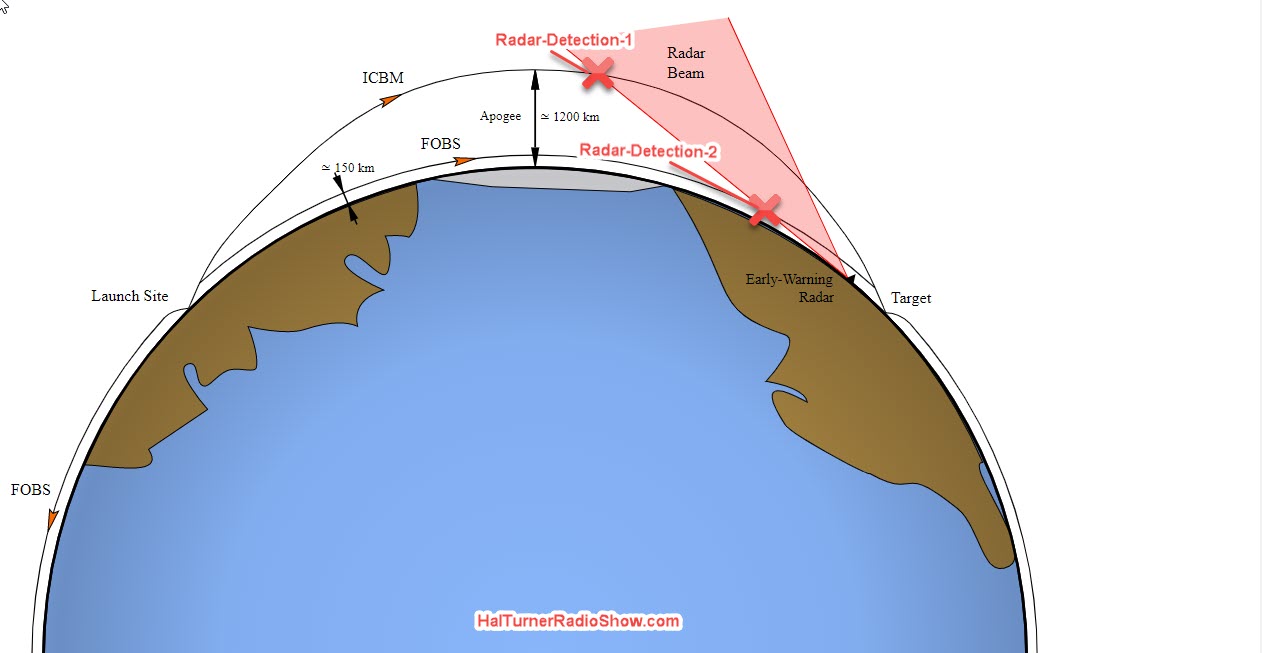
The key missing information here seems to be how many of these satellites would be required to have constant coverage of likely trajectories. This depends on the distance at which the laser remains effective. There would be no atmospheric scattering, but beam collimation is never perfect. It also depends on how fast the satellite can fire a new shot, as any warhead will be surrounded by decoys and other penetration aids. If this requires a large number of satellites, I am very sceptical. While Starlink has shown the possibility of creating large constellations, these sats would surely be much larger and more expensive. Really, Starlink makes me think something like BRILLIANT PEBBLES (https://en.wikipedia.org/wiki/Brilliant_Pebbles) would be a more reasonable alternative.
Also, could an adversary surround the warhead with absorbent chaff as a countermeasure? Or simply an ablative shield, the warhead needs one anyway to get through the atmosphere.
Still, a very interesting read from a very interesting CEO.