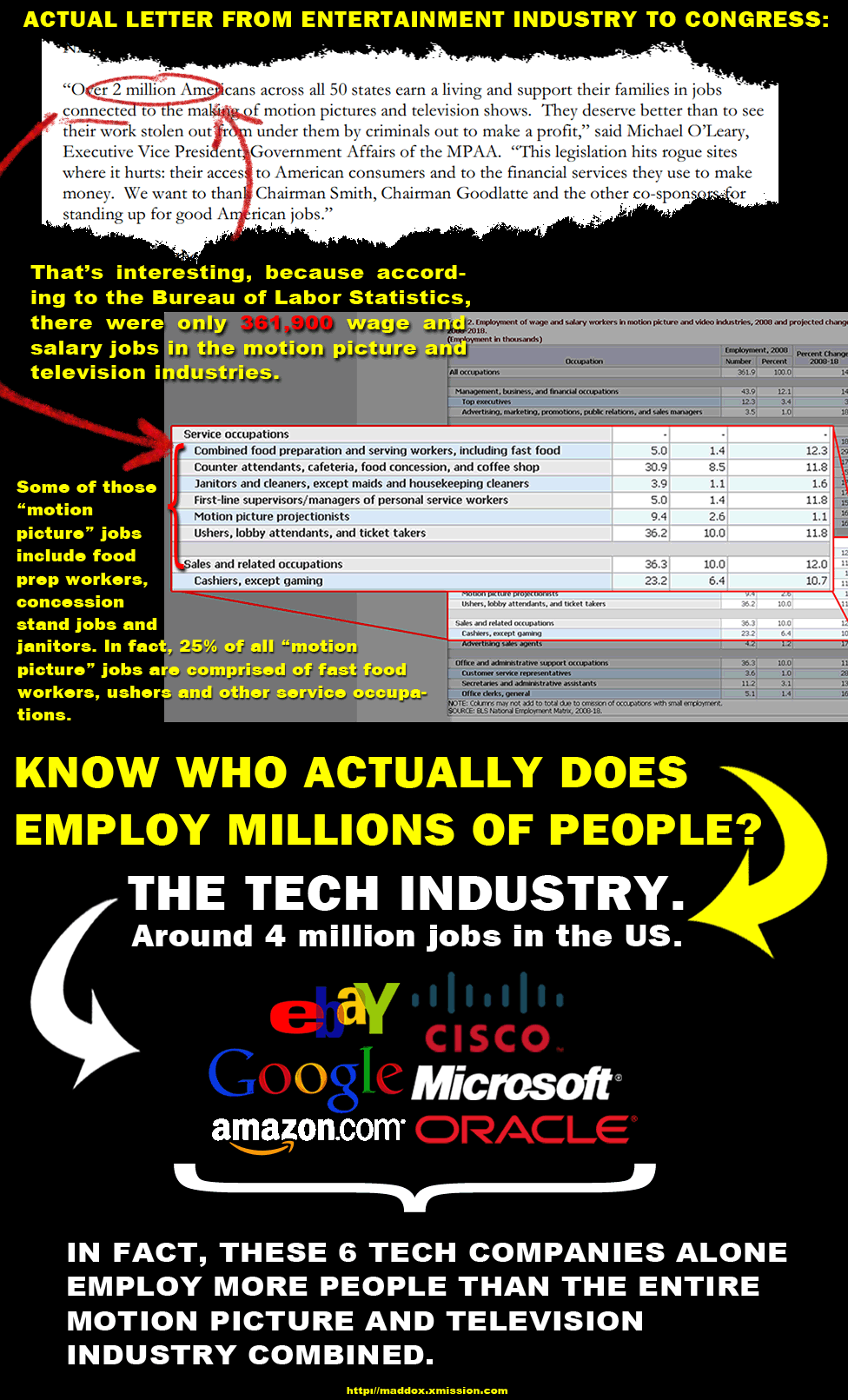
AFAICT, the statistics in this infographic only lists people involved with theaters and cinemas. I didn't see any categories that addressed people that perform jobs like actors, lighting and special effects, props, costumes, writers, directors, etc.
To have an honest discussion on this debate we need to stop talking about raw job numbers lost in one industry and instead talking about:
(1) net job losses and gains
(2) discounted by the number of jobs that are likely to be eliminated due to changes in consumption patterns and increased productivity (read: automation) in those industries.
The whole debate about job losses is dishonest if you don't accept the fact that change happens.
This isn't HN quality material. Give us deep analyses instead of a poorly made and misleading info graphic.
That's because the infographic is highlighting the fact that 25% of the much-touted jobs created by the movie industry are menial positions primarily staffed by high schoolers that would probably not flat-out disappear even if the movie industry did. The actual BLS report[1] he's citing does indeed include all those categories you're talking about, and that's where the 361,900 number comes from. I agree, though — this infographic is not very enlightening. But Maddox's overall point in the article that the infographic comes from[2] seems pretty valid: The movie industry is flat-out lying about the impact it has on employment in order to get the government to take it more seriously.
I'm wondering if job losses among high schoolers and teenagers are even a problem we should be concerned with.
I may be completely off base here, but with the exception of gas money in suburbs, I imagine that most of the income from jobs performed by people in high school is discretionary income spent on entertainment (because food and housing are still provided by someone's parents). Now I know this is not universally true, especially in low income communities, but I imagine that loss of discretionary income among this segment of society is adequately replaced by cheap or free internet content.
I would even suggest that society shouldn't even worry too much about the loss of discretionary income that is mostly being spent on goods whose price is falling together with the loss in purchasing power for those goods.
And, they can learn that they better get a good education so they have an alternative to low income jobs before they have to live off said low-income jobs.
Yes, but it's absurd to claim that just because Hollywood goes down and your local cinema closes that these kids will be permanently unemployed because of it. (Note: getting laid off would be a great life lesson for a majority of the youth)
These kids earn disposable income and dispose of it. It's safe to assume that a fair portion of this demographics disposable income is disposed of at their local theatre, whilst simultaneously providing most of the staff there too.
If these kids can no longer dispose of their income at the theatre, then it's safe to assume they'll quickly find somewhere else to dispose of their money. These other locals will receive a boost in business and require hiring more staff, possibly extending shifts into the times when young adults are more prevalent rather than closing at 8pm.
I respectfully disagree. I house a nephew, 19, in an urban area, from a rural background to give him the opportunity to go to school and establish roots out of the backwoods.
Without an entry level job, he would have no way to pay for community college and commuting- as the pell grants and available loans are simply insufficient. Even with free room and board.
I'll chime here as being in a similar boat as your nephew was.
Nearly 15 years ago I took a job at the local Wal-Mart as a high-school sophomore (15 1/2 was the minimum required age, with restrictions on hours worked), mostly so I could save up enough money to buy my own computer, or enough fairly recent parts to build something respectable. To my parents this was preferable to me hitching a ride with high school seniors in the computer club to go dumpster diving every weekend for 386s in the back of colleges, company headquarters, and landfills. Though to be honest, it yielded quite a respectable stack of working computers.
I used the computer I built from my Wal-Mart money (Pentium 200MHz with 64MB of RAM) to learn how to program, enough about relational databases, and create dynamic websites (we're talking mid-90s here), so in my latter half of high school I was building basic e-commerce sites for larger local companies to save up tuition money to go to a state college and not have to take out loans. And to play games, of course.
-----
Granted, I think most of the kids I worked with mostly spent their money on music, movies and fast food, and didn't show up when they didn't need spending money. Or to hook up with their coworkers (Kim from the shoe department, leave me alone!). I ended up taking care of 1/3rd of the store floor myself, which really ticked them off when I quit.
I completely agree about 15 years ago. But you can now get a Raspberry Pi for about $30.
Is it the latest and greatest iOS or Android device? No. But it is a platform for exploring, learning and being entertained.
A question to you that I've asked myself, would you rather have less buying power today and access to the Internet in its current form or more buying power and access to the Internet 15 years ago?
I don't mean to be crabby, but the infographic explicitly mentions that some of the jobs are from the service industry. If you look at the infographic in context[1], it lists the source[2]. Also, while I generally agree with your point about this meriting a very detailed and thorough analysis, I do not believe that it was "intentionally" misleading any more than my disagreement with you indicates that you are also being intentionally misleading. IMO, that comment (along with your guess about what is and is not "quality") is not helping in your goal of making this a constructive conversation.
I have no doubt that there is a discrepancy between the 361,900 figure from the BLS and the over 2 million figure from the MPAA, but that info graphic just isn't clear on several points and clouds the discussion.
TBH, you may be right that I am wrong about it being intentionally misleading. It may just be confusing design due to proximity. But if that is the case, I wouldn't be surprised if agenda played some role in clouding out better judgement in how it was designed. I'm still trying to figure out if the 25% refers to:
(a) 361,900 jobs, meaning there are 1,080,700 creative jobs in the industry for a total of 1,447,600 people employed; or
(b) 25% of the 361,900, meaning that 90,475 people are doing jobs like janitor and concessions and that 271,425 are creative jobs.
FYI, I removed the word "intentionally" from my original comment. I agree that including it wasn't constructive.
Plus, the same argument can be applied to tech companies. It's disingenuous to talk about people like janitors and cooks and whatnot, when people in every industry need to eat and have the spaces they occupy cleaned up and cared for.
The author of the info graphic shouldn't have discounted those jobs from the MPAA's figures without also discounting them from the tech industry figures as well.
I'm as anti-SOPA and anti-PIPA as anyone here on HN, but truth and transparency are more important than agenda, and if you give those up, you become those you are critizing.
Let's not forget that while piracy likely costs jobs in the movie industry it's not as if the money that isn't spent there due to piracy simply disappears. It is spent in other sectors, which in turn may end up generating more jobs than those which were lost in the movie industry.
I'm not saying that the movie industry has no reason to complain about piracy, but the whole 'America is losing jobs' argument isn't working for me.
It's a little unclear initially from the graphic design, but as I read it that section of the spreadsheet that is called out and enlarged relates to the section of text that follows the overall job count. That section reads:
Some of those "motion picture" jobs include food prep workers, concession stand jobs and janitors. In fact, 25% of all "motion picture" jobs are comprised of fast food workers, ushers and other service occupations.
If you look behind the callout, you'll see that the background spreadsheet image represents a partial view into the total count and breakdown.
Again, I had to do a double-take, myself, to see this. So I'm not saying the infographic couldn't stand some tweaking.
Two comments I'll make.
1) I take the point of the infographic, but I don't mean in my own observation to discount nor demean those particular jobs.
2) It would be nice to have some links to information backing this up. However, I see a web site address clearly provided at the bottom. Looking there, while it's hardly the most structured web site design, if you look for the portion of the page that begins "Update (01-20-12)", you'll find at least some linkage.
Agreed: nothing to see here, especially as MPAA represents the major Hollywood studios, not "workers in the entertainment industry."
Here's a study I'd personally like to see: spending on "legitimate" copies of entertainment products easily available through piracy versus availability of discretionary income. I can't help but think that MPAA, if they were _truly_ just a bunch of greedy bastards, would have an entirely different political agenda.
Not to mention the rather dubious claim that puts millions of jobs at risk. If piracy were going to eliminate any jobs, then they'd already be gone, as piracy is easily within reach for nearly everybody that would otherwise be buying movies.
That is to say, if you can afford $30 Blu-ray movies and a player, or going out for a $50 trip to the theatre, you surely have a high speed internet connection.
The infographic glosses over an important point - many of the production jobs are contract and as far as I could tell, not included in the job count. I wouldn't rely on this as an indication that the MPAA lied although I wouldn't hesitate to say they "exaggerated" for sure. :-)
Correct. Even if you go with the 361k figure, that's still a lot of jobs threatened by failure of existing distribution models, which have caused a lot of job losses already. To win this argument, the tech infustry needs to offer a bettter explanation for how content creators can safeguard legitimate (economically efficient) revenue. Internet warriors don't appreciate how hypocritical it seems to champion full disk encryption and ironclad privacy while simultaneously demonising DRM or anything similar. It's like saying 'all data should be locked down at all times unless I want to use it, in ehich case it should be free.'
You are conflating privacy with censorship and surveillance here. That is a bit dishonest. To put this in perspective, remember in the book "1984" that the dystopia included both a heavily controlled media, and complete surveillance and lack of privacy. It's not hypocrisy to see both of those things as bad.
furthermore, I think it's a bit silly to claim that in order to win the argument, the tech industry must prove that its many millions of jobs are more important than the entertainment industry's 376K. That 376K may be important, but is it THAT important?
Internet warriors don't appreciate how hypocritical it seems to champion full disk encryption and ironclad privacy while simultaneously demonising DRM or anything similar. It's like saying 'all data should be locked down at all times unless I want to use it, in ehich case it should be free.'
It's hardly hypocritical to think that encryption and privacy should be in the control of the owner of a device, not the device's manufacturer or a third-party content producer.
I guess we (here) could use some more insight into how BLS defines and rolls up these counts. If you're contract, are you still within the industry/category and so part of the count?
Actually, it's interesting to do the math a different way. Based on Senator Reid's statement earlier today, Congress believes that
> Counterfeiting and piracy cost the American economy billions of dollars and thousands of jobs each year, with the movie industry alone supporting over 2.2 million jobs
Doing that math, for every 1000 jobs lost, the MPAA looses 0.045% of it's workers. So "thousands" could mean as much as what… 5,000 – (2.25%) of their workforce?
This is the reason why we need to reframe this bill to being about rent-seeking.
The money leaving the industry isn't resulting in many lost jobs. It is resulting in lost revenue from rent-seeking activities. How much is highly debatable.
TBH, we need to be addressing the issue of rent-seeking activities in general. My favorite explanation of rent-seeking that highlights the problem with it is that rent-seeking is when someone seeks to take a bigger slice of an existing pie, instead helping make that pie bigger.
Everyone with half a brain know that those jobs numbers are pulled out of thin air. Only problem is that there are a lot of people out there with less than half a brain.
Yes. This is called 'protective coloration.' Ten years ago, it would have been all about national security and about how piracy funnels money to terrorists. Now "jobs" are the political flavor of the month, so anything you want is rapidly reworded to be in terms of jobs.
I'm okay with this instance but I really don't want to see a habit of linking directly to images. I assume we did this time because this image was an update to an existing post already on HN (front page yesterday) [http://maddox.xmission.com/]
All sorts of things become more efficient over time. Less people are employed in accomplishing them as technology is deployed.
This is not a bad thing. It is the reason we have the standard of living that we have.
So waving a jobs number around as a justification for something is somewhat dubious. What matters is the benefit derived for the cost of doing it.
If something were invented that healed all illness instantaneously, health care would be over as an industry. But the resources freed up would be spent on other things, with jobs in those areas increasing.
The same thing happened when we automated farming, manufacturing, basket weaving. Its how an economy evolves.
Could this be the only serious thing ever created by Maddox? His new homepage header is more like the Maddox I remember though: "I hope SOPA PASSES. Update: it didn't :("
Pardon, but do you really think the government is taking the MPAA seriously because of its claims and not its members wallets and Washington friendships?
Assuming this is correct, there is an obvious issue: is the movie industry employing a lot of low-skilled people who would be jobless if tech were favored?
Those low paying jobs would just shift to what people would be spending their money on instead.
Most middle to low income earners spend every dime they make. If they're not spending it on movies or music, it's going to something else like beer, diapers or travel.


To have an honest discussion on this debate we need to stop talking about raw job numbers lost in one industry and instead talking about:
(1) net job losses and gains (2) discounted by the number of jobs that are likely to be eliminated due to changes in consumption patterns and increased productivity (read: automation) in those industries.
The whole debate about job losses is dishonest if you don't accept the fact that change happens.
This isn't HN quality material. Give us deep analyses instead of a poorly made and misleading info graphic.