As an American living in Berlin for 2 years while working as a software dev, this article very much confirms my experience. The move started with a bit of sticker shock at having my income effectively cut in half - lower salaries and higher taxes - but I feel just as "rich".
Germany has very strong worker protection laws, I feel secure in my job, the time off minimum STARTS at 28 days a year, + holidays + effectively unlimited sick days. And recently I went to 80% work capacity at my job (I no longer work Mondays), which again is a protected legal right within Germany. And I'm using this extra time to pursue a masters degree in music composition, something I've always wanted to do but never had time for.
Germany has provided me the stability and opportunity to follow this passion, something that would be much harder to do in the U.S. I am very grateful, and I think the U.S. could learn a lot from it's European peers in this regard.
The metrics are complex and ill understood, because few people can make the comparison you have.
The thing that jumps out to me about life in the USA is how much time you spend maintaining it rather than living it. Chasing down bills for health care, until recently a lack of autopay, steady stream of paperwork and decisions from the schools…just a million fine-grained decisions and responsibilities when compared to other advanced economies.
I used to feel it was because I have more choices in the US, but some sectors here like telecom or travel are much less competitive than OECD norms.
No place is perfect, of course. But I am in SV because I love the work environment, not the quality of life in the USA which I consider flat and exhausting compared to the other countries I’ve lived in.
It's death by a thousand paper cuts. A lot of things simply cannot be depended on to work in the U.S., and you have to spend a lot of time chasing them down.
More examples: budgeting flexible spending accounts, choosing health insurance annually, finding doctors in your network (and checking again and again, with multiple sources), hotels losing your reservation, airlines overbooking flights, mail and deliveries disappearing, people promising and not returning calls, etc.
> finding doctors in your network (and checking again and again, with multiple sources)
I have a similar problem in Europe too. Most of the good public state-insurance doctors are overbooked and my option is to keep calling every doctor on a 50km radius continuously, hoping to find a free specialist with an appointment, or pay up privately out of my already small paycheck for a spot at a private doctor.
>hotels losing your reservation, airlines overbooking flights, mail and deliveries disappearing, people promising and not returning calls, etc.
That doesn't sound like anything US specific but more like a collection of things from the "shit happens" category. Same things can happen in Europe too, and some have happened to me.
I think you imagine the grass must be always greener elsewhere. It's not. Every place has its own set of perks and problems.
I should've been clearer about the doctors. Whether a doctor is part of your insurance network can change unexpectedly when the contract/relationship between your doctor and the insurance company changes, even if you yourself don't change insurance. And this happens relatively often (annually and sometimes more). So you can get a surprising bill if you go back to the same doctor.
The databases that maintain this information are not always accurate or up-to-date. So the doctor might say one thing, the insurance company another, and both be wrong in subtle ways. Nobody knows what's going on. It's often a crapshoot what you'll owe after a simple doctor's visit, even if you've asked all the right questions and stick with the same doctors.
I guess it depends on what you’re looking for because I had the opposite experience.
I went from carefully budgeting each month, thinking about buying a house maybe in a decade (or two). And put away a few hundred for retirement each month. Job opportunities were ok, but options limited.
Then I went to the US and got a 100% pay bump. And pay has only increased after that. I bought a house 2 years after arriving in the US. I was putting away 10x in savings. Suddenly retiring before I was 65 was an option.
I went from being “ok” to a state where I didn’t have to worry if I had a major expensive. The mental load went away. I could think about retiring early. Not to mention the career opportunities. I had multiple employers and cities I could work in. Sure, healthcare is a hassle, but I didn’t have to be a 1 year waitlist for a primary physician.
Overall moving to the US was a huge life upgrade for me.
Yes, my friends back home are on vacations 5 weeks a year. But I can do something in the US that almost nobody can do in Europe: put away >$100k every year and run toward financial independence and an early retirement.
Back in Europe, my friends don't even think about something like that. They all just accept that they'll be working until 63, 65 or whatever the retirement age will be when they're older.
And it's not just tech. My wife is in another sector and also makes a lot more than she would in Europe.
>As an American living in Berlin for 2 years [...] but I feel just as "rich"
You probably lucked out on landing a good job and housing, otherwise it's difficult to feel even remotely rich in Berlin as you search for housing if you're moving in right now.
Landing a good job right now is also insanely difficult if you don't have the in-demand skills & experience, a stellar resume, and willing to do lengthy take home tests or leetcode. It's highly competitive right now.
Ehh we here in US got better things to do with taxes like spending it to build another fighter jet so we can send it to the Middle East in the name of Freedom . I am told you guys in Western Europe enjoy your stability because of the “freedom” we bring for all of you at the cost of our own healthcare , worker protections and social safety net. Look we are martyrs.
*my brother in law lives in Germany making less than half of what I make and I still envy his lifestyle . He and his wife are going on a 20 day trip to Greece and I am on-call over the holidays . But I make more than double and have my “freedom” and supposed choice of where my tax dollars go.
Hey, don't knock our perfect healthcare system where we have 10 administrators for every physician because the hospital needs to negotiate rates with thousands of different insurance providers, and each insurance provider needs a glut of administrators because each hospital wants to negotiate its own rates.
I more or less quadrupled my income a few years ago, and as someone who loves to travel, this has opened a lot of doors in terms of travel. I can travel to more places, for longer, not to mention doing so more comfortably/luxuriously. If before I could comfortably afford one international vacation a year, I can afford several.
Obviously I’m not aware of what you or your brother in law make, but I’d imagine you’d easily be able to replicate his Greek vacation if you’re making double what he is.
On a more general non-travel note, I feel after you exceed a certain threshold of income in the US, you can just bulldoze your way into matching or exceeding most of the European social benefits including healthcare. Definitely possible if you’re making FAANG or near-FAANG level.
On the subject of SWE comp, an Italian SWE colleague half jokingly told me he’d make more as a gondolier in Venice than in a typical Italian SWE job. Curious if that’s really true.
It's remarkable how there are some things I just couldn't find in the US at (nearly) any price. I wanted to live somewhere I felt safe with my kids biking to school and living car-free as a family. And there are some places that kinda-sorta-barely might be doable for that (Portland, culdesac in Tempe but I've zero interest in Arizona, maybe Davis, parts of New York though it's not ideal for kids biking safely, one of those cities with golf-cart paths), but no matter what my budget I couldn't really find anywhere that gives me what I get for the price of a basic house in pretty much any city in the Netherlands.
I know I'd have more money in the US, but having lived there for 30 years, I'm confident my quality of life would be worse.
But if the lifestyle involves a certain size home, certain cars, vacations, etc then it's much harder to attain with Germany's average income vs the US.
Vacations for Europeans has another meaning, they get weeks, sometime even months each year, in the US there is not even a minimum. The average is 11 days in the states, it's really pathetic.
Can you elaborate on this, because you probably can't get much of this with the average (let alone median, which is usually the measure for this sort of thing) US income at all. "Certain" is terribly vague, and US and Germany are both big countries. Your housing dollar goes a lot further in some places than others.
I'll bet anything Germans have access to better vacations than Americans.
For example, if we compare the average homes in the US vs Germany, which it would be reasonable to assume is occupied by those in the average income bracket of those countries:
> you probably can't get much of this with the average (let alone median, which is usually the measure for this sort of thing) US income at all.
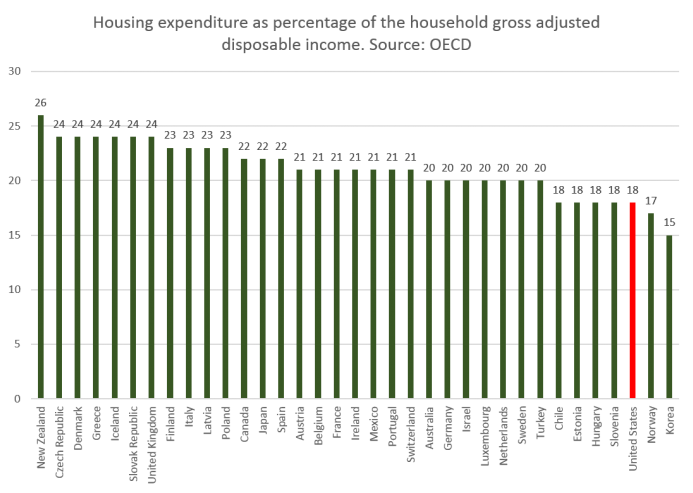
- Housing expenditure as percentage of the household income is lower in the US than pretty much everywhere in Europe, meaning American housing is more affordable with respect to American salaries: https://cdn.mises.org/styles/max_full/s3/hsgexpend_0.png
I’ll add that the average German in a major city like Berlin can be housed within walking distance to a local bakery, grocery, school/day care, and work. For Americans, long commute times from their presumably bigger homes is common..
> The move started with a bit of sticker shock at having my income effectively cut in half - lower salaries and higher taxes - but I feel just as "rich".
The thing you're feeling is not same amount of "rich", but same amount of security.
If your mental model shifted, You would find out the difference between these two things. For instance, if your aim was to make as much money as possible as soon as possible, then move to a place with much lower cost of living and work far less (or not at all), then you would not find this to be the same amount of "rich".
It is worth pointing out that we Northern Europeans can only afford this because we have a small group of highly competitive and wealth generating companies and sectors. We would be in a dire situation here in Denmark without Novo Nordisk. 1-2 years ago it was Maersk, DSV etc. that held up our economy because freight prices were high.
Denmark, Sweden, and Finland have economies that are nowhere near as concentrated as the two other Nordic nations. Norway is analogous to a Middle Eastern petrostate with over 60% of their economy being derived from oil. Iceland is also heavily reliant on aluminum mining and fishing with those two sectors making up over 70% of their economy.
It's funny in a way: because the US spends so much on its military, its allies do not have to. This of course is an enormous benefit to the US: but it's a great way for allies of the US to prosper under the might of the US military while maintaining security in this regard.
>because the US spends so much on its military, its allies do not have to
The US also doesn't have to spend so much on military considering it has no enemies at it's borders. It can always ramp down and spend the extra on social services. Ask yourself why doesn't it do that?
>but it's a great way for allies of the US to prosper under the might of the US military while maintaining security in this regard
Oh please, stop being so generous with your allies, you don't have to. You have this a bit backwards.
It's mainly the US who prospers from the oversized military. Do you think the US would stay the world reserve currency and as influential on the world stage in terms of decision making, if the US had the military the size of Denmark? It's precisely that powerful military that allows the US to dictate a lot of international terms and deals in its favor: "Oh, you're a commie nation with different values than us? Then enjoy our globally imposed embargo and sanctions that will impoverish your people."
The US could save a lot of money by shrinking its military and global influence to just cover the US/NA instead of the whole world, but then that would leave a worldwide power vacuum that China will gladly fill and that would also make the US less influential and therefore poorer.
So you see, the US spends 'hella stacks' to be the world reigning superpower because it profits more than it spends.
I can't believe you're saying these things in a post Russia-Ukraine war scenario.
Yes, US has a huge military and it benefits from it, but I would say the primary beneficiary of this military are the friends of US who now don't have to spend money on military. Rather they spend money on their social programs.
Can US walk out of this role it plays, and still remain in a beneficial position? This is the biggest raging debate in the US right now. You can check the works of Peter Zeihan (who claims that US dollar will become even more desirable after the US walkout), or Brent Johnson (who claims that, even in a complete decline scenario, US dollar will still maintain its dominance above and beyond everyone).
Either way, Americans are hugely divided on maintaining this world order as it exists, and saying "you guys would lose so much without this", it's just taking a side on that debate.
>Yes, US has a huge military and it benefits from it, but I would say the primary beneficiary of this military are the friends of US who now don't have to spend money on military.
That makes no logical sense. Why would the US invest so much money to protect its allies, if it weren't the primary beneficiary of it's giant military budget, and instead would mostly benefit its allies and not itself? The US always puts itself and own interests first.
The massive military sector is what gave birth to US's tech sector and the massive surveillance apparatus the US has at its disposal, and allowed it to own the aerospace sector too. All that give the US the biggest soft and hard power globally, and it also trickled down to its economy and to other sectors as well.
Protecting it's allies is just a happy side effect of them fitting underneath the giant umbrella the US has built primarily for itself, and it will never give it up because protecting its allies was never the main objective, but projecting its power.
It can make logical sense, in game theory. For example, you can have two situations:
A) thing A is the most beneficial thing for person A to do
B) thing A benefits person B way more than person A
These are not mutually exclusive.
I'm not exactly arguing for this (I'm not sure if the US or its allies benefits more, and we'd have to define what "benefits" means and "who" benefits etc.. etc.. etc..) I'm just saying this is very obviously possible: where the US having a huge military is the best thing for the US, and also its allies benefit from this MORE than the US benefits from it.
Some day we'll lose this ability and it'll be a sad day for HN. Feels like a special trick we've got to enjoy while we can. Nice submission OP - I learned something.
That's a fair point. It's still true that wealth is not built by permitting frivolous spending. With all the posts on HN I find interesting, I feel like It's the television chanal package effect. Even avid news readers would not have subscriptions to all the varied news sources here. About 90% of the time I pay for an honest Economist subcription. It's great, but pricey. Even if I wanted to, I could not afford simultaneous FT, Economist, NYT, Globe&Mail, etc. subscriptions.
It is also interesting that a news outlet based in one of the richest countries on Earth feels the need to put up a paywall on every single article.
Other options: a) Just have subscribers, and make do with whatever those proceeds are. b) Give subscribers access to some freemium articles. c) Give subscribers early-bird access to articles. Free access to others later (say, +1 day or so). d) Give non-subscribers 1..3 freebie articles, then paywall.
To name a few. But no: paywall everything, monetize to the last bit. Sign of the times, or indication of this news outlet's priorities / ethics?
For a long time GDP and standard of living/well-being of a society have been correlated that people started to think that these are the same. These two are becoming more and more detached each year with progressing inequality. To the point that GDP now tells us very little about a country.
For example Bermuda. The high GDP per capita incomes is fueled by offshore financial services, but that does not translate to personal wealth of the citizens. And Qatar. More than 50% of population are immigrants working mostly in low-paying jobs often in terrible conditions. They generate wealth, but they are not considered citizens. Finally the elephant in the room - USA. GDP per capita means jack shit if half of the wealth belongs to a few people.
Apart from money not being everything, it's also much "averages vs medians" (vs distributions) again.
People love using averages because they're a single number, and easy to calculate.
Medians are more difficult to calc, and distributions and percentiles are something most people are never taught, and it's no longer a single number which is easy to (artificially) compare.
I read into the numbers behind "hours worked" from OECD [1]. It seems wild to me that the United States on average works 500 more hours a year, compared to the top counties on that list, and 300 more than the EU average. I've never really been a proponent (or opponent) of the four-day work week, but this seems to indicate you become "richer" if you work less. At least according to this type of ranking.
> It seems wild to me that the United States on average works 500 more hours a year
I think that ultimately stems from different workers' rights in US where people work even if sick due to the sick leave limits and low mandatory vacation days.
I'm quite sure people that are independent/self-employed in Europe work comparable numbers because they too will likely take much less vacations and sick days.
As a US worker that regularly interfaces with colleagues in various EU/UK sites, I am not at all surprised by the discrepancy.
Edit: Elaborating… in my experience entire countries will be on holiday for up to a month at a time, while the US offices are chugging along. (And this by and large isn’t true the opposite direction, except for Thanksgiving week.)
I’m not saying it is good or bad either way, but the US prioritizes work far more than other OECD / developed countries.
I think it's also an artifact of the size of the US labour market. The huge labour pool in the single market makes for strong competition jobs. It's a race to the bottom for pay and working conditions for tons of folks.
More of the total work that people have to do, including chores, is in the US work that people pay for and are paid for, rather then doing it for themselves.
If every did their neighbor's laundry (say) and charged a fee, then everyone would be doing the same amount of laundry and have the same amount of money, yet GDP would rise?
Yes, there is also this nice story to illustrate this:
Two economists are walking in a forest when they come across a pile of shit.
The first economist says to the other “I’ll pay you $100 to eat that pile of shit.” The second economist takes the $100 and eats the pile of shit.
They continue walking until they come across a second pile of shit. The second economist turns to the first and says “I’ll pay you $100 to eat that pile of shit.” The first economist takes the $100 and eats a pile of shit.
Walking a little more, the first economist looks at the second and says, "You know, I gave you $100 to eat shit, then you gave me back the same $100 to eat shit. I can't help but feel like we both just ate shit for nothing."
"That's not true", responded the second economist. "We increased the GDP by $200!"
Yes, GDP is an unreliable measure for value created.
It's not just that some work isn't counted. It's also that work is counted based on monetary remuneration, even if it's contribution to the general welfare is very low or negative.
In my anecdotal experience this hasn't been the case. Most people I know in the US can't afford to pay people to do house work or chores. I'm thinking in contrast to a place like India where it's the norm to have hired help for things like cooking, cleaning, and laundry.
It would be interesting to see this using median income or similar meassure rather than GDP per capita. Inequality by itself doesn't have to be a problem (depending on economic ideology) but if all purchasing power is restricted to a few ultra rich that should be relevant to the discussion of whether a country is rich.
This. And also adjusted on what you get for your tax money. (Say, median income after taxes, health care, student loans and pension savings.) And adjusted for the amount of holidays you have.
All this data is available on the interwebz. I'm a Norwegian, but has worked in several countries around the world, among them the US.
According to this site,[0] the median income in US and Norway was $24K-ish in 2021 (2019 numbers for Norway), while this Wikipedia article[1] lists countries based on average annual working hours (OECD, 2022).
Based on this, we can deduce that:
* Americans are paid $13.3/hour
* Norwegians are paid $16.9/hour
It's worth noting that even though Norway doesn't have a "general" minimum wage, except for some jobs, it's considered to be $21/hour.
That's true, but that's not quite the same as eg: single household median income vs median of all household incomes.
Let's say 90% of men in the US and Norway worked full-time and 80% of women in Norway and 60% in the US worked full-time (or vice-versa) - the various subsets of medians (individual vs families) might not be sensible to compare.
This is where aggregates are really tricky. I think that they are using means at the average - this is a serious issue.
The thing is WHO is this money for? If the long tail of the population are subsisting on $20k a year while the top 1% are living large on $1M a year then things are going to feel very hard for the "average" Joe/Joanne.
You have to be careful with GDP because for some countries that money goes offshore.
Ireland is a tax haven for corporations. Google sells their IP to Google Ireland, then charges for it across a swath of markets. Then the money flows back to Ireland as GDP.
But it doesn’t stay there, it flows back to Google USA.
I think one has to be careful with the “hours worked”. I noticed Singapore takes a huge hit, but after working there, the hours often include a 2hr lunch, and frequent breaks.
At least at the company I was at, people got less work done in 10 hours than my American coworkers did in 7.
I think these calculations are essentially horseshit.
Norway is an oil company with a nation state subsidiary. Salaries and purchasing power are significantly lower than the in US. Is there an alternative to GDP that doesn't include externally invested oil profits?
In Norway we distinguish between offshore and onshore GDP [1]. The ool income goes straight into the oil fund and that does not invest in Norway and neither does a large amount of the income generated from it get spent in Norway.
So yes, there is an alternative, just do the statistics properly.
it's not just Norway, all the oil rich countries float to top on this list. So indeed they are calculating how rich is the country's bank accounts because the money is distributed through social services, which is basically free money.


Germany has very strong worker protection laws, I feel secure in my job, the time off minimum STARTS at 28 days a year, + holidays + effectively unlimited sick days. And recently I went to 80% work capacity at my job (I no longer work Mondays), which again is a protected legal right within Germany. And I'm using this extra time to pursue a masters degree in music composition, something I've always wanted to do but never had time for.
Germany has provided me the stability and opportunity to follow this passion, something that would be much harder to do in the U.S. I am very grateful, and I think the U.S. could learn a lot from it's European peers in this regard.