> "You are formally invited to A WAKE for THE RESEARCH SCIENCE CAREER of FRANCES HOCUTT FRIDAY from 7 PM to MIDNIGHT"
When I quit my PhD I had an Ungraduation Party! My wife made a cake and everyone sang Happy Ungraduation To You! It was sad and happy but overwhelmingly such a relief to get out
Good on you too not wrap your identity too much in a credential to allow yourself that decision and also having unconditional support from those close to you.
Thanks... I haven't thought about it in a long time, as it was difficult, but looking back it seems quite positive.
Three things:
1. Full disclosure at that time in my life I was rather bad at motivating myself to work independently for long periods. In hindsight starting a PhD was a bad idea for this reason alone.
2. The university closed the department I was in. I was transferred to another supervisor in another department, who was nice but saw his role as more administrative. After a while he then announced he was retiring so I was looking at moving to another supervisor again.
3. I turned out to be far, far more interested in writing software than doing research. E.g I wrote an open source unit testing library in Prolog to support my research tooling. I was learning Rails on the side. I went to the Hacker News meet-up in London, and the startup that was running them offered me a job, and the rest is history!
I had sunk multiple years into it so it wasn't easy. But in hindsight it was not even a close decision.
> We create meaning around the stress and soften transitions with rituals and rites of passage.
I graduated into the height of the pandemic, so I never had a graduation ceremony. Instead, they played a shitty video presentation over Zoom and my parents cracked open a beer and watched it on TV.
By the time I got invited back for a ceremony, I had already moved hundreds of miles away from my university. Obviously, I turned down the offer. I sometimes wonder if I'll regret that choice later on down the line.
The ceremonies at the beginning and the end—not a big deal. The part that matters is what you do there.
I think the celebrations are more for the parents, really. We live our lives in the bulk, the area, the day-to-day. We experience others’ lives at boundary transitions, the perimeter, the ending ceremonies.
> I think the celebrations are more for the parents, really.
This is important, and not to be brushed off.
During my PhD, my program had what’s called a “white coat ceremony”. This is typically a medical school ceremony, but my grad program does it after the second year of study to recognize the transition from being a graduate “student” to a graduate “research assistant”.
I was a very isolated and focused student, spending the majority of my waking time in lab from day one of school. By the end of year two, I already viewed myself as being fully immersed in research. So, the ceremony felt trivial to me, and I didn’t plan to attend.
However, at the last minute, my advisor told me he wanted me to attend despite my protest.
Due to the last minute change, I didn’t invite my parents to the ceremony, as they lived several hours away and I didn’t want them to feel obligated to travel on short notice.
As the ceremony started, I immediately realized that it was just as much for the parents as it was for the students. So many parents were there, with clear pride at their children’s growth and success (even though most had no clue what their kids were even studying).
I immediately and deeply regretted not telling my parents about the ceremony. I realized I had made a unilateral decision for them, and that my behavior was very self-oriented and inconsiderate of their desire to see me succeed.
They were disappointed when I told them about it, and I apologized for not inviting them and acknowledged that it was a selfish thing. They’re chill people and didn’t make a fuss over it, but it was a closed door that could never be reopened.
Two years later when I defended my dissertation, that was the moment I wanted my parents to be present, and of course they were. We had a blast celebrating afterwards, so all’s well that ends well.
I strongly believe “maturation” happens in discrete moments, and the start of that white coat ceremony was one of those moments for me. I grew up a lot that day.
I played college football which for the purposes of this conversation isn't a brag but call it a club. A big club. This was at a D3 non scholarship for the love of the game school.
Two weeks before school started I knew 110 students, 15 adult employees, and about 10 recent alums. It was great. I had easy access to people who could answer all my questions. What classes, what professors, what forms, what majors, what restaurants, how to move exams, parties, of age people, cars, parking, tutors etc. Can't recommend it enough.
My daughter is very indoors and "nerdy" for shorthand (So am I I just also do everything and played football). She loved DND. We lived about 12 miles from campus so as soon as she got in I found that they had DND club. I got her to ask to play in the discord early summer. She had a pack of friends by the time school started. A few freshmen and plenty of older classmates.
Can't recommend it enough. Also it generally accelerated me more than the time it took up
I didn't join many clubs when I was in university (in Germany). But for my first job I lived in Cambridge, and just attended clubs at the local university over there, and they mostly just let me in.
> I do regret that I didn't join any clubs in college until my last semester, and that I didn't make the kind of friendships I wanted
As a parent of teenagers, I struggle with how the hell to convey this to my kids. They are so engrossed in YouTube, stupid memes, and games that they don't join any clubs or sports at school; they don't seek out IRL activities; and my 17 year old has no interest in getting his driver's license. I have tried limiting screen time (and I took a lot of good lessons from Jonathan Haidt's The Anxious Generation[0]). They've both got ample opportunities for therapy (depression runs in the family, the eldest has various diagnoses, etc.) and for engagement with peers.
They simply don't make and develop friendships. I have no doubt whatsoever that this will be a huge regret of theirs because they've already said that they wished they had more friends. It's infuriating and deeply saddening to see my kids want to be connected, to have everything they need to be connected, but to still not connect.
Have you modeled to them how to make and develop friendships? Have you tried asking them what they've tried to do to make friends?
Limiting negative stimuli isn't enough for people to automatically replace it with good stimuli. It's the same struggle as leaving an abusive relationship or toxic job. People can know something is bad, but they're much less likely to leave a bad situation if they can't imagine what the better alternative is.
For example, my Dad is terrible at making friends. His co-workers and acquaintances like him, but most of the time his only significant relationship is with his spouse and his kids. My mom was great at making friends and finding community, but her ways of relating to people seemed inaccessible and indecipherable to me as a guy.
I did and do go to clubs of various sorts, but it's a real struggle to figure out how to turn those casual acquaintances into meaningful, reciprocal friendships. As soon as I had my own struggles or wasn't obsessively invested in the club, those friendships vanished overnight. I don't know any good books or resources to learn the skill of making friends. I can definitely see how someone who had more mental health struggles or was less extroverted than I who struggled to make friends in these situations would give up on trying.
These ceremonies are meaningful if you invest meaning into them.
For my college graduation, the dean did something small to make the ceremony more meaningful. He asked us all to stand up, look back to our family, and applaud them for supporting us all these years. For me, looking back at my parents and thanking them for all they've done for me was a beautiful moment. And it was a full-circle moment for our family, the culmination of a long journey of immigrating to the US, moving around in search of stability. We had moved to be able to buy a house and to get us good, affordable educations. Both of those dreams were fulfilled at that time.
I don't recall much else from that ceremony. Not the speakers, but a few of the interactions afterward with my fellow students and their families.
Fair. I hope my kids invest some meaning in it (assuming I have kids someday). Or maybe I don't care if they assign meaning to graduation?
I always cared about school, but I saw it as a means to an end. I knew what I wanted to do from a pretty young age, the path to get there was pretty clear, and I went down that path and now here I am, happy that I made it. So, for me, the ceremony really was just a formality because I knew the real reward would be all the exciting stuff I get to do with my education.
But, now I'm considering having a family in the next few years, and someday I might want to show them photos from my graduation. I can't do that, though.
If it makes you feel better, my college graduation was the only one where my school decided to have an outdoor ceremony...in May in the deep south.
Needless to say, wearing a black gown over dress cloths is not great when its 95F and humid out. For our families of all ages, sitting in the football stadium for hours in the middle of the day was even worse. Multiple people were taken to the hospital for heat stroke.
Graduation was a decent excuse for my uncles and brother to come into town for a visit, but I would have happily celebrated graduation at a Mexican restaurant with air conditioning and a margarita without the big ceremony.
As someone who also graduated during the pandemic an moved across the country.
Maybe man, but honestly it just isn't the same as actually getting to say goodbye to your friends.
Out of all of the things that went poorly that year, ppl missing their graduations is definitely pretty low on that list, but on a personal level it just really sucked having your entire social circle just disappear out of your life basically randomly.
Ironically, several of my friends and I got COVID at our delayed graduation ceremony.
And they did multiple years of graduations at once, which made it exceptionally long. By the midway point even the professors onstage in their regalia were all scrolling on their phones.
I skipped mine. Graduating college was not something that I was necessarily proud of. I wouldn't dare try to take that feeling away from someone else though. For me? College was just an obstacle -- a chore -- that was just a step in a much longer journey.
Before leaving every job I've had, every one, I worried, I agonized, I second guessed myself...
And every new job, every one, within a short time, I thought "I should have done this sooner!"
I think we need to have a bias for moving forward, and I think it is healthy.
That said, I remember a friend who immediately quit their job (for a legitimate reason) without having another job lined up and regretted it. They told me they should have stayed cool, lined up another job first, and then quit.
I made a similar move and felt a similar sense of loss. I wish I had had the mental clarity at the time to throw fun parties instead of just trying to keep life together. I'm comforted by the fact that in my new career there are great people, just like there were in academia, and that my friends who stayed there are either (a) truly great scientists (b) struggling basically with the same things (money, politics, , people, "work") that most people in most white collar jobs struggle with.
I'm afraid I can't relate. I initially invested a lot of time in my first choice of career (over a decade) and just left last year. I walked out the door, said goodbye, and the next day it was out of my mind. That being said, I think the key is keeping a strong mental separation between "passion for a field of work" and "predetermined path by society to actualize that passion". The latter, in my opinion, is something that one should never get attached to.
If you wanted to become a doctor, say, and flunked out of school, how would you find another path to become a doctor; start again in another country? Sometimes the cost of failure is high.
It is, but sometimes there is no choice but to do something else. And the cost of my own "failure" was high, though I wouldn't label it as a failure. That word is barely in my vocabulary...I prefer to consider it as a learning experience.
A few years ago I left a tenured position and transitioned to industry. It was quite a mixed bag of feelings, including grief for a career that I had identified myself with. It’s very difficult not to identify ourselves with our jobs.
Not to highjack this topic, but she was recommended (like to many others of you no doubt) quite a bit in my Youtube feeds over the last few months; and the first few videos I watched seemed to be solid enough. Yet as I watched a few more, I couldn't shake the feeling that she's so out of left field that she's not just a 'quirky renegade' anymore, but rather a quack who dresses up her quackery with just enough 'real' physics to make it all sound very convincing. (By that I don't mean that she says factually wrong things, but that her conclusions or extrapolations from established facts seem to me, well, outrageous). However, I don't know enough physics to be able to tell if this is a correct feeling, and the Youtube comments are, as usual, one big fanboy fest, which is true for any large enough channel - even those of flat earthers and similarly delusional content).
So my question is - just how serious should she (and others like her, who denounce 'mainstream' academia as much as those other fringe groups who go on and on about the corruption of 'mainstream' media) be taken? Anyone have an opinion on this?
>So my question is - just how serious should she (and others like her, who denounce 'mainstream' academia as much as those other fringe groups who go on and on about the corruption of 'mainstream' media) be taken? Anyone have an opinion on this?
I know nothing about her but the video on her experience in academia is spot on. It's a pretty common experience among STEM academics. You will face the point where you have to compromise your academic "purity" and curiosity for trendy topics to survive. This also implies publishing "bullshit" papers and "bullshit" grants. Only certain types of people make it through that.
Can I ask what you mean with "pretty common"? Do you think more than half of all STEM graduate students had a similar experience as she did? Do you have actual data to support this?
I am asking this because HN neems to be so much more negative of academia than what I am seeing around me.
More generally I think it is worth stressing that any site like this can be a terrible echo chamber at times. Generally there are smart people here, but on some topics I suspect that the consensus could be completely misguided.
Let me add another point of anectdata. I did my CS PhD with a full scholarship in the UK. Then a 3.5 year postdoc in a great Leinbiz institute in Germany. Part of a huge EU project (in Framework Programne 7)
By all measures, I was "living the life" in academia. with both my parents being academics (both researchers and pretty published in their fields)
Yet, I left it after the project finished. The prospect of having to write papers just because. The amount of trash papers I had to review for free but then looking at the cost of proceeding books (I got them for free through my institution... but what a racket it is!!)
The prospect of the "academic path" ((abitur, lecturer, associate prof and then prof) praying the stupid game..
I left it all and turned to the startup world . Maybe it was my engineer mind, but I feel way more fulfilled after 12 years in industry.
I was a biological anthropology postdoc for a year or so. My office mate used to refer to the process of turning one decent idea into as many papers as possible as producing LPUs ("Least Publishable Units"). He was joking, but it wasn't a joke.
It was depressing. I dropped out. I have love for academia, but there is a pretty overwhelming amount of gamesmanship in surviving that system. I found becoming a developer a much easier career to navigate.
> Do you think more than half of all STEM graduate students had a similar experience as she did? Do you have actual data to support this?
Yes, her entire description about her experience (safe for that weirdness with the textbook sweatshop) is relatable. I am not sure what you are looking for but STEM PhD attrition rates speak for themselves. Those do not include PhDs that decide to leave academia after retrieving their PhD. Not to mention the frequently discussed mental health crisis that consistently gets Nature articles.
I did a PhD in CS. There were certainly some students who had a bad experience, but I don't think it was the majority or even near the majority. I think 1 in 5 is a reasonable guess. The ones who did do tend to be more vocal about it, which is natural.
I don't think this is generally true and the generalization is actively hurtful. Promoting a skewed/miserable perspective on academia. It all depends on the institution, your funding situation, your field etc. The miserable academics are the ones that moan the loudest. There is often an online circlejerk of whining academics that wind themselves up (esp PhD students). Also the ones that are barely scrapping by are the ones that need to resort to bullshit. You may be able to game your stats but people can smell bullshit from a mile away. Everyone will know you're just good at playing the system
"Complainants and their critiques can be safely discarded because they need to git gud."
She states in the first three minutes of the video linked above that she was excelling academically. How bizarre to observe a lack of research in a thread complaining about how the academy has drifted from the conduct of pure research. Three minutes. One hundred twenty seconds. That's all it would have taken.
Very seriously indeed if you value higher education and research.
Lot's of people do. Over a decade ago now, Ben Ginsberg wrote "Fall of
the Faculty". Political scientists like Wendy Brown have picked apart
not only the evidence, but done deep analytical work on the reasons
for the disintegration of academia in the West. Even Peter Thiel (who
I profoundly disagree with on almost everything) has given knock-down
commentary that I find impossible to ignore on how academia went to
seed, and is now unfit for teaching, learning and honest research.
From a personal perspective; I worked in universities for over 30
years. What we have now is unrecognisable from the institutions I
started teaching at in the early 1990s. Almost all human values have
been expunged and replaced by a puppet show of performative theatrics,
led by MBA educated impostors and career administrators. It is fake to
the core. I no longer recognise these places as universities. I've
seen brilliant colleagues go crazy, retire early, turn to alcohol and
drugs, commit suicide, or just wander off to live in the mountains and
grow vegetables. I refuse to believe all those smart and dedicated
people are/were "weak". Academia is a very toxic place and I would not
advise any "smart and sensitive" person to go into that life if you
value your health.
When you consider how much it costs a nation to educate someone to PhD
level and then look at the churn and attrition, it's a massive bonfire
of wealth.
I've written numerous pieces in the Times Higher on specific failings
of universities, but one cannot halt a juggernaut of change with words
alone. Now I am left only with curiosity at how higher education will
change and what will come after.
My response has been to conduct and publish my own research
independently outside the "academic system" and to start my own
companies for teaching. By my standards, both are successful.
I think - no, I fear, fear is the right word - that there is much more than just academia disintegrating in the West.
> Almost all human values have been expunged and replaced by a puppet show of performative theatrics, led by MBA educated impostors and career administrators.
I was going to reply to a go further up but yes this has absolutely crept into many other technical areas. I had a similar grad school as others here have expressed but I didn’t stay in academia after school.
I’ve worked the past 15 years or so for several different F100 companies in various technical R&D functions. These companies manufacture real things and generally have labs, resources, and staff that rival but the very best academic institutions. The politics and worldviews with which the MBAs have infect the technical teams with the last 20 or so years is palpable.
I know there used to be real in-depth research done; talking to the old timers and looking through old technical reports showed that to me. Doing that now will quickly get you RIFed. Now quickly getting to revenue and moving onto the next project is all that matters. Nothing is retained in classic 20-30 page technical reports that help build true institutional knowledge or even allow us to repeat projects based on the learnings from 2 years ago. If you are smart you quickly learn how to test and validate things to make whomever the customer is happy (following the $) while providing the bare minimum to the lawyers to make a specific marketing claim. In practice this means I’ve become very good at not opening certain doors during research (ie the ones that I intuitively know have a high likelihood of derailing a project) even if they probably should have been. See no evil, hear no evil…
Yes, over the past few decades, that sentence applies to every institution I can think of. Academia, government, business, religion, medicine... I don't know why administration has turned into such a plague, but it keeps absorbing larger shares of our money, power, and time to do less and less with more and more.
Has Peter Thiel ever put his thoughts on higher education down in long-form writing? I've seen him speak about it, but I'd be interested in a deep dive.
It's interesting and worth watching, but it becomes apparent that Thiel is a financier, and science takes place on a different timescale. Better seek advice from someone who was active when US science was still functional, let's say Roy Vagelos.
Can you give any examples of her promoting "quackery"? I don't know how you can admit you are weak in physics but nevertheless sense she is phony.
My biggest criticism of hers is that she is cynical and spends too much time tearing down other ideas rather than promoting anything.
But overall she does great things with showcasing the more ridiculous side of academia. She is adept at taking published research and showing that it is quackery. She shows how they manipulate data and mislead the media, often for more research money. I also applaud her counterpoint in particle physics regarding the waste involved in building yet another gigantic particle accelerator. It's a POV I wouldn't have considered, but I agree that the money could be better spent in other areas.
I'm not a physicist so I can't answer that question, though personally I trust in her expertise and really loved her book Lost in Math, but many of her most recent videos and tweets are not about physics at all but instead about nuclear power, capitalism, climate change, not having children, trans athletes, AI and so forth. The lure of punditry...
As an expert in at least some of the things Sabine makes videos about (string theory), Sabine is a contrarian who, if you are not otherwise an expert on what she is talking about, it would be best to avoid.
Sabine, like many contrarians, takes advantage of the fact that there are smart and convincing criticisms of many mainstream ideas, and she does her best to rely on those criticisms. However like all contrarians she presents a biased and exaggerated view of things in order to stoke engagement, and unless you are an expert it can be difficult/impossible to determine whether the view she is giving is balanced.
This is a classic issue with string theory critics, because string theory has many legitimate problems with it, but many of the critics are intellectually dishonest and you probably shouldn't listen to their criticisms on principle (but even I must admit it's quite hard to find good quality intellectually honest criticism of string theory which is digestible, so these contrarians tend to be the only loud voice).
In Sabine's case it is not so bad, because it is clear from some of her other positions that she is basically a crank. MOND and superdeterminism are basically crank physics at this point but she supports them purely because she is a contrarian. On this evidence alone you should not trust anything she says on any other subject, otherwise you're falling for a kind of Gell-Mann amnesia.
As another 'mainsteam' academic with relevant expertise I think this comment is spot on.
I would like to add that Sabine's video on her academic experience was quite a tragic thing to watch. If her allegations are true then the behavior of her PhD supervisor was completely outrageous.
She also did seem a bit too dreamy-eyed about academia. Sure you can criticize everything you want, but she never seemed to have understood that tone of voice still matters. Academics are busy people with emotions, and not likely to engage with someone whose claims appear to have more loudness than substance.
I certainly am not making any comments about her experiences for sure! Academia is difficult and full of terrible stories, and its not surprising that it causes many people to become exceedingly bitter and contrarian (Peter Woit is famously of the same ilk as another string theorist critic who fell out of academia like Sabine).
Unfortunately a chip (even a legitimately earned one) on ones shoulder about the bad parts of academia doesn't save you from being criticized for being crank-y.
Likewise. I did my PhD in quantum foundations/information, albeit some years ago now. I'm not aware of any serious researchers in the field that look kindly on superdeterministic interpretations.
It's bizarrely parochial to suppose that every single photon is magically correlated with the experimenter's future measurement choices in a way that will exactly violate Bell's Theorem.
Another way to put it:
> If such a theory did exist, it would require a grand
conspiracy of causal relationships leading to results in precise agreement with quantum mechanics, even though the theory itself would bear no resemblance to quantum mechanics. Moreover, it is hard to imagine why it should only be in Bell experiments that free choices would be significantly influenced by causes relevant also to the observed outcomes; rather, every conclusion based upon
observed correlations, scientific or casual, would be meaningless because the observers’s method would always be suspect. It seems to us that any such theory would be about as plausible, and appealing, as, belief in ubiquitous alien mind-control.
Sabine has repeatedly touched the third rail of current day physics - the string theory industry and HEP. The comment above reflects that.
On the latter, her beef is not that HEP has not made signficant discoveries in the past, rather that the costs going forward can no longer be justified and starve many, many other areas of physics of needed funding. Compounding her disdain for future projects are the increaingly lofty claims of what will be discovered since inception of LHC. Do you really think she is alone on this?
On the former, who is the crank here? The person with the advanced degree calling out the failure of a 50 year old theory to make one scientifically provable and confirmed prediction? (I could say 80 years if going back to the beginnings with S-matrix theory)
I'll grant that some maths have been developed that may be tangentally useful but other than enriching the publishing industry, what has string theory brought? Zilch. It seems that the more public this becomes, the louder the cries of those with deeply vested interests. I can think of no other large theory that has gone for so long with no experimental confirmations at all and is not likely to in mankinds future either.
As to MOND like theory, Sabine has had varying degrees of support over the past twenty years as data has come in and theory has changed. Very frankly, the reason to give a degree of trust to her on other subjects too is because she is willing to be objective and call people out on their BS.
I've seen similar reactions and I can't help but think she's intentionally communicating provocatively to make people engage their brains.
You shouldn't just "take her seriously", you should take what she says *critically*. Hear the information and opinions, then decide for yourself whether to accept them.
> Hear the information and opinions, then decide for yourself whether to accept them.
This sounds awfully similar to the “do your own research” defense that is often used as a cop-out disclaimer for quackery topics.
When someone presents themselves as an expert on a topic and invests a lot of time into making convincing videos about their beliefs, defending them with a “do your own research” feels like a tacit admission that they’re not actually the expert they present themselves as.
This feels somewhat like the high-brow intellectual equivalent of Joe Rogan making confident statements about COVID and then defending himself with “I’m just a comedian, do your own research”. You can’t have it both ways.
The difference is sources. Sabine shows her sources prominently on screen, with searchable citations to find the original. She makes it clear in her phrasing whether she's paraphrasing a source, or passing her own judgement.
It's easy to know whether to internalize what she says when you view it critically. Ask "does the presented research seem legit, complete, and impartial?" and "is her conclusion logical?". She gives you the receipts to check. This is not the same as deciding whether to put blind faith into a comedian's off-the-cuff anecdotes and opinions.
I often disagree with her conclusions, but at least she makes it very easy to validate her chain of though, find where our views diverge, and only absorb the information I trust.
Her channel has strayed far beyond the topics she has credibility in. A physics academic talking about AI, sociology, and politics… why should I care? Even of the physics topics that she does cover it’s all “pop-sci” news coverage stuff, she’s not even using her actual depth of knowledge to make videos that are different than the layman takes from dozens of other YouTubers.
Someone speaking provocatively and authoritatively on topics they don’t have credibility in is where you should think critically and turn it off.
> Her channel has strayed far beyond the topics she has credibility in.
I appreciate that she makes her videos so easily verifiable, by prominently showing her research, that it was easy to see the point when this started happening and tune out. A lot of opinion-faucets on the internet try to be irrefutable by hiding their sources.
I don't trust Sabine intrinsically, but I trust that I can notice when she under-researches a topic or makes a leap of logic. She conveys enough good information that I find it worth my time to watch.
I think this is true for most careers and prominent roles:
"When I first came to The Times in 2006, a reporter warned me not to identify myself too heavily with my work. “Any job at The Times is a rented tux,” she said."
I have never mourned on career changes. I do miss access to things associated with a former career. However, I can often buy or build what I need due to strong electromechanical skills developed along the way and or as side hustle skill builder type gigs taken oppertunistically.
Learning new things and working with others more skilled than I always pays off. I end up with the skill and have a pool of help available should I need it. I myself can help others too.
First change was from manufacturing as a prototype mechanic / planning production mfg engineer to pre-sales and training related to then high end CAD software and related systems engineering. (Sgi IRIX and Win NT) I could make almost anything I modeled.
Second change was from the CAD position to General management and engineering R&D at a small company needing some of both. This was fun. I got to use all accumulated skills. I picked up several more.
Third change was into the Additive Manufacturing industry as services lead, moving into product development.
Fourth and current is tech founder in an additive related startup about to be funded. This one also allows me to use all accumulated skills. Same industry, so this is more like a move, not change.
That is three real, leave old career behind type moves.
Times change, I tend to go where the opportunity is and will do what it takes to rapidly master new aspects while employing what I know and mentoring others, usually seeking to help make more of my type available. I have a few to my credit, all doing things in ways similar to my own path.
None of that was easy. Some of it was very difficult. All of it was fun and rewarding
The best thing I did along the way was to network, cultivate friendships and help others. When I need the same, I usually get it gladly.
11 years ago i left my PhD in theoretical physics. I started so happy in 2008 and left in discontent 'cuz the corruption and culture of the institution. I started it for the love of knowledge so it was easy to leave evethough i wws about to finish. I left as a protest, i hope it had caused some ripple effects (i lost any form of contact since i left).
Maybe that's the reality oh things but i wanted to do research just for the love of curiosity and knowledge but gosh why do we humans corrupt eveything? anywho... this feels right at home.
I don't know anything about the author and their situation, but in my experience the first time you realize that your life is not going to be as you expected in major ways can be quite hard.
I don't think mourning is an inappropriate word to use for this.
Leaving academia is like this. It's very sticky and scary to leave. I remember how devastating it was for me. I think it's because there's a very strong sense of a missed dream, and that you can never return.
For me it was more of a 'good riddance' moment haha .
But I ded finish my PhD and a postdoc, so I didn't leave with a feeling of 'I have failed '
I remember though, that feeling when I was doing my PhD and I got the quits fever.
I think a lot of people struggle mentally when they quit in the middle mainly because of a sense of defeat.
To them I would say scree it. If you found out the stupid churn of the academia process is not for you, leave without remorse.
It's like game programming. It's fantasized during childhood, but once you get in and see the swamp it is, you realize it's either for you or it isn't no shame at all in leaving.
I did a PhD and postdoc too. My issue was how drawn out it was. I had a 3 year postdoc contract with great pay, so it seemed like a really bad idea to quit. Basically I spent 3 years wanting to quit but knowing I couldn't because it made no economic sense. Our group leader didn't care at all. He was totally fine with me sitting around earning money while doing everything.
I think I would have done far better if I were simply fired.
I feel the need to point out that it's not difficult for people whose identity is not centered around their jobs, since I see that disconnect in the comments. I found the author's take full of the pageantry that I often associate with people who make big deals out of fairly inconsequential things, but before I begrudge the author their take, I have to remember that my career is of relatively little importance to me.
Hypothetically, when you meet someone new, do you introduce yourself as your job? Is one of the first exchanges of self-identifying information what you do for a living? A lot of people do and while I do not understand it, I guess that is what their lives are. Tbh, I find it a bit sad. Generally, my career does not enter the conversation unless there is some relevant reason. I'd rather talk about my productive hobbies where I am making or building or learning a thing.
Breaking this down, when we use our jobs as our identity, I find it exceptionally difficult to pull the "why do you do it" out of that conversation, because a career is just a paycheck, in the end and involves very little personal enrichment. Of course, not everyone views careers that way and I'm not here to try to change minds, but shed light on why it might seem silly to many of us.
Perhaps we are not one of the lucky few with those unicorn jobs that both pay the bills, offer a bright future, and promote personal growth. They exist, I am sure, but they are the exception to the rule.
I think academia is one of those special places where a lot of people who enter it are altruistic and idealistic, and consider it a part of their identity to make a change in the world in a larger sense. You are literally taking a pay-cut, willingly, in order to make the world a better place. At least in theory. So, in that sense, academia is (or at least used to be) more akin to monasteries than corporations.
Not that other jobs aren't making a change in the world, but you know what I mean. It's one thing to be a knowingly replaceable cog in a team that tries to offer more effective ads, and it's quite another to singularly, completely in isolation, try to devote your life trying to invent the MRI, where if you fail the MRI may never come to exist. So yes, a lot of people in academia traditionally do ascribe a big part of their identity to their jobs, but I think this goes beyond the superficial sense you describe (i.e. I'm so boring and soulless that my work defines me).
Which is also why it's such a big deal when some academics are found to be 'cheating' the system (again, see monasteries). Traditionally, the whole edifice has been based on 'honor', but the tide seems to be changing; the rampant corporatisation of academia has been a very recent phenomenon, and now that the inevitable shills and snake-oil merchants have entered the game, we don't quite know how to handle them.
>You are literally taking a pay-cut, willingly, in order to make the world a better place
This is a pretty interesting take. I feel that it may be even a bit "western " if not 'American ' centric.
In my country Academia is perceived as a "ladder" in the socioeconomic level. It's one of few ways people coming from low class can actually climb their SE level. As such, there is a different kind of pressure one side, and on the other, a lot of people are 'living their best life' doing the academia dance.
In the 19th century you had the same job for life. If you were a
blacksmith you stayed a blacksmith and died a blacksmith in the
village where you were born. Your surname was synonymous with your
skill. Wheeler. Smith. Potter. Even in the mid 20th century people
worked for the same company for life. The "corporate" (body) world
meant something very different than today. The corporation took care
of you. It paid for your health and holidays. If you were unhappy in
work, it helped sort that out so you would stay. As late as the 1960s,
and still for some people who work in government, and still a culture
in Japan, you can get a "job for life".
"Career" means to move haphazardly. It replaced the more stable
notions of "vocation" and "calling". Today you might spend a year in
hospitality, a few years in sales, then do a diploma in programming,
move to California, get into media design, and then open a juice bar
on the beach... Everyone is at the mercy of ever swirling markets and
the slings and arrows of outrageous fortune, layoffs and takeovers,
new trends. Who here didn't "get into AI" in the last 2 years?
In a way that's a richer better life. It's more challenging. It is
also shallower. There are less places to put down roots and grow
anything worthwhile. People with active minds and a lust for life
naturally outgrow scenes, groups and institutions. Moving on should be
an exciting joy. What I see of America and UK now (at least here on
HN) is that people are held in place by fear. We've regressed to 19th
century ideas about work and life, minus the positive 'belonging'.
What I think people sometimes "grieve" is the sunk-cost spiritual
investment in what they thought an institution represented. Or they
found themselves in an career that is in decline. or in institutions
that have decayed - and it's painful to move on. Those reasons may be
emotionally noble; loyalty, fidelity to values etc. You can let go of
values and of a dream. Or you can take them with you, by realising
that they never belonged to any "institution" in the first
place. They're yours.
Academia is definitely that place in 2024. The reality of academic
life is the antithesis of human values we traditionally associate it
with. If the institutions we inhabit are inflexible, ineffectual, and
less than our ambitions then it's time to move on. The problem is not
so much that people identify with what they "do", but where and with
whom they do it. It's a strong and valuable kind of person who keeps
their calling/purpose separate from their employment identity.
IMHO, this is one of the most "wise" replies on this thread. I personally experienced that "reality of academic life", with my own (now abandoned) Ph.D journey.
It's worth calling out how recent (and US-centric) it is, to strongly invest one's work with one's entire reason for being. Derek Thompson termed it "workism":
I appreciate the extra nuance you added, about the "where and with whom they do it". I can personally attest to the importance of work colleagues and environment, over the work itself. The former can make up for the latter, but rarely (if ever) the other way around.
Having an institution/career represent your passions, ambitions and most importantly your community is an immense luxury.
For the rest of us, it definitely makes more sense to put roots down in one place, build up community, indulge in the local arts scene etc -> exactly the kind of stuff that modern life is not aligned with. You cannot be moving around every few years and expect any sort of community.
I agree for most jobs, but academia is different. It's so wildly different to other careers, that it does feel more like a calling, and is far easier to identify with. Especially if you are a first generation academic, you are doing something considered wildly more prestigious than anything anyone before you has done.
That is, I think it's relatively easy to dismiss your career as not that important if you have a normal job. But I think it's inherently much harder if you are an academic for many reasons.
You can't really be an academic whose identity is not centered around their job. This is because it virtually never makes sense to pursue an academic career as a means to other ends (given that pay and conditions tend to be quite bad).
Another anecdata point... For me leaving academia was a big challenge - I'd have to find a job, pass interviews, move home, etc, etc. Scary stuff! But as soon as I had actually done this, my new career path in industry went smoothly, and my first year in industry massively improved my personal confidence. As an academic I was surrounded by other academics, but in industry I was forced to interact and communicate with a more diverse group of people, and I quickly found that it wasn't as scary as I had thought. E.g. doing product demos to senior people, supporting our marketing people by building prototypes, etc.
Amazingly, the company I moved to had much better tooling for the type of software research research I was recruited for than I had had access to at Uni. I built something (as part of a supportive team that understood software dev) in about six months, that I had struggled (and failed) to build in academia over a couple of years.
At some level in industry you have at least the potential to have the paradox of choice. Of course, some people are perfectly happy and successful with roles that are essentially the same in the fundamentals from one company to the next. But others largely reinvent themselves with each new role both between different companies and even within the same one. That really isn't an option in academia.
Not OP, but in general to be hirable in academia you need to demonstrate a constant flow of papers and grant proposals.
Being 'out of the game' for a couple of years means you have not published or applied to grants within that time. At best, you might be looking at restarting at the bottom of the ladder until you've reasonably caught up in numbers to climb back up again.
And it's not even just a case of "computer says no" because of automated metrics. In the UK at least, government initiatives like the REF mean that the university will actively avoid hiring you because by definition you would be costing the university money. (and conversely, you have an advantage for being hired if you demonstrate the right REFfable metrics, even if you weren't the most suitable candidate at the interview, because this automatically brings a university money that is directly linked to your recent REF outputs).
I don't know what the situation is like in the US, but I'm fairly sure similar exercises exist with effectively the same effect.
Academia tends to have fairly linear career paths. You do a doctorate, then maybe do a post-doc, then become a lecturer / assistant professor, etc. If you don't follow the path you end up without the track record (publications, funding, etc.) you need for promotion and will be passed over for other candidates who look more likely to succeed. There are many more applicants than positions in most fields.
If you're not on this career path, there is basically no alternative in most institutions. You can be an adjunct, or lab assistant, or other low-level employee forever but this will lead nowhere. This is particularly a problem in the US, where the tenure track system gives you seven years of grind to achieve tenure, and if you fail your academic career is basically over.
(Things are changing. Some institutions have, for example, teaching track positions.)
Academia is a guild. There are far more people who want the job that can get it, and has very strong employment protections for members. They don't welcome outsiders anyhere except the bottom of ladder.
Well, for one, people usually leave for systematic issues with academia that won't just magically be fixed over time.
Second, it's very difficult to get back in anyway, you will have a publication gap and with the extreme increase in publish and perish it's hard to imagine it being a good choice. Here in Germany, getting any permanent academic position is a pipe dream even for the extremely motivated. This ties back into the first point.
They aren't claiming their career decision is a monumental thing for anyone but themselves, but a complete change of career is a monumental moment for the person whose career it is.
If you're suggesting that having a dinner party with friends to mourn/celebrate the change, and writing a blog post about it, is overly "dramatic" then I completely disagree. If, on the other hand, you just mean that some of the minor specifics such as the invite including "Dressing in your personal version of mourning wear, the more over-the-top the better, is highly encouraged but not required." then I think you're just not in sync with her(his?) sense of humour.
The process in my mid-20s of realising I was not going to have the career I'd expected since my mid-teens was pretty rough. I eventually dusted myself off and pivoted, but it might have been healthy to mourn (although I can't imagine myself summoning my friends to a gathering for that purpose - but good for her, sounds like she had a sense of humour about it)
I worked with someone who dropped out of a physical chemistry graduate program at one of the most prestigious universities in the U.S.. His epiphany: This has nothing to with people. He is now a physician.
Looking at the webpage, she is now active in the diversity & inclusion space, which is still booming. She gets an endorsement from Sumana Harihareshwara, who turned the DEI up to 11 in Wikiland.
The talks of the Women in Chemistry section at the recent American Chemical Society meeting included gems like "Metalloids and mentoring: Life at a PUI as the 'Other" and "Transgender chemistry graduate students navigating between trans and STEM identities".
All of that sounds nice until you start teaching in Alabama or get students from a reservation in New Mexico, then you see that what the DEI folks offer is completely useless when it comes to deprivation.
Reading their first post about leaving https://modelviewculture.com/pieces/i-didn-t-want-to-lean-ou..., I'm not sure how seriously I should take this piece. 'They don't tell you ...'. Of course not, but they certainly hint at it. This is something that goes well beyond academia...
Its interesting to me how you start with career maps. Maybe this is advertising, but I made a career mapping app here - https://www.moveup.ai/for-individuals - I wonder if you would find it interesting.
oh; thanks for trying it - our linkedin api provider is imperfect. If you could try to put in your resume that would be great. I'm happy to get on a call and talk about it but no pressure.
I don’t agree. It’s obviously not a “real” wake, just something for friends to hang out and show support. And switching careers often means moving to a different city, so it would be nice to say goodbye to friends who won’t be seen for years (or forever).
I’ve been to a couple “deportation parties” for friends who couldn’t get their visas renewed, and it’s sort of the same thing. Mostly lighthearted but a slight somber undertone.
I'm sure the author (in addition to this blog post) posted some trite little post on LinkedIn with a photo of a vista or something. We live in a golden age of narcissism.


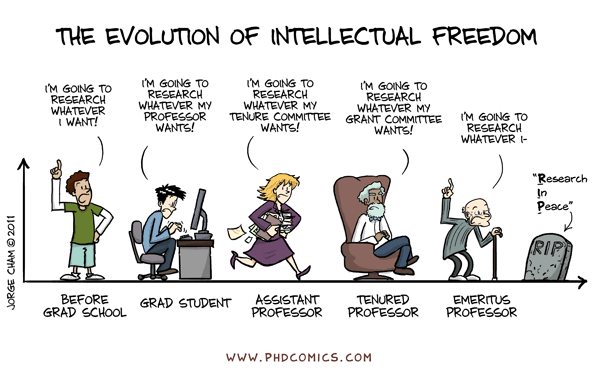
When I quit my PhD I had an Ungraduation Party! My wife made a cake and everyone sang Happy Ungraduation To You! It was sad and happy but overwhelmingly such a relief to get out