Not to highjack this topic, but she was recommended (like to many others of you no doubt) quite a bit in my Youtube feeds over the last few months; and the first few videos I watched seemed to be solid enough. Yet as I watched a few more, I couldn't shake the feeling that she's so out of left field that she's not just a 'quirky renegade' anymore, but rather a quack who dresses up her quackery with just enough 'real' physics to make it all sound very convincing. (By that I don't mean that she says factually wrong things, but that her conclusions or extrapolations from established facts seem to me, well, outrageous). However, I don't know enough physics to be able to tell if this is a correct feeling, and the Youtube comments are, as usual, one big fanboy fest, which is true for any large enough channel - even those of flat earthers and similarly delusional content).
So my question is - just how serious should she (and others like her, who denounce 'mainstream' academia as much as those other fringe groups who go on and on about the corruption of 'mainstream' media) be taken? Anyone have an opinion on this?
>So my question is - just how serious should she (and others like her, who denounce 'mainstream' academia as much as those other fringe groups who go on and on about the corruption of 'mainstream' media) be taken? Anyone have an opinion on this?
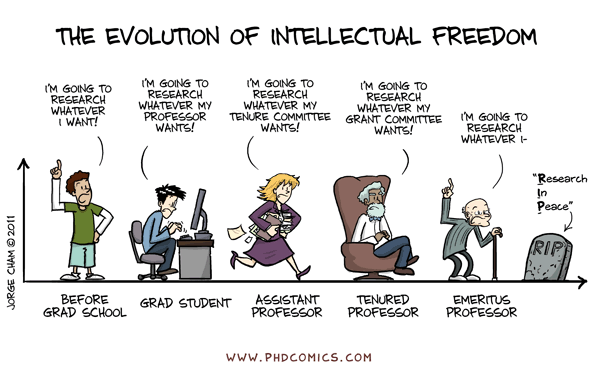
I know nothing about her but the video on her experience in academia is spot on. It's a pretty common experience among STEM academics. You will face the point where you have to compromise your academic "purity" and curiosity for trendy topics to survive. This also implies publishing "bullshit" papers and "bullshit" grants. Only certain types of people make it through that.
Can I ask what you mean with "pretty common"? Do you think more than half of all STEM graduate students had a similar experience as she did? Do you have actual data to support this?
I am asking this because HN neems to be so much more negative of academia than what I am seeing around me.
More generally I think it is worth stressing that any site like this can be a terrible echo chamber at times. Generally there are smart people here, but on some topics I suspect that the consensus could be completely misguided.
Let me add another point of anectdata. I did my CS PhD with a full scholarship in the UK. Then a 3.5 year postdoc in a great Leinbiz institute in Germany. Part of a huge EU project (in Framework Programne 7)
By all measures, I was "living the life" in academia. with both my parents being academics (both researchers and pretty published in their fields)
Yet, I left it after the project finished. The prospect of having to write papers just because. The amount of trash papers I had to review for free but then looking at the cost of proceeding books (I got them for free through my institution... but what a racket it is!!)
The prospect of the "academic path" ((abitur, lecturer, associate prof and then prof) praying the stupid game..
I left it all and turned to the startup world . Maybe it was my engineer mind, but I feel way more fulfilled after 12 years in industry.
I was a biological anthropology postdoc for a year or so. My office mate used to refer to the process of turning one decent idea into as many papers as possible as producing LPUs ("Least Publishable Units"). He was joking, but it wasn't a joke.
It was depressing. I dropped out. I have love for academia, but there is a pretty overwhelming amount of gamesmanship in surviving that system. I found becoming a developer a much easier career to navigate.
> Do you think more than half of all STEM graduate students had a similar experience as she did? Do you have actual data to support this?
Yes, her entire description about her experience (safe for that weirdness with the textbook sweatshop) is relatable. I am not sure what you are looking for but STEM PhD attrition rates speak for themselves. Those do not include PhDs that decide to leave academia after retrieving their PhD. Not to mention the frequently discussed mental health crisis that consistently gets Nature articles.
I did a PhD in CS. There were certainly some students who had a bad experience, but I don't think it was the majority or even near the majority. I think 1 in 5 is a reasonable guess. The ones who did do tend to be more vocal about it, which is natural.
I don't think this is generally true and the generalization is actively hurtful. Promoting a skewed/miserable perspective on academia. It all depends on the institution, your funding situation, your field etc. The miserable academics are the ones that moan the loudest. There is often an online circlejerk of whining academics that wind themselves up (esp PhD students). Also the ones that are barely scrapping by are the ones that need to resort to bullshit. You may be able to game your stats but people can smell bullshit from a mile away. Everyone will know you're just good at playing the system
"Complainants and their critiques can be safely discarded because they need to git gud."
She states in the first three minutes of the video linked above that she was excelling academically. How bizarre to observe a lack of research in a thread complaining about how the academy has drifted from the conduct of pure research. Three minutes. One hundred twenty seconds. That's all it would have taken.
Very seriously indeed if you value higher education and research.
Lot's of people do. Over a decade ago now, Ben Ginsberg wrote "Fall of
the Faculty". Political scientists like Wendy Brown have picked apart
not only the evidence, but done deep analytical work on the reasons
for the disintegration of academia in the West. Even Peter Thiel (who
I profoundly disagree with on almost everything) has given knock-down
commentary that I find impossible to ignore on how academia went to
seed, and is now unfit for teaching, learning and honest research.
From a personal perspective; I worked in universities for over 30
years. What we have now is unrecognisable from the institutions I
started teaching at in the early 1990s. Almost all human values have
been expunged and replaced by a puppet show of performative theatrics,
led by MBA educated impostors and career administrators. It is fake to
the core. I no longer recognise these places as universities. I've
seen brilliant colleagues go crazy, retire early, turn to alcohol and
drugs, commit suicide, or just wander off to live in the mountains and
grow vegetables. I refuse to believe all those smart and dedicated
people are/were "weak". Academia is a very toxic place and I would not
advise any "smart and sensitive" person to go into that life if you
value your health.
When you consider how much it costs a nation to educate someone to PhD
level and then look at the churn and attrition, it's a massive bonfire
of wealth.
I've written numerous pieces in the Times Higher on specific failings
of universities, but one cannot halt a juggernaut of change with words
alone. Now I am left only with curiosity at how higher education will
change and what will come after.
My response has been to conduct and publish my own research
independently outside the "academic system" and to start my own
companies for teaching. By my standards, both are successful.
I think - no, I fear, fear is the right word - that there is much more than just academia disintegrating in the West.
> Almost all human values have been expunged and replaced by a puppet show of performative theatrics, led by MBA educated impostors and career administrators.
I was going to reply to a go further up but yes this has absolutely crept into many other technical areas. I had a similar grad school as others here have expressed but I didn’t stay in academia after school.
I’ve worked the past 15 years or so for several different F100 companies in various technical R&D functions. These companies manufacture real things and generally have labs, resources, and staff that rival but the very best academic institutions. The politics and worldviews with which the MBAs have infect the technical teams with the last 20 or so years is palpable.
I know there used to be real in-depth research done; talking to the old timers and looking through old technical reports showed that to me. Doing that now will quickly get you RIFed. Now quickly getting to revenue and moving onto the next project is all that matters. Nothing is retained in classic 20-30 page technical reports that help build true institutional knowledge or even allow us to repeat projects based on the learnings from 2 years ago. If you are smart you quickly learn how to test and validate things to make whomever the customer is happy (following the $) while providing the bare minimum to the lawyers to make a specific marketing claim. In practice this means I’ve become very good at not opening certain doors during research (ie the ones that I intuitively know have a high likelihood of derailing a project) even if they probably should have been. See no evil, hear no evil…
Yes, over the past few decades, that sentence applies to every institution I can think of. Academia, government, business, religion, medicine... I don't know why administration has turned into such a plague, but it keeps absorbing larger shares of our money, power, and time to do less and less with more and more.
Has Peter Thiel ever put his thoughts on higher education down in long-form writing? I've seen him speak about it, but I'd be interested in a deep dive.
It's interesting and worth watching, but it becomes apparent that Thiel is a financier, and science takes place on a different timescale. Better seek advice from someone who was active when US science was still functional, let's say Roy Vagelos.
Can you give any examples of her promoting "quackery"? I don't know how you can admit you are weak in physics but nevertheless sense she is phony.
My biggest criticism of hers is that she is cynical and spends too much time tearing down other ideas rather than promoting anything.
But overall she does great things with showcasing the more ridiculous side of academia. She is adept at taking published research and showing that it is quackery. She shows how they manipulate data and mislead the media, often for more research money. I also applaud her counterpoint in particle physics regarding the waste involved in building yet another gigantic particle accelerator. It's a POV I wouldn't have considered, but I agree that the money could be better spent in other areas.
I'm not a physicist so I can't answer that question, though personally I trust in her expertise and really loved her book Lost in Math, but many of her most recent videos and tweets are not about physics at all but instead about nuclear power, capitalism, climate change, not having children, trans athletes, AI and so forth. The lure of punditry...
As an expert in at least some of the things Sabine makes videos about (string theory), Sabine is a contrarian who, if you are not otherwise an expert on what she is talking about, it would be best to avoid.
Sabine, like many contrarians, takes advantage of the fact that there are smart and convincing criticisms of many mainstream ideas, and she does her best to rely on those criticisms. However like all contrarians she presents a biased and exaggerated view of things in order to stoke engagement, and unless you are an expert it can be difficult/impossible to determine whether the view she is giving is balanced.
This is a classic issue with string theory critics, because string theory has many legitimate problems with it, but many of the critics are intellectually dishonest and you probably shouldn't listen to their criticisms on principle (but even I must admit it's quite hard to find good quality intellectually honest criticism of string theory which is digestible, so these contrarians tend to be the only loud voice).
In Sabine's case it is not so bad, because it is clear from some of her other positions that she is basically a crank. MOND and superdeterminism are basically crank physics at this point but she supports them purely because she is a contrarian. On this evidence alone you should not trust anything she says on any other subject, otherwise you're falling for a kind of Gell-Mann amnesia.
As another 'mainsteam' academic with relevant expertise I think this comment is spot on.
I would like to add that Sabine's video on her academic experience was quite a tragic thing to watch. If her allegations are true then the behavior of her PhD supervisor was completely outrageous.
She also did seem a bit too dreamy-eyed about academia. Sure you can criticize everything you want, but she never seemed to have understood that tone of voice still matters. Academics are busy people with emotions, and not likely to engage with someone whose claims appear to have more loudness than substance.
I certainly am not making any comments about her experiences for sure! Academia is difficult and full of terrible stories, and its not surprising that it causes many people to become exceedingly bitter and contrarian (Peter Woit is famously of the same ilk as another string theorist critic who fell out of academia like Sabine).
Unfortunately a chip (even a legitimately earned one) on ones shoulder about the bad parts of academia doesn't save you from being criticized for being crank-y.
Likewise. I did my PhD in quantum foundations/information, albeit some years ago now. I'm not aware of any serious researchers in the field that look kindly on superdeterministic interpretations.
It's bizarrely parochial to suppose that every single photon is magically correlated with the experimenter's future measurement choices in a way that will exactly violate Bell's Theorem.
Another way to put it:
> If such a theory did exist, it would require a grand
conspiracy of causal relationships leading to results in precise agreement with quantum mechanics, even though the theory itself would bear no resemblance to quantum mechanics. Moreover, it is hard to imagine why it should only be in Bell experiments that free choices would be significantly influenced by causes relevant also to the observed outcomes; rather, every conclusion based upon
observed correlations, scientific or casual, would be meaningless because the observers’s method would always be suspect. It seems to us that any such theory would be about as plausible, and appealing, as, belief in ubiquitous alien mind-control.
Sabine has repeatedly touched the third rail of current day physics - the string theory industry and HEP. The comment above reflects that.
On the latter, her beef is not that HEP has not made signficant discoveries in the past, rather that the costs going forward can no longer be justified and starve many, many other areas of physics of needed funding. Compounding her disdain for future projects are the increaingly lofty claims of what will be discovered since inception of LHC. Do you really think she is alone on this?
On the former, who is the crank here? The person with the advanced degree calling out the failure of a 50 year old theory to make one scientifically provable and confirmed prediction? (I could say 80 years if going back to the beginnings with S-matrix theory)
I'll grant that some maths have been developed that may be tangentally useful but other than enriching the publishing industry, what has string theory brought? Zilch. It seems that the more public this becomes, the louder the cries of those with deeply vested interests. I can think of no other large theory that has gone for so long with no experimental confirmations at all and is not likely to in mankinds future either.
As to MOND like theory, Sabine has had varying degrees of support over the past twenty years as data has come in and theory has changed. Very frankly, the reason to give a degree of trust to her on other subjects too is because she is willing to be objective and call people out on their BS.
I've seen similar reactions and I can't help but think she's intentionally communicating provocatively to make people engage their brains.
You shouldn't just "take her seriously", you should take what she says *critically*. Hear the information and opinions, then decide for yourself whether to accept them.
> Hear the information and opinions, then decide for yourself whether to accept them.
This sounds awfully similar to the “do your own research” defense that is often used as a cop-out disclaimer for quackery topics.
When someone presents themselves as an expert on a topic and invests a lot of time into making convincing videos about their beliefs, defending them with a “do your own research” feels like a tacit admission that they’re not actually the expert they present themselves as.
This feels somewhat like the high-brow intellectual equivalent of Joe Rogan making confident statements about COVID and then defending himself with “I’m just a comedian, do your own research”. You can’t have it both ways.
The difference is sources. Sabine shows her sources prominently on screen, with searchable citations to find the original. She makes it clear in her phrasing whether she's paraphrasing a source, or passing her own judgement.
It's easy to know whether to internalize what she says when you view it critically. Ask "does the presented research seem legit, complete, and impartial?" and "is her conclusion logical?". She gives you the receipts to check. This is not the same as deciding whether to put blind faith into a comedian's off-the-cuff anecdotes and opinions.
I often disagree with her conclusions, but at least she makes it very easy to validate her chain of though, find where our views diverge, and only absorb the information I trust.
Her channel has strayed far beyond the topics she has credibility in. A physics academic talking about AI, sociology, and politics… why should I care? Even of the physics topics that she does cover it’s all “pop-sci” news coverage stuff, she’s not even using her actual depth of knowledge to make videos that are different than the layman takes from dozens of other YouTubers.
Someone speaking provocatively and authoritatively on topics they don’t have credibility in is where you should think critically and turn it off.
> Her channel has strayed far beyond the topics she has credibility in.
I appreciate that she makes her videos so easily verifiable, by prominently showing her research, that it was easy to see the point when this started happening and tune out. A lot of opinion-faucets on the internet try to be irrefutable by hiding their sources.
I don't trust Sabine intrinsically, but I trust that I can notice when she under-researches a topic or makes a leap of logic. She conveys enough good information that I find it worth my time to watch.


https://www.youtube.com/watch?v=LKiBlGDfRU8