"It's strange to imagine now, but prior to the 1920s, city streets looked dramatically different than they do today. They were considered to be a public space: a place for pedestrians, pushcart vendors, horse-drawn vehicles, streetcars, and children at play."
I think this point is very important. After the automobiles took over, the street slowly ceased to be the #1 public space where people hangout, shop, play or shoot the bull. Fast forward to today's US, spending an extended time on the street is associated with being poor, homeless or conducting criminal activity. Streets' sole purpose is for travel and commute.
Countries with less developed economy still enjoys a vibrant street life much like the pre 1920 US (i.e. Mexico, Brazil, Turkey, China, Thailand etc). As they get richer and purchase more automobile though, the same street transformation is happening again. One can notice a big difference if one visited China in 2000 vs today. They are in some dire need for parking lots.
Of course, there are definitely developed wealthy countries in Europe that also enjoy vibrant street life. However car ownership there is not as widespread as in the US due to a number of economic constraints (space cost, gas price, taxes).
> However car ownership there is not as widespread as in the US due to a number of economic constraints (space cost, gas price, taxes).
As someone living in one of those cities (not owning a car), I can say that the reason is certainly not the cost. It's just that 99% of the time taking the bike or using public transport is way more comfortable. For the remaining transports to the country side (where the public transport is insufficient), car sharing fills my needs just fine.
> Countries with less developed economy still enjoys a vibrant street life much like the pre 1920 US
You're connecting the dots wrong. Most European cities lead urban planning so that mixed zones are vibrant and busy, sometimes banning or punishing cars from city centers. It's intentional policy that (in Europe) is a result of policy, so is lowering car ownership in Denmark or the Netherlands.
Bigger wealth doesn't indicate that everyone will follow the US and create unwalkable suburb monstrocities.
This. In some European countries (e.g. UK, Scandinavian countries) there is no such thing as jaywalking. Pedestrians always have the right of way, except on motorways.
I guess I might not be interpreting you correctly, but pedestrians have no right of way. AFAIK, if someone is crossing the street you must stop your vehicle (which seems obvious because if not, you'd run them over). This doesn't mean that you can just cross the street wherever and whenever you may please, neither does it mean that you can actually walk in the street. Still focusing on Europe, it's not that uncommon to see drivers disrespect the law and not stop at a crosswalk when there's someone trying to cross it.
> This doesn't mean that you can just cross the street wherever and whenever you may please, neither does it mean that you can actually walk in the street.
Yes, that's exactly what I meant. I couldn't find it when this discussion was going on, but last time I looked at the Swedish law it said something like this about pedestrians: Pedestrians may travel wherever and whenever, except on motorways. If there is a dedicated pedestrian walkway nearby, it is recommended to use it. If there is a pedestrian crossing signal, and it is red, it is strongly recommended not to cross.
I.e. pedestrians have right of way always, outside motorways, and may walk on the street as they please.
pedestrians have right of way always, outside motorways, and may walk on the street as they please.
With the caveat that it is illegal to so in a reckless manner that that causes danger to others. Also you can be held financially responsible for any injuries or damage this recklessness causes.
When I lived in Lausanne, the local police were definitely giving tickets to pedestrians for crossing against the light. So its not all European countries (though the Swiss are more law and order than most).
The interesting thing about this is that it's very nearly a First Amendment infringement on the right to assemble. In order to assemble on a street–a fairly obvious place to do so, for a protest, since it has good exposure and visibility–you have to ask the police to explicitly redirect traffic on your behalf. That's not a small hurdle.
It is absolute if you aren't a weasel or have a political axe to grind (the supreme court):
"Congress shall make no law respecting an establishment of religion, or prohibiting the free exercise thereof; or abridging the freedom of speech, or of the press; or the right of the people peaceably to assemble, and to petition the Government for a redress of grievances."
Old city centers often still have some vibrant street life, and in some places, particularly the shopping districts, cars are banned completely or at least strongly discouraged. Much of Amsterdam is far too narrow for two-way traffic, so often it's one-way anyway, and so bumpy and twisty that it's just not very practical for cars. These are places where you can still see people walking in the streets.
Some years ago, Netherland changed the default blame in car-pedestrian collisions back to the car. Even if you have right of way, if you hit a pedestrian, you're still at fault.
> However car ownership there is not as widespread as in the US due to a number of economic constraints (space cost, gas price, taxes).
Compared to the US, the primary difference is space. It's just hard to find a place to park a car in Amsterdam, and you can get everywhere in the city by bike or public transport (and why would you ever want to leave the city?). Outside the city, car ownership is much more common, and poverty becomes the primary reason not to own a car.
By the way, I once heard that 75% of New Yorkers also don't have a car. Again primarily because space is simply scarce in a city.
One of the funniest things was to see a bicycle pile-up in Amsterdam when a tourist walked into the bike lanes. OK, well, it wasn't funny at the moment. This jay walking thing is dangerous, cars or not.
I am all for personal responsibility. However, here in the US the driver would get sued to hell and back if a person were to jaywalk and get hit. Going back to the Netherlands, it was interesting to take tours of windmills and find no safety barriers between the tourists and the internal mechanism. Here in the US we'd probably add a full plexiglass barrier to prevent accidents. So I have to wonder how much of this is due to differences in the laws around the world.
Oh god, jaywalking tourists on bike paths! It's totally fine to cross the bike path, but you really should watch before you cross. Pedestrians can behave very erratically, and it can be incredibly hard for a cyclist to predict what you're going to do (though I've gotten pretty good at it over the years). Fortunately such collissions are rarely serious.
Reminds me walking through the streets of Saigon. You just slowly start crossing and the motorbikes 10-20 deep on main streets magically separate around you. Traffic doesn't move more than 40km/h anywhere in the city.
> However car ownership there is not as widespread as in the US due to a number of economic constraints (space cost, gas price, taxes).
It's not just economic constraint here in the Netherlands. A lot of people can reach anything they need using their bike and public transport (you can take your bike on the train).
If you don't need a car, why bother getting and maintaining one?
and once we get flying car (more specifically - an octocopter scaled up to carry 2-4 peoples, not that big of a problem if you take time to look into it), we'll be able to get back to the situation, and even better - the streets can be more like park style space and of irregular shape (with some bike paths for short distance travels using bike or something like golf-cart). The massive asphalted/concreted surfaces will become a thing of the past. The only main roads/highways will be left for self-driving cargo-trucks.
more specifically - an octocopter scaled up to carry 2-4 peoples, not that big of a problem if you take time to look into it
An octocopter will have even worse range than a normal helicopter, so you cant get very far, and everyone having flying cars based on pushing air will not be able to use them from the street due to the problem of blowing pedestrians over. Flying cars as envisioned in sci-fi require reactionless drives, at least if you want to be able to take off from the street without endangering everyone.
Imagine a dozen 20 pound wild turkeys flying together. They are quite a bit more efficient than a single 240 pound craft/passenger because air displacement grows by the surface area of an object (by the square) while weight grows by the cube. That's why birds get off the ground easily while a human powered airplane needs a hundred foot wingspan.
Mathematically, the efficiency of a helicopter rotor is roughly proportional to its length. Double the diameter and fuel usage falls by roughly half for the same lift. However the lift for an array of rotors grows by the square of length, even though efficiency stays constant. So if you start with a quadcopter running on batteries that’s 10 times as efficient as a full-scale helicopter running on gas, an array of them with the same lift will still be 10 times as efficient. It will also have a smaller cross sectional area at the cost of greater complexity.
So the future of high efficiency lift is almost certainly in using arrays of rotors. The reason that hasn't happened yet is that most aircraft are designed for high speed travel, not hovering. I still want my reactionless drive though!
"So if you start with a quadcopter running on batteries that’s 10 times as efficient as a full-scale helicopter running on gas"
This I have never heard of. In a ratio of energy efficiency against carrying capacity I was under the impression that a normal helicopter massively outperformed a small quadcopter.
My impression with doing lifts with lots of small drones was that you get around this by constantly cycling the swarm.
Also, this still doesn't get around the problem of downwash. Either you shift a massive cross section of air for your force and get very little downwash, but then you end up with something much bigger than a car, or you focus it and get lots. You cannot get around the fact that to suspend a mass you have to move something equivalent downward.
edit - I get what you are saying with the turkeys. However, in a vehicle carrying four people, you have replaced the turkey bodies with a giant blob that has much less lifting potential, especially at low speed, than lots of turkey bodies. You have to dump a lot of useful surface area. Also I note that turkeys do not hover much.
> a normal helicopter massively outperformed a small quadcopter.
not really. The power loading (power divided by surface of the propeller's circle) is the key factor what matters for efficiency (until of course Reynolds number - air viscosity factor - starts to change - happens when we come to Kolibri scale)
In general, helicopter with 3m long blades (6m diameter) on one 500kw turbine or something like 16 of 30kw motors with 1.5m diameter propeller (with the same number of blades as helicopter) each is pretty much equivalent. That is pretty theoretical starting point. After that we can optimize these systems in different ways. 16-copter allows to use somewhat bigger, yet less-bladed, like 2-3 bladed propellers which are more efficient than multi-blades of helicopter (and you can't really have 2 bladed rotor on helicopter). You can use ducts on 1.5m propellers - not a case for helicopter. So all this allows to increase efficiency.
Ya there are definitely many ways of looking at this. I found the link about rotor power halving for each doubling of diameter (where it says: "So in this process the power is halved to (2m)(v/2)2/2 = mv2/(2x2) = P/2."):
Downwash definitely figures into this, as well as using fewer blades.
But, the key point is that we intuitively know that smaller craft require exponentially less power than larger craft. We could build a large craft with a very wide rotor to approach the efficiency of small craft, but I think it will turn out to be easier to use multiple small craft and scale how much weight we lift linearly.
"the key point is that we intuitively know that smaller craft require exponentially less power than larger craft."
This is where your intuition has let you down. Think about a normal helicopter's lifting capability and range as you go between models and full size aircraft. Or why you see bees walking.
>An octocopter will have even worse range than a normal helicopter, so you cant get very far
not really. Octocopters are much easy for a scheme with tilting of a couple of rotors and thus having efficient plane style horizontal flight than tilting the whole machine like helicopter. As result - higher speed, longer range.
> and everyone having flying cars based on pushing air will not be able to use them from the street due to the problem of blowing pedestrians over.
You statement is true for helicopters. The octocopters are much efficient with pushing of the air. Google e-volo. https://www.youtube.com/watch?v=CzP0Zqxam7E
(or the old work - Piasecki VZ-8 Airgeep - much less of airwash effect)
lotsofmangos is right! I have designed and built RC helicopters, tricopters, and quadcopters, from scratch. More blades is usually a lot less efficiency. There is something to be said for tricopters. From the point of view of pure efficiency, one large blade is always more efficient than 3 or more smaller once. Don't trust me, take a look at any static thrust calculator[1]. However, I found that with large and voluminous loads sometimes a tricopter can be more efficient because it allows you to mount the props away from the center load, so that the thrust of the prop isn't lost by pushing against the frame of the craft. This works in RC vehicles, but probably wouldn't be much of a benefit in full scale vehicles.
As for the prop wash of an octocopter, try standing right next to one that's taking off caring just 5 kilos of payload (batteries and DSLR). I have, and trust me, it gets really, really, windy. And that's with a 5 kilo payload, with a copter capable of generating maximum of 12 kilos of trust. No scale that up to 1000 kilos.
with correct design for the frame and ducts, the same airmass down flow would generate 20-30% more of static trust than the same airmass flow in case of helicopter. And that airflow will not have that blade end vortex which causes helicopter crashes and is just straight efficiency loss until that.
I did spend my time with trust calculators and some other systems :)
Yes, but 8 props will be considerably less efficient then one prop in generating that thrust in the first place. For instance:
One 300x8 inch prop will generate roughly 1 ton of thrust while spinning at 330RPM and consuming 12kW of energy. So, let's say we go with your prediction, and assign a 30% air flow efficiency to the one prop system. So in reality, according to you, it is generating 700 kilos of thrust. 700/4 is 87.5 kilos. So now we need to figure out how big of a prop we need to generate 1/8 of the thrust of the 300 inch prop, or roughly 88kg. I am going to use 60 inch props, because that will allow us to space 8 props in a circle roughly the same size as the original 300 inch prop.
Ok, so a 88x8 prop, spinning at 2350 RPM will generate roughly 88 kg of thrust wile consuming 6.7 kW of energy! That's 6.7 kW x 8 props, or a total of 54 kW, or almost 4.5 times less energy efficient than the one prop system, and that's taking into account your proposed 30% efficiency gain from multi-bladed systems and ducts.
I build these things all the time, there is a reason why the industry still uses helicopters with a single prop. It IS more efficient.
You're making a mistake. There is no 1 ton helicopters with 12 kW power on shaft. Even with 24 or 36 kW. I'm on iPhone so can't say exactly what thrust 12kw would produce on 6m prop. Around 300kg I'd estimate.
And another thing. 8 60in props aren't equivalent to 1 300 in wrt power loading. You need 16 of 60in to get equivalent of 1 240in prop.
Anyway, you've just calculated an octocopter with 700kg+ thrust on 60kw power. Is it bad? My neighbor's 400kg single-seater has 100kw gas turbine and it isn't 4x excessive power.
>You're making a mistake. There is no 1 ton helicopters with 12 kW power on shaft. Even with 24 or 36 kW. I'm on iPhone so can't say exactly what thrust 12kw would produce on 6m prop. Around 300kg I'd estimate.
Based on what, please provide at least some reference to an equation or calculator.
>And another thing. 8 60in props aren't equivalent to 1 300 in wrt power loading. You need 16 of 60in to get equivalent of 1 240in prop.
>Anyway, you've just calculated an octocopter with 700kg+ thrust on 60kw power. Is it bad? My neighbor's 400kg single-seater has 100kw gas turbine and it isn't 4x excessive power.
Can you give me an example than using some kind of calculations from a reliable source, not the "my neighbor" anecdotes. For instance, what makes you think that equivalent for a 240in prop would be 16 x 60 inch props? I understand that 16 60 inch props would have roughly the same area, but you do realize that 16 props arranges in such a way as not to create interference with each other would take up significantly more area? This is the main problem of a multirotor, you wither have to use smaller, less efficient props, or you have to make it much larger to accommodate the props.
In any case, when you are at your computer, if you feel like it, please do calculate, with references, a single prop machine lifting 1 ton vs an octo lifting the same 1 ton. I understand that a machine that lifts 1 ton would need to provide more than a ton of thrust, of course, but let's make it simple. Just a simple calculation. One prop producing 1 ton of thrust vs 8 props which can be arranged in such a way at to take up no more then 150% as much area as the original 1 prop, producing the same 1 ton of thrust.
If you really can show me that 8 props can be as efficient as 1 prop, please, by all means, prove me, and every one else who designs flying machines, wrong. But please do so with calculations I can verify.
Trust me on this. Blade efficiency is not only a swept area game, but also the middle of the blade is extra useless due to horrible vortex effects. One big blade massively outperforms eight little ones. And you cannot get away from the fact that you are hovering around a minimum of a ton. Either you have a really big cross sectional area of downwash from massive blades, or everyone falls over.
> One big blade massively outperforms eight little ones.
taking just blades into account - yes, though not that "massively". But the moment we consider the whole system - attach the blades onto a shaft, connect that shaft to reductor, to gas turbine, etc... ie. if that system is helicopter than bigger blade is still better, but if we change the whole system, ie. octocopter built using electric motors - the equation starts to change and we have good efficiency with octocopter and, which is more important, - much better control (eight electric motors with some of them allowed to be tilted gives precise control compare to very sluggish system of one big rotor driven by one big gas turbine), which addresses your point about " hovering around a minimum of a ton" - impossible task to do safely for helicopter in urban environment and pretty easy to do with ducted octocopter (you can't really have ducted helicopter precisely because of the size of the blades)
As far as i see, the lack of good control (not efficiency, range, payload, etc..) and direct danger from unshrouded blades is that doesn't allow to fly helicopters in any (even close to)urban environment, and especially for regular people.
I don't know what country you're in but in the US something like 80% of the population lives in urban areas where playing in the street is essentially impossible.
I live in the US. If you had been there and not just read some statistic you would have a better idea what you are talking about. The majority of the US live on quiet suburban streets. It is quite humorous how confused people get about America.
As of 2011, about 250 million Americans live in or around urban areas. That means more than three-quarters of the U.S. population shares just about three percent of the U.S. land area.[48]
And many suburbs are deliberately designed with tree-like roads, maximizing cul-de-sacs, and minimizing the probability of rat-running and other through-traffic.
Of course, without shortcuts and bike lanes, the same road pattern destroys walkability, because such road networks involve a trip to and from the trunk to get anywhere.
Then you have the gated communities of southern Florida, which are much worse.
Actually, China has gates, fences around everything, there is no such thing as an "open" campus or open apartment complex (unless it is very very urban). It is annoying to the say the least (especially when the gate you want to use is locked).
It may be interesting to note that here in Sweden, "jaywalking" is not a crime, and we have what may be the lowest rate of driving-related deaths in the civilized world. People here do indeed jaywalk more than in many other countries, but we look both ways first.
The entire country would be completely unworkable if you could only cross at a "cross-walk." Some villages literally don't have any. The only jaywalking-type laws in the UK are for motorways (70 MpH).
The whole jaywalking thing seems very authoritarian are arbitrary in the US. But the US has a lot of that type of thing in general. Just look at the recent articles about New York's ticketing strike, some of the things they were ticketing for on mass were a little odd and petty.
New York's been following what's called a "broken window" policing strategy. The premise is that you go into areas that have high rates of (serious) crime, and do zealous enforcement of even minor crimes (graffiti, jaywalking), and that this sort of enforcement contributes towards the reduction of the crime that matters. It's named for the premise that ostentatious signs of lawlessness and urban decay (like broken windows) invite further, more dangerous, disorder, like gangs staking out turf and assaulting/robbing people passing by.
This sort of policing policy is controversial in New York and is relatively uncommon in the rest of the nation.
For what it's worth, violent crime and murders in most of these predominantly-minority communities has been reduced substantially in the past several years. However, it seems to result in at least some members of the community feeling substantially more oppressed, and it does result in inequal treatment of minorities by police if for no other reason than geographic correlation.
(Disclaimer. The general desirability of this approach is neither endorsed nor condemned herein.)
>For whatever reason, however,riding your bike on the sidewalk is rigidly enforced against.
and it is very good reason. A bike on the move at say double pedestrian speed has like 30ft ahead by 6ft width virtual zone which is dangerous for anybody else and thus has to be empty. It just doesn't fit into typical sidewalk space which would typically be like those 6ft wide and bike rider routinely lets people get into the 30ft ahead zone thus constantly placing them in danger.
> The whole jaywalking thing seems very authoritarian
> are arbitrary in the US. But the US has a lot of
> that type of thing in general.
That depends on your viewpoint.
Here in Holland people are being arrested for owning airsoft guns (toys which fire plastic ball-bearings at speeds high enough to pierce paper but low enough as to minimise chance of injury).
I don't know; a man was arrester in New Jersey for firing an airsoft gun in his backyard[1], since they're classified as regular firearms and require permit in that state.
Using one-off examples as it pertains to the US doesn't work very well as an argument when laws and enforcement vary so drastically from location to location.
Simply put, that isn't a good counter example to the parent's point, because it doesn't apply to more than a very small percentage of the US population.
7 million is about the population of the Randstad, the agglomeration in the west of Netherland that contains the major cities (Amsterdam, Rotterdam, The Hague, Utrecht) as well as numerous minor ones, grown together into what's practically one giant city.
But there's still 10 million people living in the rest of the country.
It's also legal to cross a pedestrian crossing on the "red man" in the UK - the lights on the crossing are only advisory to pedestrians.
I live near the German school in West London and have many German friends here. When I cross on the red light, I always get lots of hard stares from the Germans waiting at the crossing. Many don't realize the laws here are different, and it's perfectly legal. Of course if you do get yourself run over, the driver is unlikely to be found at fault.
I left a large metal concert in Leipzig at about 3am in a big group, wandered straight across the empty dual carriageway against the red man, and found myself alone on the other side being tutted at by 50 metalheads opposite.
I live about 1km from the Deutsche Schule. I was surprised to find three German bakeries within 5 minutes walk of my house when I moved here...
* Seattle: Pedestrians don't even jaywalk on empty streets at 1AM
* Manhattan: Jaywalk at your own risk
* Boston: Everyone jaywalks all of the time, everywhere. Pedestrians cross streets anywhere at free random and do not acknowledge the existence of motor vehicles.
> Boston ... do not acknowledge the existence of motor vehicles
I presume you haven't spent much time in Boston? There's a constant dialog that goes on between pedestrians, cars, bikes, etc where for any situation everybody judges each others' velocity, figures out the obvious ordering, and then executes on that plan. When there's a conflict, the party that's already behind generally delays themselves slightly and that's that. It's the people that don't understand this give-and-take that tend to cause problems.
To me, that seems a lot more reasonable that eg SoCal where if I'm planning on walking behind a car in a neighborhood or parking lot, most of the time they'll slam on their brakes and wave me on as if they're doing me a favor by getting in my way.
This has always amazed me about Boston. The image burned in my mind from my one visit there years ago was of a very elderly woman with a hunched back simply crossing the street, as you say almost "at random", and without acknowledging the "existence of motor vehicles". There was a wall of traffic incoming from a fresh green light, but she aimed at a store across the street and just started walking diagonally towards it, not looking either way, and without even a pause for consideration. The traffic simply stopped and waited as she slowly crossed; no-one honked.
In Manhattan I have a different memory, of masses of people stubbornly crossing against the red, right at the crosswalk, while a taxi slowly tried pushing its way into the sea of pedestrians. But I don't blame them because in NYC every. single. god. damn. intersection has a traffic light. I guess they thought Stop signs weren't good enough. Or even just right of way.
Oh, if y' ain't from that town and y' look like the troublemakin' sort, the sheriff will swoop in like a hawk and getcha, after one teensy J walkin' step. It don't matter if you look real careful ever' which way before doin' it. He's got his eyes on you.
Degree of enforcement also seems to be very much subject to officer discretion. I've never met anyone ticketed for jaywalking an empty 2-lane street at night, but if you dash across a busy thoroughfare right in front of oncoming traffic you are much more liable to get ticketed.
> The entire country would be completely unworkable if you could only cross at a "cross-walk." Some villages literally don't have any.
Austria does not have a jaywalking law but it has a law that requires any participant in traffic to adhere to light signals. Neither cars, nor bikes nor pedestrians are allowed to ignore red lights and if they do, they can be (and will be) fined.
In New Zealand, if I recall correctly, jaywalking rules only apply if you are within 100 metres of a crosswalk. Walking an extra 200 metres to cross the road might seem a bit excessive, but you won't get in trouble for crossing the road when no crosswalk is in sight.
That being said, I haven't heard of anybody ever being caught for jaywalking in New Zealand.
In urban Oregon and Washington autos are required by law to stop for pedestrians crossing the road. Visiting there, the odd thing to me was how seriously drivers take it... They actually stop if it appears pedestrians are preparing to cross, even. This is distinctly different from most of the US, where it's up to the pedestrians to cross at cross walks or dodge cars at their peril and stepping into the street is more likely to get you honked at than stopped for.
> In urban Oregon and Washington autos are required by law to stop for pedestrians crossing the road. Visiting there, the odd thing to me was how seriously drivers take it... They actually stop if it appears pedestrians are preparing to cross, even.
This is California law, too, and I am beyond tired of people honking at me, peeling out to whip around me, then nearly killing the pedestrian for whom I stopped. I've never been one to succumb to road rage, but every time some impatient Californian gets behind me and starts punishing me for obeying the law, or nearly kills the pedestrian for whom my stopping was signal to proceed, I feel urges I do not wish to feel like walking back to their car with a fucking sledge hammer.
Although people like to get all legal scholar on this rather than just taking the ten seconds to be considerate (toe in a crosswalk? etc, just Google around for armchair Columbos trying to get out of their ticket with lexical study of the law), here's a good formula for driving success in California: if a pedestrian is crossing or preparing to cross the road in a marked or unmarked crosswalk with one of those yellow signs or without, stop. It's not that hard, but drivers here suck so much at this that it burns me. Sit next to Shoreline in Mountain View (south of Central), where there are several mid-block crosswalks that are frequently used, and watch how many people nearly die every day because some dipshit can't be bothered to apply his brake pedal.
At least in New Jersey and New York, I could predict that a driver was going to elect the most selfish choice. I could handle being cut off there because I could generally predict what another driver was going to do and plan accordingly. It felt like professional driving; I knew you were going to cut me off 30 seconds ago. Here? Between everybody texting, being indecisive, and not paying attention, I cannot predict with any measure of certainty what a Californian driver will do, including when I elect to obey the law and stop at a crosswalk. It drives me absolutely nuts.
> In urban Oregon and Washington autos are required by law to stop for pedestrians crossing the road.
Actually, it's required everywhere—even on the freeway. Of course, it's illegal for pedestrians to be walking on the freeway.... But pedestrians ALWAYS have right of way.
In Brazil "jaywalking" does not exist either, we do have pedestrian crossings on streets, and the law says you are supposed to use them, but I think there is no legal penalty for ignoring them.
In fact after learning english it took me several years to understand what the hell was "jaywalking" because as a Brazillian it makes no sense.
I look both ways before crossing a one-way street.
The cost is minimal and the benefit of not getting hit by a car whose driver didn't realize it was a one-way is pretty high.
Maybe it's an American thing, but I notice people completely flouting driving laws often enough that I don't trust anything but declared intentions when it comes to cars. Crossing at a crosswalk isn't even safe; many drivers seem to think speeding down the street and slamming on the brakes so that the car slides halfway into the designated pedestrian zone is okay.
I've been pretty regularly tempted to climb on top of car hoods on my way across the street without moving left or right.
There was a court case about that in Germany a while ago. (I think in the end, the pedestrian got it classified as political protest, and got away with it. The drivers tried to sue for damages to the car or some such.)
Not the OP, but once when I was a teenager I saw a foreign-owned car driving the wrong way on a one-way street, and driving fast. Since then I've always looked both ways when crossing a one-way street.
People here do indeed jaywalk more than in many other countries, but we look both ways first.
I want to point out it's not the "not looking both ways" that is the only significant cause. I walk 4 miles per day and I rarely jaywalk. I often have to jump out of the way of cars because they refuse to yield the right of way to me. I think it's a cultural thing. I think too few people walk in the US and therefore cannot empathize with people that do. The number of times someone waits for me to walk slightly out of their way and zooms past, within inches of me, is flat out infuriating. All it would take is a small miscalculation on their part to kill me. Honestly, it makes my blood boil thinking about it.
Put those people into cross walks 20-30 times a day for a month, and I'd bet they would stop doing that shit.
The article seems to paint the automakers as a cabal of villains for convincing people to not walk in front of a moving vehicle. I'm not sure what I'm supposed to make of it.
> One was an attempt to shape news coverage of car accidents. The National Automobile Chamber of Commerce, an industry group, established a free wire service for newspapers: reporters could send in the basic details of a traffic accident, and would get in return a complete article to print the next day. These articles, printed widely, shifted the blame for accidents to pedestrians — signaling that following these new laws was important.
The Freakonomics guys did a podcast on the perfect murder, and it turns out it was "kill someone with your car" because only a tiny percentage of people that kill pedestrians are prosecuted for manslaughter. Tiny.
This is also evil, though I'm not sure who is to blame for it.
I think it is a form of judicial corruption where the justice system does what is popular rather than what is right. Pretty much everyone drives and anyone can make a mistake while driving. The needs of the majority outweigh the needs of the few.
The Canadian Supreme Court actually stated this principle in a decision where they weighed the "social value" of driving against the responsibility of the driver. If we were to make drivers strictly responsible for their actions we would make the value of the automobile less.
I think the point is that perhaps we've swung too far to the extreme in favor of cars. We've lost a social gathering place. Not to mention, when other modes of transportation (i.e. bikes) share the road with cars, in cases of bike-car collisions, it is almost always assumed that the bicyclist is at fault.
Also, I think the tide is shifting. Many cities are moving towards more pedestrian friendly corridors, replacing some streets with parks etc.
>Also, I think the tide is shifting. Many cities are moving towards more pedestrian friendly corridors, replacing some streets with parks
But that's orthogonal -- the cities are saying "no cars here". They're not saying "hey, peds get (more) preference on the car-shared roads now". They still enforce the very same car/foot traffic separation that the auto industry (and anyone concerned with safety) wanted.
I can certainly agree that the car culture in the US is a bad thing. But I don't quite understand why streets make sense at all as a social gathering place. Why not parks or people's yards/driveways/patios?
Because in urban areas, people live next to the street, and their neighbors live next to the street, and the closest park is a few blocks away, and almost nobody has a yard/driveway/patio.
It's a shift of responsibility from the motorist to the pedestrians. The car "belongs" in the street and the pedestrian doesn't. Cars are not required to look out for people, people have to look out for cars. That's a change that shifts the generally understood purpose of the whole infrastructure.
If you and I are walking on the sidewalk, we're equals. It's as much your responsibility not to run into me as it is my responsibility to run into you. According to the article, before cars the situation was the same in the street. Everyone was equal. With the advent of jaywalking laws, suddenly cars are prioritized above all other traffic. If a car hits someone who wasn't in the street at a designated spot, the car has no responsibility for the accident.
> Cars are not required to look out for people, people have to look out for cars.
It's not always sufficient to just "look out for people". It is quite possible that the driver, at the speed they're driving at, does not have the reflexes or braking distance to safely stop when encountering a "jaywalker".
The alternative that many people propose is to reduce driving speed to "safe" values, which I always thought naive. Even if you make everyone drive at 20MPH inside cities, you'll still have people exceeding that limit and getting into accidents. IMHO, it's just safer to keep pedestrians away from cars.
The main issue is unless we ban cars from areas that benefit from pedestrian traffic, it's essentially impossible to keep pedestrians from cars. Given there will be a mixing of cars and pedestrians, who should we design primarily for: the person driving or walking? If we design for driving, then we relegate walkers to malls and parking lots. If we design for pedestrians, we relegate cars to narrow, crowded, slow streets, and possibly limit which streets cars are allowed on (or which streets through-traffic is allowed on). There isn't one "right" solution, but these are conscious decisions that communities need to be aware of.
>It's not always sufficient to just "look out for people"....
Aren't the drivers of vehicles expected to look out for other vehicles that may be driving either slower or stopped within a driver's line of transit such as delivery vehicles or police cars?
Is it reasonable to say "... well I can't be looking out for a police car working a traffic accident, it's really more their fault than mine..."
That seems to be the implication if the collision is vehicle/person vs. vehicle/vehicle.
At some point it's not unreasonable for drivers have to pull their heads out of their asses and "look out for people" as they drive.
Alright, so the majority of that is pretty ridiculous. Obviously drivers are looking out for any potential obstruction, and anyone whose head is not up their ass knows that much.
The point is, and this is the real crux of the issue, when you're traveling at the speeds that the automobile was invented, purchased, licensed, taxed, and the road was paved to support, you don't always have the ability to react to obstructions that come up suddenly, such as a pedestrian stepping off of a crowded sidewalk.
So what most people here seem to be arguing is, cars are inherently bad. Streets should always be crowded with people walking on foot, no matter the weather, because it is the only mode of transportation ordained by God and Steve Jobs, and to hell with peoples' want of freedom to travel in comfort on their own schedule.
What about the freedom of the people who are walking to travel in comfort and safety? Yes, we do now have a vast infrastructure optimized for cars. The point of the article is that this didn't just spring up out of nowhere as a naturally occurring phenomenon, it was the result of a concerted effort by people with an interest in selling cars.
Cars are a great tool for travelling from one city to another, but they kind of suck for getting around a crowded city center. Yet, the streets in the city center are still giving the highest priority to cars, at least partly because car manufacturers lobbied for it to be that way.
the crux of the issue is that you, the licensed operator of the automobile, have been trusted to identify possible hazards and adjust your speed accordingly.
if you're driving to fast to stop for a pedestrian from a crowded sidewalk, you shouldnt have a license.
> Even if you make everyone drive at 20MPH inside cities, you'll still have people exceeding that limit and getting into accidents.
The key is how you make everyone drive 20mph. It's been pretty well established that speed limits do a horrible job of forcing drivers to slow down and are even counter productive since a small minority of drivers will actually follow them. This creates a delta between them and the majority of drivers and deltas between drivers, more so than absolute speed, contribute to an increase in accidents.
However you can actually slow drivers down by making the lanes narrower. Drivers may complain, object and lobby to revert back to wider lanes, but they'll actually slow down until that happens.
Responsibility needs to be allocated according to reality, not historical sentiment.
Horses have priority over hikers and mountain bikers on trails because horses spook, and around here hikers defer to mountain bikers because a hiker can quickly stop and step off the trail, while the biker cannot.
Also, it's not true that the vehicle automatically bears no responsibility if they strike a jaywalker.
Really? Bikes should always defer to hikers. If you can't stop quickly enough to do so, you're being reckless, since you then wouldn't be able to stop quickly enough to avoid an injured hiker on the trail or an obstacle, or my 73 year old mother.
I don't know, maybe it's just a courtesy thing then, but either way that's what happens. As a mountain biker and hiker, when on foot I defer to bikes because that's what I would want as a biker, and that's what others do for me when I'm biking.
Here in Oregon, pedestrians and bicyclists are routinely run over by cars, buses, and light rail trains. Almost invariably without consequences. At least for the motorist; the bicyclist often suffers severe medical consequences.
Usually it's considered an "accident". The one thing you can't do is "hit and run", you must stop. The police aggressively investigate hit-and-run accidents.
There is no liability unless you are "negligent". So if you've been drinking and driving you could face both civil and criminal penalty.
And certainly you can be sued by whoever you hit. And maybe your insurance company will pay the pedestrian, but that's usually because it's cheaper to pay a few medical bills than to pay lawyers to continue to litigate. Cost-benefit analysis.
I'm surprised about 'routinely' for light rail trains (which I call trams).
There have been three pedestrians killed by trams in the UK in the last 20 years[1]. Every accident/incident gets a 30+ page independent report (linked from [1]). Railway safety has reached the point where the greatest danger to passengers is falling down stairs, or tripping over when running. The last fatality to someone on a train was on 23 February 2007.
How different things would be if a fatal road accident led to a 30-page report concluding with a set of recommendations and an expectation that they'd all be implemented.
Here are three deaths from Portland's MAX light rail in about the last 13 months.[1][2] And it's not a very big system.
There have been 34 deaths in just one portion of the light rail, in less than 30 years. A few are classified as suicide.[3]
There are some barriers and crossing gates, but MAX mostly runs alongside pedestrians and vehicles. It's up to the pedestrians to pay attention.
Edit: BTW I think that what we call "light rail" may be larger than what you consider a tram and what we call a "streetcar". A MAX car is about 28 meters long, a streetcar is about 20 meters long.[4]
I think a lot of people are exaggerating in this thread. Still, only 5% of New York drivers who are involved in a fatal crash with with a pedestrian are arrested, let alone convicted[1]. It seems that most of the time, there isn't much criminal liability.
The point is that they worked to establish the norm that pedestrians must defer to cars on city streets, instead of cars deferring to pedestrians. This makes it viable to actually get somewhere by driving a car in the city, but at the cost of dramatically reducing walkability and undermining incentives for public transit.
Well, I've no doubt about that, but should we care that people do the right thing for the wrong reason?
I suppose there's some room for debate about whether it's the "right" thing, as the goal of the article seems to be "hey, roads used to be for PEOPLE", apparently forgetting that there's people in the cars as well whose want and right to unobstructed travel is just as valid as those outside the car.
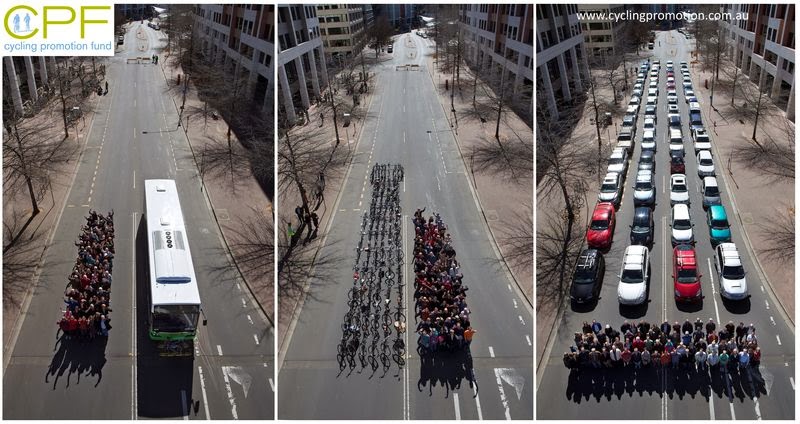
Though the driver's desire for unobstructed travel is just as legitimate as anyone else's, the amount of land area required to cater to that desire is far larger than that of the pedestrian, cyclist, or mass transit user:
http://3.bp.blogspot.com/-JFCIT3QO2IE/UxqPRqcRK7I/AAAAAAAAY3...
Beyond simple use of space, cars moving at high speeds preclude a safe and pleasant experience for those outside of cars. The driver's desire to travel at high speeds is perfectly reasonable, but when we as a society attempt to meet that desire in a dense urban area, the result is unpleasant at best and deadly at worst.
I'm a person, but I don't think you'd have much sympathy if I expressed a desire to walk down a busy street swinging a pickaxe around my head, notwithstanding the fact that it's great exercise and I enjoy it. Someone in a car is taking up a larger share of space and imposing larger risks on passers-by. I know vehicle owners pay an annual fee for their tags and for each gallon of gasoline they purchase, but it's arguable that their use of the road was heavily subsidized for quite a while.
The article makes clear that city streets were once a mix of pedestrians, pushcarts, street cars, horse drawn vehicles, etc.
The automobile industry didn't just push for equal rights for cars. They already had that. They wanted exclusive rights, and they used the problem of pedestrian deaths as leverage.
In a sense, they were, if you consider "evil" to be doing whatever it takes to advance your agenda.
On a more on topic note, I'm trying to imagine a world where personal cars didn't take off. What would be the difference (at least in the US)? More cities, less suburbans comes to mind. Will it be better?
Different countries have far different degrees of automobile use. Essentially nobody commutes by automobile in Tokyo or Manhattan, and those cities are organized around major railroad stations as opposed to highway interchanges, with neighborhoods designed to satisfy needs in compact walkable areas rather than distant auto-oriented shopping centers.
Many Manhattan vehicles are delivery trucks or service vehicles driven by construction or foodservice workers. Many are taxis or car service vehicles. Some are avoiding the $17+ toll on the Verazzano Narrows bridge by taking the free Manhattan Bridge & Holland Tunnel. Parking a car for a reasonable price is essentially impossible in much of Manhattan, and garages are also packed by valets that pack cars in tightly in tiny garages accessed via car elevator. Unless you're a cop, in which case you just park on the sidewalk because you know the other cops won't ticket you.
And, of course, the number of pedestrians is far more vast than the number of cars.
We'd have to build up instead of out. Jet-powered elevators become the norm, with a villainous group of Elevatormakers lobbying for jayleapers to not rappel down elevator shafts.
…and if that were the definition of "jaywalking", you might be on to something. :\
Underlying your comment is the assumption that it is the walker's responsibility to not be injured, not the driver's responsibility not to cause injury. It begs the question.
What you describe as "walk in front of a moving vehicle" could just as well be described as "drive into a pedestrian." Your very phrasing assumes guilt for one party and innocence for the other, when there's no particular reason to assign it that way.
If one crosses into the territory of the other without following a prescribed rule of law, who do you think should take responsibility?
In order for me to "drive into a pedestrian" I'd have to swing my car onto a crowded sidewalk, and unless a swarm of bees exits the car with me I'd have a hard time maintaining my innocence after that.
I concur. Where is the article about the train cabals who deprived people of their inalienable right to have a picnic on the railroad? Where's the stock photo of the Caltrain "$271 fine for crossing when lights on"?
How many railroads are in your way as you walk about every day?
The automobile is a deep incursion into our lives, for the benefit of some, and great risk and cost to others. The automobile has no inalienable right of way across the entirety of our communities.
Mass transit is also a lot different from the princely horsepowered carriage trundling through the streets in order to maintain a proper separation from the unwashed masses.
Jaywalking is not a crime here, but I'm always amazed when a TV segment indignantly shows people jaywalking and talks about its risks.
I actually find it safer to cross the street somewhat away from the crosswalk. Crosswalks are usually close to road intersections and other places with increased traffic, where the traffic seems to be less predictable.
I didn't realise quite how mental the US is over something as simple as crossing the road till I read this:
"A distinguished British historian claims he was knocked to the ground by an American policeman before being arrested and spending eight hours in jail — because he crossed the road in the wrong place.
Felipe Fernandez-Armesto said he had been the victim of "terrible, terrible violence" after he inadvertently committed the offence of "jaywalking" in Atlanta, Georgia, last week and failed to realise the man telling him to stop was an officer.
The slight, bespectacled professor claimed that five burly officers pinned him to the ground after Kevin Leonpacher kicked his legs from under him as he hesitated to show his ID.
He was left "traumatised and disorientated" and with a gashed forehead as he was taken to the local jail and charged with pedestrian failure to obey a police officer and physical obstruction of police."
In the UK, we were just taught this thing called the "Green Cross Code" as children in a series of slightly surreal public information films, though the message in it is basically no more complex than to just to stop and pay attention to what the traffic is doing, before deciding to cross the road. Pedestrians aren't allowed on motorways (freeways), but that is about it. http://en.wikipedia.org/wiki/Green_Cross_Code
It's increasingly obvious to me that in the future we won't have flying cars. Transportation will be below ground and the people will take back the streets.
Examples of this trend include: boston big dig, atlanta beltway.
The unfortunate thing is that the police won't even bother to ticket drivers who fail to yield to pedestrians in a crosswalk. Most US drivers have no concept of how right-of-way works and their obligations to yield. I've taken to using an airhorn for busy crossings and have been chewed out by cops for expecting my traffic rights to be observed.
Interestingly, when pedestrian crossings were being introduced in the UK it was decided that a statement like 'DON'T CROSS' was problematic. There was no legal basis on which pedestrians could be prevented from crossing a road and the instruction was therefore being given without due authority! The town council had no right to tell a law-abiding Englishman not to cross the street! So, we got the 'Green Man' signs intead, and of course there is still nothing preventing you from crossing the street wherever you wish here in the UK. Another interesting snippet was the fact that in East London it was thought that signs on crossings would not work due to the large number of Russian immigrants, since "[...] these people are excitable and ill-disciplined."
See this article for more information http://www.cbrd.co.uk/articles/pedestrian-crossings/
>In the early days of the automobile, it was drivers' job to avoid you, not your job to avoid them. But under the new model, streets became a place for cars — and as a pedestrian, it's your fault if you get hit.
I drove Alaska->Argentina [1] and I was extremely lucky that someone told me that the minute you cross into Mexico (and further south) you should expect the old way of doing things. Roads in Developing countries are not a right of way for cars. They are places to play volleyball, dry coffee beans, change your rear axle, get a tan or herd your cattle. I saw all of these and many more, even on the Pan-American highway in 60mph zones.
In China, if you hit a pedestrian with a car, it is your fault no matter what. So a lot of poor people will camp out in a road waiting for a car to hit them to make some money.
On the other hand, a dog (or child) running out into the road in China is less likely to be struck by a car because this happens so often that the drivers are hyper aware. Still, I've seen a girl on a bicycle struck and killed at a Beijing intersection (the light was green for the car). You never forget that. Also, yielding on a right turn is a western myth.
It is really not that great; I mean, the cars have to go slower overall, the traffic gets congested, everyone is out for themselves, there are no courtesies, and people die. There has to be a middle ground between pedestrian friendly streets and sanity.
> In China, if you hit a pedestrian with a car, it is your fault no matter what.
I didn't know that, and you wouldn't guess by the way the Chinese drive. It was amazing to see little kids sitting, unrestrained, on the back platforms of delivery trikes, in the middle of the usual jam of cars and busses. I've seen a cyclist get knocked over by a car in Beijing, but traffic was creeping along, so no harm to the rider or bike. Drivers in China drive insanely close to cyclists. If anyone in America drove that close to my back tire I'd assume they were actively trying to kill me.
I wonder what the casualty rate per mile is in China. I was shocked to find that hundreds of cyclists are killed in the US each year despite the very low rate of bicycle usage outside of recreation.
As a whole, the Netherlands have one of the highest population densities in the world. Per city, I am sure China has some of the denser cities in the world.
It appears to be similar in Taiwan, where I've visited for business twice now. There are rarely ever signalled cross walks. As a pedestrian you just have to gauge the best time to step into the street, and after that both the cars and people do their best to avoid collision. As an American I think it's crazy and dangerous, but given the population density here, there might not be a better option. On the bright side, most vehicles here are scooters, so they can swerve in and out of the pedestrian hordes with ease. And it seems to keep both the pedestrians and drivers aware of their surroundings at all times. Which is in stark contrast to the common, oblivious moron drivers in the U.S.
In jaywalking arrests, cops may also press additional charges resisting arrest, assault on police officer, obstruction of justice, endangering public safety etc.
People have had virtual life sentences for parking tickets.
Can't pay them on time? Your car's impounded and you're jailed for sixty days. Oh, you lost your job because you're in jail? You were evicted from your home? Too bad.
Jaywalking is like a parking ticket in California. And mostly not even enforced in most of America.
The only place I ever lived that tried enforcing it was my college campus after like 3 students got KO'd by a Bus while listening to an Ipod and not looking while crossing the street.
My college campus enforced it (after three deaths in less than a year in the same damn place!) by building a giant wall down the middle of the road. Pretty effective.
Damn it, pedestrians should be able to go anywhere at any time they please.
Airport tarmacs, power stations, water treatment plants, you name it! If I want to step off the train station platform and onto the tracks, it's my god-given right.
"Authorized Personnel" or "Staff Only" be damned, along with "No Tresspassing".
"Sign sign, everywhere a sign / Blocking out the scenery, breakin' my mind ..." goes the song.
It's all just a scheme to repress the people. Or rather, to repress them in a small way so their attention is thwarted from the big ways. Yeah, that's it!


I think this point is very important. After the automobiles took over, the street slowly ceased to be the #1 public space where people hangout, shop, play or shoot the bull. Fast forward to today's US, spending an extended time on the street is associated with being poor, homeless or conducting criminal activity. Streets' sole purpose is for travel and commute.
Countries with less developed economy still enjoys a vibrant street life much like the pre 1920 US (i.e. Mexico, Brazil, Turkey, China, Thailand etc). As they get richer and purchase more automobile though, the same street transformation is happening again. One can notice a big difference if one visited China in 2000 vs today. They are in some dire need for parking lots.
Of course, there are definitely developed wealthy countries in Europe that also enjoy vibrant street life. However car ownership there is not as widespread as in the US due to a number of economic constraints (space cost, gas price, taxes).